

The first sign of GCSEs often arrives as a thick options booklet at the bottom of a school bag. Suddenly, a 13-year-old is being asked which subjects they want to keep for two years, while everyone around them has a firm opinion.
Knowing how to prepare your child for GCSEs in Year 9 makes that moment calmer. Year 9 is not the time for relentless past papers. It is the time to understand the next stage, make sensible choices and repair small gaps before they become expensive problems.
The scale is real. Ofqual recorded 5,840,185 provisional GCSE entries in England for summer 2026, up 1.1% from 2025. That figure sounds enormous, but a family only needs to deal with the next useful decision: subjects, foundations, habits and support. Ofqual’s official statistics explain the 2026 entry figures.
This guide explains the KS3 to GCSE transition in plain English. It covers options, core skills, early study routines, tutoring and the summer before Year 10.
What changes between KS3 and GCSE in Year 9?
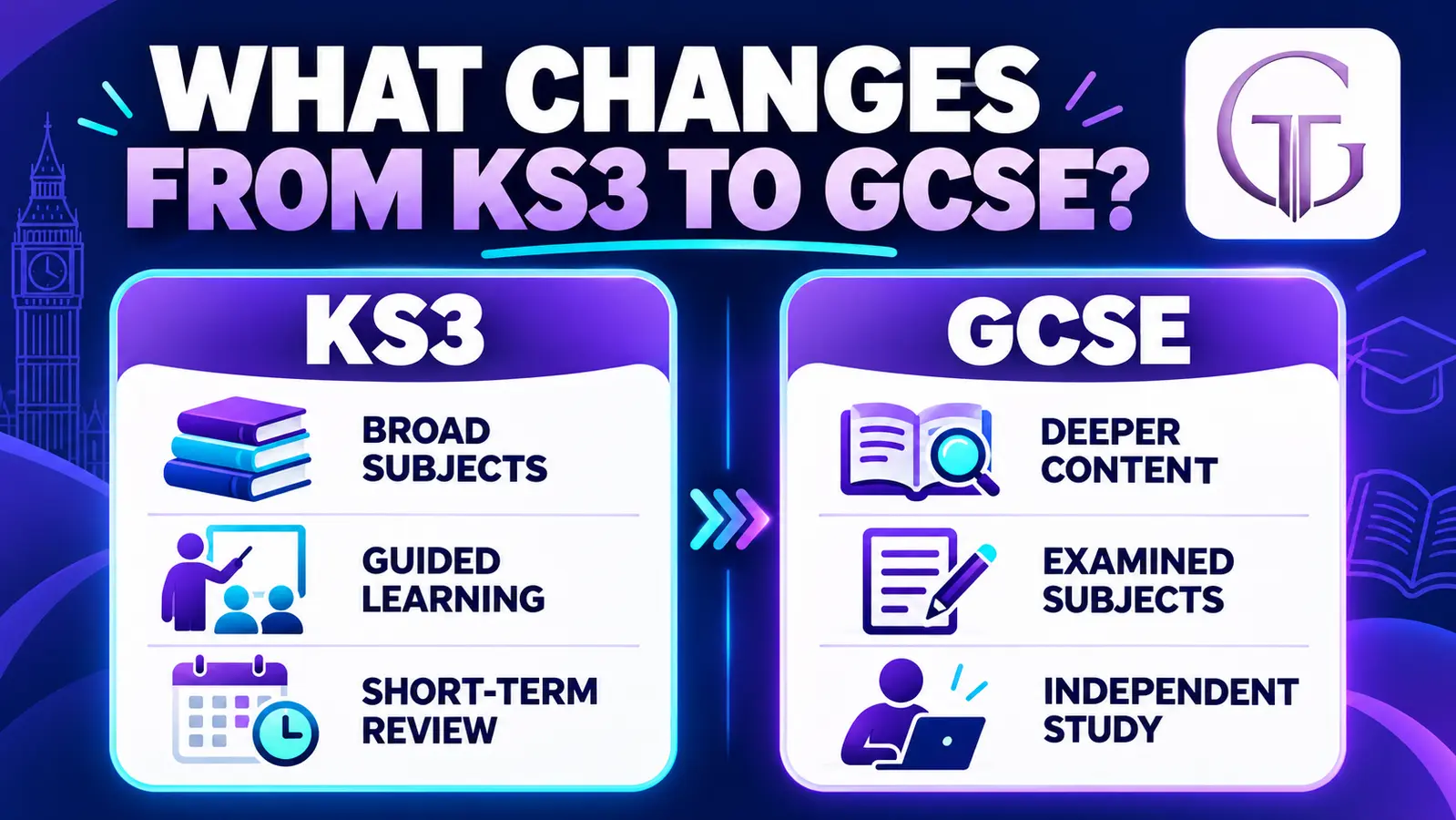
Year 9 usually completes Key Stage 3 and prepares pupils for Key Stage 4, when GCSE courses begin. Students move from a broad timetable towards fewer examined subjects, deeper content, longer-term recall and greater responsibility for organising work, deadlines and independent study.
In England, Key Stage 3 covers the broad secondary curriculum before most pupils work towards GCSEs or Technical Awards in Key Stage 4. The official Key Stage 3 and 4 curriculum overview lists English, maths, science, humanities, languages, computing, arts and other subjects at KS3.
Schools do not all use the same timetable. Several begin selected GCSE content during Year 9, while others wait until Year 10. Ask the school what starts when. Guessing based on another parent’s experience is a surprisingly poor strategy.
The practical changes usually include:
- fewer subjects after option choices;
- more demanding subject vocabulary;
- knowledge that must be retained across two or three years;
- more extended writing, multi-step calculations and practical analysis;
- closer attention to specifications, assessment objectives and exam technique;
- stronger expectations around independent work.
Parents who want a broader explanation can read what GCSEs are and how the qualification works. Understanding the system helps, but your child does not need to live like an exam candidate yet.
When will your child choose GCSE options?
Most pupils choose GCSE options in Year 9, although a school may run the process in Year 8 or start certain courses early. Dates, option blocks and available qualifications are set locally, so the school’s current options booklet and deadline should guide every decision.
An options process often includes an assembly, booklet, parents’ evening, subject talks and a submission form. Schools may ask for reserve choices because timetable blocks can clash. Put every deadline in the family calendar as soon as it arrives.
Read the assessment details, not just the subject title. GCSE Art involves sustained practical work. GCSE Drama is not simply performing. Computer Science includes computational thinking and programming, not everyday computer use. A child can love a Year 9 lesson yet dislike the GCSE assessment model.
Ask each relevant teacher three concrete questions:
- What does the GCSE course actually contain?
- How is it assessed, and how much writing, calculation or practical work is involved?
- Does my child’s current work suggest that the subject is a sensible fit?
Which GCSE subjects are compulsory and optional?
In England, English, maths and science form the compulsory core at Key Stage 4. Schools must also provide other statutory subjects and offer choices across arts, design and technology, humanities and languages, but each school controls its qualifications, option blocks and timetable.
English commonly leads to separate English Language and English Literature GCSEs. Science may be taught as Combined Science, worth two GCSEs, or as separate sciences. Exact routes and entry decisions differ by school.
The English Baccalaureate, usually called the EBacc, is a school performance measure rather than a separate qualification. It covers English language and literature, maths, sciences, history or geography, and a language. The Department for Education’s EBacc guidance explains the combination.
| Subject area | Typical position in England | What parents should check |
|---|---|---|
| English | Core, often Language and Literature | Whether both qualifications are entered |
| Maths | Core | Foundation or Higher tier decisions come later in most schools |
| Science | Core | Combined Science or separate sciences, plus how the school allocates routes |
| Humanities | Usually offered as options | History, Geography and any EBacc expectations |
| Languages | Usually offered as options | Languages available and school expectations |
| Creative and technical subjects | Offered according to the school | Coursework, practical demands, equipment and timetable blocks |
| Vocational qualifications | Available in certain schools | Assessment mix, awarding body and progression routes |
The GCSE grades guide is useful if grade 9 to 1 language still feels unfamiliar.
How should your child choose GCSE options?
Good GCSE choices balance genuine interest, current strengths, assessment style and future flexibility. Your child should lead the decision, while parents test the reasoning and teachers supply evidence. Choosing a subject for a friend, a favourite teacher or imagined prestige rarely ages well.
Use a four-part decision test
Score each possible subject from one to five against four factors:
- Interest: Would your child still care about the subject when the work becomes harder?
- Evidence: Do classwork, reports and teacher comments show a workable foundation?
- Assessment fit: Does the mix of exams, practical work and extended projects suit them?
- Future value: Does it keep open a route they are seriously considering?
A low score does not automatically rule out a subject. It exposes the trade-off. A keen artist may accept a heavy project load because the work matters to them. A pupil choosing Business only because it sounds useful may struggle if they dislike written analysis.
Keep career research proportionate. A 13-year-old does not need a fixed profession. They do need to know whether a likely A-level, college course or apprenticeship expects a particular GCSE. School careers staff can check that without turning one form into a life sentence.

What academic foundations should a Year 9 student strengthen?
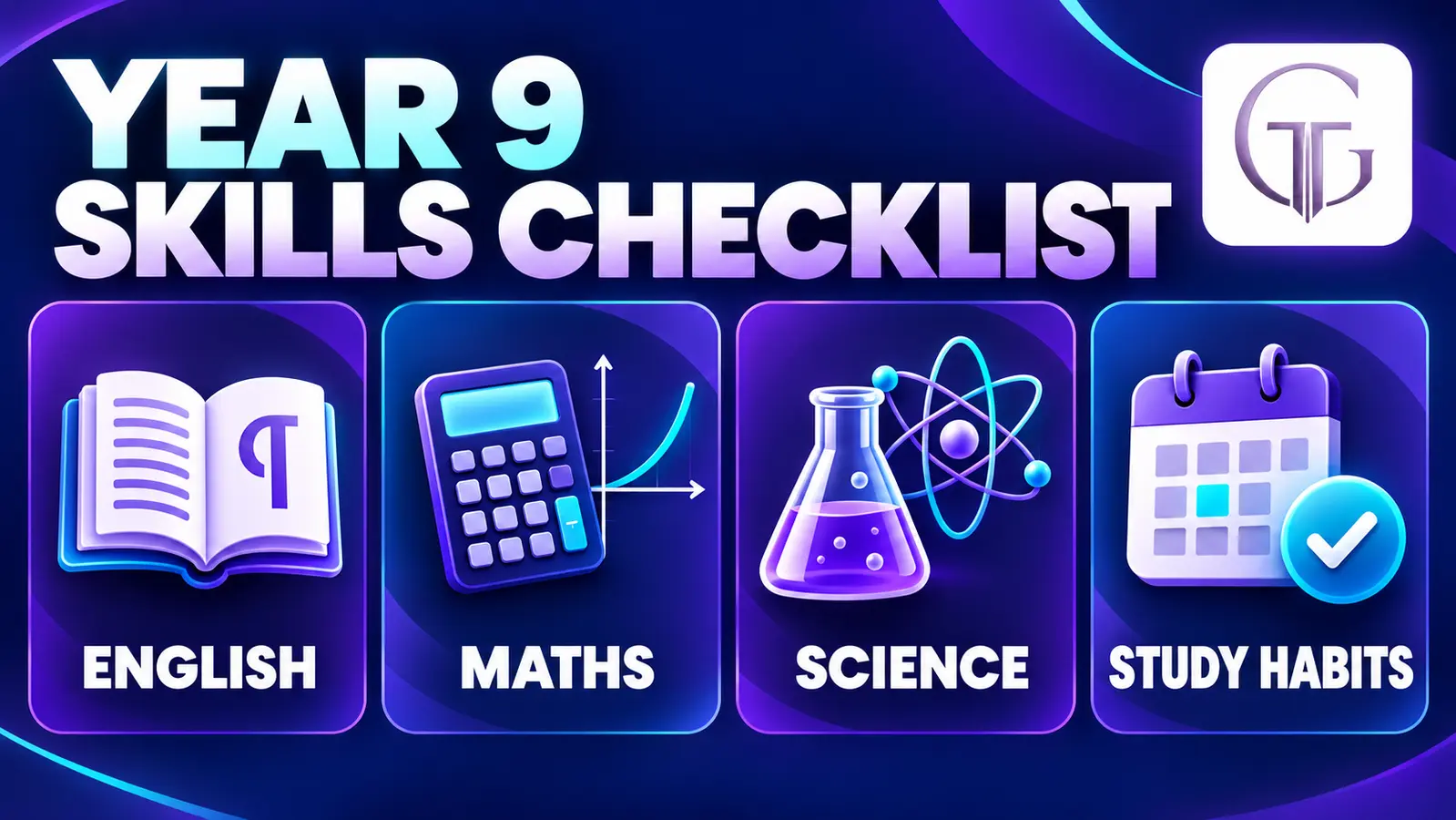
Year 9 preparation should focus on foundations that carry into several GCSE subjects: accurate reading, clear writing, secure number skills, scientific reasoning and subject vocabulary. A short review of school reports and recent work will reveal two or three gaps worth fixing first.
English foundations
Strong GCSE work depends on reading a question closely, selecting evidence and explaining an idea in a clear paragraph. Encourage regular reading across fiction and non-fiction, but do not reduce every book to an exercise. Ten useful minutes of discussion can beat a worksheet nobody wants.
The GCSE English tutoring page explains the skills that later support language and literature study.
Maths foundations
Fractions, percentages, ratios, negative numbers, algebraic manipulation and interpreting graphs reappear throughout GCSE Maths and Science. If one of those areas keeps causing trouble, address it now. New GCSE content becomes much harder when basic operations still demand full attention.
Families can review the scope of support on the GCSE Maths tutoring page.
Science foundations
Year 9 pupils benefit from secure units, formula rearrangement, graph skills, practical variables and concise explanations using scientific terms. Memorising disconnected facts is not enough. Students need to connect evidence, method and conclusion.
The GCSE Science tutoring page shows how Biology, Chemistry and Physics support can be separated when one area needs attention.
How can you build good study habits before Year 10?
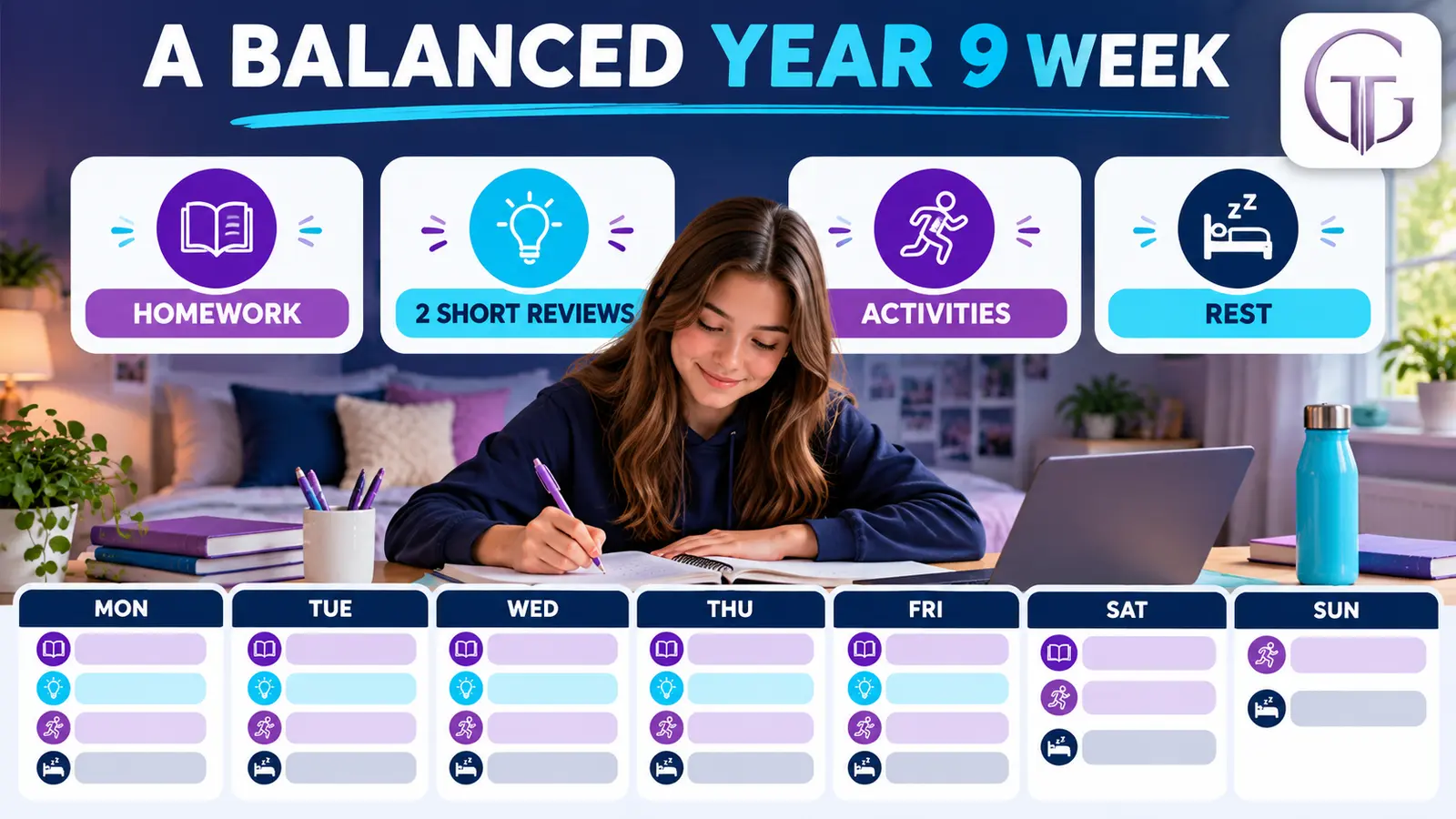
Build a light, repeatable routine rather than a crowded revision schedule. Year 9 pupils need a reliable place to work, prompt homework completion, brief weekly review and a simple way to record questions. Consistency matters more than long sessions or expensive resources.
A workable week might include two 25-minute review blocks, one organisation check and normal homework. The review blocks should retrieve knowledge from memory, then check it, rather than copy a textbook.
Try this sequence:
- Choose one topic taught that week.
- Close the book and write what can be remembered.
- Answer three to five questions without notes.
- Check the answers and correct errors in a different colour.
- Record one point to ask a teacher next lesson.
That is active recall, which means bringing information to mind instead of repeatedly reading it. The method also reveals gaps early. Pretty notes have their place, but they can hide weak recall with impressive stationery.
Students who need more technique ideas can use the complete guide to revising for GCSEs selectively. Year 9 should borrow the methods, not the Year 11 workload.
Should your child start GCSE revision in Year 9?
Your child should not begin intensive GCSE revision in Year 9, but they can learn how to review and remember material. Short retrieval practice, tidy notes and prompt gap-fixing prepare them well without using full papers or creating unnecessary exam pressure too early.
Full exam papers may cover material a Year 9 student has never learned. That makes the score meaningless and often dents confidence. Topic questions, low-stakes quizzes and short explanations are better tools at this stage.
Revision should increase only when the course and school timetable justify it. A simple GCSE revision timetable becomes useful later, especially when homework, mocks and several subjects compete for time.
Watch the language used at home. “You’re already behind” creates urgency without direction. “Let’s find the first topic that is getting in the way” gives the child a task they can actually complete.
When can tutoring help a Year 9 student?
Tutoring can help in Year 9 when a persistent knowledge gap blocks current work, confidence is falling, school feedback repeats the same concern or a child needs structured accountability. It should solve a defined problem, not add lessons simply because GCSEs are approaching.
Good Year 9 tutoring usually starts with evidence: marked work, teacher feedback, a short diagnostic task and the child’s explanation of what feels difficult. The plan may then target algebra, analytical writing or scientific calculations for a fixed review period.
Early support is most useful when it prevents a narrow weakness spreading into several subjects. Algebra, for example, affects Maths, Physics and Chemistry. That is a better reason to act than a vague fear about future grades.
Read when to start GCSE tutoring for a comparison across Years 9, 10 and 11. If format is the main question, the online versus in-person tutoring guide covers the trade-offs.
How can parents support motivation without adding pressure?
Parents support motivation best by creating calm structure, listening before advising and praising specific effort or improvement. Keep responsibility with the student, agree small actions together and discuss school feedback without turning every meal into a GCSE meeting. Pressure is not the same as support.
Ask questions that produce information:
- Which lesson felt clearest this week?
- Where did you get stuck?
- What has the teacher asked you to improve next?
- Would you like help planning, testing or finding an explanation?
Avoid comparisons with siblings, classmates or your own school days. Current GCSE courses, grading and assessment arrangements are different. More importantly, comparison often makes a child defend their position instead of examining it.
Stress deserves attention even in Year 9. Changes in sleep, repeated avoidance, stomach aches and tearfulness are reasons to slow down and speak with the school. The guide to tackling GCSE exam anxiety gives practical language and support steps.
What should your child do in the summer before Year 10?
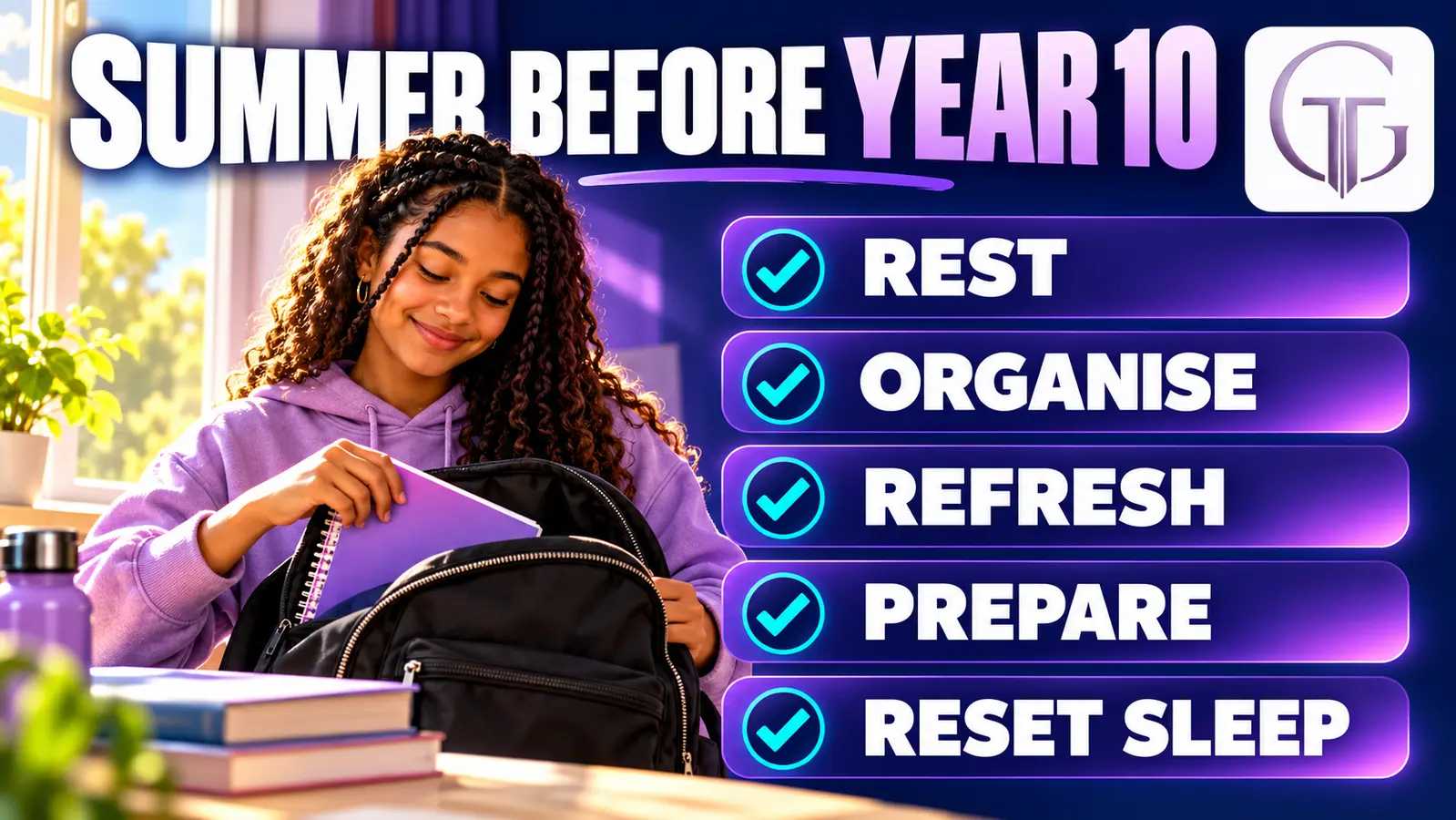
The summer before Year 10 should combine proper rest with a small amount of preparation. Confirm subjects, organise materials, read any school instructions and refresh one or two weak foundations. A short reset in late August is enough for most students.
Start by checking that the final option list is correct. Then gather only the equipment the school has requested. Buying a shelf of revision guides before confirming the exam board wastes money and creates clutter.
A sensible late-August reset looks like this:
- clear old papers and file useful Year 9 material;
- check the school email or portal for summer tasks;
- confirm the calculator, stationery and login details work;
- complete two or three short foundation reviews;
- restore a school-night sleep routine during the final week;
- agree one weekly planning time for the autumn term.
Rest still belongs on the list. A child who reaches September bored of GCSE preparation has not gained an advantage.
What Year 9 GCSE preparation checklist should families follow?
Families should confirm the school timeline, understand compulsory and optional subjects, compare choices against interest and evidence, identify two foundation gaps, establish a light weekly routine and review wellbeing. Revisit the plan once each term, because needs change as courses become clearer.
Use this checklist without trying to finish it in one weekend:
- Download the current school options booklet.
- Record information evenings and submission deadlines.
- Ask how and when GCSE teaching begins.
- Compare option subjects by interest, evidence, assessment and future value.
- Confirm the final choices and one or two reserves.
- Review recent reports, tests and teacher comments.
- Choose no more than three foundation gaps to address first.
- Set two short weekly review blocks.
- Keep sport, friends, hobbies and downtime in the week.
- Agree how your child will ask for help.
- Review progress at half term, then adjust.
Preparing your child for GCSEs in Year 9 is mainly about direction. Keep the plan small enough to repeat, and specific enough to show whether it is working.
Frequently asked questions about Year 9 GCSE preparation
Is Year 9 part of GCSE study?
Year 9 is usually the final year of Key Stage 3 in England, but schools may introduce GCSE content or start Key Stage 4 early. Check the school curriculum plan rather than assuming every school follows the same model.
How many GCSEs do students usually take?
Most students take a school-designed programme containing core subjects and several options. The exact total varies because Combined Science counts as two GCSEs, separate sciences count individually and vocational qualifications may sit alongside GCSEs.
Can a child change GCSE options after submitting the form?
A change may be possible before or shortly after courses begin, but it depends on timetable space and missed content. Contact the school quickly. Treat the published deadline as real, even if limited movement sometimes happens later.
Should parents choose GCSE subjects for their child?
Parents should guide and question, but the child should have a meaningful voice. They will attend the lessons and complete the work. Use teacher evidence and course details to challenge weak reasoning without taking over the decision.
Does choosing the EBacc give a separate qualification?
No. The EBacc is a school performance measure built from a defined group of GCSE subjects. Students receive their individual GCSE qualifications, not an additional EBacc certificate.
Should a Year 9 student use GCSE past papers?
Usually not as full timed papers. Topic questions are more useful until enough course content has been taught. Full papers can produce misleading scores when a student has not encountered large parts of the specification.
How much should a Year 9 student study at home?
School homework comes first. Beyond that, two focused 25-minute review sessions each week are a sensible starting point for many pupils. Increase support only when evidence shows a need, not because another family follows a heavier schedule.
What if my child has no idea which subjects to choose?
Start with their school booklet, current work and teacher conversations. Remove choices they clearly dislike, then compare the remaining subjects by interest, evidence, assessment style and future relevance. A reserve choice reduces pressure too.
Need GCSE Support?
Get one-to-one online GCSE tutoring for Maths, English, Science and other GCSE subjects from home.