
Online GCSE Tutoring in Dalston
One-to-one lessons for Year 10, Year 11 and resit students, £30 per lesson
Online GCSE tutoring in Dalston across every subject we teach. Something we are asked more often each year, usually after a headline: are GCSEs about to move onto computers, and should a student be preparing differently because of it?
The short answer is that work is genuinely underway, that no decision has been published, and that a student sitting exams in the next couple of years should plan for pen and paper.
The longer answer is below, along with what we think is worth doing about it, which is less than the headlines imply. The first session is free and runs the way the exam still does.
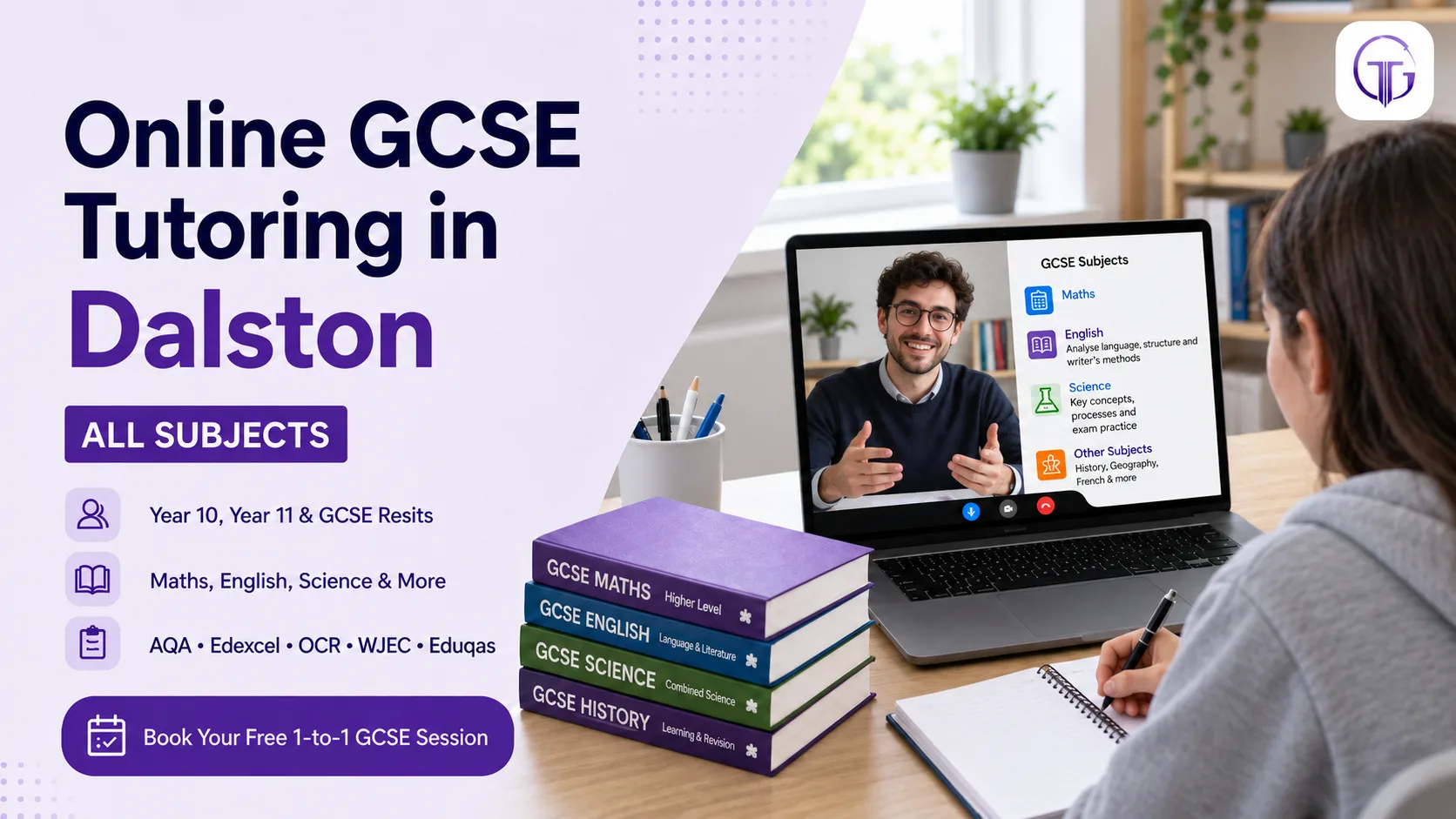
What Dalston parents ask
- Whether GCSEs are going digital.
- When any change would arrive.
- Whether typing should be practised.
- If handwriting still matters.
- Where a real announcement would come from.
What has actually been proposed?
A regulated, controlled introduction of on-screen assessment, with paper remaining the primary method while it happens.
Ofqual ran a consultation on regulating on-screen assessment from December 2025 to March 2026. Its framing was deliberately cautious: innovation where it can be delivered safely, with pen and paper still the main route.
The principles set out alongside it are the interesting part. Any move has to avoid putting standards or public confidence at risk, has to maintain or improve accessibility for disabled students, and has to be deliverable securely by the platforms and by the centres running the exams.
That third condition is the one that decides the timetable in practice. Ofqual also published research on on-screen assessments in sessional high-stakes qualifications, and the difficulty is not whether a question can be answered on a screen. It is whether several hundred thousand students can do it simultaneously, in ordinary school halls, without anyone losing an answer.
At the time of writing, responses are still being analysed and no outcome has been published.
Where it stands
| Question | Position |
|---|---|
| Who is consulting | Ofqual |
| Consultation closed | March 2026 |
| Outcome published | Not yet |
| Main method meanwhile | Pen and paper |
Nothing here amounts to a date for any particular subject.
What should a student do differently?
Almost nothing. The skills that would transfer to a screen are the ones already worth building, and the one that would not is still being examined.
Handwriting stamina is the obvious example. A GCSE season still asks for several hours of writing by hand under time, and a student who has only ever typed at length arrives unprepared for that in a way no amount of general ability compensates for.
Everything else is medium independent. Knowing the content, reading a question properly, planning an answer and managing the clock work identically whether the answer is typed or written.
The one thing genuinely worth doing is unglamorous: keep practising on paper, because that is what the next few series will be. Preparing for an exam format that has not been announced, in place of the one that has, is a bad trade.
How much handwriting a GCSE actually demands is covered on our Swiss Cottage page.
Transfers either way
- Knowing the specification.
- Reading the command word properly.
- Planning before writing.
- Timing per mark.
- Checking work at the end.
Where does technology already help?
In practice and feedback, which is where it has been useful for years, rather than in the exam hall.
A student can already have every past paper, mark scheme and examiner report for their board open in a browser at no cost. That is a bigger practical change than the assessment medium, and a surprising number of families have not used it.
Online lessons sit in the same category. A shared screen with the paper on it, annotated live by a specialist in that subject, is a better teaching surface than a kitchen table with one copy of a textbook.
What technology does not do is mark extended writing in a way a student can learn from, or notice that the same mistake has now appeared four weeks running. That remains a person paying attention.
Where AI tools help revision and where they cross into malpractice is covered on our Walthamstow page.
Useful now, free now
Find the board’s specification
The real one, not a summary.
Download every past paper
Plus mark schemes.
Read one examiner report
It names the common errors.
Work on paper, under time
As the exam still runs.
Get the writing marked
By someone who can explain it.
Which GCSE subjects can your child get help with?
All of the below, taught live rather than assigned as a video course.
Maths
Both tiers, on the school’s board. See GCSE Maths tutoring.
English Language and Literature
Both GCSEs, prepared separately. See GCSE English tutoring.
Combined and Triple Science
A specialist for each science. See GCSE Science tutoring.
Computer Science
The subject closest to all of this. See GCSE Computer Science tutoring.
Business Studies
Case studies and calculation. See GCSE Business Studies tutoring.
History, Geography and RS
Subject to a specialist being free.
Does any of this affect resits?
No. The November and summer series run on paper, exactly as they do for everyone else.
A resit student has a short run to a fixed date, and format speculation is the last thing that should occupy any of it.
Dalston students leaving Year 11 without grade 4 in maths or English come under the 16 to 19 maths and English condition of funding, updated in July 2026. Grade 3 keeps the GCSE going, and grade 2 or below allows Functional Skills level 2.
Maths and English Language have a November series. Everything else waits for the summer.
For resit students
- The papers are on paper.
- November covers maths and English Language.
- The college controls entry.
- Ten weeks is enough for a focused run.
See GCSE resit tutoring and the exam dates page.
How does an online lesson run?
Video and a shared whiteboard, with the student writing on paper at their end.
Tell us the subject and board
So the right specialist takes it.
Free one-to-one session
A real lesson, no card details taken.
Questions worked together
On screen for the tutor, on paper for the student.
Written work photographed and marked
Returned before the next lesson.
Reviewed at six weeks
Against a timed paper.
The full process is on how it works. Hackney Education publishes the borough calendar where families can check school term dates, and academies near Dalston set their own.
What does a GCSE tutor in Dalston cost?
One to one at £30, the same whether the paper ends up on screen or on paper.
There is no platform fee, no software to buy and no annual subscription attached to any of it.
Check what the hourly rate in any quote actually buys before you compare it. Our guide to GCSE tutoring costs covers the range.
What £30 covers
- A full one-to-one lesson with a subject specialist.
- Past papers and mark schemes supplied.
- Written work marked by a person.
- Timed papers under exam conditions.
- A tutor change if the match is wrong.
Tell us which subject is the problem
Year group, subject and board. We reply during the day.
- Year group and subject.
- Exam board and tier, if known.
- Current grade and target grade.
- Whether the issue is content or exam technique.
- Days and times that work at home.
Prefer to talk it through? WhatsApp us, or use the contact page.
Send an enquiry
Frequently asked questions
Are GCSEs moving on screen?
Some of them may, eventually. Ofqual consulted on regulating on-screen assessment over the winter of 2025 and the consultation closed in March 2026. The outcome has not been published, so nothing is settled.
Will my child sit a digital exam?
For a student taking GCSEs in the next couple of years, almost certainly not. Pen and paper remains the main method and any introduction was proposed as a controlled one rather than a switch.
Does that mean typing practice matters now?
Not at the expense of handwriting. Students still write by hand for several hours across a GCSE season, and that is the skill with an immediate return.
Would on-screen exams be easier?
There is no reason to expect that. The standard is set by the demand of the questions, not by the medium the answers are typed or written into.
How would a family find out if it changes?
Through the school and the exam board rather than the news. A change of assessment method for a specific subject reaches centres well in advance.
Which GCSE subjects do you cover?
Maths, both English GCSEs, Combined and Triple Science, Computer Science, Business Studies and humanities subject to availability.
What does it cost?
£30 a lesson, one to one, and no software or subscription is bundled into it.
Do you have a tuition centre in Dalston?
No. Lessons run online and the business is registered in Feltham, not E8.
Book a free GCSE session for your child in Dalston
One free one-to-one session, no card details and no obligation. Whatever the exam hall looks like in ten years, the work that moves a grade this year has not changed.