
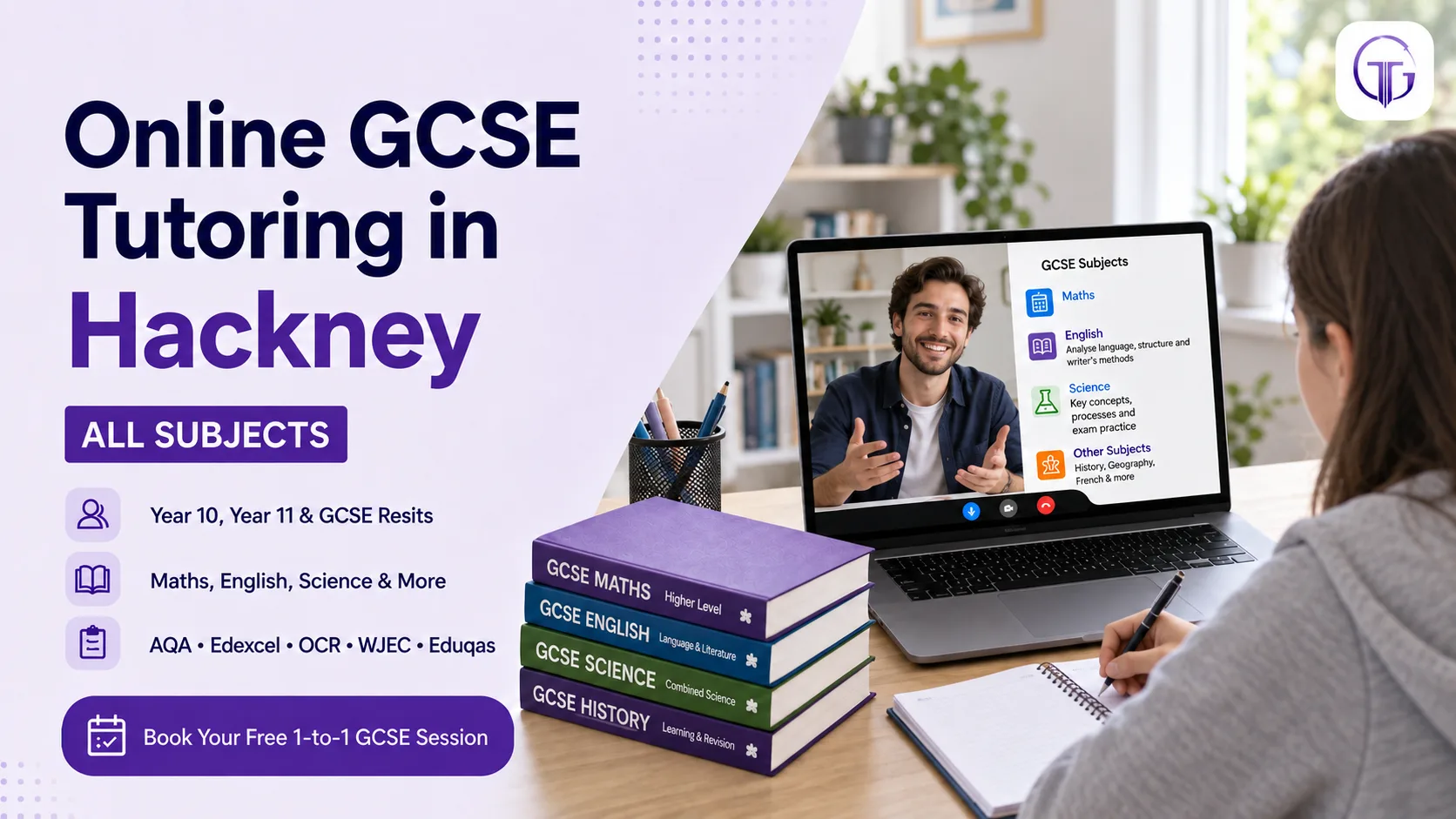
Online GCSE Tutoring in Hackney
One-to-one lessons for Year 10, Year 11 and resit students, £30 per lesson
Online GCSE tutoring in Hackney across every subject we teach. Plenty of the enquiries we get from here open with a version of the same sentence: we know what would help, we are not sure we can pay for it, and we do not know what else is out there.
So this page is about the money rather than about us. What is funded, who administers it, what it can actually be spent on, and what to do before paying anybody anything.
We charge £30 a lesson and the first one is free. That is the whole of our commercial pitch, and the rest of this page is genuinely useful whether or not you ever book it.
What Hackney parents ask
- What financial help exists at sixteen.
- Whether free school meals still matter.
- What pupil premium is actually spent on.
- Whether any of it covers tutoring.
- What to ask the school for first.
What is available while a student is still at school?
Two things worth knowing about, and neither of them arrives unless somebody asks.
The first is free school meals. Eligibility is set nationally and you apply for free school meals through the local authority. In a school where meals are already provided to everyone, families often skip the form, which is a mistake.
It is a mistake because registration also triggers funding for the school. The pupil premium is paid for eligible pupils and schools decide how to spend it, which in Year 10 and Year 11 frequently means small group teaching, revision materials or one-to-one intervention in maths and English.
That leads to the second thing: asking. A school running an intervention programme does not usually advertise it to parents individually. The subject teacher or head of year is the person who knows what exists and whether a particular student could be put on it.
What a school already provides free, and how to ask for it, is covered in detail on our Tottenham page.
Before paying anyone
- Register for free school meals if eligible.
- Ask what intervention runs in that subject.
- Ask whether the student is already on it.
- Collect the free past papers for the board.
- Then decide what is actually missing.
What changes at sixteen?
A different pot opens, aimed at the cost of attending a course rather than at the teaching itself.
The 16 to 19 Bursary Fund is for students in publicly funded education in England who are aged sixteen to nineteen, and it can pay for clothing, books and equipment for the course, plus transport and lunch on study days.
It comes in two forms. A vulnerable bursary applies to specific groups, including students in care, care leavers and some students receiving benefits in their own name. Everything else is discretionary, which means the school or college sets the criteria and decides who gets what.
Students aged nineteen or over can still qualify in two situations: continuing a course they began between sixteen and eighteen, or having an education, health and care plan.
What it will not do is fund private tutoring. The money follows participation in the course, and the provider administers it against their own rules, so the application is made to the college rather than to any national body.
The two bursaries
| Type | How it is decided |
|---|---|
| Vulnerable bursary | Specific eligible groups |
| Discretionary bursary | The provider’s own criteria |
| Who applies | The student, to the college |
| Typical uses | Transport, equipment, lunch |
Both are administered by the school or college, not centrally.
If money is tight, what is worth buying?
Very little, until the free options are exhausted. After that, one subject taught properly beats three taught thinly.
Almost everything a GCSE student needs is published free by the exam boards. Specifications, past papers, mark schemes and examiner reports cost nothing and are better than most paid material, because they are the actual thing rather than an approximation of it.
Where paid help earns its place is in the bit a document cannot do: working out why a particular student keeps losing the same marks, and standing over the correction until it sticks. That is a person, and it does not need to be a lot of hours.
Our honest advice to a family on a tight budget is to buy one subject, weekly, for a term, and to pick the subject where a grade boundary is closest rather than the one that feels worst.
Which free resources are worth the time is covered on our Cricklewood page, and choosing the one subject to fund on our Earlsfield page.
A tight budget, spent well
Exhaust the free school support
It is already paid for.
Download the board’s papers
Specification, papers, mark schemes.
Pick one subject
Where the boundary is nearest.
Weekly for a term
Long enough to show something.
Review before extending
Against a marked paper.
Which GCSE subjects can your child get help with?
The full list, and adding a second subject means a second specialist.
Maths
Foundation and Higher alike. See GCSE Maths tutoring.
English Language and Literature
Two GCSEs, two approaches. See GCSE English tutoring.
Combined and Triple Science
Three specialists, one price each. See GCSE Science tutoring.
Computer Science
Theory papers and programming. See GCSE Computer Science tutoring.
Business Studies
Calculations and case studies. See GCSE Business Studies tutoring.
History, Geography and RS
Where a specialist in the board is free.
Is a resit year funded?
The course is, if the student is in the system. The support around it depends on the college and on the bursary.
A student continuing in education after Year 11 without grade 4 in maths or English carries on studying it under the 16 to 19 maths and English condition of funding, updated in July 2026. The teaching comes with the college place at no cost to the family.
That is also the point at which the bursary becomes relevant, because travel to a college several bus rides away is a real cost that stops some students attending consistently.
Grade 3 keeps the GCSE itself in view. Grade 2 or below allows a Functional Skills level 2 route instead, and the college decides which applies.
For resit students
- The GCSE teaching comes with the college place.
- The bursary can cover travel to it.
- Grade 3 and grade 2 lead different ways.
- The college decides the entry.
See GCSE resit tutoring and the exam dates page.
How does an online lesson run?
Video, a shared whiteboard, and no equipment to buy beyond what is already at home.
Tell us the subject and board
That is all we need to start.
Free one-to-one session
A real lesson, no card details taken.
Paid weekly only if it helped
Decided after, not before.
Work set and marked
Between sessions.
Reviewed at six weeks
And stopped if it is not working.
The full process is on how it works. Hackney Education publishes the borough calendar so families can check school term dates, and academies set their own.
What does a GCSE tutor in Hackney cost?
£30 a lesson, one to one, which is the number to weigh against whatever is already funded.
Nothing is taken before the free session, there is no minimum run, and stopping costs nothing.
If you are comparing quotes, lesson length is the variable that makes two hourly rates incomparable. Our guide to GCSE tutoring costs sets out the range across the country.
What £30 covers
- A full one-to-one lesson with a subject specialist.
- Work set and marked between lessons.
- Past papers and mark schemes provided.
- Timed papers under exam conditions.
- A tutor change if the match is wrong.
Tell us what the school is already doing
If there is support running, say so. It changes what we would suggest.
- Year group and subject.
- Any intervention already in place.
- Exam board and tier, if known.
- Current grade and target grade.
- Days and times that work at home.
Prefer to talk it through? WhatsApp us, or use the contact page.
Send an enquiry
Frequently asked questions
Is there any funded help with the costs around exams?
For students aged 16 to 19 in publicly funded education there is the 16 to 19 Bursary Fund, which can cover transport, equipment, books and lunch on study days. Below sixteen the routes are free school meals and whatever the school does with its pupil premium.
Who gets a bursary?
There is a vulnerable bursary for specific groups, including students in care, care leavers and some students receiving benefits in their own name. Everything else is discretionary and decided by the school or college against its own criteria.
Does free school meals eligibility do anything beyond lunch?
It triggers pupil premium funding for the school, which is money the school decides how to spend on support. Registering matters even in a school where meals are already universal.
Can a bursary pay for private tutoring?
Realistically no. It is aimed at the costs of attending and participating in a course, and it is administered by the provider against their own rules.
What can a family do that costs nothing?
Ask the school what intervention already exists for that subject, register for free school meals if eligible, and use the free past papers and mark schemes the boards publish. That is the order we would work in.
Which GCSE subjects do you cover?
Maths, English Language and Literature, science in either form, Computer Science and Business Studies, plus the humanities we can staff for your board.
What does it cost?
£30 a lesson, one to one, with no registration fee and no block to buy in advance.
Do you have a tuition centre in Hackney?
No. Teaching is online only, and the business is registered in Feltham rather than anywhere in E8 or E5.
Book a free GCSE session for your child in Hackney
One free one-to-one session, no card details and no obligation. If the honest answer after it is that the school can cover this without you paying anybody, we will say so.