
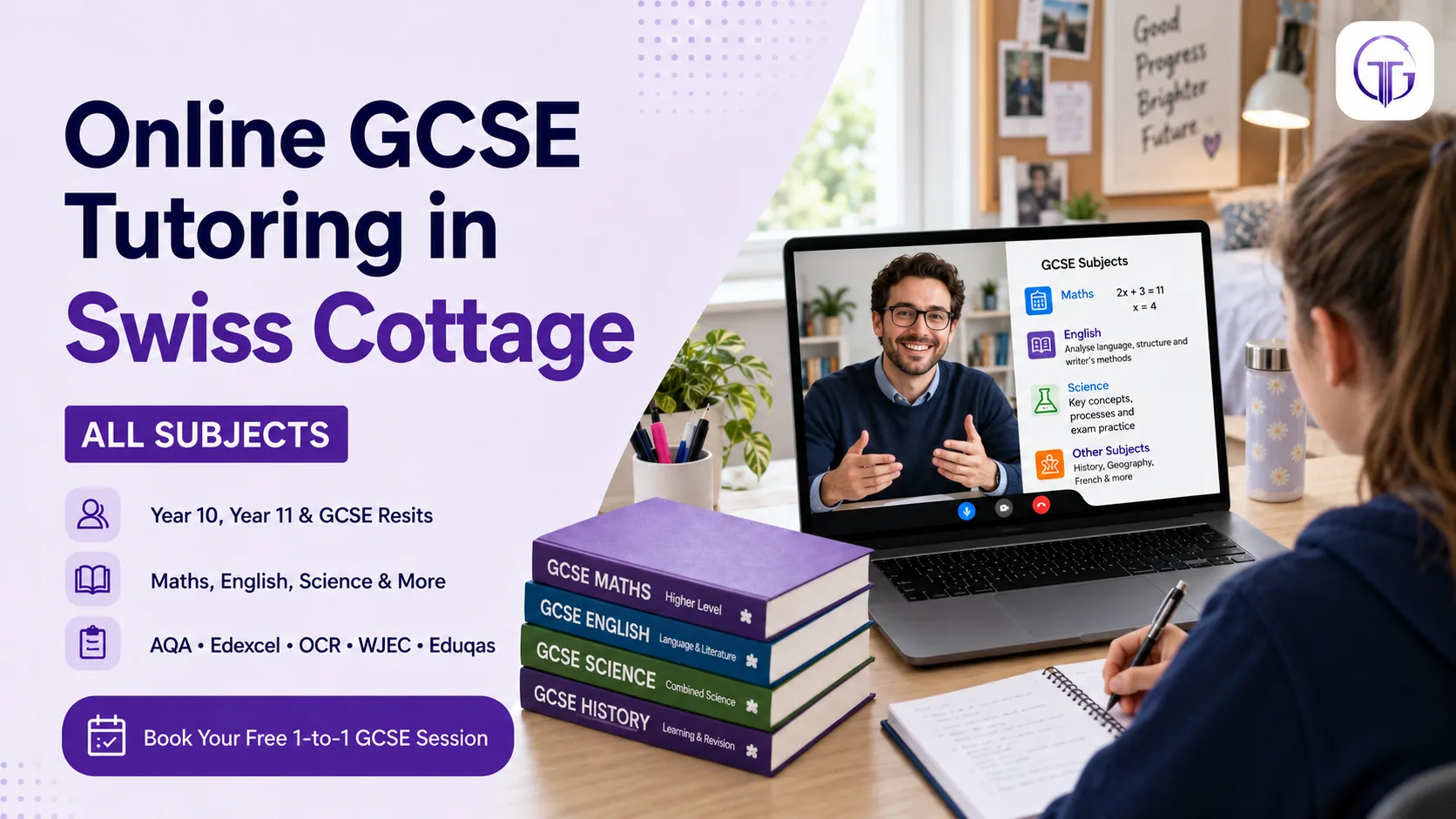
Online GCSE Tutoring in Swiss Cottage
One-to-one lessons for Year 10, Year 11 and resit students, £30 per lesson
Online GCSE tutoring in Swiss Cottage across every subject we teach. A student who has done all their practice in twenty-minute pieces on a laptop is about to sit a set of papers that ask for continuous handwriting for well over an hour at a stretch. That mismatch costs marks quietly, and nobody diagnoses it as the problem.
This is one of the few GCSE difficulties that is purely physical and procedural, which makes it unusually fixable. It just has to be noticed first.
The first session is free and it is a real lesson, with the student writing on paper rather than typing.
What Swiss Cottage parents ask
- Whether handwriting costs marks.
- Why answers run out of time.
- Whether a laptop is ever allowed.
- How to build writing stamina.
- Whether planning is worth the minutes.
How much handwriting does a GCSE actually demand?
Considerably more than a school year of typed homework prepares anyone for.
English Language alone asks for two substantial pieces of writing plus a set of reading responses, across two papers. English Literature adds several essays. History, Religious Studies and Geography each carry extended answers of their own, and even the sciences want six-mark responses written out properly.
Add it up across a summer series and a student is writing by hand, at speed, for a number of hours that they have almost certainly never approached in practice. Most revision is done in fragments: a question here, a plan there, notes on a screen. The exam is the opposite shape.
The result is a specific and recognisable failure. The first answer of a paper is well written, the second is shorter, and the last one, which is often worth the most, is a rushed paragraph. That pattern is not a knowledge gap. It is a student who has never done the whole thing in one sitting.
It also explains why practising the hardest question type in isolation can leave a grade unchanged. The question was never the problem; its position on the paper was.
The tell on a marked paper
| What the paper shows | What it means |
|---|---|
| First answer strong, last rushed | Stamina or pacing, not knowledge |
| Every answer equally weak | A knowledge problem |
| Long answers unfinished | Planning, usually |
| Crossings out and reordering | Started writing too soon |
| Examiner comments on legibility | Worth acting on quickly |
Why does planning save time rather than cost it?
Because the alternative is not writing faster. It is writing more, and then reorganising it on the page.
A student who begins writing the moment they read the question does not know where the answer is going, so they discover the argument while writing it. That produces a first paragraph that turns out to be irrelevant, a middle that repeats itself, and a conclusion arrived at just as time runs out.
Three minutes of planning removes most of that. Not a detailed plan, and not an essay in miniature: four or five words per paragraph, in an order. The argument is decided before the pen starts, so every sentence written is a sentence that stays.
Students resist this for an understandable reason. Planning feels like not working while the clock runs, and in a room where everyone else is already writing it takes some nerve. It is worth practising precisely so that it stops feeling like a risk.
The same three minutes also fix the commonest reason a good answer scores in the middle band, which our Golders Green page covers: answering a slightly different question from the one asked.
Three minutes, spent well
Underline the command word
Explain, evaluate, compare. It sets the shape.
Four or five words per paragraph
Not sentences. Words.
Decide the order
Including which point closes it.
Then write, and do not reorganise
The plan already did that.
When is a laptop or extra time appropriate?
When it reflects how a student normally works and there is evidence of a genuine need, and in that case the school arranges it.
Access arrangements exist for students whose difficulty is substantial and long term, and a word processor is one of them. So is extra time. Both are applied for by the school, assessed against published criteria, and granted on evidence rather than on request, and the Joint Council for Qualifications sets out how the process works.
The test that catches families out is normal way of working. An arrangement has to reflect how the student already works in school, which means it cannot be introduced in March as an exam strategy. A student who types everything at home and writes everything at school will not qualify on the strength of the home habit.
That is worth knowing in Year 10 rather than Year 11. If a student genuinely cannot produce legible handwriting at length, the conversation with the school belongs in the year before the exams, not the term of them.
Our Clapham page goes through who applies, what evidence is needed, and why arrangements used in class do not carry into the hall automatically.
Where a tutor cannot help
- Applying for an arrangement. The school does that.
- Deciding whether a student qualifies.
- Providing evidence of need.
- Anything after the awarding body deadline.
- What we can do is the writing practice itself.
Which GCSE subjects can your child get help with?
Every subject listed, with written work marked in all of them.
English Language
Two long writing tasks under time, which is where stamina shows. See GCSE English tutoring.
English Literature
Several essays across two papers, all handwritten. See GCSE English tutoring.
Maths
Where showing method legibly is worth real marks. See GCSE Maths tutoring.
Combined and Triple Science
Six-mark answers, written properly rather than listed. See GCSE Science tutoring.
Business Studies
Evaluation answers, which reward a planned structure. See GCSE Business Studies tutoring.
Humanities
History, Geography and Religious Studies, where extended writing dominates, when a specialist has room.
Does this matter for an English resit?
More than anything else, because English Language is almost entirely a writing test with very little content to revise.
Resit students often ask what there is to revise for English Language and are told, unhelpfully, to read more. What actually moves the grade is writing full answers to time, having them marked, and doing it again. That is uncomfortable and it works.
Missing grade 4 means the subject continues after Year 11, under the 16 to 19 maths and English condition of funding as updated in July 2026. A grade 3 carries on towards a GCSE, and grade 2 or below opens Functional Skills level 2.
For an adult returning to the subject after years away, the handwriting itself is often the shock. Very few adults write by hand for ninety minutes any more, and it is worth building back deliberately.
Two English GCSEs
- Language: November or the summer series.
- Literature: summer only.
- Both are written entirely by hand.
- The centre controls the entry.
See GCSE resit tutoring and the exam dates page.
How does an online lesson run?
Video, a shared whiteboard, and handwriting done by hand so the speed can be seen.
Send one timed answer
Written by hand, photographed.
Free one-to-one session
A real lesson, no card details taken.
Plan one answer in three minutes
Then write it, timed.
Build up to a full paper
In one sitting, before the exams.
Reviewed at six weeks
Against marked writing.
The full process is on how it works. Camden publishes its term dates, and academies and independent schools here set their own.
What does a GCSE tutor in Swiss Cottage cost?
One to one, £30, including the writing we mark between sessions.
Marking is part of the price rather than an extra, which matters in a subject where the marking is most of the value.
Two quotes only compare once you know how long each lesson runs. Our guide to GCSE tutoring costs covers the market.
What £30 covers
- A full one-to-one lesson with a subject specialist.
- Handwritten work marked against the real scheme.
- Timed practice rather than untimed discussion.
- Planning technique that saves minutes in the hall.
- A tutor change if the match is wrong.
Send us one answer written to time
A photograph of a handwritten answer tells us more than a grade does.
- Year group and subject.
- Whether answers run out of time.
- Whether the last answer is always the weakest.
- Any access arrangement already in place.
- Days and times that work at home.
Prefer to talk it through? WhatsApp us, or use the contact page.
Send an enquiry
Frequently asked questions
How much writing does a GCSE student actually have to do?
More than most people picture. Across English Language, English Literature, History and Religious Studies a student can be writing for several hours in a week of exams, almost all of it by hand and against the clock.
Does bad handwriting lose marks?
Not directly, but illegible handwriting loses marks indirectly, because an examiner can only credit what they can read. There is no penalty for untidiness and there is a real cost to being unreadable.
Can a student type their exams?
Sometimes, through the access arrangements process, where a word processor is their normal way of working and there is evidence of need. The school applies for it. It is not something a family or a tutor can arrange.
My child runs out of time on the long questions. Is that a writing problem?
Often it is planning rather than speed. A student who starts writing immediately and reorganises mid-answer takes far longer than one who spends three minutes planning, and the second answer is usually better as well.
Does hand strain in exams matter?
It is real and it is trainable. A student who has never written for ninety minutes continuously will find their first attempt uncomfortable, which is an argument for practising full papers rather than question fragments.
Which GCSE subjects do you cover?
All the written subjects: Maths, English Language and Literature, Combined or Triple Science, Computer Science, Business Studies, humanities subject to availability.
What does it cost?
£30 a lesson, one to one, with marked writing included.
Do you have a tuition centre in Swiss Cottage?
No. All teaching is online, and the registered address is in Feltham.
Book a free GCSE session for your child in Swiss Cottage
One free one-to-one session, no card details and no obligation. Bring a handwritten answer written to time and the tutor will tell you whether the problem is what the student knows or how they are getting it onto the page.