
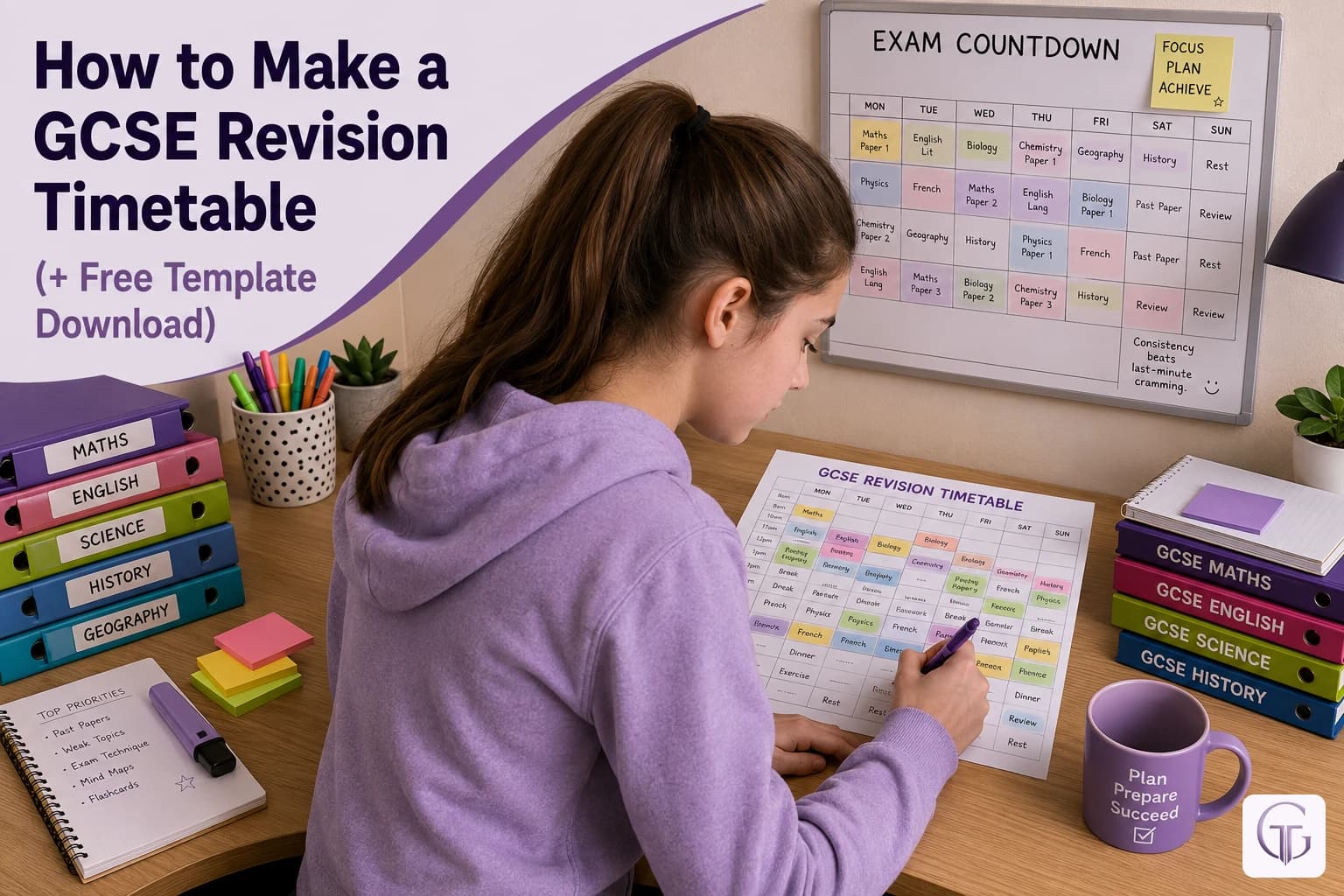
Walk into any Year 11 form room in March and you’ll spot two types of student. One has a beautiful colour-coded wall planner and still can’t tell you what they’re revising on Thursday. The other has written nothing down at all.
Both are stuck for the same reason. A GCSE revision timetable earns its place only when it tells you what to open, when to open it, and when to stop. Everything else is decoration.
The scale of the job is worth seeing clearly. Ofqual recorded 5,840,185 GCSE entries in summer 2026, a 1.1% rise on the year before, with Combined Science alone accounting for 951,510 of them. Most students in England sit 8 to 10 GCSE subjects, roughly 25 separate papers inside a six-week window.
Below: the method, the hours that are realistic at each stage of the year, and a free template you can fill in tonight.
What is a GCSE revision timetable, and why does it beat a to-do list?
A GCSE revision timetable is a fixed schedule that assigns named topics to named time slots across your week. A to-do list only records intentions. A timetable forces you to decide in advance how much time each subject gets, which is why weak subjects stop quietly disappearing.
Lists reward whatever feels easiest at 7pm on a Tuesday, and that’s almost always the subject you already like. A timetable takes the decision away from tired-you and hands it to organised-you, sitting down on a Sunday with the whole week in front of them.
Building one also shows you your real capacity. Once school, homework, football and a Saturday job are blocked out, the space left is usually far smaller than the fantasy schedules circulating on TikTok.
The seven parts of a working GCSE revision timetable
- Your exam dates, from your school’s personalised timetable rather than a generic one
- Named topics, not subject names, “B1 cell transport” instead of “Biology”
- Session lengths you can actually hold, usually 25 to 50 minutes
- Breaks, written in as fixed blocks so they don’t expand into evenings
- A method column: flashcards, past paper, exam question, mark scheme review
- Repeat slots so each topic comes back at least twice before the exam
- Two empty catch-up slots a week for the sessions you inevitably miss
That last one is the part almost every template online leaves out, and it’s why most timetables collapse in week three.
When should you start your GCSE revision timetable?
Build a light version in September of Year 11 and a full version 12 to 16 weeks before your first paper. Summer 2027 GCSE exams begin on Monday 10 May, so a full timetable should be running by mid-January 2027 at the latest.
Year 10 doesn’t need an exam-season timetable. What it needs is a habit: three or four short review sessions a week covering whatever was taught that fortnight. Students who do this arrive in Year 11 revising content they half-remember rather than content they haven’t seen since the lesson.
Year 11 changes in November. Mocks land, gaps become visible, and checking your marks against published GCSE grade boundaries for 2027 shows how far each subject really sits from the next grade. The plan stops being general and starts being targeted.
Resit students work to a different clock. November GCSE Maths and English Language resits mean a compressed autumn plan, and our GCSE resit tutoring usually starts by rebuilding the timetable around the two or three topic areas that cost the most marks last time.
Key summer 2027 dates to anchor your timetable
From the provisional AQA and Pearson Edexcel timetables, agreed through the Joint Council for Qualifications:
- First GCSE exam: Monday 10 May 2027
- Last GCSE exam: Friday 18 June 2027
- Contingency day: Wednesday 23 June 2027, you must stay available
- Most AQA non-exam assessment submissions: 7 May 2027
- Results day: Thursday 19 August 2027
Morning papers start at 9:00am and afternoon papers at 1:30pm. Worth putting your hardest sessions in those windows from Easter onwards. Cross-check every paper against your own board, AQA, Edexcel, OCR, WJEC and CCEA publish separately, and schools issue a personalised timetable on top of that.
How many hours a week should you actually revise?
Roughly 4 to 5 hours a week in Year 10, rising to 13 or 14 hours twelve weeks before exams, and 25 to 30 hours during study leave. Anyone offering a single number for the whole year is guessing.
| Stage | When | Weekdays | Saturday and Sunday | Weekly total |
| Year 10 groundwork | September to July | 30 to 45 mins, 3 days | 1 hour each day | 4 to 5 hours |
| Year 11 autumn | September to November | 1 hour, 4 days | 1.5 hours each day | 7 hours |
| Mock season | November to January | 1.5 hours, 4 days | 2 to 3 hours each day | 10 to 12 hours |
| 12 weeks out | February to March | 1.5 hours, 5 days | 3 hours each day | 13 to 14 hours |
| 6 weeks out | Late March to April | 2 hours, 5 days | 3 to 4 hours each day | 16 to 18 hours |
| Study leave | May to June | 4 to 5 hours per day, one half-day off | – | 25 to 30 hours |
Notice the weekends do the heavy lifting. Weekday evenings after a full school day are the worst hours you own, and loading them with three hours of Physics is how students end up hating a subject by April.
One honest warning about that bottom row. Thirty hours a week only works because study leave removes school, attempting it in February, on top of a full timetable, burns students out before the exams they’re preparing for. Weak subjects are also where the grade jumps live, which is why extra GCSE Maths tutoring tends to buy more marks than another pass over a subject you’re already comfortable with.
How do you build a GCSE revision timetable step by step?
Work out your available slots, split every subject into topics, rank those topics by weakness, then fill the slots hardest-first. The whole process takes about 45 minutes. Spend longer than 90 minutes and you’re procrastinating with a ruler.
- Write down every exam date from your school’s personalised timetable. Not a generic board timetable — yours.
- Block out fixed commitments: school, homework, clubs, part-time work, family, sleep.
- Count what’s left and convert it into numbered slots per week.
- List every topic in every subject, using the specification rather than your memory.
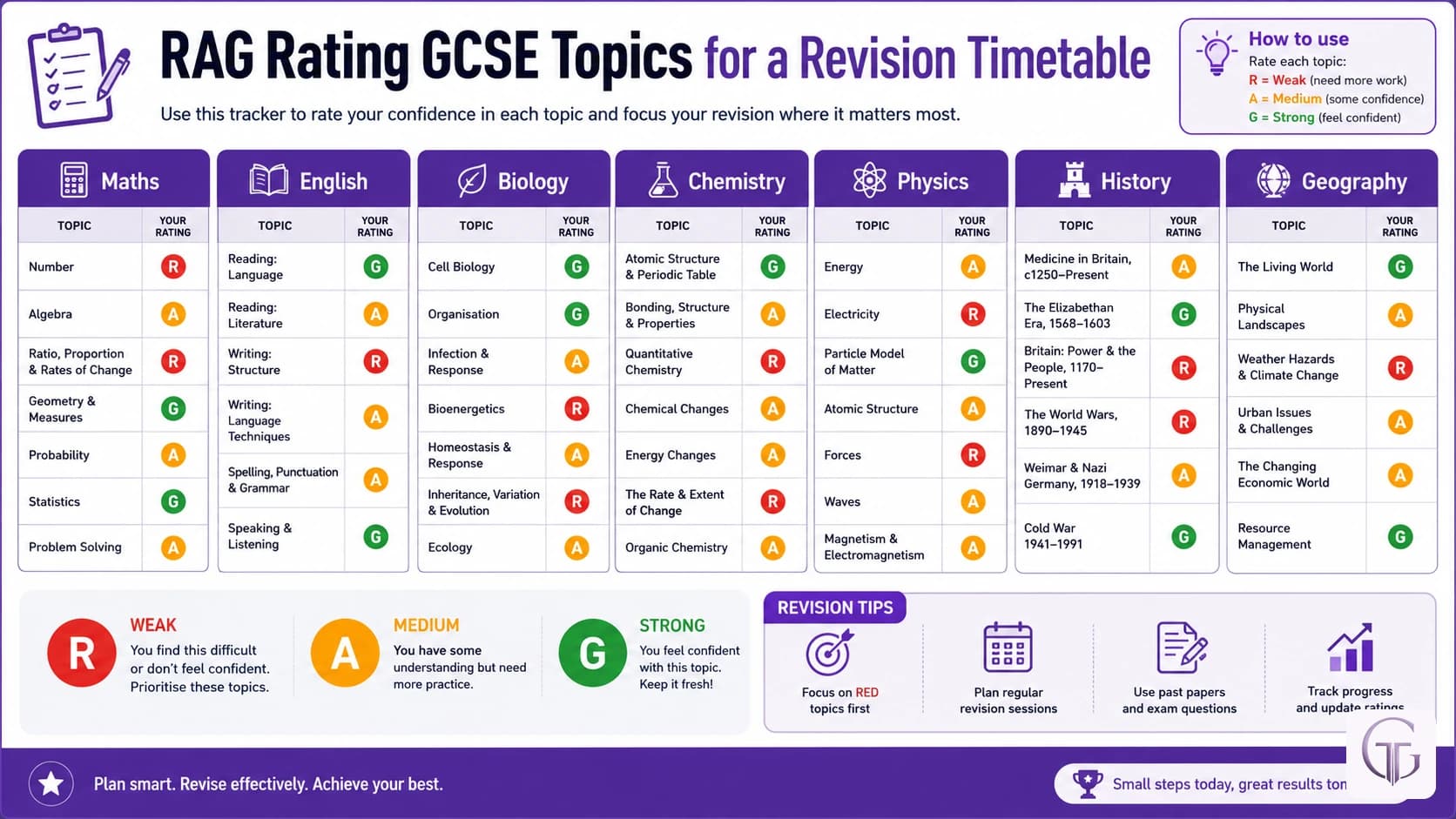
- Rate each topic red, amber or green based on mock papers, not on how you feel.
- Assign reds first, then ambers, then greens, making sure every red topic appears at least three times before its exam.
- Review every Sunday for ten minutes, moving anything missed into next week’s catch-up slots.
How to work out how many revision slots you really have
Count the whole days remaining, then multiply by the sessions you can realistically hold in a day. Ten days at four 45-minute sessions gives you 40 slots. Divide those by weakness, not evenly.
The number is usually smaller than expected, and that’s the point of doing the sum. Forty slots across nine subjects is four and a bit each. Once you can see that, you stop planning to “go over everything” and start choosing.
How to break subjects into topics you can finish in one sitting
“Revise Chemistry” is not a task. “Practise 8 mark questions on rates of reaction” is.
Pull the topic list straight from your exam board specification, then cut anything that won’t fit in one session. Combined Science is the obvious offender, worth two GCSEs and carrying six papers, it needs roughly double the slots of a single-award subject. Students working with our GCSE Science tutors often find the plan improves the moment Biology, Chemistry and Physics get separate colours instead of one shared “Science” block.
What should you actually do in each revision session?
Test yourself, and spread topics out over time. In a review of 10 study techniques published in Psychological Science in the Public Interest, Dunlosky and colleagues rated only two as high utility: practice testing and distributed practice. Rereading and highlighting scored low.
So the method column should contain things like:
- Blank-page recall, write everything you remember, then check it against your notes
- Flashcards, split into a “got it” pile and a “revisit” pile after each run
- Exam questions from past papers, marked against the official mark scheme
- Corrections, redoing the questions you got wrong last week
- Full timed papers, one per subject per week from about February half term
Reading your notes feels productive because it’s comfortable. Recall feels awful because it exposes what you don’t know, which is exactly why it works. Students reaching the very top bands tend to work this way by default, something we unpicked in our guide to getting a grade 9 in GCSE Maths.
Mark schemes deserve a slot of their own. Plenty of marks are lost not through ignorance but through missed command words, the gap between “describe” and “explain” is worth real grades, and it’s what our GCSE English tutors spend the most time correcting.
Should your timetable be prospective or retrospective?
A prospective timetable decides in advance what you’ll revise each day. A retrospective one logs what you covered and when, then sends you back to whatever you’ve left longest. Prospective suits Year 10 and early Year 11; retrospective suits the final ten weeks.
The flaw in a purely prospective plan is that it can’t respond to you. You schedule quadratics for 3 February, you do quadratics on 3 February, and you never find out whether it stuck.
A retrospective version is just a spreadsheet: topics down the side, date and confidence score across the top. Log every session. When you sit down to work, open the sheet and pick whatever has the oldest date or the lowest score. Plenty of students run both.
How does your revision timetable change once study leave starts?
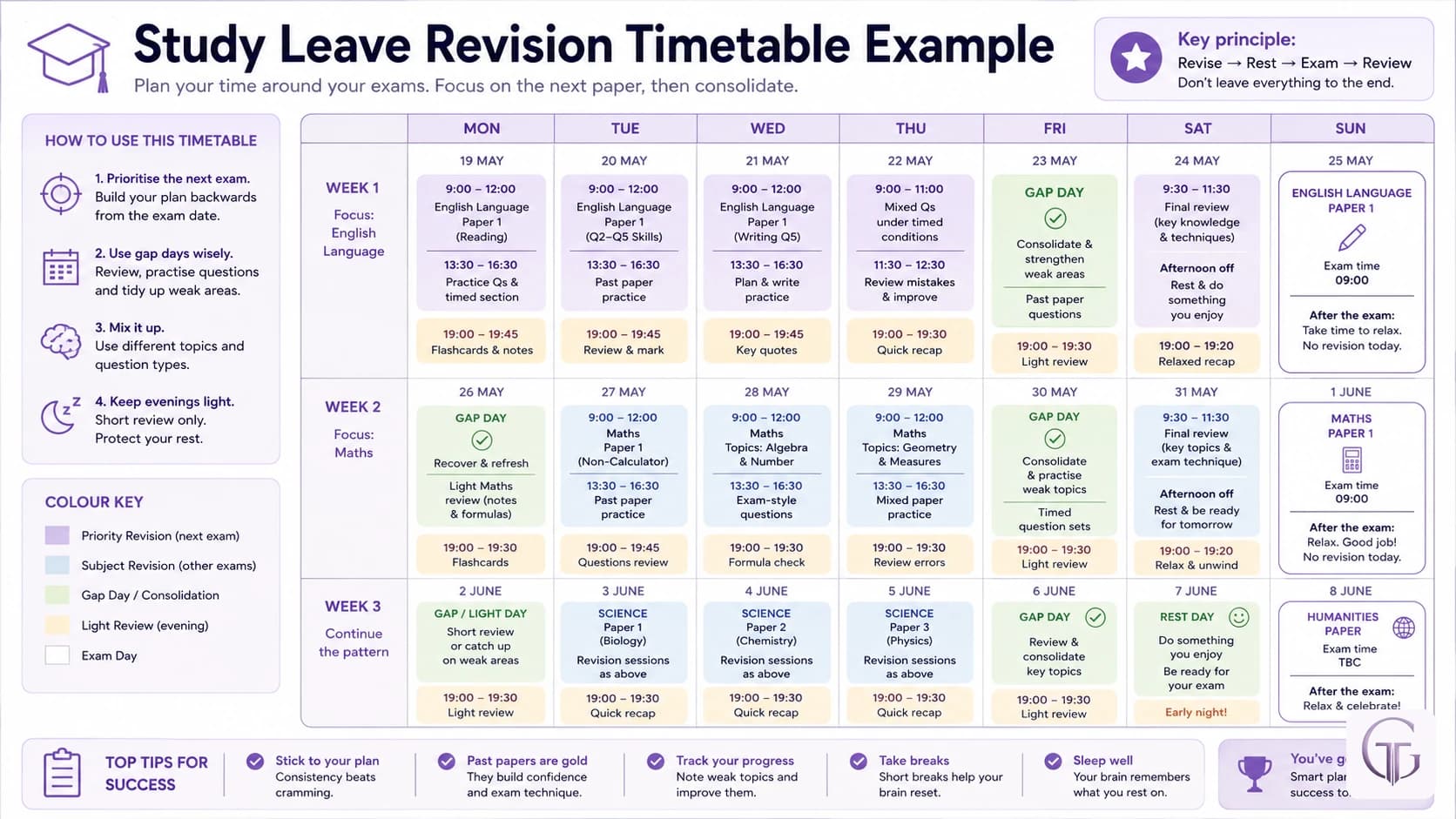
Study leave removes six hours of school a day and replaces it with empty time, which is harder to handle than it sounds. Rebuild around exam mornings, spend gap days on the next paper only, and protect one half-day off each week.
Three rules matter more here than anything in your term-time plan.
Front-load the morning. Papers start at 9:00am, so revising from 9:00 to 11:00 trains you for the window you’ll be examined in.
Use gap days properly. Chemistry on Monday and History on Thursday means Tuesday and Wednesday belong to History. Revising ahead to a paper three weeks away is a common and costly instinct.
The night before does not rescue you. Light flashcards, a quick look at formulae, then stop. Sleep does more for recall at that point than another two hours will.
And keep 23 June 2027 clear. The contingency day is a JCQ requirement, so booking a holiday before it is a genuinely bad idea.
What are the most common GCSE revision timetable mistakes?
Overplanning, ignoring weak subjects, and building a schedule with zero slack. Each one produces a timetable that looks impressive on the wall and gets abandoned by the third week of February.
- Spending three hours making it look nice. Twenty minutes, then revise.
- Scheduling only favourites. Grade jumps come from your worst subject, not your best.
- Writing subject names instead of topics. Vague slots get skipped.
- No breaks. A plan with no gaps has no room for a bad day.
- Never updating it. January mock results should change what February looks like.
- Forgetting non-exam assessment. Coursework deadlines land before exams and eat revision time.
The prettiest timetables tend to belong to the students furthest behind. There’s a reason for that.
What should you do if you fall behind schedule?
Don’t rebuild it. Move missed sessions into next week’s catch-up slots, drop the lowest-priority green topics, and carry on. Restarting from scratch costs another evening and changes nothing about what you actually know.
Falling two or three sessions behind in a week is normal. Falling a fortnight behind across four subjects means the plan was too ambitious, and the fix is fewer hours that you’ll genuinely complete.
When the same topic keeps sliding week after week, the problem usually isn’t time management, it’s that you don’t understand it well enough to start. That’s the point where targeted help beats another hour of staring at it, and our one-to-one online lessons often begin by working out which topics are being avoided and why. Whether that support works better on a screen or across a kitchen table is a fair question, and we’ve compared both formats in detail.
Where can you download a free GCSE revision timetable template?
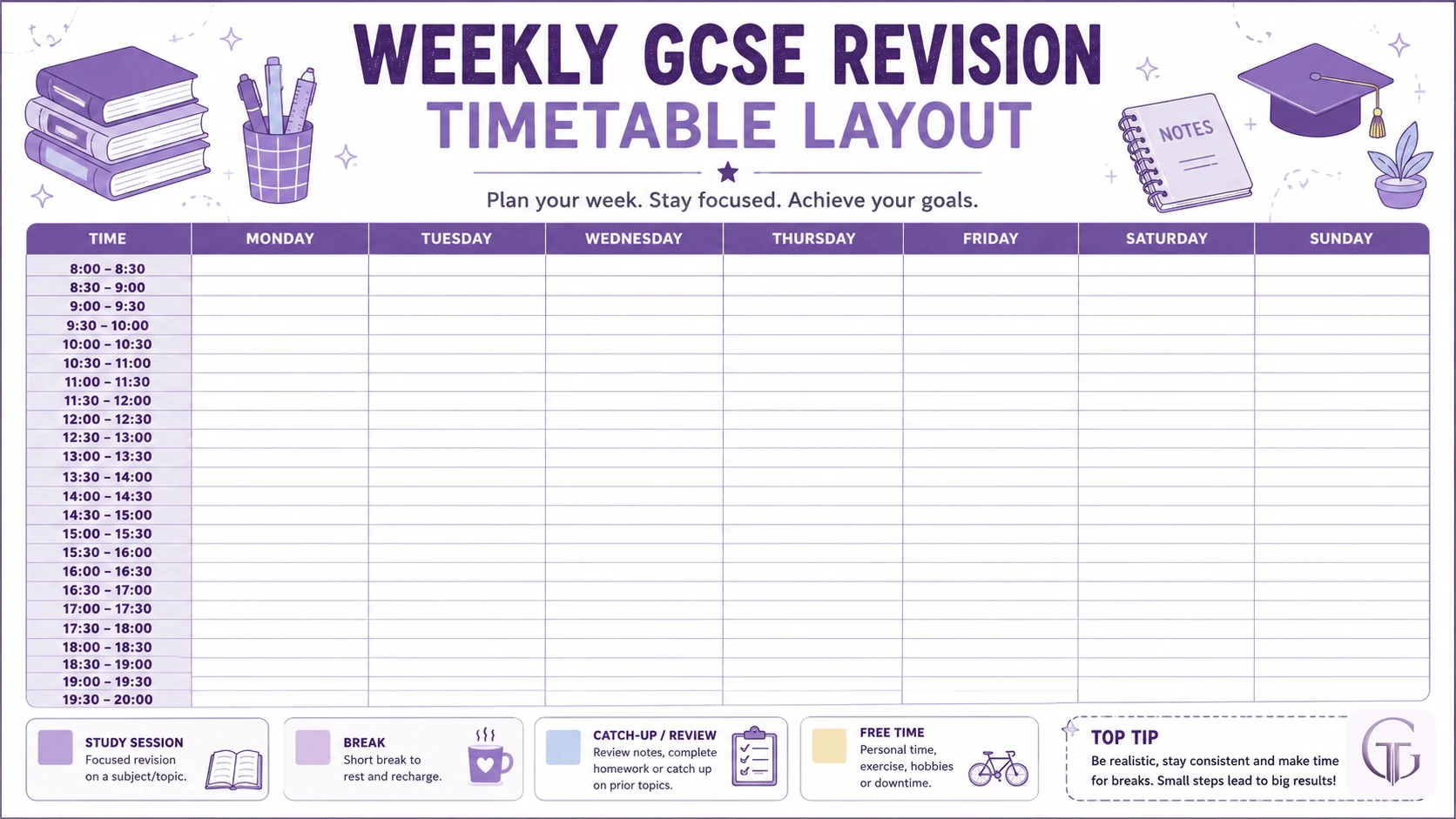
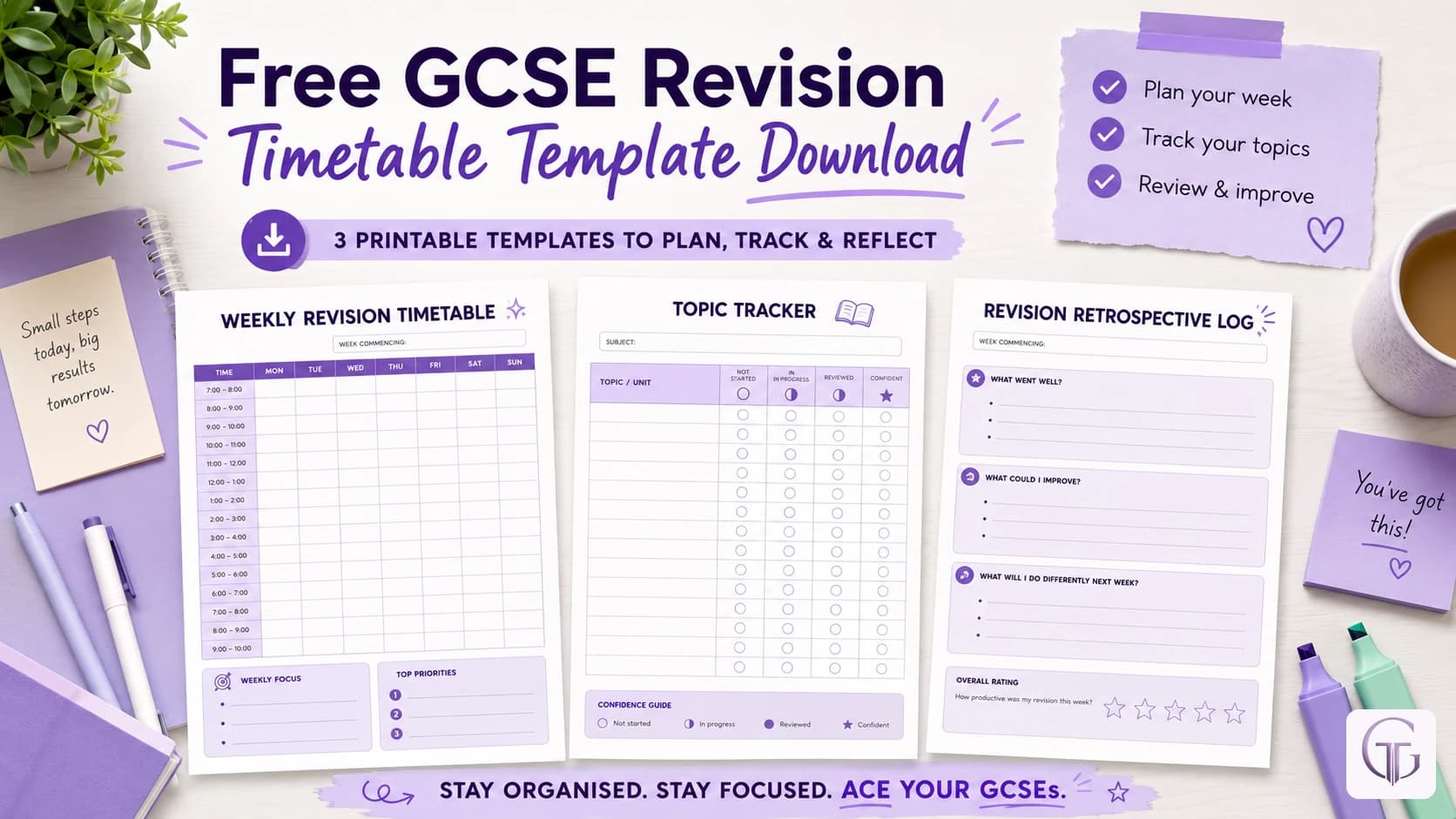
Our free GCSE revision timetable template downloads as an editable file you can print or complete on a laptop. It includes a blank weekly grid, a topic tracker with RAG rating, and a worked example for a Year 11 student sitting nine subjects.
Inside the download:
- A weekly planner running 8:00am to 9:00pm in 30-minute rows
- A subject and topic tracker with red, amber and green columns
- A retrospective log sheet for the final ten weeks
- A completed example week for reference
- Space for exam dates, NEA deadlines and mock dates
Print two copies. One for the wall above your desk, one for the fridge so someone else can see it, accountability from a parent is unglamorous and surprisingly effective.
Free Excel Template
Download Your Free GCSE Revision Timetable
Plan each subject, prioritise weaker topics and keep your GCSE revision on track with our editable timetable.
Weekly revision planner RAG topic tracker Exam and deadline tracker Editable Excel workbook
No sign-up required · Excel file · Easy to edit and print
Free Download GCSE Revision Timetable
Frequently Asked Questions
How many hours a day should I revise for GCSEs?
Between 1 and 2 hours on school days and 3 to 4 hours a day at weekends during Year 11, rising to 4 or 5 hours a day on study leave. Two focused hours will always outperform five distracted ones.
When do GCSE exams start in 2027?
Summer 2027 GCSE exams begin on Monday 10 May 2027 and finish on Friday 18 June 2027, with a contingency day on Wednesday 23 June. Results day is Thursday 19 August 2027. Confirm your own papers against your school’s personalised timetable.
Is it better to revise one subject a day or several?
Several, in most cases. Mixing related topics within a session, known as interleaving, produces better long-term recall than spending a whole day on one subject. Two or three subjects a day with clear topic boundaries suits most students.
How far in advance should I make a GCSE revision timetable?
Twelve to sixteen weeks before your first paper for a full timetable, and September of Year 11 for a lighter one. Fewer than six weeks means prioritising rather than covering, which is still worth doing properly.
Should I revise every day?
No. Schedule at least one full day or half-day off each week. Recall improves with rest, and a timetable with no days off is the one students abandon first.
Do I need a different timetable for mocks?
Yes, a shorter one. Mock timetables typically run four to six weeks and cover only the content taught so far, which makes them a useful rehearsal for the summer.
Ready to make the plan work? Tell us your child’s year group, subjects and exam board, and we’ll suggest where tutoring would make the biggest difference. Book a free consultation or browse more guides in our Insights library.
Need GCSE Support?
Get one-to-one online GCSE tutoring for Maths, English, Science and other GCSE subjects from home.