
The pencil case is packed, the revision notes are open, and suddenly your mind is rehearsing every possible way the exam could go wrong. That surge of worry is familiar to plenty of Year 10 and Year 11 students. Learning how to tackle GCSE exam anxiety does not mean forcing yourself to feel calm all the time. It means knowing what to do when nerves become loud.
Sleep is one of the first things anxiety disrupts, yet the NHS says most teenagers need 8 to 10 hours each night. Losing sleep to squeeze in more revision often makes concentration, recall and emotional control worse the next day. The heroic all-nighter is mostly a bad bargain.
This guide explains why GCSE exam anxiety happens, how to make revision feel manageable, what to do if panic rises in the exam hall, and when to ask for more support. The aim is not perfect confidence. The aim is enough control to show what you know.
What is GCSE exam anxiety, and when do normal nerves become a problem?
GCSE exam anxiety is persistent worry or fear connected to revision, exams or results. Normal nerves may sharpen attention for a short time. Anxiety becomes a problem when it repeatedly disrupts sleep, concentration, eating, school attendance, revision or your ability to complete a paper.
A stress response can affect your thoughts, emotions, body and behaviour at once. Your heart may race because your body has read the exam as a threat. Your mind may then interpret the racing heart as proof that you cannot cope. That second conclusion is not a fact, even when it feels convincing.
What does GCSE exam anxiety feel like?
Students do not all experience anxiety in the same way. One student may revise for hours because stopping feels unsafe. Another may avoid opening a book because the amount of work feels unbearable. Both can be anxiety responses.
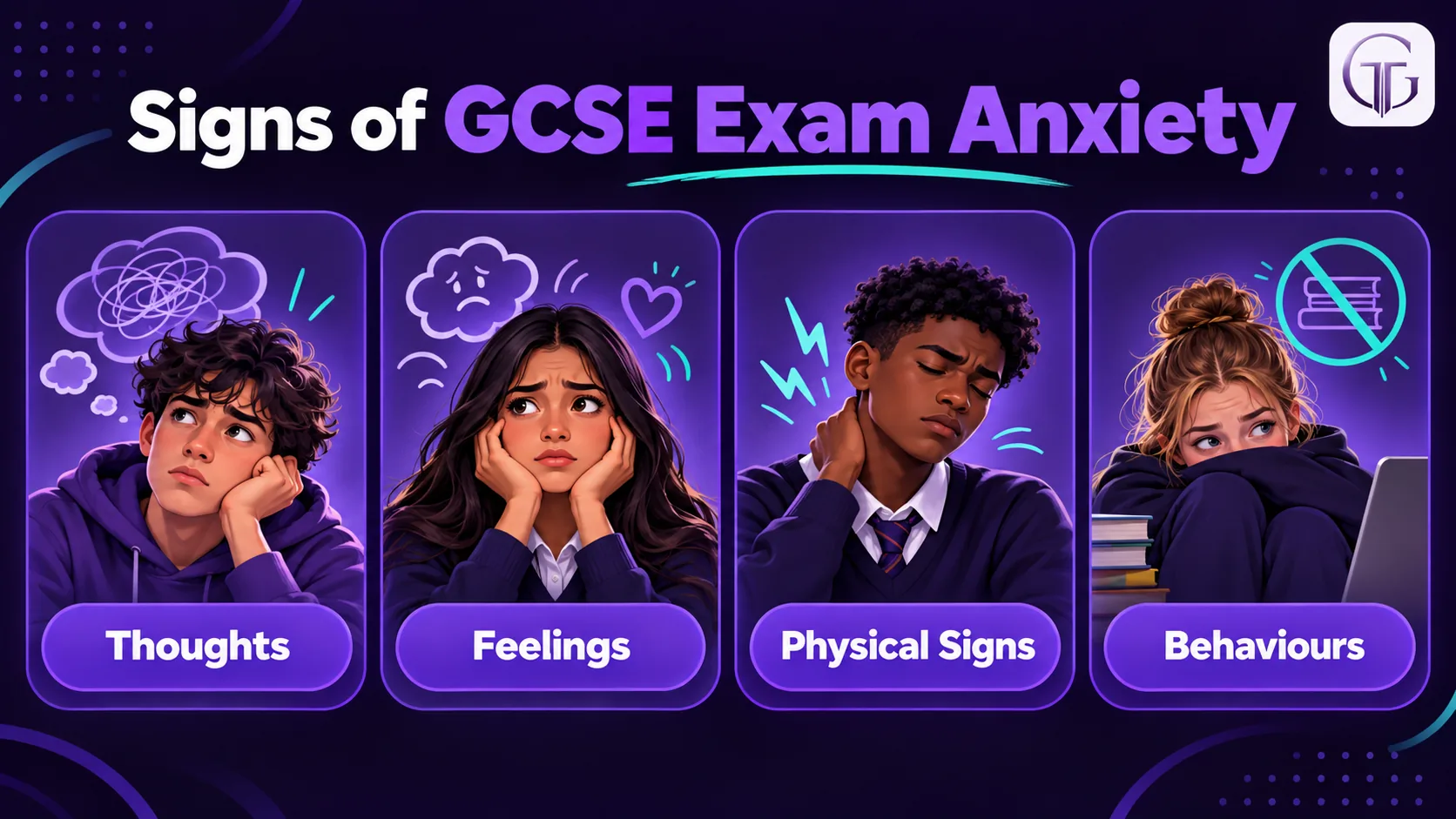
Common signs include:
- racing thoughts or repeatedly imagining failure
- headaches, nausea, shaking, sweating or a tight chest
- trouble falling asleep or waking early with worries
- irritability, tearfulness or snapping over small things
- difficulty starting revision, even when you want to begin
- reading the same paragraph without taking it in
- avoiding lessons, mocks, revision or conversations about exams
- believing one difficult paper will ruin your entire future
How can you tell the difference between nerves and harmful anxiety?
| What you notice | Normal exam nerves | Anxiety that needs attention |
|---|---|---|
| Timing | Appears before a test, then settles | Continues for days or weeks |
| Revision | You can start after a little hesitation | You regularly freeze, avoid work or cannot stop |
| Sleep | One unsettled night | Repeated loss of sleep or exhaustion |
| Body | Butterflies or temporary tension | Frequent nausea, panic, headaches or breathlessness |
| Daily life | You still eat, attend school and see people | School, food, relationships or routines are affected |
| Support | Reassurance and a plan usually help | Usual coping methods are not enough |
The table is a guide, not a diagnosis. Severe, persistent or worsening symptoms deserve a conversation with a trusted adult, school staff member or GP.
Why does GCSE exam anxiety happen?
GCSE exam anxiety usually grows from several pressures rather than one cause. High expectations, uncertain questions, weak areas, previous exam experiences and constant comparison can combine. Avoiding revision then increases uncertainty, which creates more worry and makes starting feel even harder.
GCSEs can feel bigger than ordinary school tests because grades may influence sixth-form, college or course choices. Adults sometimes add to that pressure without intending to. A steady stream of questions about target grades can make home feel like another assessment room.
How does the anxiety and avoidance cycle work?
The cycle often looks like this:
- You think about the amount of content left to revise.
- Your body reacts with tension, nausea or a racing heart.
- You avoid the task, scroll on your phone or reorganise notes instead.
- The short escape brings relief.
- Lost time makes the exam feel more threatening later.
Avoidance works for a few minutes, which is exactly why it becomes tempting. The way out is a small, specific action. “Revise Science” is too vague. “Answer five cell biology questions and mark them” gives your brain a visible finish line.
Which thoughts make exam anxiety worse?
Anxious thinking often turns a possibility into a certainty. “I might find the paper difficult” becomes “I will fail.” A disappointing result becomes “I am a failure.” One classmate's revision hours become proof that you are behind.
Try a more accurate replacement:
- Instead of “I know nothing,” use “I have gaps, and I can identify the next one.”
- Instead of “I must get every answer right,” use “I need to collect marks across the paper.”
- Instead of “Everyone is ahead of me,” use “I cannot see the quality of anyone else's revision.”
- Instead of “My mind will go blank,” use “If I freeze, I have a reset routine.”
Positive thinking does not mean pretending everything is easy. Realistic thinking is stronger because you can actually believe it.
How can you reduce GCSE anxiety before revision starts?
Reduce GCSE anxiety by replacing a vague workload with a short, visible plan. List subjects and topics, rate confidence honestly, choose one achievable task, and decide when it will finish. Starting with a defined action restores control faster than waiting to feel motivated.
Open the relevant specification or topic list and mark each area red, amber or green. Red means you cannot yet answer a basic question. Amber means your knowledge is uneven. Green means you can retrieve and apply it without notes.
Do not spend the week polishing green topics because they feel comfortable. Give red topics attention, but mix them with amber work so every session does not feel punishing.
How should you turn worry into a revision plan?
- Write down every GCSE subject you are taking.
- Break each subject into units or topics.
- Rate each topic red, amber or green.
- Check the order of your papers using the current GCSE exam dates.
- Choose two or three priority tasks for the next seven days.
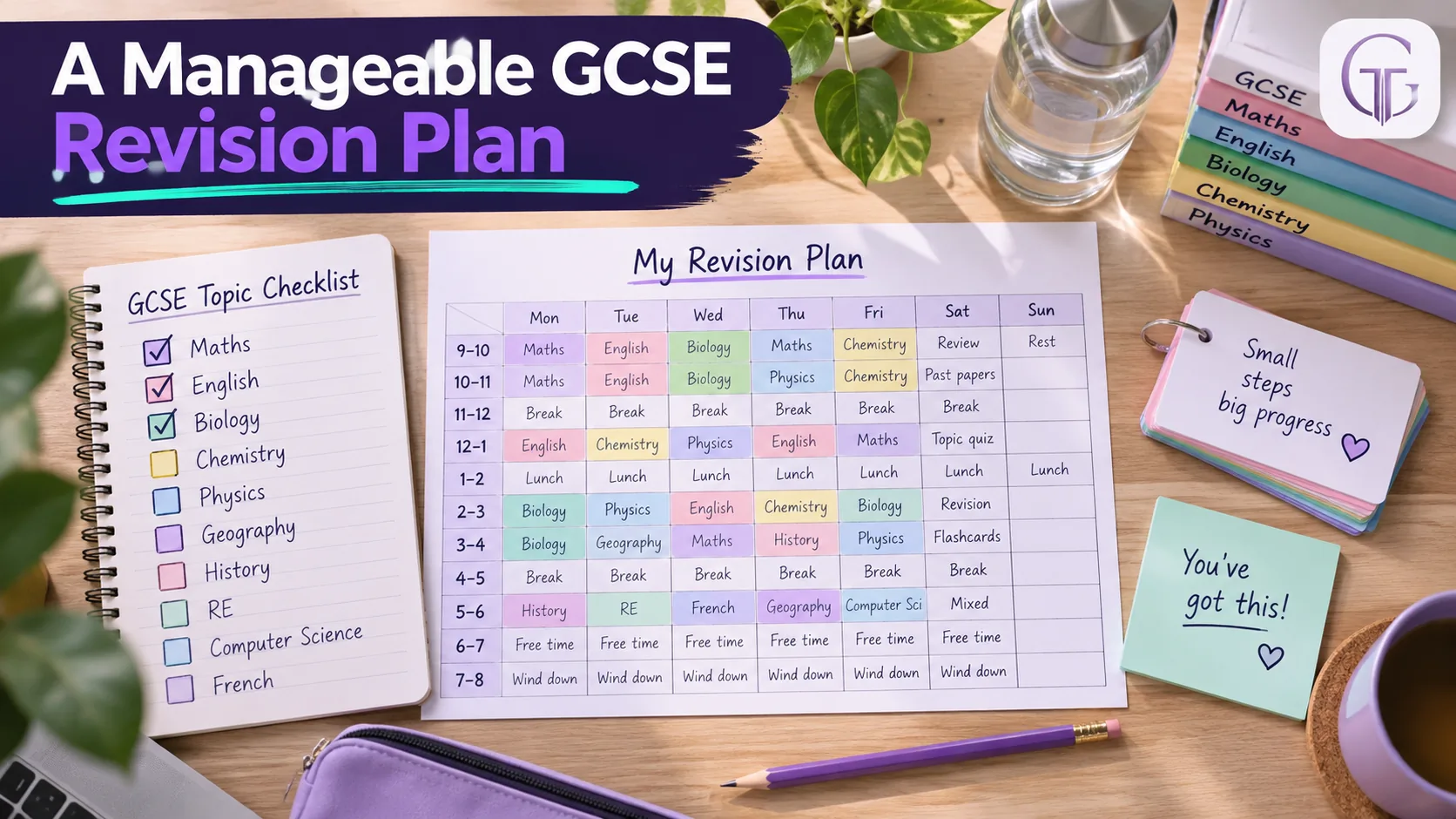
- Put those tasks into a realistic GCSE revision timetable.
- Review the plan weekly and move unfinished work without treating it as a moral failure.
A useful task names the topic, method and length. Try “complete and mark one algebra past-paper section for 30 minutes,” not “do Maths.” Specific plans remove the exhausting decision about what to do next.
What should a manageable revision session include?
Begin with a two-minute recall of what you already know. Spend 20 to 40 minutes on one focused task, then check your answer against notes, a mark scheme or teacher feedback. Finish by writing the next action.
Effective revision should make your brain retrieve information. Flashcards, exam questions, blurting and explaining a concept aloud usually reveal more than rereading. Our guide on how to revise for GCSEs explains how to match these methods to different subjects.
Which daily habits help to control exam stress?
Regular sleep, meals, water, movement and genuine breaks make anxiety easier to regulate. These habits will not remove every worried thought, but they give your brain a better working environment. Consistency matters more than an elaborate routine that lasts three days.
| Habit | A realistic action | Why it helps |
|---|---|---|
| Sleep | Keep a similar bedtime and wake time | Supports attention, memory and mood |
| Food | Eat regular meals and a familiar breakfast | Prevents hunger from adding to shakiness or poor focus |
| Water | Keep water nearby while revising | Reduces avoidable discomfort and distraction |
| Movement | Walk, stretch, dance or play sport daily | Releases tension and creates a proper mental break |
| Caffeine | Notice whether coffee or energy drinks worsen symptoms | Can reduce avoidable jitters and sleep disruption |
| Phone use | Put the phone outside reach for one study block | Cuts comparison and repeated interruptions |
| Downtime | Schedule an activity with no grade attached | Reminds your brain that life is larger than the exam series |
How much revision is enough each day?
No single number fits every student. Three focused 30-minute sessions can achieve more than four distracted hours at a desk. Judge revision by completed retrieval tasks and corrected mistakes, not by how long a textbook stays open.
Plan a stopping time. Without one, revision spreads across the evening and creates guilt whenever you are not working. Rest then feels like cheating, which is a quick route to burnout.
Should you use energy drinks during GCSEs?
Energy drinks are a poor fix for exhaustion if caffeine makes you shaky, restless or unable to sleep. Water, food and a normal sleep routine are less dramatic and more useful. If you already drink caffeine, notice its effect rather than suddenly changing everything on exam morning.
How can you calm down when anxiety suddenly spikes?
When anxiety spikes, slow your breathing, anchor attention in the room and give yourself one small action. The aim is not to erase every symptom instantly. A short reset tells your body that you are safe enough to continue with the next task.
How do you use slow breathing for exam anxiety?
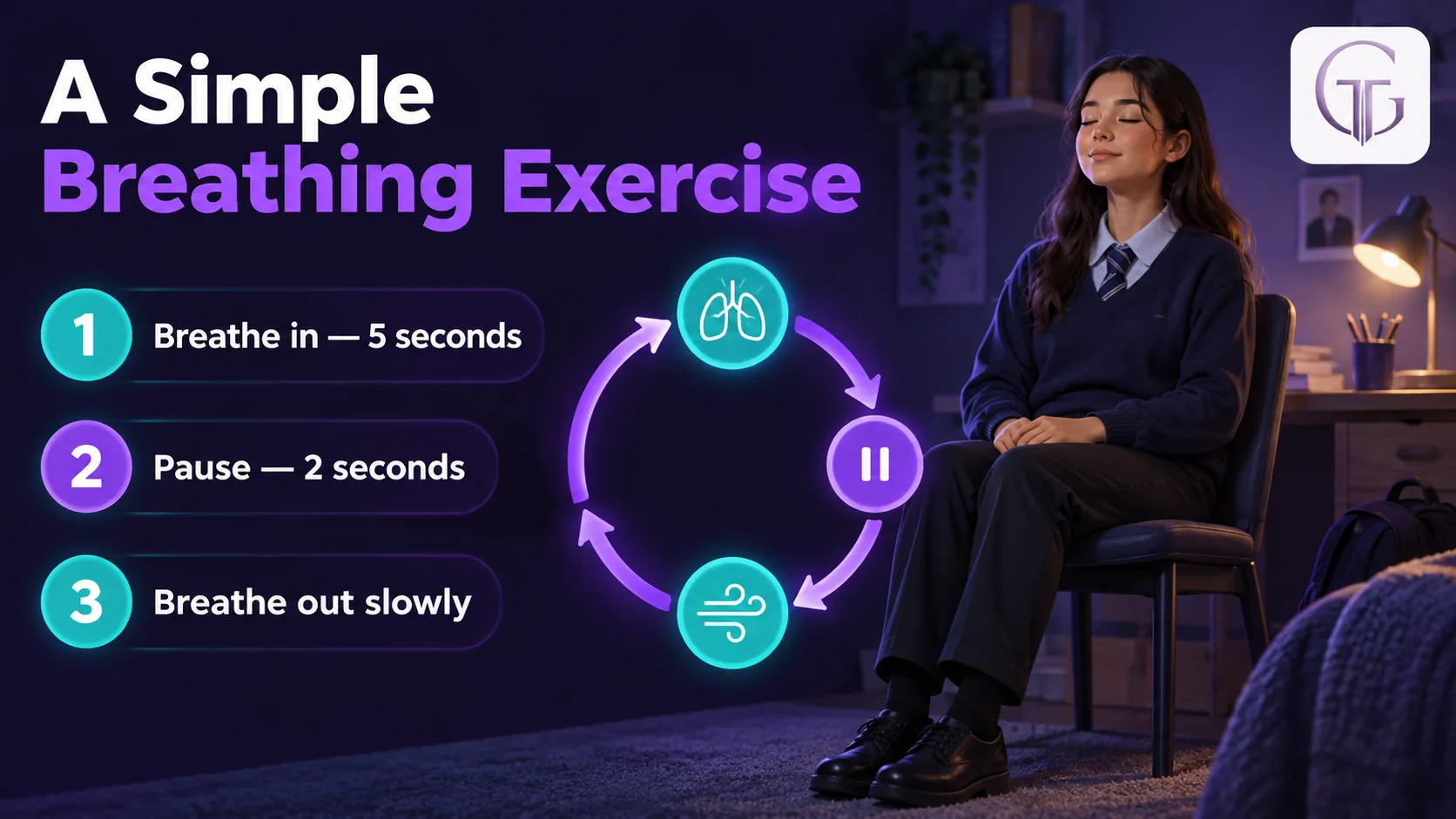
The government's student guide to coping with exam pressure recommends slow, deep breathing to regain control. Practise the technique when you are fairly calm, not for the first time outside the exam hall.
- Sit with both feet supported.
- Relax your jaw and drop your shoulders.
- Breathe in gently through your nose for five seconds.
- Hold for two seconds if that feels comfortable.
- Breathe out slowly through your mouth.
- Repeat for one or two minutes.
Do not force a huge breath. Quiet, steady breathing is enough. If counting makes you more tense, focus only on making the out-breath a little longer.
What is a grounding exercise?
Grounding moves your attention from frightening predictions to what is happening now. Name five things you can see, four things you can feel and three things you can hear. Then identify the next useful action, such as opening the paper or underlining the command word.
Progressive muscle release can also help. Tighten your hands for a few seconds, then let them soften. Repeat with your shoulders and legs without making the movement obvious. Your body often needs a physical signal before your thoughts settle.
How should you practise for the GCSE exam room?
Practise under exam conditions in gradual steps, so the room, timing and paper format feel less unfamiliar. Begin with one timed question, then a section, then a full paper. Mark each attempt and use mistakes to choose the next revision task.
Uncertainty feeds anxiety. Practice removes uncertainty about the paper layout, command words, timing and what you will do when a question looks difficult.
How can you build up to timed papers without panicking?
Start below your current stress limit. A student who freezes at full papers may begin with ten minutes and one familiar question. Increase the time only after the shorter task feels manageable.
Use this progression:
- Answer one question with notes and no timer.
- Answer a similar question without notes.
- Answer a short set with a generous time limit.
- Complete one timed section under quiet conditions.
- Attempt a full paper using the official time.
- Mark it, record patterns and practise the weakest skill.
Subject practice should reflect the real demand. A GCSE Maths tutor may work on choosing methods under time pressure. A GCSE English tutor may focus on planning quickly and sustaining an answer. For Biology, Chemistry and Physics, GCSE Science tutoring can combine knowledge recall with calculation and practical-method questions.
What should you do the night before an exam?
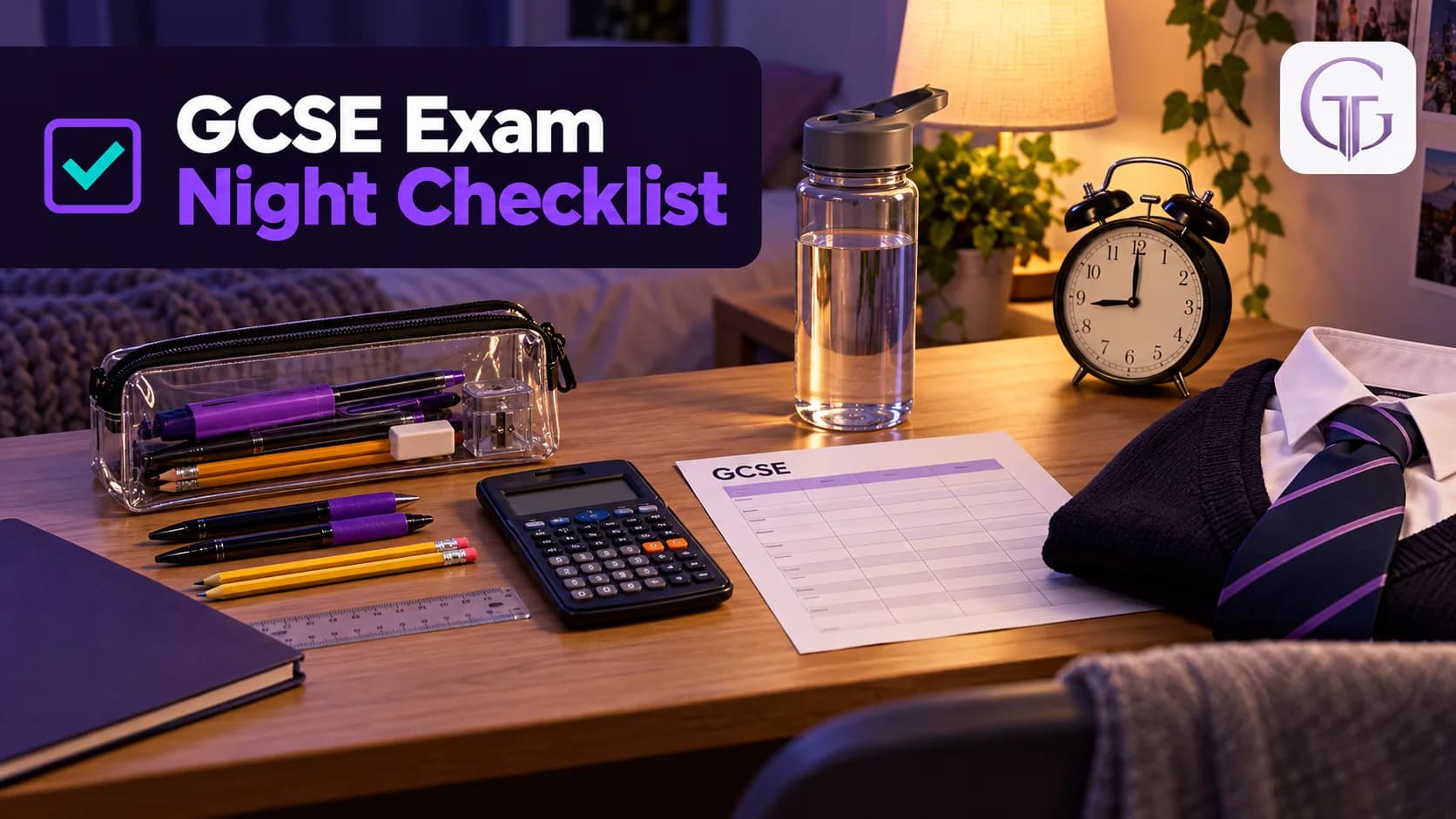
Prepare the boring details. Check the start time, location, route, uniform and permitted equipment. Pack spare pens, pencils, a ruler and an approved calculator where needed. Set an alarm and choose breakfast in advance.
Finish heavy revision at a sensible time. A short review of key facts is fine if it reassures you, but learning an entire unit at midnight is not a rescue plan. Put the materials away and let the day end.
What should you do if your mind goes blank during a GCSE exam?
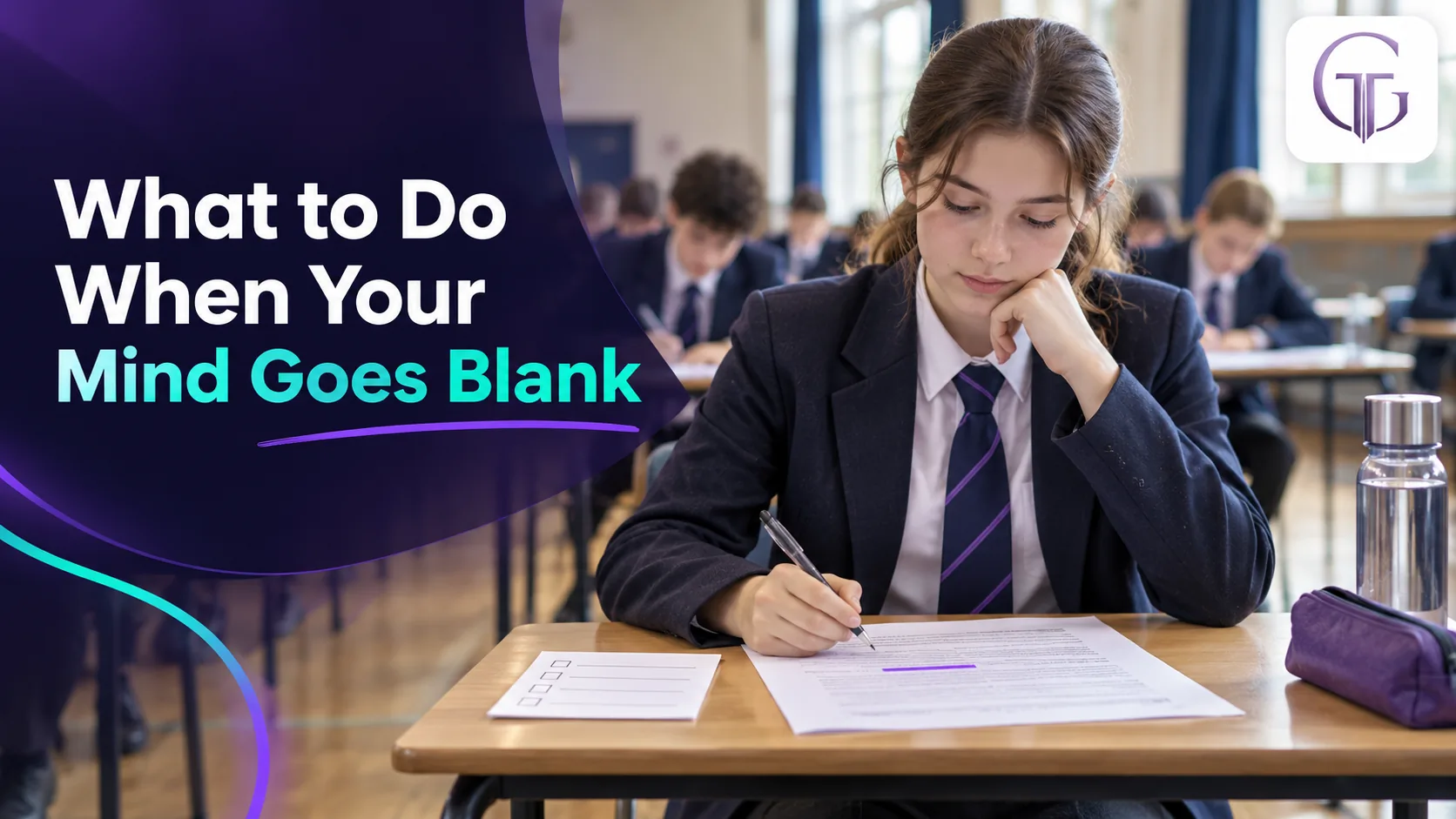
If your mind goes blank, pause for about one minute, slow your breathing and reconnect with the page. Start with a manageable question or write one relevant fact. Momentum often restores recall more effectively than staring at the hardest question.
What is a simple exam-room reset?
Use the same routine every time:
- Put the pen down and place both feet on the floor.
- Breathe out slowly, then take three or four steady breaths.
- Read the question again and underline the command word.
- Write one fact, formula, quotation, date or keyword that might help.
- If you are still stuck, mark the question and move on.
- Return after collecting marks elsewhere.
Skipping a question temporarily is a strategy, not surrender. Spending 15 minutes fighting a two-mark item can turn one difficult moment into a time problem across the whole paper.
How can you manage time without watching the clock constantly?
Before writing, scan the paper and note its sections and marks. Use the number of marks as a rough guide to the amount of work required. Check time at planned points, such as after each section, instead of every minute.
If anxiety rises again, repeat the reset. Invigilators can help with practical issues, such as a broken pen or feeling unwell, although they cannot explain a question. Raise your hand if you need their attention.
How can parents and tutors help without adding pressure?
Parents and tutors help most by listening, reducing practical uncertainty and praising useful actions rather than predicted grades. Ask what support the student wants, protect sleep and breaks, and keep one difficult paper in perspective. Calm support beats constant monitoring.
What should adults say to an anxious GCSE student?
| Adds pressure | More helpful alternative |
|---|---|
| “How many hours have you done?” | “What is the next task on your plan?” |
| “You need a grade 7.” | “What skill would help you collect more marks?” |
| “Your cousin revised every night.” | “Which routine is working for you?” |
| “Do not worry.” | “I can see you are worried. What would help right now?” |
| “That exam sounded easy.” | “What part felt manageable, and what should we leave behind?” |
Adults should not promise a particular result. “You will definitely get a 9” can feel supportive, but an anxious student may hear another expectation they must meet. Confidence is better built from evidence: completed questions, clearer methods and mistakes that no longer repeat.
When might tutoring reduce anxiety?
Tutoring may help when anxiety is tied to specific knowledge gaps, confusing feedback or not knowing how to revise. A good tutor makes the work more predictable, checks understanding and gradually introduces timed practice. Tutoring is academic support, not treatment for an anxiety disorder.
Families deciding whether support is needed can read when to start GCSE tutoring. Online GCSE Tutoring also explains how its one-to-one lessons work, including the lesson process and subject support available.
When should you seek more support for GCSE exam anxiety?
Seek more support when anxiety is severe, lasts beyond brief exam nerves, keeps getting worse or interferes with sleep, eating, school, relationships or daily life. Tell a trusted adult, pastoral lead, SENCO or GP rather than trying to manage it alone.
Ask for help promptly if you are having frequent panic attacks, missing school, barely sleeping, unable to eat, feeling persistently hopeless or using harmful ways to cope. If you may hurt yourself or someone is in immediate danger, call 999 or go to A&E.
Who can help at school?
Start with the adult you can speak to most easily. That might be a form tutor, subject teacher, head of year, pastoral lead, school counsellor, designated safeguarding lead or SENCO. You do not need a polished explanation. “Exam anxiety is stopping me sleeping and revising” is enough to begin.
Schools may offer a check-in, quiet study space, wellbeing support or help with a realistic revision plan. If academic uncertainty is part of the problem, regular one-to-one support through online GCSE tutoring can sit alongside, not replace, appropriate school or healthcare support.
Can students get exam access arrangements for anxiety?
Access arrangements are adjustments agreed before exams for eligible students with evidenced needs. They do not make an exam easier or change what is assessed. The school or college decides what is appropriate under current rules.
The Joint Council for Qualifications guidance explains that arrangements must reflect evidence of need and the student's normal way of working. Supervised rest breaks may suit certain students with social, emotional or mental-health needs, but anxiety does not automatically lead to extra time or a separate room.
Speak to the SENCO or exams officer as early as possible. Do not wait until the morning of the first paper, because evidence and normal working arrangements may need to be established in advance.
What should you do after each GCSE exam?
After each exam, step away from detailed answer comparisons, eat, drink and take a proper break before revising again. Note only practical lessons that could help with the next paper. Replaying answers you cannot change usually increases anxiety without improving a future result.
Friends will want to compare answers. You are allowed to say, “I am not discussing the paper yet.” Online unofficial mark schemes can wait too. One disputed answer has a strange talent for swallowing an entire afternoon.
How do you reset for the next paper?
Give yourself a defined recovery period. Walk home, listen to music, shower, eat or talk about anything unrelated to school. Later, check the next exam's time and choose one or two useful revision tasks.
Do not punish a difficult exam with an exhausting night of work. You need enough energy for the rest of the series.
What if you are anxious about results or resits?
Results-day worry often tries to solve a future problem before the information exists. Make a simple plan for who you will go with, how you will contact your school and which adult can help you discuss options.
A disappointing result can be upsetting, but it is not the end of education. Reviews, alternative courses and resits may be available depending on the subject and circumstances. Our GCSE resit tutoring guide explains how focused support can help students prepare for another attempt.
What is a realistic seven-day plan for reducing GCSE exam anxiety?
A useful seven-day plan combines organisation, active revision, exam practice, sleep and recovery. Keep each day's target small enough to complete. The goal is to prove that you can act while anxious, not to transform into a perfectly calm student within one week.
| Day | Main action | Anxiety-management action |
|---|---|---|
| 1 | List subjects and rate topics red, amber or green | Tell one trusted person how anxiety is affecting you |
| 2 | Complete one 25 to 40-minute amber-topic session | Practise slow breathing for two minutes |
| 3 | Answer and mark a short set of exam questions | Take a phone-free walk or movement break |
| 4 | Review errors and choose one red-topic task | Replace one catastrophic thought with a realistic statement |
| 5 | Complete one timed section | Use the grounding routine before starting |
| 6 | Review progress and prepare next week's plan | Finish revision at a set time and wind down |
| 7 | Do light retrieval or take planned rest | Pack materials and protect sleep |
If a day goes badly, continue with the next one. Do not double the next day's workload to repay a made-up debt. Revision plans are tools, not judges.
Frequently asked questions about GCSE exam anxiety
Is GCSE exam anxiety normal?
Yes, some GCSE exam anxiety is normal. Short-term nerves can increase alertness, but anxiety needs attention when it becomes severe, persistent or begins to disrupt revision, sleep, eating, school attendance or everyday life.
How do I stop panicking before a GCSE exam?
Slow your breathing, relax your shoulders and focus on the next physical action, such as entering the room or writing your details. Avoid last-minute group cramming if it increases your stress.
What should I do if I cannot sleep before an exam?
Stop heavy revision, dim screens, prepare your equipment and follow a familiar wind-down routine. If sleep problems keep happening, tell a parent, school staff member or GP rather than relying on caffeine.
Can a GCSE tutor help with exam anxiety?
A tutor can reduce anxiety caused by knowledge gaps, weak exam technique or an unclear revision plan. A tutor should not present academic support as treatment for severe or persistent anxiety.
Should I revise on the morning of a GCSE exam?
Light recall may help if it feels reassuring, but frantic last-minute learning often raises stress. Eat, drink, arrive on time and keep any review short and familiar.
Can I get extra time because of exam anxiety?
Not automatically. The school or college must follow current JCQ rules, assess evidence of need and consider the student's normal way of working. Speak to the SENCO or exams officer well before the exam series.
What if I think I failed one GCSE paper?
Leave the paper behind and protect your energy for the next exam. A difficult paper may feel worse than it was, and one assessment rarely tells you the final grade by itself.
Need GCSE Support?
Get one-to-one online GCSE tutoring for Maths, English, Science and other GCSE subjects from home.