
Online GCSE Tutoring in Balham
One-to-one lessons for Year 10, Year 11 and resit students, £30 per lesson
Online GCSE tutoring in Balham across every subject we teach. Most SW12 enquiries open with two numbers that disagree: a target grade from the school and a mock grade from the same term. This page is about which of them means anything.
Lessons run one-to-one over video at times that suit the household, later evenings included. Nobody travels, so a weekly slot survives the dark half of the year.
The first session is free and it is a genuine lesson. Bring both numbers and the tutor will tell you which one to plan around.
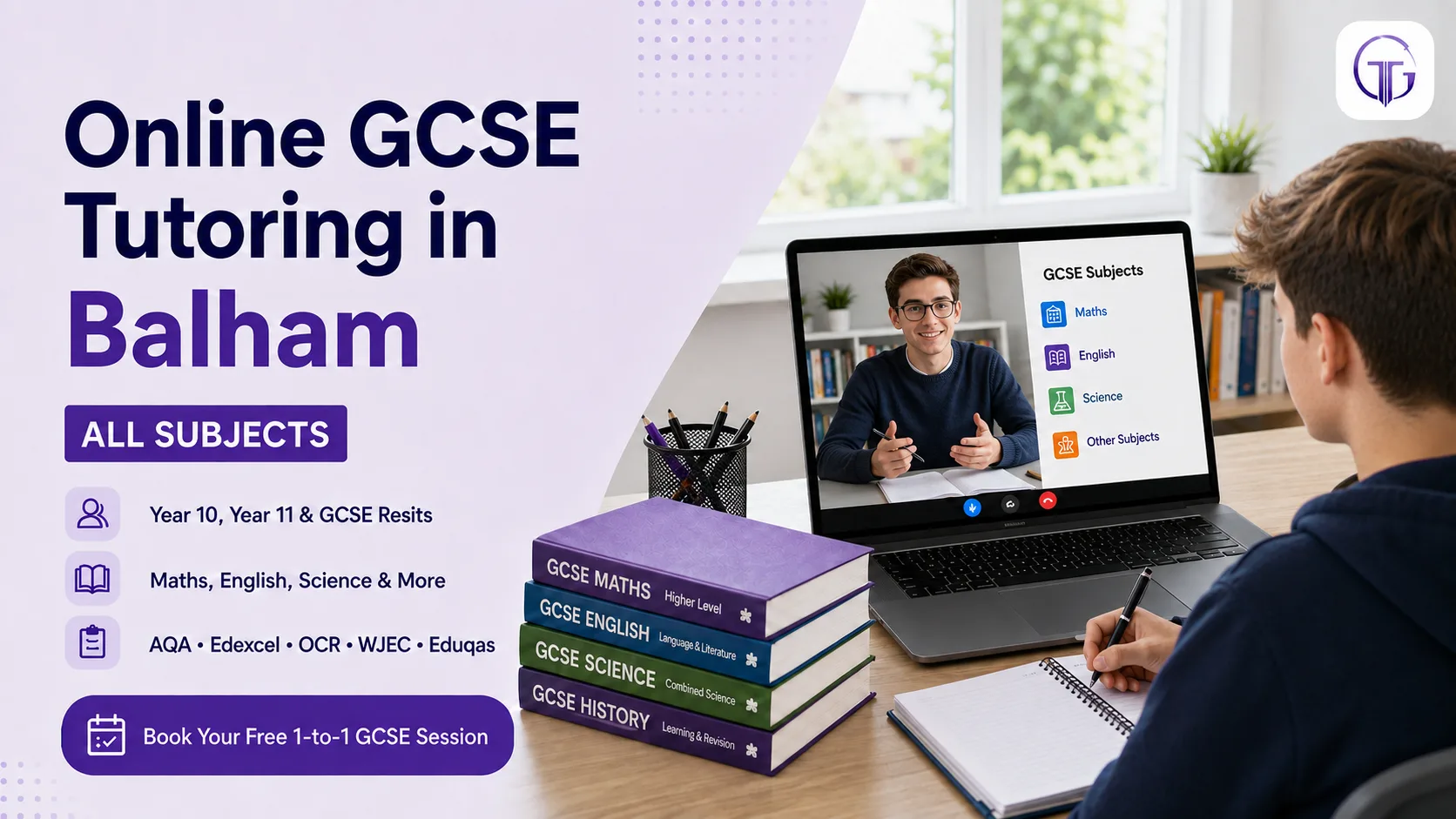
What Balham parents bring us
- A target grade nobody can explain the origin of.
- A mock two grades below what the report says.
- A student who has decided the target is a ceiling.
- Maths and English before the Year 11 mocks.
- Triple Science taught by three specialists.
What is a target grade, and who decided it?
Not the teacher, in most cases, and not recently. Understanding where the number came from changes how much weight it deserves.
Most target grades start life as statistics. A school takes a student’s Key Stage 2 results from the end of primary, runs them against a national dataset showing how similar students went on to perform, and produces an expected outcome. It is a reasonable planning tool for a whole year group and a blunt instrument for one child.
Consider what that means in practice. The number was generated from tests sat at eleven, before secondary school, before a subject was chosen, before anybody knew whether the student would take to Chemistry. By Year 11 it is describing a version of your child who no longer exists.
A predicted grade is a different animal. That is a teacher’s judgement of where the student is currently heading, based on classwork and assessments. It is more current and more subjective, and it moves.
The two get quoted interchangeably in parents evenings, which is where the trouble starts. A family hears "target grade 7" and reads it as a promise. Another hears "target grade 5" and reads it as a verdict. Neither is either.
Three numbers, three meanings
| Number | Where it comes from | What it tells you |
|---|---|---|
| Target grade | KS2 data and a national dataset | Where a similar cohort tended to land |
| Predicted grade | The teacher, from current work | Where this student is heading now |
| Mock grade | A real paper under time | What they can do today, unrevised |
Only the third one is evidence about your child under exam conditions.
What should you do with the gap between them?
Measure it in marks rather than grades, because marks are the thing a student can actually work on.
Grades are a compression of marks, and a coarse one. The distance between a grade 5 and a grade 6 in a GCSE subject is frequently a handful of marks across two or three papers, which sounds far more achievable than a whole grade and is exactly the same thing.
So the useful conversion is downwards. Take the mock, find the mark, find the boundary the school used, and work out how many marks are actually missing. Then look at where those marks went, because a dozen marks lost to one weak topic is a very different job from a dozen scattered across careless slips.
Boundaries themselves move each year, set after marking by the exam boards under Ofqual, which is why schools grade mocks against last year’s. It also means a student sitting exactly on a boundary is not safe, and the sensible target is always a cushion of marks above it rather than the grade itself.
Our explainer on what GCSE grades from 9 to 1 mean and our guide to grade boundaries both go into this further.
Questions worth asking the school
- What is the target grade calculated from?
- Which boundaries were the mocks graded against?
- How many marks short was my child of the next grade?
- Is the predicted grade different from the target, and why?
- Which topics did the class as a whole find hardest?
All five are ordinary requests and all five are usually answered if you ask directly.
Which GCSE subjects can your child get help with?
All of them here, and each subject goes to a tutor who teaches that subject.
Maths
Foundation and Higher tier, where the marks lost to method rather than knowledge are easiest to recover. See GCSE Maths tutoring.
English Language and Literature
Reading questions, structured writing and the set texts. See GCSE English tutoring.
Combined and Triple Science
Biology, Chemistry and Physics as three strands with three specialists. See GCSE Science tutoring.
Computer Science
Programming, algorithms and the written paper. See GCSE Computer Science tutoring.
Business Studies
Case studies, calculations and evaluation answers. See GCSE Business Studies tutoring.
Humanities
History, Geography and Religious Studies, when a specialist has capacity.
What if the real grade lands short?
For maths and English the subject carries on into sixth form or college, whatever the target said.
The 16 to 19 maths and English condition of funding, updated in July 2026, requires a student aged 16 to 19 on a study programme without grade 4 in maths and English to keep studying it. Grade 3 means a GCSE route. Grade 2 or below allows Functional Skills at level 2.
Our Wandsworth page covers what that looks like in practice, including who decides whether a student is entered in November.
Two series
- November covers Maths and English Language only.
- Around ten weeks after August results.
- Every other subject waits for the following summer.
- The provider decides entry timing, not the family.
See GCSE resit tutoring and the exam dates page.
How does a lesson work in practice?
Video, a shared whiteboard, and paper at the student’s end. The tutor watches the method, not the final answer.
Send both numbers
The target and the most recent mock, ideally with the paper.
Free one-to-one session
A real lesson, no card details, then a straight report.
Convert grades to marks
How many marks short, and where they went.
Weekly lessons on those marks
One target area per lesson, practised under time.
Recount every few weeks
The mark gap either shrinks or it does not.
The full process is on how it works, and Wandsworth schools set their own term dates, so check yours through the government term dates finder before booking a weekly slot.
What does a GCSE tutor in Balham cost?
One to one, £30 for the session, and there is nothing to pay before the first lesson.
How many lessons depends on the size of the mark gap, which is why we will not quote a package before seeing a paper.
Check the lesson length before you compare that with an hourly price somewhere else. Our guide to GCSE tutoring costs sets out the market.
What £30 covers
- A full one-to-one lesson with a subject specialist.
- Planning against your child’s exam board and tier.
- Marked practice against the real mark scheme.
- Progress measured in marks, not adjectives.
- A tutor change if the match is wrong.
Send us both numbers
The target and the mock. The gap is the interesting part. We reply during the day.
- Year group and subject.
- The target grade, and the mock grade or mark.
- Exam board and tier, if you know them.
- The marked paper, if you can get it.
- Days and times that work at home.
Rather talk than type? WhatsApp us, or use the contact page.
Send an enquiry
Frequently asked questions
Where does my child’s target grade actually come from?
Usually from their Key Stage 2 results, run through a national dataset that says how students with similar primary scores went on to perform. It is a statistical expectation for a group, applied to one child, and it was calculated before they sat a single GCSE lesson.
Is a target grade the same as a predicted grade?
No, and confusing the two causes a lot of unnecessary arguments. A target is an aspiration set from old data. A prediction is a teacher’s judgement of where the student is heading right now. They can differ by two grades in either direction.
Should we treat a target grade as a ceiling?
Never. It is an expectation drawn from a cohort average, not a limit. Plenty of students beat their target by two grades, and a target well below what a student is capable of is worth questioning rather than accepting.
The school says grade 7 and the mock says grade 5. Which is right?
Neither, on its own. The mock is evidence of where the student is today under exam conditions. The target says where somebody hoped they would land. The gap between them is the useful part, because it tells you how much work sits in between.
Which GCSE subjects do you cover?
Maths and both English GCSEs, science in either the Combined or the Triple route, Computer Science and Business Studies. Humanities we take on when a specialist is free.
Do you have a tuition centre in Balham?
No. All lessons are online and the business is registered in Feltham. Local schools are named as context only.
How much does it cost?
£30 a lesson, one to one. There is no registration fee, and you can stop after any session.
Can you work towards a specific target grade?
We can work towards the marks that grade needs, which is the only part anyone controls. Boundaries themselves are set after the papers are marked, so the honest goal is a mark cushion rather than a number.
Book a free GCSE session for your child in Balham
One free one-to-one session, no card details and no obligation. Bring the target, the mock and the paper if you have it.