
As a GCSE education writer and tutor, I am often asked by parents moving to the UK: “What exactly is a GCSE?” The General Certificate of Secondary Education (GCSE) has been the standard qualification for 14‑ to 16‑year‑olds in England, Wales and Northern Ireland since the late 1980s. It marks the culmination of Key Stage 4 of the national curriculum, covering years 10 and 11. Students usually start their GCSE courses aged 14 and complete examinations at 15–16, making GCSE results their first formal record of academic achievement. In this guide I will explain what GCSEs are, how the system works, why they matter and how families can support their children through the process.
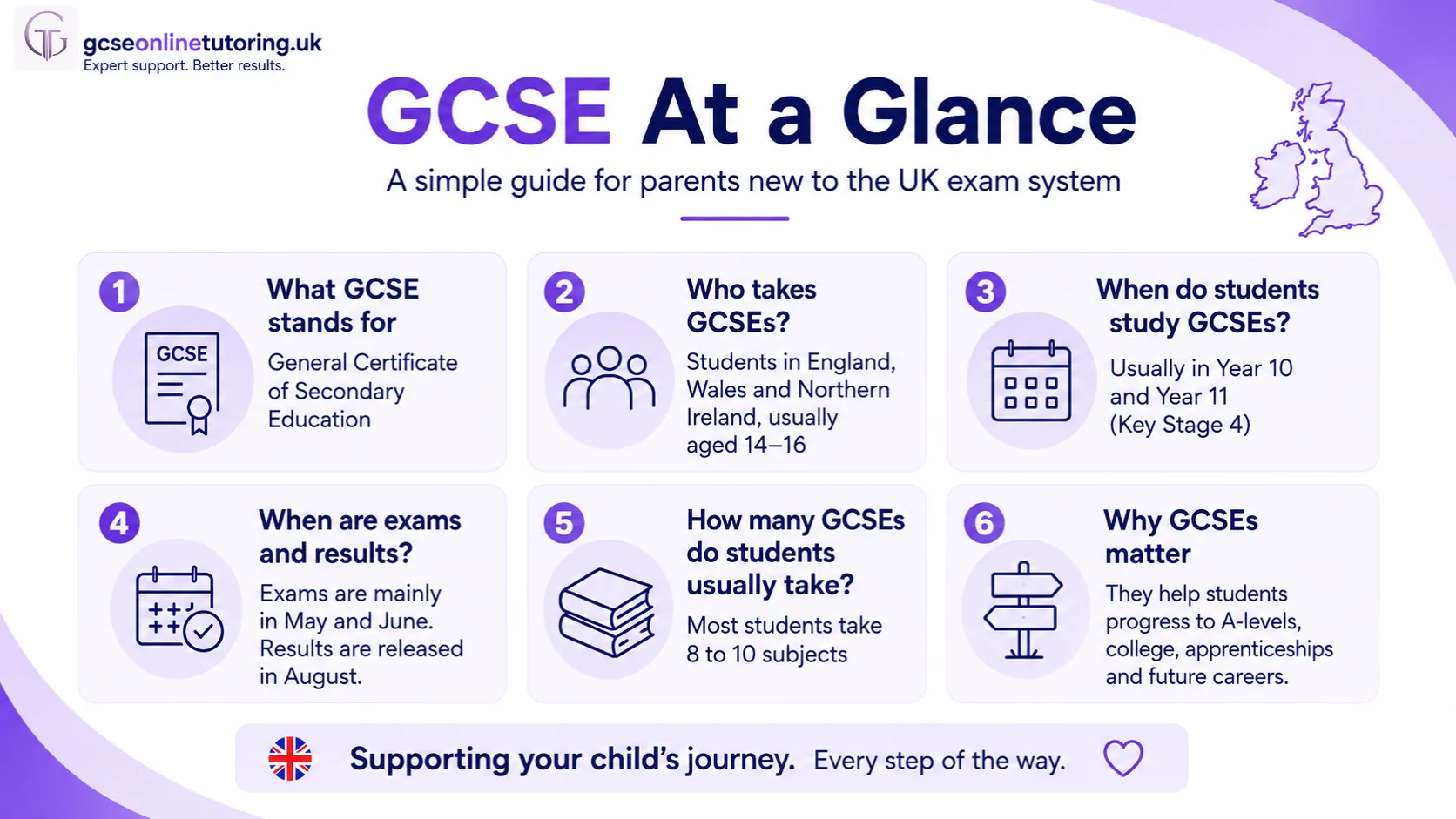
What Does GCSE Stand For? (What is GCSE)
GCSE stands for General Certificate of Secondary Education. Introduced in 1986 to replace the separate O‑Level and CSE qualifications, GCSEs were designed to provide a single, comprehensive measure of academic ability across a broad range of subjects. While the old O‑Level system relied almost solely on final exams, GCSEs combine exams with coursework in some subjects, placing greater emphasis on skills such as analysis, problem‑solving and independent study.
Who Takes GCSEs and When?
The GCSE years correspond to Key Stage 4 of the UK curriculum. Students choose their options in year 9 (around age 13–14) and begin studying GCSE courses in year 10, finishing with examinations at the end of year 11. Most pupils study for two years, although fast‑track courses may compress this into one year. Students in England must remain in some form of education or training until age 18, so after GCSEs they either stay in sixth form to study A‑levels, take vocational courses such as BTEC or T Levels, start an apprenticeship or work part‑time while studying.
Key Points
- Age range: Typically 14–16 (years 10–11).
- Course duration: Usually two years, but accelerated one‑year courses exist.
- Examinations: Predominantly in May and June at the end of year 11, with results released in August.
- Leaving age: Students can leave school at 16 but must continue in education or training until 18.
GCSE Subjects (Core and Options)
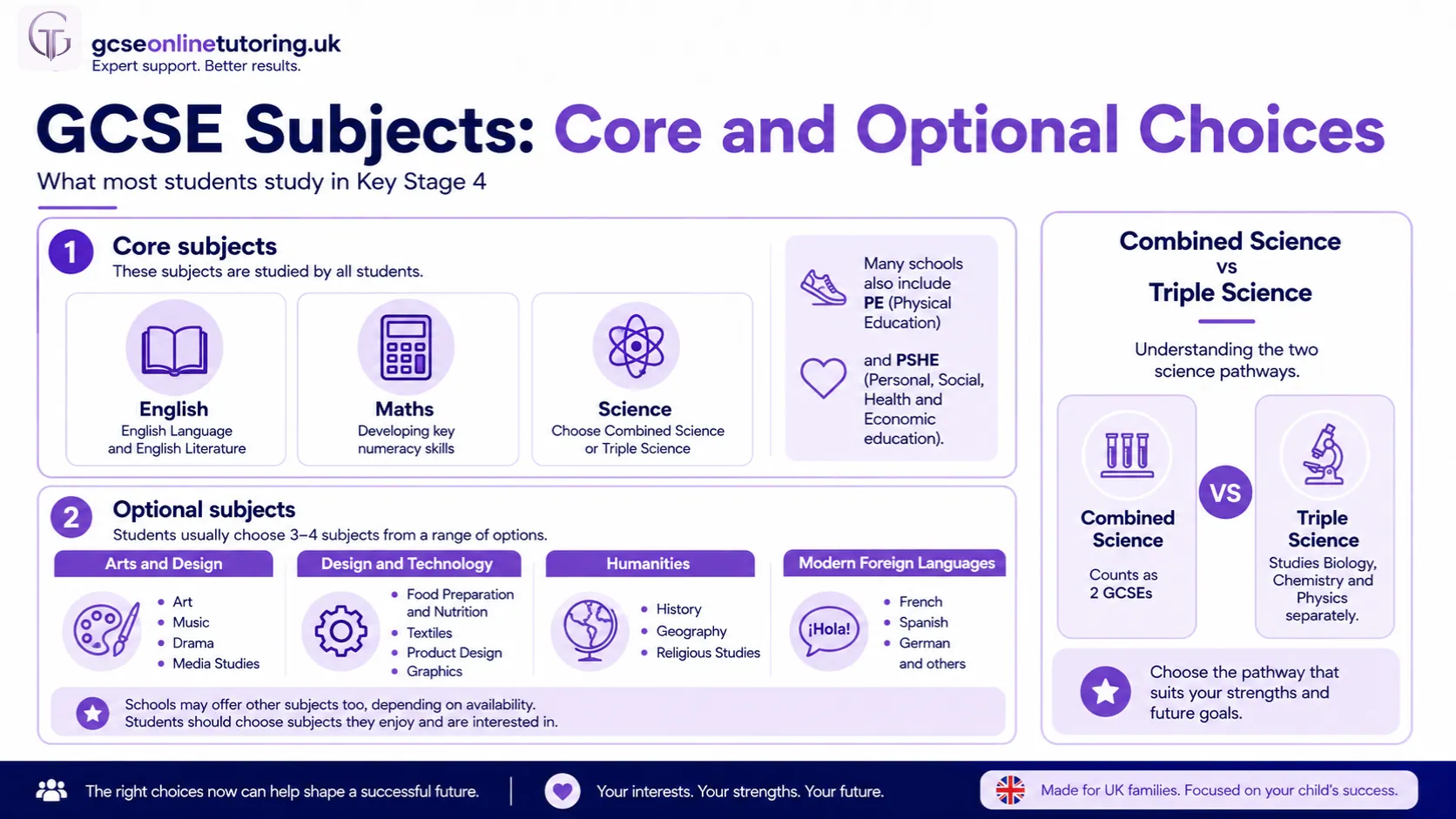
GCSEs offer a broad curriculum designed to give pupils a solid foundation in essential skills while allowing them to explore their interests. GCSE Mathematics, English and Science are compulsory subjects, and most schools also require Physical Education (PE) and Personal, Social, Health and Economic Education (PSHE), though the latter may not involve formal exams. Students then choose additional subjects from four entitlement areas:
- Arts and Design: Art, music, dance, drama and media studies.
- Design and Technology: Electronics, food preparation, graphic design, textiles and product design.
- Humanities: History, geography, religious studies.
- Modern Foreign Languages: French, Spanish, German and others.
Most pupils take between 8 and 10 GCSEs, although independent schools and high‑achieving students may take more, and some may take fewer for special educational needs or vocational programmes. As a tutor, I often advise families to balance interests, strengths and future plans: combine subjects needed for potential A‑level or career routes (for example, triple science for medicine) with subjects that keep doors open (a language or humanities subject). Students should avoid overloading themselves; depth of understanding is more important than quantity.
Combined Science vs Triple Science
When choosing science, students can take GCSE Combined Science, which counts as two GCSEs, or Triple Science, studying Biology, Chemistry and Physics separately. Combined Science suits pupils who want a balanced overview, while Triple Science is recommended for those considering science A‑levels or careers in medicine and engineering. Many parents I work with worry that their child will be disadvantaged by choosing Combined Science, but universities value both; what matters is achieving strong grades and demonstrating interest in the subject.
The GCSE Grading System
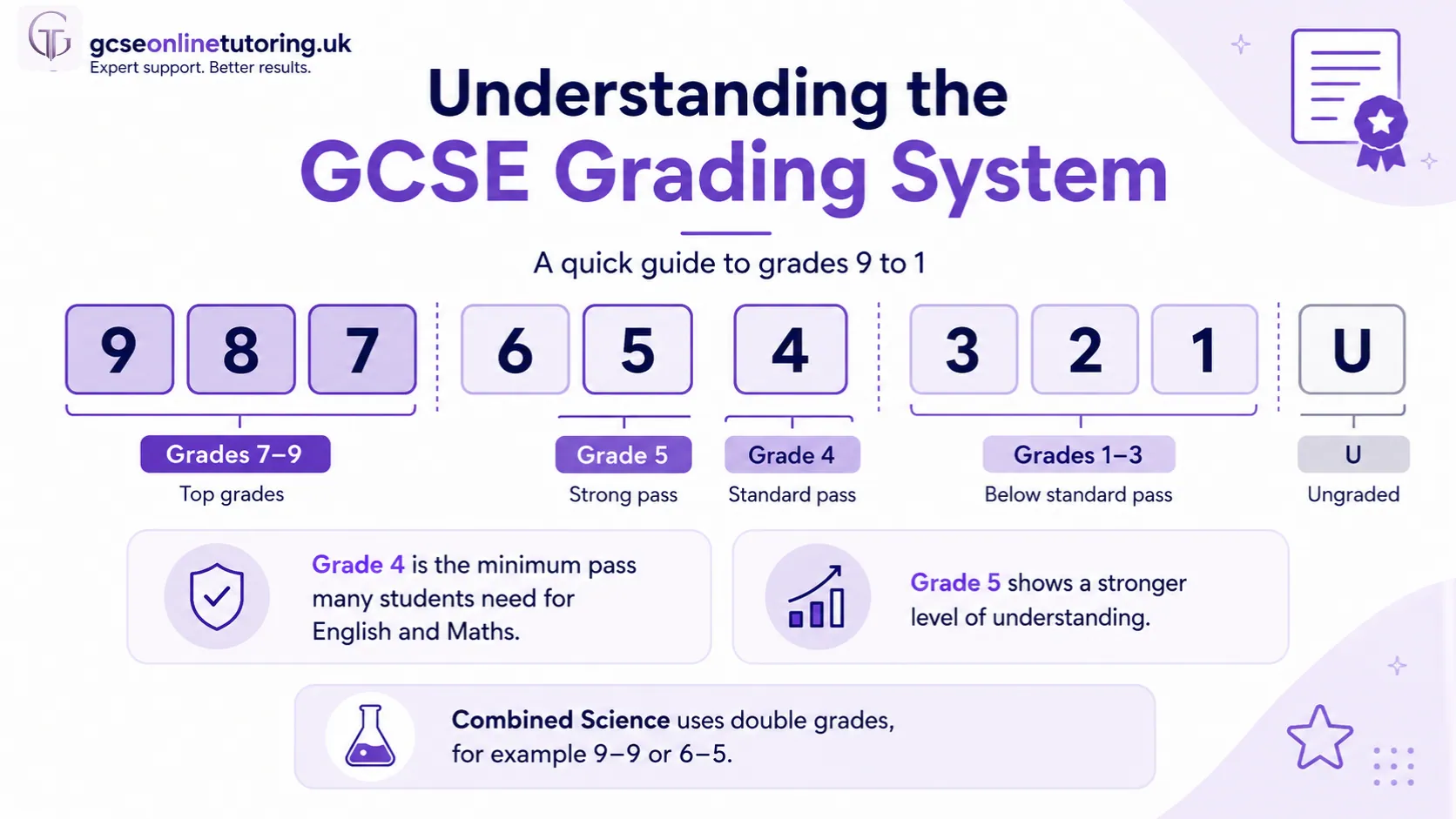
Since 2017, GCSEs in England have been graded on a 9–1 scale, replacing the old A*–G letters. Grade 9 is the highest and is considered higher than the old A*, while grade 1 is the lowest and U stands for “ungraded”. The government’s official comparison shows that the bottom of grade 7 aligns with the bottom of the old grade A, the bottom of grade 4 aligns with the old grade C and the bottom of grade 1 aligns with the old grade G. In combined science, students receive a double grade (for example, 9–9 or 9–8).
Pass Grades: Standard vs Strong
A common question parents ask is “What grade counts as a pass?” There are two types of pass:
- Standard Pass (Grade 4): Equivalent to the old grade C, this is the minimum level required for many apprenticeships and is the threshold that the government uses to judge school performance. Students who achieve a grade 4 in English and maths meet the basic requirement for further study and many jobs.
- Strong Pass (Grade 5): Roughly equivalent to a high C or low B, a strong pass demonstrates a deeper understanding of the subject. Sixth forms and universities often look for grade 5 or higher in core subjects.
Grades 7–9 correspond to the top of the old A and A* and are necessary for competitive courses; grades 1–3 correspond to the old D–G. According to official guidance, students awarded a grade 3 or below in English or maths must be offered support if they continue in further education.
How GCSEs Are Assessed
Most GCSE subjects are linear, meaning students sit their exams at the end of year 11. Some subjects include coursework (also known as non‑exam assessment), such as controlled practicals in science or design projects. Exam boards like AQA, Edexcel and OCR set grade boundaries each year based on the difficulty of the papers and overall performance. This ensures fairness: a particular mark may earn a grade 6 one year and a grade 5 another year if the exam was considered easier or harder.
Why GCSEs Matter
GCSEs form the foundation for post‑16 education. Sixth forms and colleges use GCSE grades to determine whether students are ready for A‑level, IB or BTEC courses; universities use them to assess consistency and academic potential. Many employers request a minimum of grade 4 or 5 in English and maths. From my experience, universities and apprenticeship providers often look beyond the grades themselves. They consider the combination of subjects, evidence of commitment (such as improving grades through resits) and, increasingly, extracurricular activities or work experience. Nevertheless, securing strong GCSE grades makes progression smoother and opens more options.
What Happens If You Don’t Pass?
Not every student achieves the grades they hoped for on results day, and that’s okay. Resits are common and can be taken at school or through online courses. According to the National Careers Service, students on a 16–19 programme who do not have at least a grade 4 in English or maths must continue studying those subjects. GCSE English and maths can be retaken in the autumn, while other subjects are normally retaken the following summer. Functional skills qualifications offer an alternative Level 2 route for older students.
From working with hundreds of students, I have noticed that resits are most effective when accompanied by targeted support. Students should review exam feedback, focus on weak topics and practise under timed conditions. Many find that a structured revision plan and one‑to‑one tutoring help rebuild confidence and ensure they meet or exceed a grade 4 or 5 on the second attempt.
GCSEs for International Students and Families Moving to the UK
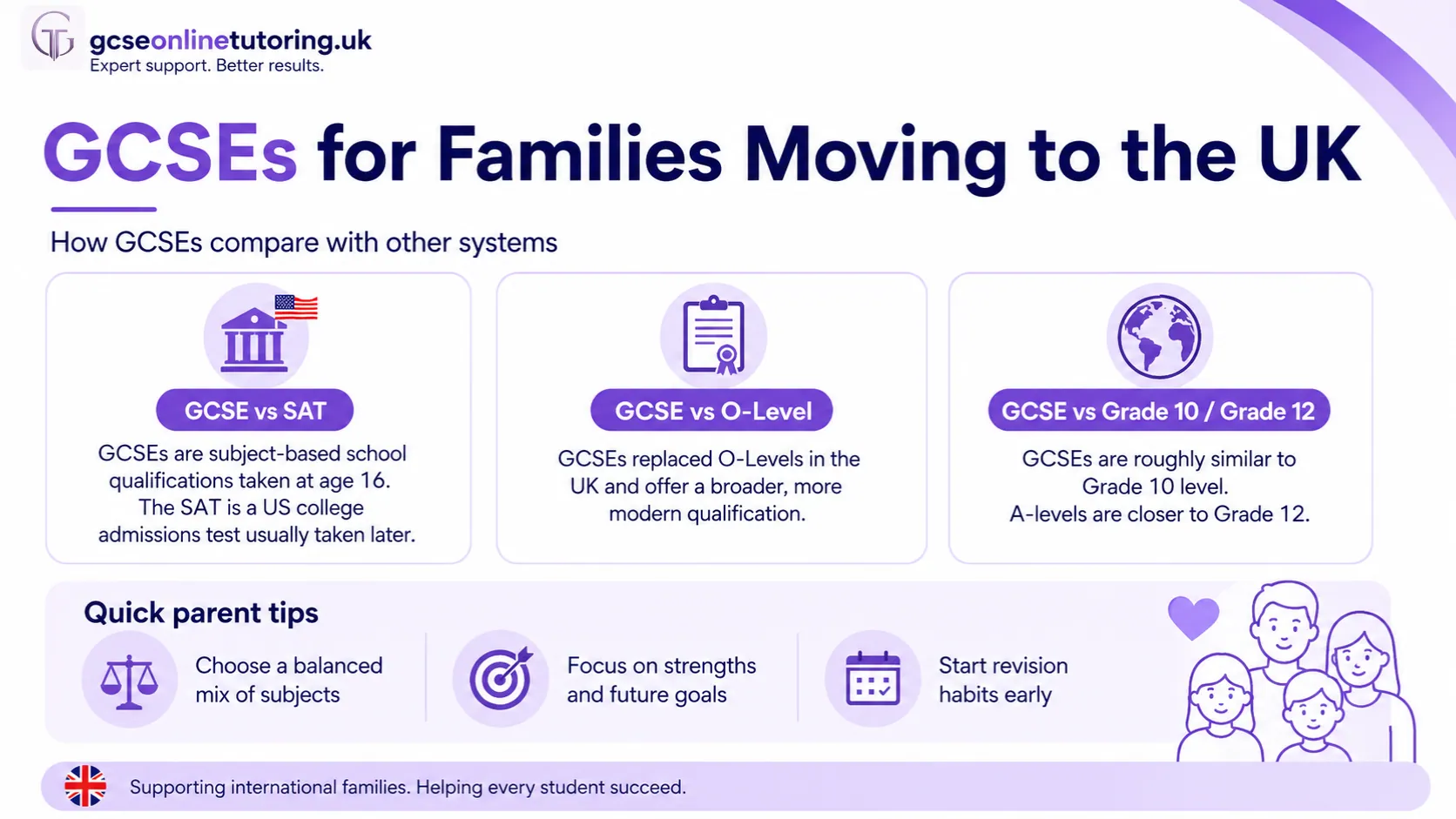
Families relocating to the UK often ask how GCSEs compare with qualifications in their home countries. Here are some key comparisons:
GCSE vs SAT (USA)
The SAT is a standardised test used for university admissions in the United States. According to a Cambridge Assessment comparison, the SAT primarily assesses formal elements of English and mathematics and its content is largely included within the National Curriculum for England.
The level of difficulty is roughly equivalent to level 2 of the UK National Qualifications Framework, which corresponds to higher‑tier GCSEs. However, the SAT is designed as a reasoning test for college admissions and is typically taken by 16‑ to 18‑year‑olds, whereas GCSEs are subject‑specific qualifications taken at 14–16 and are a prerequisite for A‑levels and vocational courses. In short, GCSEs are broader and form part of compulsory education, while SATs are optional and used for university entry in the USA.
GCSE vs O‑Level
Before 1988, UK students took GCE O‑Levels, which were largely exam‑only qualifications. They were replaced by the GCSE to combine the academic rigour of O‑Levels with the wider accessibility of the Certificate of Secondary Education (CSE). The O‑Level’s heavy reliance on final exams often disadvantaged students who performed better in coursework. Today, O‑Levels still exist in some countries (for example, Singapore’s GCE O‑Level) and are similar in difficulty to high‑tier GCSEs. GCSEs, however, offer a more balanced assessment and a single national standard across England, Wales and Northern Ireland.
GCSE vs High School Grade 10/12 (USA and other systems)
In many countries, students complete Grade 10 or Grade 12 examinations that are more akin to GCSEs or A‑levels respectively. GCSEs are taken at age 16, roughly equivalent to Grade 10 or Sophomore year in the US, while A‑levels correspond to Grade 12. GCSEs are more specialised than typical US high school assessments and provide a formal qualification that universities and employers recognise. For families moving from systems where external exams occur only at 18, the GCSE might seem early, but it allows students to narrow their subject choices before specialising further at A‑level.
Choosing GCSE Subjects (Practical Advice for Parents)
When choosing GCSE options, encourage your child to consider three factors:
- Future aspirations: Some careers require specific GCSEs. For example, medicine typically requires triple science and good grades in maths and English. Engineering often demands strong grades in maths and physics. If your child is uncertain, keeping a broad range including a science, a language and a humanities subject – maintains flexibility.
- Interests and strengths: Students perform better in subjects they enjoy. Encourage them to think about what they like and where they excel. This boosts motivation during revision and reduces stress.
- Workload balance: Be realistic about the number of subjects. Ten GCSEs can be manageable, but if your child is involved in sport, music or has additional needs, fewer subjects with a focus on quality may be wiser.
From my experience tutoring GCSE students, one common pattern is that young people underestimate the jump in workload from Key Stage 3 to GCSE. In the first term of year 10, they often feel overwhelmed by the volume of content. Setting up a structured study timetable early, practising past papers regularly, and seeking help when concepts are unclear can make an enormous difference.
How Difficult Are GCSEs?
Parents sometimes ask whether GCSEs are “harder” than other exams. The answer depends on the subject and the student’s strengths. GCSEs are designed to be accessible to the majority of students: foundation tiers are available in subjects like maths, where grades 1–5 can be achieved, and higher tiers allow grades 3–9. Some subjects, however, are widely regarded as challenging. Mathematics and modern languages demand persistent practice; English literature requires critical analysis; while triple sciences involve a wide range of concepts. At the same time, creative subjects like art and drama require time‑intensive coursework.
In my tutoring work, I’ve noticed that organisation and resilience make the biggest difference. Students who create revision cards from the start of year 10, practice retrieval and spacing techniques, and reflect on teacher feedback adapt better. Those who leave revision until spring of year 11 often feel overwhelmed. Encourage your child to start small but consistent study habits early.
Preparing for GCSEs (Tips from a Tutor)
- Build a revision timetable: Plan revision in bite‑sized chunks from the beginning of year 10. Use half‑hour sessions focusing on specific topics and interleave subjects to improve retention.
- Practise past papers: Once content is covered, practise under timed conditions. This helps students understand question styles and improves time management. Past papers are available from exam boards like AQA, Edexcel and OCR.
- Use active techniques: Flashcards, mind maps and teaching others are more effective than passive reading. Encourage your child to explain concepts to you – if they can teach it, they understand it.
- Seek feedback: Teachers and tutors provide valuable insights. Ask for marked mock exam scripts and review what went wrong. Don’t be afraid of mistakes; they guide improvement.
- Look after well‑being: Balanced diet, regular exercise and sleep are vital. Encourage breaks and social time. Stress management techniques such as mindfulness or breathing exercises can help during exam season.
When a GCSE Tutor Can Help
There isn’t a one‑size‑fits‑all answer to tutoring. From experience, I recommend considering additional support if:
- Your child is not on track to achieve the grades required for their chosen sixth‑form course or apprenticeship.
- They struggle with a particular subject despite putting in effort.
- Their confidence is low due to past exam results or weak mock grades.
- Your family’s schedule makes it difficult for you to provide consistent academic support.
A good tutor provides more than subject knowledge: they offer study strategies, exam practice and moral support. At gcseonlinetutoring.uk, our tutors use structured programmes tailored to each student, focusing on core subjects like English, maths and science. We emphasise understanding concepts rather than rote learning and adapt the pace to individual needs. Whether your child needs regular weekly sessions or targeted revision before exams, tutoring can relieve pressure on parents and give students the tools to succeed.
Why GCSEs Matter for Future Paths
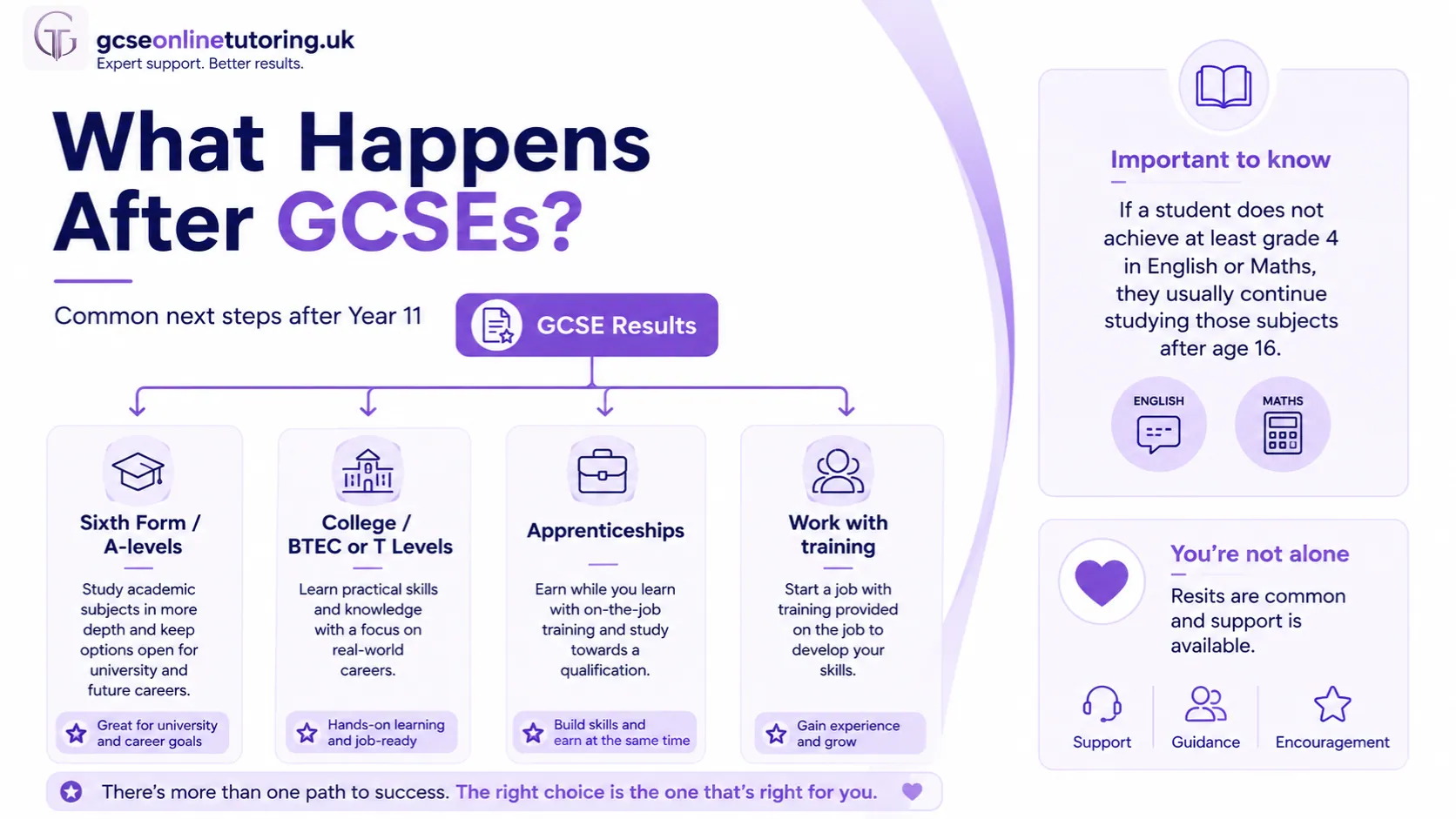
GCSE grades influence which A‑levels or vocational courses students can take and, indirectly, the universities and careers available to them. Many competitive sixth‑form colleges require at least five GCSEs at grade 4 or higher, including English and maths. Elite universities may look for high grades (7–9) in relevant subjects. Apprenticeships and traineeships often require a standard pass in English and maths, and some employers use GCSE grades as a minimum threshold. However, GCSEs are not the sole determinant of success. Resilience, curiosity and extra‑curricular experiences also count. If grades are lower than expected, resits, functional skills courses or alternative qualifications like the International Baccalaureate Middle Years Programme can keep doors open.
Frequently Asked Questions
Is GCSE year 10 and 11?
Yes. GCSE courses typically start in year 10 when students are aged 14–15 and examinations are taken at the end of year 11. Some schools may begin certain subjects in year 9, but the formal GCSE programme covers years 10 and 11.
Is GCSE like the SAT?
Not exactly. The SAT is a standardised test taken by US students aged 16–18 for university admissions, focusing mainly on mathematics and English reasoning. A Cambridge Assessment study notes that the SAT assesses content largely contained within the National Curriculum and is roughly equivalent to the difficulty of higher‑tier GCSEs. However, GCSEs are subject‑specific qualifications taken by UK students aged 14–16 and are part of compulsory education, whereas the SAT is optional and taken later.
Is GCSE grade 10 or grade 12?
GCSEs correspond to grade 10 (sophomore year) in the US system, as they are taken at age 16. A‑levels, taken at age 18, correspond more closely to grade 12.
What is a GCSE exam?
A GCSE exam is an assessment at the end of a two‑year course during Key Stage 4. Most subjects are assessed through written exams in May and June of year 11; some include practical or coursework components.
Is GCSE hard or easy?
GCSEs are designed to be accessible with different tiers for varying abilities. Difficulty depends on the subject and the student’s preparation. Subjects like mathematics, modern languages and triple science can be challenging, but consistent study and support make them manageable.
Is grade 7 a pass in GCSE?
Grade 7 is a high grade, equivalent to the bottom of the old grade A. It is well above the pass threshold (grade 4). Grade 4 is a standard pass and grade 5 is a strong pass.
What happens if I fail a GCSE?
You can resit GCSEs. According to the National Careers Service, students on a 16–19 programme who have not achieved grade 4 in English or maths must continue studying those subjects. GCSE English and maths can be retaken in the autumn, while other subjects can be retaken during the following exam period. Functional skills courses are an alternative Level 2 qualification.
What age do students take GCSEs?
Students typically take GCSEs at 14–16 years old (years 10–11). Adults can also study GCSEs through evening classes or online courses.
How many GCSEs do students usually take?
Most students take eight to ten GCSEs, including core subjects (English, maths, science) and optional subjects from the arts, humanities, languages or technology. The number can vary depending on the school and student.
Do GCSEs matter for university?
Yes. Universities often look at GCSE grades, particularly in English and maths, as evidence of foundational skills. Competitive courses may set minimum GCSE grade requirements, and strong GCSE results can strengthen an application.
Can you resit GCSEs?
Yes. Resits are common, especially in English and maths. Students can retake English and maths in the autumn following results day and other subjects the following summer. Many schools and colleges offer support programmes for resits.
Conclusion
The GCSE is a pivotal stage in a young person’s education in the UK. Understanding what GCSEs entail from subject choices and the grading system to their role in future education, helps parents guide their children with confidence. While the process can seem daunting, preparation and support make a significant difference. As a tutor, I’ve seen students grow in resilience, discover new passions, and open doors to careers they never considered. With the right guidance and a positive mindset, GCSEs become not just an exam, but a stepping stone to a world of possibilities.
If your child is entering Year 10 or struggling with GCSE English, maths or science, expert one‑to‑one tutoring can make the journey smoother. Our tutors at gcseonlinetutoring.uk provide personalised support, helping students build confidence and achieve their target grades. Contact us to discuss how we can support your child through their GCSEs.
Need GCSE Support?
Get one-to-one online GCSE tutoring for Maths, English, Science and other GCSE subjects from home.