
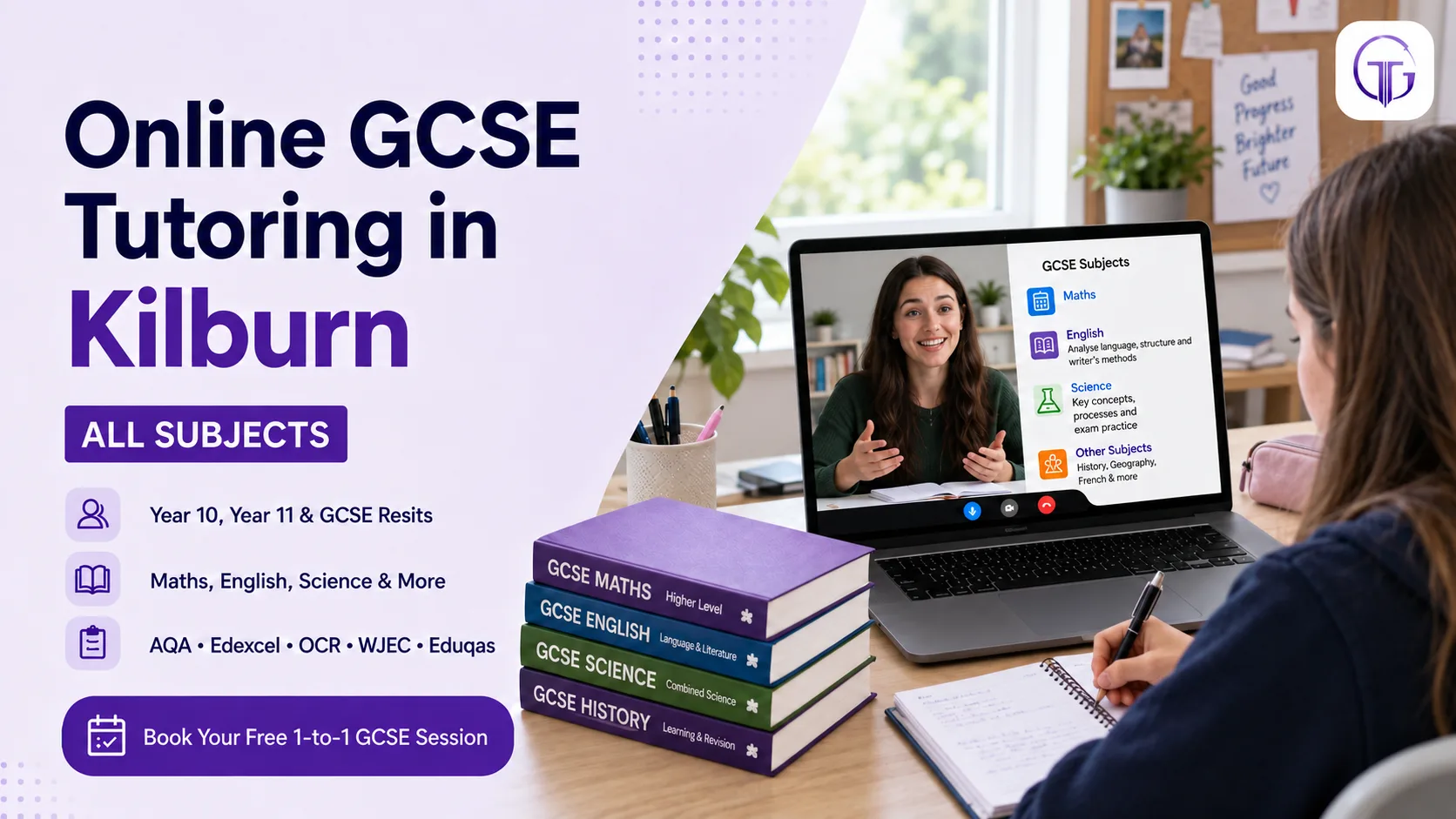
Online GCSE Tutoring in Kilburn
One-to-one lessons for Year 10, Year 11 and resit students, £30 per lesson
Online GCSE tutoring in Kilburn across every subject we teach. Parents in NW6 sometimes open an enquiry by apologising for the fact that English is not the language spoken at home, as though it were a diagnosis. It is not one, and treating it as one leads to the wrong help being bought.
A student who speaks Somali, Portuguese or Arabic at home may be more fluent in English than half their class. Where difficulty does appear it is usually narrow and specific, and that is good news, because narrow and specific is what one-to-one teaching is for.
The first session is free and it is a real lesson. Bring a piece of marked English work to it.
What Kilburn families ask
- Whether the home language is the problem.
- What the EAL label on a report means.
- Why unseen texts are harder than set texts.
- Whether to switch to English at home.
- Which council covers this side of the road.
What does the EAL label on a report actually mean?
Considerably less than most families assume, and the department that collects the data says so itself.
A pupil is recorded as having English as an additional language if they are exposed to a language at home believed to be other than English. That is the whole definition. The Department for Education states plainly that the measure is not a measure of English language proficiency and not a good proxy for recent immigration.
It is also extremely common. In 2025/26, 19.3 per cent of pupils in state-funded secondary schools in England were recorded as EAL, alongside 23.8 per cent in primary schools. In parts of north west London the proportion is a great deal higher than the national figure, and it includes a very large number of students born here who have spoken English since nursery.
The reason this matters practically is that the label attracts the wrong intervention. A student flagged as EAL who is fluent does not need English language support; they may need exactly what every other student in the set needs, which is help with analysis or structure. Buying language support for an analysis problem wastes a year.
The useful question is never what language is spoken at home. It is which specific marks are being lost, and on what kind of question.
Two different problems
| Looks like | Actually needs |
|---|---|
| Fluent, weak essays | Analysis and structure |
| Strong ideas, awkward phrasing | Written register, not language |
| Misreads unseen texts | Idiom and inference practice |
| New to English this year | Genuine language support |
| Fine in Maths, weak in English | Neither. Look at the papers |
Where does difficulty genuinely show up?
In three fairly predictable places, none of which is general fluency, and all of which respond to targeted work.
The first is idiom in unseen material. English Language papers put a text in front of a student that nobody has prepared them for, and unseen writing is thick with expressions that cannot be worked out from their parts. A student who reads every word correctly and still misses the tone of a passage is meeting idiom, not vocabulary, and it is learnable in a way that feels unfair until someone teaches it directly.
The second is cultural reference, which lands hardest in English Literature. A nineteenth century novel assumes a great deal about class, religion and social convention that is not explained in the text and is not obvious to anyone who has not absorbed it in passing. This is not a language gap and it is not confined to multilingual households, but it shows up there more.
The third is the vocabulary of instruction rather than the vocabulary of the subject. Words like justify, to what extent, and comment on are doing precise work in a question, and a student who reads them loosely answers a slightly different question. That single fix moves marks in every subject at once.
Our East Finchley page covers those command words in more detail, including how the same fix carries into science and humanities.
What we work on
- Idiom and inference in unseen passages.
- The assumed background in nineteenth century texts.
- Command words, read precisely.
- Written register, which is nobody’s first language.
- Analysis and structure, which most students need.
Should the family switch to English at home?
No, and this comes up often enough to be worth answering directly rather than politely.
Families sometimes decide, usually around Year 10, that speaking English at home will help. It is a well-meant decision with a real cost. The home language is often the one in which a student can express complicated things, argue, and be understood by grandparents, and trading that for a marginal gain in exam English is a poor bargain.
It is also unlikely to produce the gain. By Year 10 a student educated in England has had a decade of English at school, six hours a day. The marginal effect of adding it at the dinner table is small compared with what is already there, and strong literacy in a first language tends to support rather than compete with the second.
What does help is reading in English, widely and for pleasure, which is a different request. So is talking about a set text in whichever language the conversation flows best in, because understanding a novel is not a language exercise. A student who has argued about the ending of a book in Arabic understands the book.
Practical, and free
- Read in English for pleasure, at any level.
- Discuss the set text in whichever language works.
- Keep the home language, fully.
- Get the text read once before the class does.
- Ask the school which reading support already exists.
Which GCSE subjects can your child get help with?
All of them, with the tutor chosen for the subject rather than for convenience.
English Language
Unseen texts, idiom and structured writing under time. See GCSE English tutoring.
English Literature
Set texts, and the background a novel assumes you already have. See GCSE English tutoring.
Maths
Both tiers, and worth checking before assuming English is the issue. See GCSE Maths tutoring.
Combined and Triple Science
Three strands with a specialist each. See GCSE Science tutoring.
Computer Science
Programming and the written papers. See GCSE Computer Science tutoring.
Business Studies
Case study reading, which rewards precise instruction words. See GCSE Business Studies tutoring.
What about resitting English Language?
The most commonly resat subject in the country, and one where technique moves marks faster than knowledge does.
English Language has very little content to learn, which disorients students who expect revision to look like memorising. What it has instead is a set of tasks done to time, and those improve with marked practice rather than with reading.
The 16 to 19 maths and English condition of funding, updated in July 2026, requires the subject to continue after Year 11 where grade 4 was missed. A grade 3 points to a GCSE entry; grade 2 or below allows Functional Skills level 2 instead.
English Literature is a separate GCSE and is not covered by those rules, so before committing to a Literature retake it is worth checking whether the destination actually asks for it.
Two English GCSEs
- Language: November or the summer series.
- Literature: summer only.
- The funding rules concern Language.
- The centre controls both entries.
See GCSE resit tutoring and the exam dates page.
How does an online lesson run?
A video call with a shared whiteboard, and the student working on paper alongside.
Send a piece of marked writing
It answers most of the questions above.
Free one-to-one session
A real lesson, no card details taken.
Identify which of the three it is
Idiom, background, or instruction words.
Weekly work with marked practice
Written to time, marked properly.
Reviewed at six weeks
Against the marks, not the fluency.
The full process is on how it works. Kilburn straddles a borough boundary, so check whether your school follows Brent or Camden’s term dates; the gov.uk term dates finder will point you at the right council.
What does a GCSE tutor in Kilburn cost?
£30 a lesson, one to one, with no separate rate for English support.
There is no premium for English and no separate language-support tariff, because in most cases the work is ordinary GCSE English teaching.
Ask for the length of the lesson, not just the hourly figure. Our guide to GCSE tutoring costs sets out the market.
What £30 covers
- A full one-to-one lesson with a subject specialist.
- Written work marked against the real scheme.
- An honest read on whether language is the issue at all.
- Practice with unseen texts under time.
- A tutor change if the match is wrong.
Tell us which marks are being lost
A marked piece of writing tells us more than any description could. We reply during the day.
- Year group and subject.
- Which questions lose the most marks.
- Whether it is set texts or unseen material.
- Current grade and target grade.
- Days and times that work at home.
Prefer to talk it through? WhatsApp us, or use the contact page.
Send an enquiry
Frequently asked questions
Does speaking another language at home hold a student back in GCSE English?
Not by itself, and the assumption that it does causes real harm. Many students who speak another language at home are entirely fluent in English and need nothing beyond what any other student needs.
What does the EAL label actually mean then?
Only that a language other than English is used at home. The Department for Education is explicit that it is not a measure of English proficiency and not a good proxy for recent arrival.
How common is it?
Very. In 2025/26, 19.3 per cent of pupils in state-funded secondary schools in England were recorded as having English as an additional language, and the figure is far higher in parts of north west London.
Where do problems actually show up?
Usually in a narrow place: idiom in unseen texts, cultural reference in nineteenth century novels, and the vocabulary of instruction rather than the vocabulary of the subject. Those are teachable and specific.
Should we speak more English at home?
There is no need to, and switching a family language for exam reasons is a large cost for an unclear benefit. Strong literacy in a first language supports rather than competes with the second.
Which GCSE subjects do you cover?
Both English GCSEs and Maths, science as Combined or Triple, plus Computer Science and Business Studies. English Language is the one we are asked for most in NW6.
What does it cost?
£30 a lesson, one to one, whichever subject and whichever language is spoken at home.
Do you have a tuition centre in Kilburn?
No. Every lesson is online. The company is registered in Feltham, not in NW6.
Book a free GCSE session for your child in Kilburn
One free one-to-one session, no card details and no obligation. If the honest answer is that the home language has nothing to do with it, the tutor will say so and tell you what is actually costing the marks.