
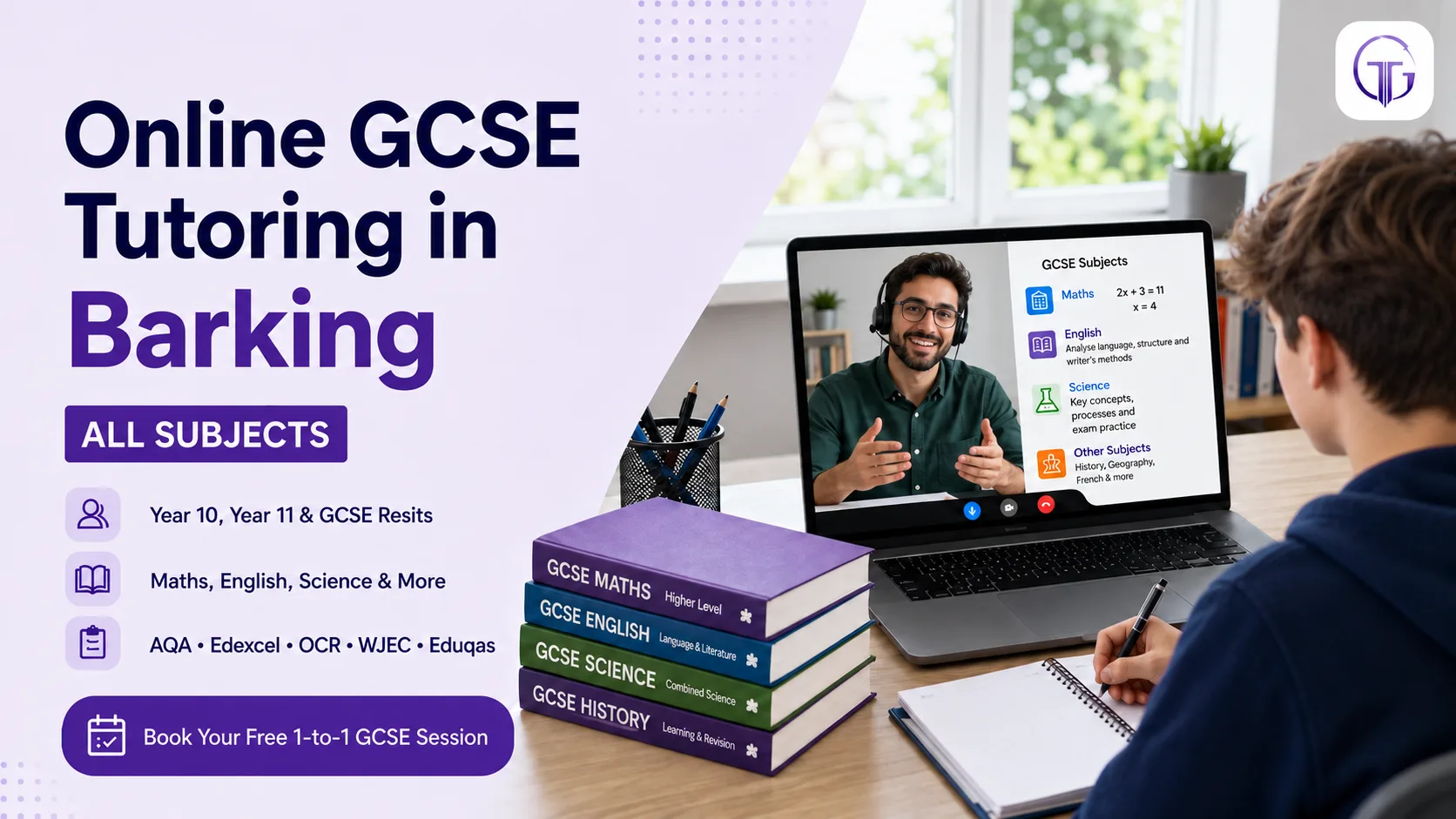
Online GCSE Tutoring in Barking
One-to-one lessons for Year 10, Year 11 and resit students, £30 per lesson
Online GCSE tutoring in Barking for the full range of subjects. Every so often a school offers a strong maths student something extra, a GCSE in Statistics or a Further Maths certificate, and the family has a week to decide whether to say yes.
It sounds like an easy yes. Sometimes it is. Sometimes it quietly takes the time a student needed to turn a 6 into a 7 in a subject that matters more.
This page explains what those two qualifications actually are, who they genuinely help, and the questions to ask before taking one on. The first session is free.
What Barking parents ask
- What GCSE Statistics involves.
- What Level 2 Further Maths is.
- Whether sixth forms care.
- How much extra work it means.
- Whether it is worth it for my child.
What does GCSE Statistics involve?
A full GCSE built around investigating questions with data, rather than a smaller version of Maths.
The Department for Education published the GCSE Statistics subject content in 2016, for teaching from 2017. It is organised around the statistical enquiry cycle: planning an investigation, collecting data, processing and presenting it, interpreting the results and evaluating the whole process.
There is some overlap with GCSE Maths, particularly in averages, charts and probability, but the department notes that most of the content is unique to Statistics. Higher tier includes ideas like Spearman’s rank correlation that never appear on a maths paper.
The bigger difference is the style of question. Statistics asks students to interpret, criticise and justify in writing far more than Maths does. A student who is quick with methods but dislikes explaining themselves can find it harder than expected.
GCSE Statistics against GCSE Maths
| Statistics | Maths | |
|---|---|---|
| Organised around | The enquiry cycle | Content areas |
| Written interpretation | Frequent | Occasional |
| Algebra and geometry | Little | Substantial |
| Tiers | Foundation and Higher | Foundation and Higher |
Based on the Department for Education subject content for each GCSE.
What is Level 2 Further Maths?
A qualification for students already secure at the top of GCSE Maths, designed to stretch them towards A-level.
The best known is AQA’s Level 2 Certificate in Further Mathematics. It is not a GCSE, but it sits at the same level and covers material beyond the GCSE course: more demanding algebra, coordinate geometry, an introduction to calculus and matrices.
For a student heading for A-level Maths, and especially Further Maths, it is genuinely useful. The first term of A-level leans hard on algebraic fluency, and students who have met calculus once already tend to find the transition far smoother.
For a student who is not yet secure at grade 7 or above in GCSE Maths, it is usually the wrong priority. The extra time is better spent making the GCSE grade safe.
Which A-levels punish rusty GCSE skills in September is covered on our Southgate page.
Who it suits
- Secure at grade 7 or above in Maths.
- Planning A-level Maths or Further Maths.
- Comfortable with algebra under pressure.
- Has time without squeezing other subjects.
- Enjoys maths for its own sake.
Is an extra qualification worth it?
Only when it builds something the student will use next, and only when the core grades are already safe.
Sixth forms and colleges mostly look at a short list: English, Maths, and the subjects the student wants to study. An additional GCSE rarely changes an offer on its own. What it can do is prepare a student for what comes next, which is the reason to take it.
The cost is time. Every hour spent on an extra qualification comes from somewhere, and for most students the most valuable hour in Year 11 is the one spent on their weakest core subject. A 9 in Statistics alongside a 5 in English is usually a worse result than an 8 in Statistics and a 6 in English.
So the honest test is three questions. Are the core grades safe? Does this qualification lead somewhere the student actually wants to go? And can it be done without squeezing something more important?
Barking students attend schools from Barking Abbey and Eastbury to Riverside, and not all of them offer Statistics or Further Maths. Where the school does not, a private entry is possible but means preparing largely alone.
Before saying yes
Check the core grades
English and Maths first.
Ask where it leads
A-level Maths, science, economics?
Ask how it is taught
In lessons, after school or alone?
Estimate the hours
Weekly, honestly.
Decide what gives way
Something always does.
Which GCSE subjects can your child get help with?
Statistics and Further Maths sit with our maths tutors, alongside everything else.
Maths, Statistics and Further Maths
Every level. See GCSE Maths tutoring.
English Language and Literature
Both GCSEs. See GCSE English tutoring.
Combined and Triple Science
Specialists for each. See GCSE Science tutoring.
Computer Science
Including data handling. See GCSE Computer Science tutoring.
Business Studies
With its own calculations. See GCSE Business Studies tutoring.
History, Geography and RS
When a specialist is available.
What about resit students in Barking?
Barking and Dagenham College is the usual route, and the resit rules come with the enrolment.
A student who does not reach grade 4 in English or Maths by 16 keeps studying it. The 16 to 19 maths and English condition of funding sets the terms: a grade 3 leads back to the GCSE, and grade 2 or below permits Functional Skills level 2.
For a resit student, an extra qualification is almost never the right move. The full focus belongs on the one grade that unlocks the next step.
For resit students
- The college makes the entry.
- November covers Maths and English Language.
- Focus on the grade that matters.
- Evening lessons fit around college.
See GCSE resit tutoring and the exam dates page.
How does an online lesson run?
On video with a shared whiteboard, with the first session used to judge whether extra maths is wise.
Free first session
An honest view on readiness.
Core grades checked
Before anything extra.
Weekly lesson agreed
At a time that works.
Practice set between lessons
Statistics, Further Maths or both.
Past papers in the final term
Timed and reviewed.
See how it works for the full process. Barking and Dagenham publishes its school term dates and planned closures, and asks families to confirm final dates with their own school.
What does a GCSE tutor in Barking cost?
£30 for a one-to-one lesson, the same for Statistics, Further Maths and everything else.
If we think an extra qualification is the wrong use of a student’s time, we will say so in the first session, even though it would mean more lessons for us.
Our GCSE tutoring cost guide explains typical rates, and our comparison of online and in-person tutoring covers which suits which student.
What £30 covers
- A full lesson with a maths specialist.
- Honest advice on whether to take it on.
- Practice marked between lessons.
- No registration fee.
- A tutor change if the fit is wrong.
Tell us what the school has offered
And how the student is doing in Maths and English now.
- Year group.
- The extra qualification on offer.
- Current Maths and English grades.
- Plans after GCSEs.
- Days and times that work.
Rather message? WhatsApp us or use the contact page.
Send an enquiry
Frequently asked questions
What is GCSE Statistics?
A separate GCSE built around the statistical enquiry cycle: planning an investigation, collecting and presenting data, analysing it and drawing conclusions. It overlaps with GCSE Maths, but most of the content is its own.
Is GCSE Statistics easier than GCSE Maths?
It is narrower rather than easier. The calculations are more limited, but the papers ask for interpretation and written judgement that Maths rarely does, which suits some students and frustrates others.
What is the Level 2 Further Maths qualification?
A qualification offered by AQA for strong mathematicians, covering algebra, coordinate geometry, calculus basics and matrices beyond GCSE. It is not a GCSE, but sixth forms recognise it as preparation for A-level Maths.
Will an extra GCSE help with sixth form applications?
Rarely by itself. Sixth forms mostly look at the grades in the subjects they ask for. An extra qualification helps when it builds a skill the student will need next, and hurts when it takes time from the core subjects.
Can my child take one of these if the school does not offer it?
Sometimes, as a private candidate or if the school agrees to enter them. It depends on the centre, and it means preparing largely outside lessons.
Do you tutor GCSE Statistics?
Yes, through our maths tutors, along with Further Maths preparation for strong Higher students.
How much do lessons cost?
£30 a lesson, one to one, for any of these qualifications.
Is there a Barking office?
No. Every lesson is online, and the business is registered in Feltham rather than IG11.
Book a free GCSE session for your child in Barking
One free one-to-one session, no card details and no obligation. If the decision is whether to take on extra maths, we will help you make it with the evidence in front of you.