
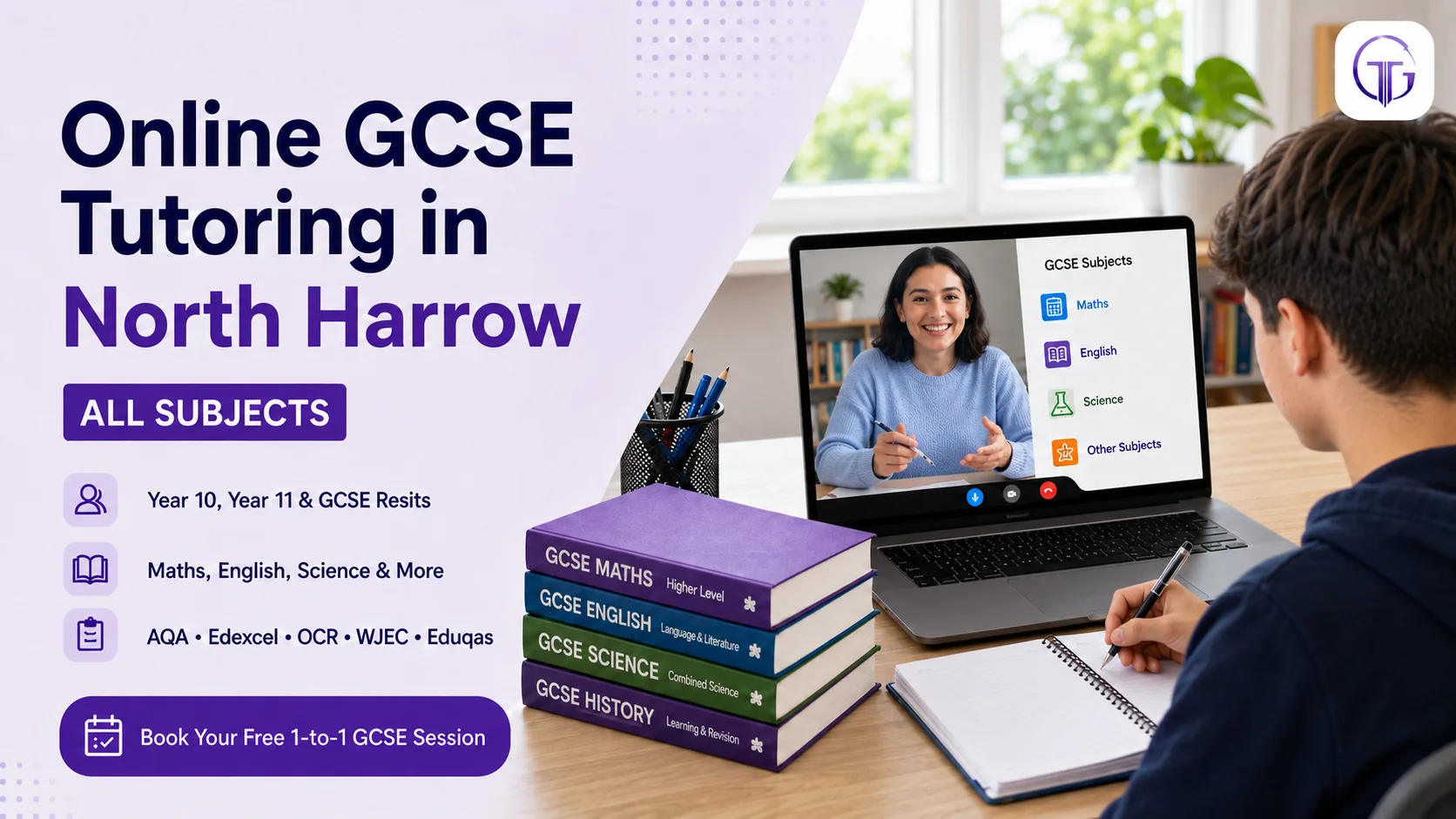
Online GCSE Tutoring in North Harrow
One-to-one lessons for Year 10, Year 11 and resit students, £30 per lesson
Online GCSE tutoring in North Harrow across every subject we teach. Families here usually arrive having already tried the school route, come away from a parents’ evening with five minutes per subject, and no clearer idea of what to do on Saturday morning.
A tutor working in parallel with the school, rather than alongside it in ignorance, is worth considerably more. This page is about closing that gap: which questions get useful answers, what the school data can and cannot tell you now, and how homework actually fits.
The first session is free and it is a real lesson. Bring whatever the school last sent home.
What North Harrow parents raise
- Getting something useful out of parents’ evening.
- Reading a school report that says very little.
- Whether to tell the school about a tutor.
- How much homework is the right amount.
- Who to contact when a subject slips.
How do you get five minutes to be worth something?
By arriving with one question per subject rather than an open invitation to summarise a term.
An open question gets a general answer, because a teacher with fourteen appointments cannot do anything else. "How is she getting on?" produces a version of "fine, could apply herself more", which is true of most fifteen year olds and useless to act on.
A narrow question produces something you can use on Saturday. What would move this grade by one? Which topic did she score worst on in the last assessment? Is she on the right tier? Is the current grade based on a mock, a class test, or a professional guess? Each of those has a real answer and takes under a minute.
The most valuable one is usually the first. Teachers know exactly which two or three things are holding a particular student back, and are rarely asked to say so in that form. Ask it in every subject and you leave with a list rather than an impression.
The Education Endowment Foundation rates parental engagement as a moderate benefit at very low cost across an extensive evidence base, while being honest that engagement schemes are hard to run well. Asking better questions costs nothing and skips the hard part.
Five questions, one per subject
- What would move this grade by one?
- Which topic lost the most marks last time?
- Is my child on the right tier?
- Is that grade from a mock or an estimate?
- What should we do at home that would help?
Write down the answers. By the fourth subject you will not remember the first.
Why has the progress measure disappeared?
Because there is nothing to measure progress from, and that is a genuine gap rather than an oversight by the school.
Progress 8 compared a student’s GCSE results against the results of students who started secondary school at the same Key Stage 2 level. It needed that starting point to work. The primary tests for the cohorts now sitting GCSEs were cancelled during the pandemic, so the starting point does not exist.
The Department for Education states plainly in its Key Stage 4 performance statistics that it is not possible to calculate Progress 8 for 2024/25 or 2025/26. Schools are not withholding it and league tables cannot show it.
For a parent this matters less than it sounds, because a school-level progress score never told you much about one child. What replaces it is more useful anyway: attainment figures for the school, and specific information about your own child from the people teaching them.
The related trap is treating a target grade as a prediction. Our Balham page sets out where each number comes from and why the two so often disagree.
What is still published
- Attainment 8, the average across eight subjects.
- The share reaching grade 5 in English and maths.
- The share entered for the English Baccalaureate.
- Destination data for where students went next.
- No Progress 8 for 2024/25 or 2025/26.
How much homework is the right amount?
Enough that the practice happens, and structured enough that it is not just occupying an evening. The evidence here is weaker than the confidence with which it is usually quoted.
The Education Endowment Foundation puts homework at around five months of additional progress on average, and notes the effect is larger in secondary schools than in primary. It also rates the security of that evidence as low, with a relatively small number of studies behind it. Both halves of that deserve saying.
What the research does suggest is that quality beats quantity. Homework tied directly to what was taught that week, with feedback afterwards, does more than a large volume of unrelated exercises. Three well-chosen questions marked properly beat twenty that nobody looks at.
The common North Harrow version of this problem is not too little homework but no visibility of it. Work is set on the school platform, the student does not mention it, and by the time it surfaces on a report the term has gone. Checking the platform weekly takes two minutes and removes the argument entirely.
A workable weekly routine
Check the platform, not the child
Two minutes, once a week.
Ask what was marked
Not what was set. Different question.
Keep the marked work
It is the raw material for any tutor.
Pick one subject at a time
Three at once fixes none of them.
Which GCSE subjects can your child get help with?
All of the below, matched to the exam board the school actually uses.
Maths
Both tiers, taught in step with the school scheme of work. See GCSE Maths tutoring.
English Language and Literature
The set texts the school chose, not a generic version. See GCSE English tutoring.
Combined and Triple Science
Biology, Chemistry and Physics with a specialist each. See GCSE Science tutoring.
Computer Science
Programming and the written papers. See GCSE Computer Science tutoring.
Business Studies
Case studies, calculation and evaluation. See GCSE Business Studies tutoring.
Humanities
History, Geography and Religious Studies, where a specialist has room.
And if Year 11 has already finished?
The same principle applies with a different institution: find out what the college is actually teaching before paying anyone to teach something else.
Resit classes at college vary enormously in pace and quality, and a tutor who knows what happens in that class every Tuesday is far more useful than one working from a generic scheme.
The 16 to 19 maths and English condition of funding, updated in July 2026, requires students without grade 4 in maths or English to keep studying the subject. Grade 3 leads to a GCSE; grade 2 or below allows Functional Skills level 2.
Ask the college the same narrow questions you would ask a school. What would move this by one grade, and which topic is costing the most marks.
Two entry points
- November for Maths and English Language.
- Around ten weeks after results.
- Everything else in the summer series.
- The college controls the entry.
See GCSE resit tutoring and the exam dates page.
How does an online lesson run?
Video, a shared whiteboard, and paper at the student’s end, with the tutor reading the working as it appears.
Send us what the school said
A report, a marked paper, or five notes from parents’ evening.
Free one-to-one session
A real lesson, no card details taken.
Lessons pointed at the school’s topic
Not a parallel syllabus running alongside.
A short note after each lesson
So the same message reaches everyone.
Reviewed at six weeks
Against marked work.
The full process is on how it works. Harrow publishes term dates for community schools, with academies and voluntary aided schools setting their own.
What does a GCSE tutor in North Harrow cost?
A single price of £30 a session, one to one, with nothing added on top.
No registration fee, no materials charge, and no difference between subjects or year groups.
Two quotes are only comparable once both lesson lengths are on the table. Our guide to GCSE tutoring costs sets out the going rate across the market.
What £30 covers
- A full one-to-one lesson with a subject specialist.
- Work aimed at what the school is teaching now.
- A short written note home after the lesson.
- Planning against the school’s exam board.
- A tutor change if the match is wrong.
Tell us what the school has told you
Even a vague report is a useful starting point. We reply during the day.
- Year group and subject.
- What the last report or parents’ evening said.
- Current grade and target grade.
- The exam board, if you know it.
- Days and times that work at home.
Prefer to talk it through? WhatsApp us, or use the contact page.
Send an enquiry
Frequently asked questions
What should I actually ask at parents’ evening?
Ask what would move the grade by one, and ask it subject by subject. Five minutes per teacher does not allow a general discussion, and a specific question gets a specific answer that you can act on the same week.
Why does the school report not show a Progress 8 figure any more?
Because it cannot be calculated. The Department for Education has confirmed that Progress 8 is not available for 2024/25 or 2025/26, since the Key Stage 2 tests those cohorts would have sat were cancelled during the pandemic.
So how do we judge whether the school is doing well?
On attainment measures, on what the department tells you about your own child, and on the marked work coming home. A single school-level number was always a poor proxy for one student anyway.
Should I tell the school we have hired a tutor?
Yes, and most teachers respond well to it. A department that knows a student has weekly one-to-one support can point it at the right topic, which is worth more than the tutor guessing.
How much homework should there actually be?
Enough to practise, not so much that nothing gets done properly. The evidence puts homework at a moderate benefit that is larger in secondary than primary, though the research base behind it is thinner than most people assume.
What if my child says there is never any homework?
Check the school’s online platform rather than relying on the answer. In most cases the work is set and recorded there, and the gap is between what was set and what was seen.
Which GCSE subjects do you cover?
The core exam subjects: Maths, English Language and English Literature, science in either route, Computer Science and Business Studies, plus humanities where we have cover.
What does it cost?
£30 a lesson, one to one, and you decide week by week whether to carry on.
Book a free GCSE session for your child in North Harrow
One free one-to-one session, no card details and no obligation. Tell us what the school said and the tutor will start from there rather than from a diagnostic test.