
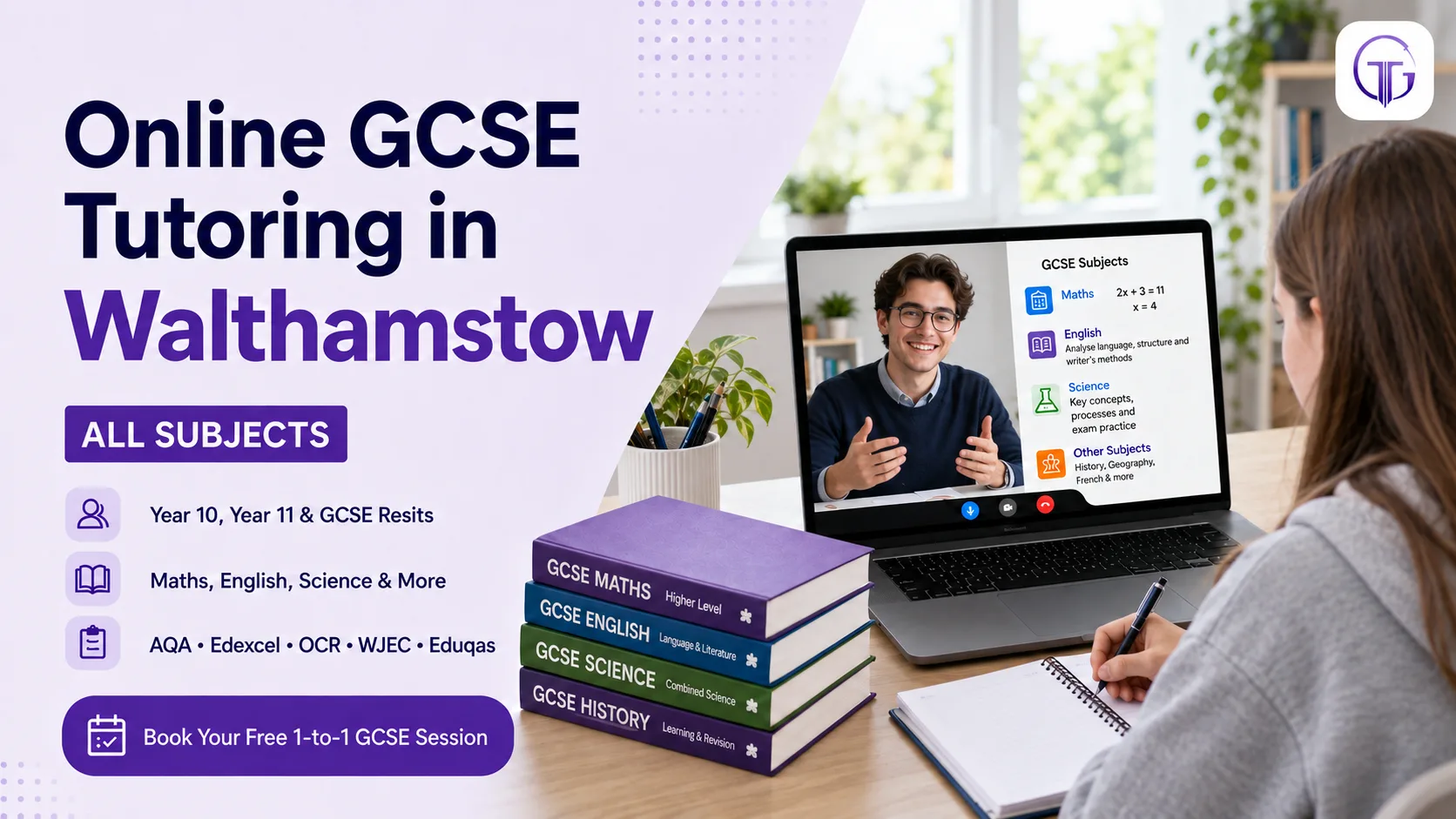
Online GCSE Tutoring in Walthamstow
One-to-one lessons for Year 10, Year 11 and resit students, £30 per lesson
Online GCSE tutoring in Walthamstow across every subject we teach. Most students in E17 now have an AI chatbot a few taps away, and many use it for homework without anyone at home knowing quite what the rules are. For revision that is one conversation. For coursework it is a very different one.
This page sets out where AI genuinely helps a GCSE student, where it quietly makes learning worse, and where it crosses into malpractice under the rules the exam boards follow.
The first session is free and it is a real lesson, with a person explaining rather than a tool generating.
What Walthamstow parents ask
- Whether AI is allowed for homework.
- What counts as cheating with AI.
- Whether AI must be referenced.
- Whether teachers can tell.
- Whether AI helps or hurts revision.
What are the rules for AI in coursework?
Clear, and stricter than many students assume. Work submitted for assessment has to be the student’s own.
The Joint Council for Qualifications publishes guidance on AI use in assessments that schools and colleges follow. It applies to work that counts towards a qualification, such as coursework and non-exam assessment.
A student commits malpractice if they use AI tools in a way that means the work they submit is not their own, or without appropriate referencing. Where AI is used legitimately, the student is expected to acknowledge it, keep a copy of the prompts and generated content in a non-editable form such as a screenshot, and explain how it was used.
Teachers have to authenticate coursework before it is submitted. If they suspect AI use that has not been declared, they follow the school’s malpractice policy, and detection tools may be used as one check among others. Consequences can be serious, including losing marks or being disqualified.
Which subjects still carry coursework, and how it is marked, is covered on our Wealdstone page and in the JCQ coursework and non-exam assessment instructions.
In assessed work
| Use of AI | Status |
|---|---|
| Submitting AI-written text as own work | Malpractice |
| Using AI without referencing it | Malpractice |
| Using AI, referenced, with records kept | May be acceptable |
| Following the school’s specific policy | Required |
Schools may set tighter rules. Theirs is the one to follow.
Does AI help revision?
It can, in narrow ways, and it can also create a comfortable illusion of learning that falls apart in the exam hall.
Used well, a chatbot can explain a concept in a different way from the textbook, or produce extra practice questions on a topic. For a student stuck at ten at night with nobody to ask, that has real value.
The risks are just as real. AI tools can state wrong answers with complete confidence, and a student revising a topic they do not understand cannot tell when that happens. They also cannot mark an answer against a specific exam board’s mark scheme reliably, which is where most GCSE marks are actually won or lost.
The bigger risk is how it changes effort. Asking a tool to explain an answer feels productive, but reading an explanation is not the same as being able to produce the answer from memory under timed conditions. The exam tests the second.
For the revision methods that do build that recall, see our Tooting page.
Helpful, and not
- Helpful: a second explanation of a concept.
- Helpful: extra practice questions to attempt.
- Risky: checking answers it may get wrong.
- Unhelpful: reading solutions instead of attempting them.
- Never: writing any assessed work.
What should families actually do?
Agree simple rules, know the school’s policy, and keep AI on the revision side of the line.
Start with the school’s policy. Many schools now publish how students may and may not use AI, and it can be stricter than the exam board guidance. That policy is the one a student will be held to.
Then separate the two worlds clearly. Anything that will be marked for a qualification is off limits for AI unless the school permits it and it is fully declared. Revision and understanding are a different space, where careful use can be fine.
A useful rule for revision: attempt the question first, then use a tool to check or explain if needed. Never the other way round. That keeps the learning in the student and uses the tool for what it is reasonably good at.
Household rules that work
Read the school’s AI policy
It is the one that applies.
No AI in assessed work
Unless permitted and declared.
Attempt first, then check
Never the reverse.
Check AI answers against the mark scheme
It can be wrong.
Which GCSE subjects can your child get help with?
The full list, taught live by a person in every case.
Maths
Where working has to come from the student, not a tool. See GCSE Maths tutoring.
English Language and Literature
Writing that has to sound like the student. See GCSE English tutoring.
Combined and Triple Science
Three strands with a specialist in each. See GCSE Science tutoring.
Computer Science
Programming that the student can explain line by line. See GCSE Computer Science tutoring.
Business Studies
Evaluation written in the student’s own words. See GCSE Business Studies tutoring.
Humanities
History, Geography and Religious Studies, when a specialist has room.
Does any of this affect resits?
Less directly, because maths and English Language resits are written exams with no coursework to submit.
A maths or English Language resit is decided entirely by written papers, so AI malpractice in coursework is not a risk. The revision risks on this page still apply.
In Walthamstow as elsewhere, a student leaving Year 11 below grade 4 in either subject keeps studying it under the 16 to 19 maths and English condition of funding, updated in July 2026. At grade 3 that is another GCSE; at grade 2 or below, Functional Skills level 2 is open too.
College courses taken alongside a resit may include coursework of their own, where the AI rules apply fully.
Resit essentials
- Maths and English resits are written exams.
- November covers both.
- College coursework follows the AI rules.
- The college controls the entry.
See GCSE resit tutoring and the exam dates page.
How does an online lesson run?
A video call, a shared whiteboard, and handwriting rather than generated text.
Tell us what help is needed
Revision, or understanding coursework rules.
Free one-to-one session
A real lesson, no card details taken.
Attempts made by the student
Explained by the tutor.
Marked against the real scheme
Not an AI guess.
Reviewed at six weeks
Against marked work.
The full process is on how it works. Waltham Forest publishes school holiday and term dates for its community schools; academies in E17 may follow their own.
What does a GCSE tutor in Walthamstow cost?
One to one at £30 per session, with a human marking the work.
We do not write coursework for students and will not help anyone break the rules on assessed work. What we teach is the understanding that makes their own work better.
Prices compare properly only once the minutes are known. Our guide to GCSE tutoring costs sets out the market.
What £30 covers
- A full one-to-one lesson with a subject specialist.
- Work marked by a person against the real scheme.
- Clear guidance on staying within coursework rules.
- Planning against your child’s exam board.
- A tutor change if the match is wrong.
Tell us how your child is studying
Including any AI tools already in use. We reply during the day.
- Year group and subject.
- Whether any coursework is in progress.
- How AI tools are currently being used.
- Current grade and target grade.
- Days and times that work at home.
Prefer to talk it through? WhatsApp us, or use the contact page.
Send an enquiry
Frequently asked questions
Can students use AI tools like chatbots for GCSE work?
For revision and understanding, it can help if used carefully. For any work that counts towards a qualification, such as coursework, using AI without acknowledging it can be malpractice.
What counts as malpractice with AI?
Using an AI tool in a way that means the submitted work is not the student’s own, or using it without appropriate referencing. The consequences can include losing marks or disqualification.
Do students have to reference AI if they use it?
For assessed coursework, yes. Guidance expects students to acknowledge the tool, keep a copy of the questions they asked and the content generated, and explain how it was used.
Can teachers tell if work was written by AI?
Often, and detection tools may be used as one check. More reliably, teachers know a student’s voice and ability, and work that suddenly sounds nothing like them raises questions.
Is AI useful for revision?
Sometimes. It can explain a concept a different way or generate practice questions. It is also wrong with confidence at times, and it cannot mark work against a real mark scheme reliably, so it needs checking.
Which GCSE subjects do you cover?
Maths, both English GCSEs, Combined or Triple Science, Computer Science and Business Studies, and humanities, all taught live rather than through an app.
What does it cost?
£30 a lesson, one to one, taught by a person rather than generated by a tool.
Do you have a tuition centre in Walthamstow?
No. No centre in E17; lessons are online and the company is registered in Feltham.
Book a free GCSE session for your child in Walthamstow
One free one-to-one session, no card details and no obligation. A real person explaining, a student doing the thinking, and marking against the scheme the examiner will use.