
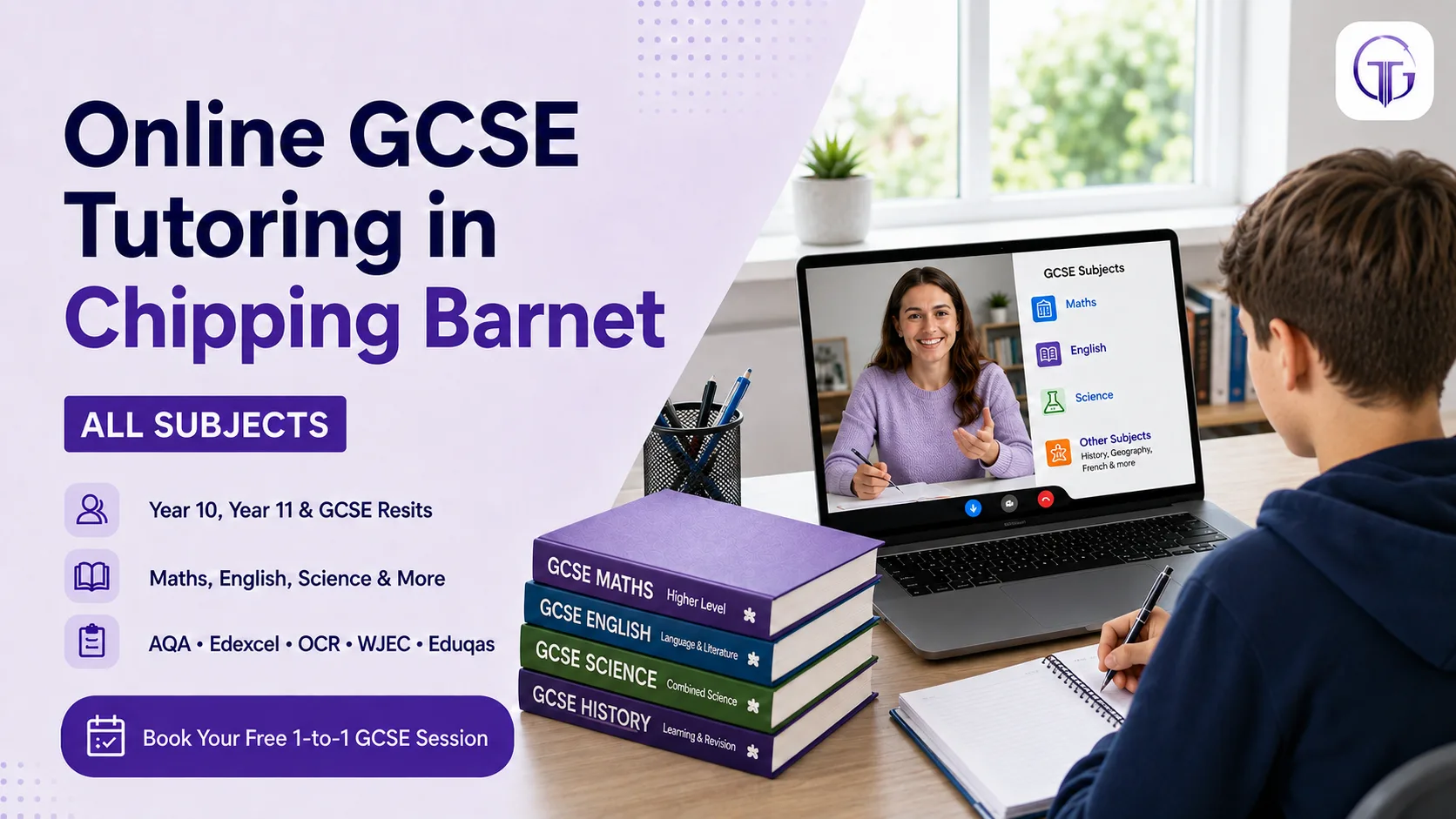
Online GCSE Tutoring in Chipping Barnet
One-to-one lessons for Year 10, Year 11, resits and private candidates, £30 per lesson
Online GCSE tutoring in Chipping Barnet across every subject we teach. Some students here are not sitting their exams through a school at all. Home educated, out of school for a period, or an adult picking up a subject they need, and in every case the qualification is only half the job.
The other half is administrative, and it defeats more people than the syllabus does. Finding a centre, understanding two separate sets of fees, and hitting a deadline nobody publicised are all part of it.
The first session is free and it is a real lesson. If the entry side is the immediate worry, we will spend part of it on that instead.
What Chipping Barnet families ask
- How to find a centre that takes private candidates.
- What entering actually costs.
- When the real deadline falls.
- Which subjects are realistic to enter.
- Whether a grade obtained this way counts the same.
Who ends up as a private candidate?
More people than the phrase suggests, and the resulting certificate is identical to anybody else’s.
A private candidate sits exams at an approved centre without being on roll there. That covers home educated students, students who left school without completing a subject, adults who need a grade 4 in maths or English for a course or a job, and students at a school that has declined to enter them for a particular subject.
The Joint Council for Qualifications publishes guidance for private candidates, including a tool for finding centres that accept them. Availability is the binding constraint rather than eligibility: plenty of centres take private candidates, but not for every subject and not every year.
The grade itself carries no marker. A GCSE in maths obtained as a private candidate is the same qualification, from the same board, on the same certificate as one obtained by a Year 11 student sitting in their own school hall.
What is different is that nobody is holding the process for you. The entry, the fees, the deadline and the arrangements on the day all belong to the candidate or their family.
Who this applies to
- Home educated students of any age.
- Adults who need a grade 4 for work or study.
- Students out of school for a period.
- Anyone whose school will not enter them for a subject.
- Students wanting a subject their school does not offer.
What does it actually take to enter?
A centre, two fees and a date. All three catch people out, and the date catches the most.
Start with the centre, because everything else depends on it. Contact several rather than one, ask which subjects and which boards they can offer, and ask whether they take candidates for the specific specification you have been studying. A centre that offers maths may offer it with a different board from the one your materials are written for, which matters more than it sounds.
Then the money. There are two separate charges: the exam board’s entry fee for the subject, and the centre’s own administration fee, which the centre sets and which varies widely. Asking for a single figure tends to produce one of the two, so ask for both explicitly and in writing.
Then the deadline, which is the item most likely to cost a year. Boards publish entry deadlines, but every centre works to an internal cut-off well before them, because it has to collect and process entries. Ask for that internal date on the first call and put it in a calendar immediately.
Subjects with a practical or coursework component are the hardest to place, since the centre must supervise and authenticate work it has not taught. Maths, English Language and the sciences are the most commonly available.
The first phone call
- Which subjects and which boards do you offer?
- What is your internal entry deadline?
- What is the board fee and what is your fee?
- Do you accept candidates for coursework subjects?
- What arrangements are made on the exam day itself?
How far ahead should you start?
Further than for a school candidate, because the entry has to be secured before the teaching schedule can be fixed.
For a school student, the entry is somebody else’s problem and the syllabus is already being taught. A private candidate has to solve the entry first, since it determines the board, which determines the specification, which determines what is actually being learned.
That order matters. Starting to study a subject and then finding a centre, only to discover it offers a different board, means either changing centres or changing materials. Neither is fatal, and both waste weeks that were not available.
So the sequence is: find the centre, confirm the board and the deadline, then plan teaching back from the exam date. For a maths GCSE from a standing start, most private candidates need considerably longer than the ten weeks a resit student gets, because there is no class covering the content in parallel.
Home educated students often carry an additional advantage worth using: the timetable is theirs. Lessons can sit in the morning when concentration is best rather than at seven in the evening after a school day.
In this order
Find and confirm a centre
Several calls, not one.
Confirm the board and specification
Everything else follows from this.
Note the internal deadline
Not the board’s published one.
Plan teaching back from the paper
Then start.
Re-confirm the entry in writing
Before relying on it.
Which GCSE subjects can we help with?
All of the below, and for private candidates the sciences are worth discussing early because of the practical requirement.
Maths
The most commonly entered subject privately, and the most widely available. See GCSE Maths tutoring.
English Language
Assessed by written papers, with spoken language reported separately. See GCSE English tutoring.
English Literature
Closed book, so the set texts must match the centre’s board. See GCSE English tutoring.
Combined and Triple Science
Check practical arrangements with the centre first. See GCSE Science tutoring.
Computer Science
Written papers, with programming taught properly. See GCSE Computer Science tutoring.
Business Studies
Fully exam assessed, so straightforward to enter. See GCSE Business Studies tutoring.
What about an adult who needs a grade 4?
A common reason to sit a GCSE privately, and the route depends on age as much as on the subject.
A student aged 16 to 19 in education or training is usually covered by their provider. The 16 to 19 maths and English condition of funding, updated in July 2026, requires continued study of maths or English where grade 4 was not reached, so the college handles the entry and the teaching.
An adult outside that system has to arrange it themselves, and the private candidate route is how. Many colleges also run adult GCSE courses, which handle the entry as part of the course and are worth checking before organising anything independently.
For an adult, the November series is often the better target than the following summer, since it comes round sooner and covers exactly the two subjects most adults need.
Two series a year
- November covers Maths and English Language.
- Summer covers the full range of subjects.
- Private entries follow the centre’s deadlines.
- Adult courses at a college handle entry for you.
See GCSE resit tutoring and the exam dates page.
How does an online lesson run?
A video call, a shared whiteboard, and paper at the student’s end. For a private candidate it is often the only structured teaching in the week, so it carries more weight than usual.
Tell us the centre and the board
Or that you are still looking for one.
Free one-to-one session
A real lesson, no card details taken.
Plan back from the exam date
Not forward from today.
Weekly lessons with work between
There is no class filling the gaps.
Reviewed at six weeks
Against past paper work.
The full process is on how it works. Barnet publishes school term and holiday dates, which is useful mainly for knowing when centres are closed.
What does a GCSE tutor in Chipping Barnet cost?
£30 a session, one to one, and private candidates pay the same as anyone else.
That is the tutoring only. Entry fees go to the exam board and the centre, and we have no part in either, so budget for them separately.
Ask about duration alongside price, or an hourly figure tells you very little. Our guide to GCSE tutoring costs sets out the range across the market.
What £30 covers
- A full one-to-one lesson with a subject specialist.
- Teaching matched to the centre’s exam board.
- A schedule planned back from the exam date.
- Practical advice on the entry process.
- A tutor change if the match is wrong.
Tell us where you are in the process
Whether that is a confirmed entry or a blank page. We reply during the day.
- The subject, and the exam board if known.
- Whether a centre has been found yet.
- The exam series you are aiming for.
- Whether the student is home educated or an adult returner.
- Days and times that work.
Prefer to talk it through? WhatsApp us, or use the contact page.
Send an enquiry
Frequently asked questions
What is a private candidate?
Someone who sits exams at an approved centre without being enrolled there as a student. Home educated students, adults returning to a subject, and students whose school will not enter them all fall into it.
How do you find a centre?
The Joint Council for Qualifications maintains a tool listing centres that accept private candidates. Availability varies by subject and by year, so confirm directly with the centre before assuming anything.
What does it cost to enter?
Two separate things. The exam board charges an entry fee per subject, and the centre adds its own administration or accommodation fee on top, which it sets itself. Ask for both figures rather than one total.
When are the deadlines?
Earlier than the board’s published date, because each centre sets its own internal cut-off. Ask for that date explicitly on the first call, since missing it usually means waiting a whole year.
Which subjects are hardest to enter privately?
Anything with a practical or coursework component, because the centre has to supervise and authenticate work it has not taught. Maths, English Language and the sciences are the most straightforward.
Do you teach home educated students?
Yes, and it is a substantial part of what one-to-one online tutoring is for. The teaching is the same; what changes is that the family is also managing entries and deadlines.
Which GCSE subjects do you cover?
Maths, English Language, English Literature, Combined or Triple Science, Computer Science and Business Studies, with humanities depending on cover.
What does it cost?
£30 a lesson, one to one, and the price does not change by subject or year group.
Book a free GCSE session in Chipping Barnet
One free one-to-one session, no card details and no obligation. If the entry process is the part that is stuck, say so and we will spend the session on that instead of on the syllabus.