
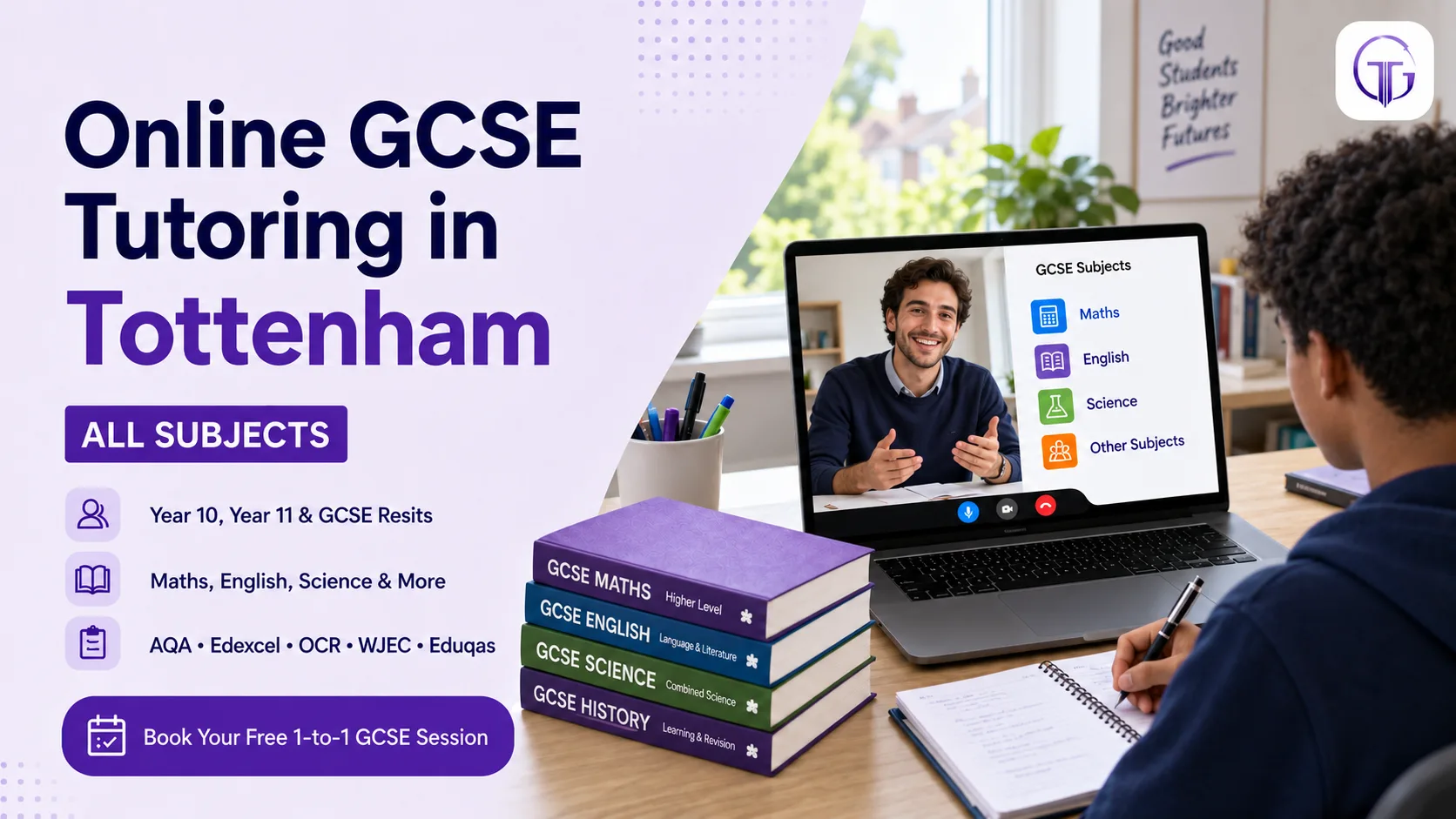
Online GCSE Tutoring in Tottenham
One-to-one lessons for Year 10, Year 11 and resit students, £30 per lesson
Online GCSE tutoring in Tottenham across every subject we teach. Before a family spends anything on tutoring, there is a set of free support that most schools already run and that a surprising number of parents have never been told about. This page is about asking for it first.
That is an odd thing for a tutoring company to publish and it is the honest order to do things in. Paid help works best on top of the free help rather than instead of it.
The first session is free and it is a real lesson. If the answer is that the school should be doing this, you will hear that.
What Tottenham families ask
- What the school already offers free.
- Who to ask, and how.
- What pupil premium funding covers.
- Whether free school meals registration matters.
- When paid tutoring is actually the next step.
What does a school usually already run?
More than the letters home suggest, and most of it is available on request rather than by invitation.
Most secondaries run some form of subject intervention: revision sessions before school, at lunchtime or after it, usually led by a subject teacher and usually aimed at students who are close to a grade boundary. They are frequently underfilled, and a student who asks to attend is rarely turned away.
Many also run holiday revision, particularly at Easter of Year 11, and small group catch-up in maths and English. Some have literacy or numeracy intervention running through the year, which is the sort of thing a family only learns about when a child is placed in it.
The reason to ask rather than wait is that these are targeted, and the targeting is based on data that may not reflect what is actually happening. A student who is quietly struggling but not flagged will not be invited to something they would benefit from. Asking puts them on the list.
The question that works is specific. Not "is there any extra help", which invites a general answer, but "does the maths department run catch-up sessions, and can my child come".
Worth asking about by name
- Subject catch-up or intervention sessions.
- Before-school or lunchtime revision clubs.
- Easter or half-term revision programmes.
- Small group support in maths or English.
- Homework club, for students who cannot work at home.
When is paid tutoring actually the right next step?
When the free support exists, has been used, and has not closed the specific gap, which is a real situation rather than a rhetorical one.
School intervention is usually a group. That is not a criticism; it is what the funding stretches to, and a well-run group session is genuinely valuable. What a group cannot do is stop for one student’s particular broken step, which is precisely the thing that a one-to-one hour is for.
So the honest division is this. Free school support covers content, revision structure, and practice, and covers them adequately for most students. A paid tutor is worth the money when a specific, identifiable gap has survived all of that, or when the student will not ask a question in front of other people and therefore gets nothing from the group.
The second of those is more common than it sounds and is worth naming, because it looks like laziness from the outside. A student who attends every intervention session and asks nothing has attended, not learned.
Our Harlesden page describes what a first session should find, which is the fastest way to tell whether there is a specific gap or a general one.
Free help against paid help
| Situation | What suits it |
|---|---|
| Broadly behind in a subject | School intervention |
| Needs structure and practice | School intervention |
| One identifiable broken step | One to one |
| Will not ask in front of others | One to one |
| Not attending anything | Neither, yet |
Which GCSE subjects can your child get help with?
All of these, and none of them worth paying for until the free options are used up.
Maths
Where school intervention is most common and most worth taking. See GCSE Maths tutoring.
English Language and Literature
Both GCSEs, with writing marked between sessions. See GCSE English tutoring.
Combined and Triple Science
Three strands with a specialist in each. See GCSE Science tutoring.
Computer Science
Programming and the written papers. See GCSE Computer Science tutoring.
Business Studies
Case studies and evaluation marks. See GCSE Business Studies tutoring.
Humanities
History, Geography and Religious Studies, when a specialist has room.
Is there free support after Year 11 too?
Yes, and it is the part families most often miss, because the resit teaching itself is funded.
A student continuing maths or English at a college is taught it as part of their course, at no cost. That is the direct consequence of the 16 to 19 maths and English condition of funding, updated in July 2026, which requires the subject to continue where grade 4 was missed and funds the provider to deliver it.
Grade 3 puts a student on a GCSE route; grade 2 or below allows Functional Skills level 2 instead. Either way the teaching is there and it is free, which makes a paid tutor a supplement rather than a substitute.
For adults outside that age range the picture is different and often still free. Many colleges run funded English and maths GCSE courses for adults, and it is worth asking the local college before assuming private tuition is the only route.
Funded after Year 11
- GCSE or Functional Skills teaching at college.
- Included in the course, not charged separately.
- November covers Maths and English Language.
- Adult GCSE courses are often funded too.
- Ask the college before paying anyone.
See GCSE resit tutoring and our Hammersmith page.
How does an online lesson run?
Video, a shared whiteboard, and written work the tutor can read as it appears.
Tell us what the school offers
And whether it has been used.
Free one-to-one session
A real lesson, no card details taken.
An honest view on whether to pay
Including when the answer is not yet.
Weekly lessons on the specific gap
Alongside the school support, not instead.
Reviewed at six weeks
Against marked work.
The full process is on how it works. Haringey publishes its school term dates, and academies set their own, which matters for holiday revision programmes.
What does a GCSE tutor in Tottenham cost?
One to one at £30 a lesson, after you have used whatever the school provides free.
Nothing is bought in blocks and the first session costs nothing, so finding out whether paid help is needed does not itself cost anything.
Compare on minutes as well as pounds, or the cheaper quote may not be. Our guide to GCSE tutoring costs sets out the market.
What £30 covers
- A full one-to-one lesson with a subject specialist.
- Work on the gap the group session cannot stop for.
- Teaching alongside school support, not duplicating it.
- An honest recommendation to use free help first.
- A tutor change if the match is wrong.
Tell us what the school has offered
If the answer is nothing, that is worth chasing before anything else.
- Year group and subject.
- Any catch-up or intervention already offered.
- Whether your child has attended it.
- Current grade and target grade.
- Days and times that work at home.
Prefer to talk it through? WhatsApp us, or use the contact page.
Send an enquiry
Frequently asked questions
Is there free GCSE support we should be using first?
Usually yes. Most secondaries run subject catch-up or intervention sessions, often before school or at lunch, and many are underused because nobody tells families they exist. Ask the head of department directly.
What is pupil premium and does it mean anything for us?
It is funding schools receive for disadvantaged pupils, including those eligible for free school meals at any point in the last six years. Schools decide how to spend it, and a common use is small group or one-to-one academic support.
How do we find out whether our child is eligible?
Ask the school office. Eligibility is usually tied to free school meals, and registering matters even if a child does not take the meal, because the funding follows the registration.
Will the school tell us what support exists?
Sometimes, and often only if asked. A specific question to a head of department about catch-up in that subject gets a much better answer than a general question at parents’ evening.
Why is a tutoring company telling us this?
Because a family who has exhausted the free options and still needs help is a family we can genuinely help, and one who has not is spending money on something they might already have.
Which GCSE subjects do you cover?
Maths, English Language and English Literature, science in either route, Computer Science and Business Studies, and humanities subject to a specialist being free.
What does it cost?
£30 a lesson, one to one, and we would rather you used the free help first.
Do you have a tuition centre in Tottenham?
No. Online only. The company is registered in Feltham and we claim nothing local.
Book a free GCSE session for your child in Tottenham
One free one-to-one session, no card details and no obligation. If the honest recommendation is to go back to the school and ask for something you are already entitled to, that is what you will get.