
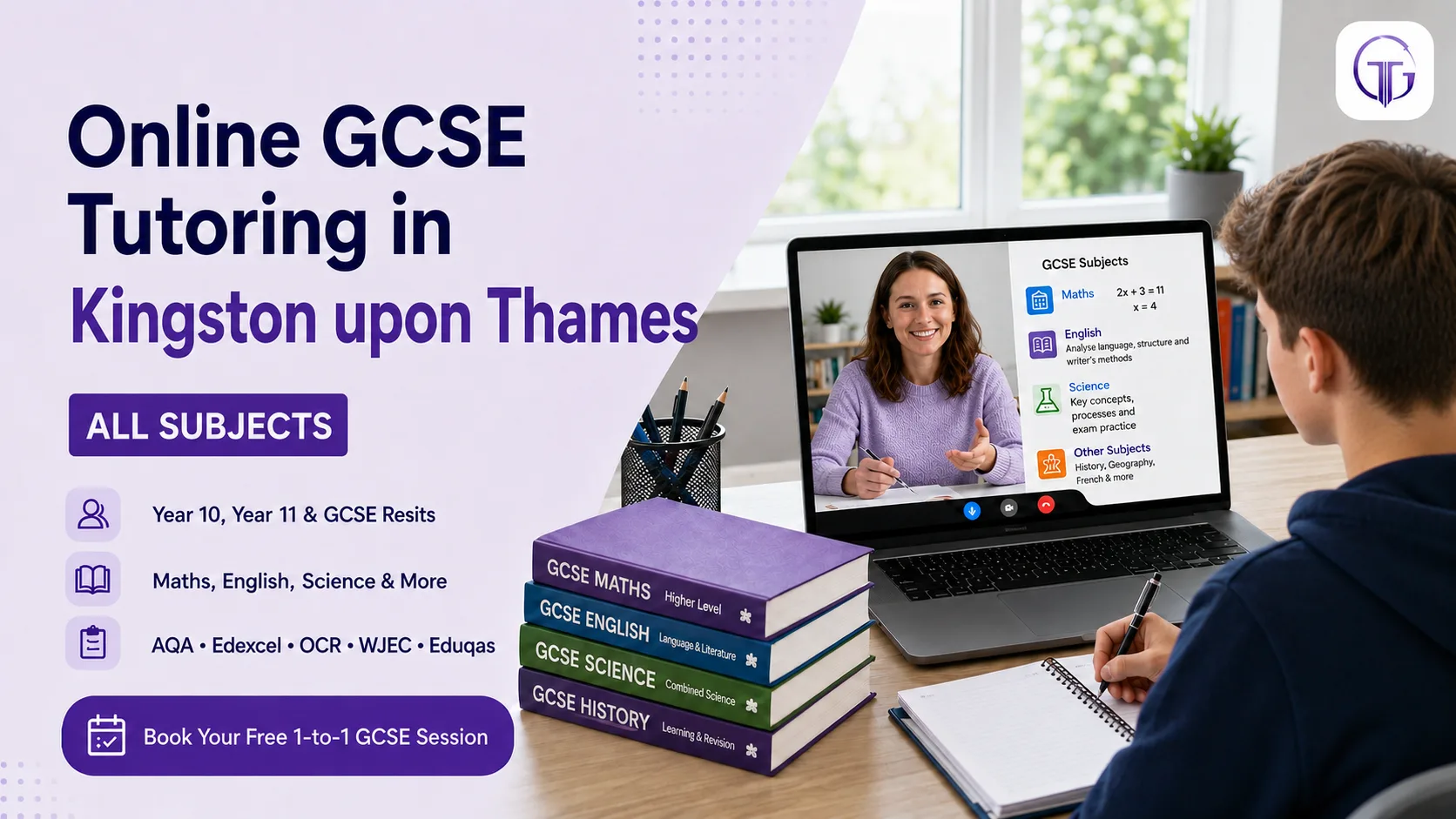
Online GCSE Tutoring in Kingston upon Thames
One-to-one lessons for Year 10, Year 11 and resit students, £30 per lesson
Online GCSE tutoring in Kingston upon Thames across every subject we teach. Kingston families tend to be thinking about sixth form early, and that changes the timetable: an application closing in December is judged on work done long before the exams.
Lessons are one-to-one over video, at times that fit around school and everything else in the week. Nobody travels through the town centre at half past four.
The first session is free and it is a real lesson. Tell us which sixth form you have in mind and the tutor will work backwards from its entry requirements.
What Kingston families ask about
- The grades a particular sixth form actually requires.
- Whether an autumn mock will decide an offer.
- A subject sitting one grade below the A-level requirement.
- Triple Science taught by three specialists.
- Maths and English before the Year 11 mocks.
What do sixth forms actually ask for?
Two things, and the second one catches families out. A general threshold across the whole set, and a specific grade in each subject you want to continue.
The general threshold is usually something like five GCSEs at grade 4 or above including English and maths. That part is widely known and rarely the problem.
The subject-specific requirement is where offers actually fall over. A sixth form that wants a grade 6 in Maths before it will let a student take A-level Maths is making a reasonable demand, and a student sitting on a 5 has a very particular job to do, in one subject, by June. The same applies to a 7 for Further Maths, or a grade in Chemistry before A-level Chemistry.
So the useful exercise in Year 10 is narrow: list the three or four A-levels the student might want, look up what the sixth form requires for each, and compare that against current grades. Usually one subject is short. Occasionally none are, and the family can relax about the rest.
The timing then matters more than the content. Applications commonly open in the autumn of Year 11 and close before Christmas, so a conditional offer is made on predicted grades and autumn mocks. Work done in February improves the final result; it rarely improves the offer.
Worth doing in Year 10
- List the A-levels the student might realistically want.
- Look up each subject requirement at the sixth forms in reach.
- Compare against current grades, subject by subject.
- Identify the one or two that are short.
- Check whether internal students face the same requirements.
Entry requirements are published. Reading the actual ones beats assuming, and it usually narrows the problem to a single subject. Staying in education or training until 18 is required either way, and gov.uk sets out when a student can leave school and what has to follow it, whether that is full-time study, an apprenticeship, or part-time training alongside work.
And if the grades miss the offer in August?
Less catastrophic than it feels in the moment, provided somebody thought about a second option before results day.
Sixth forms exercise discretion in much the same way universities do. A student one grade short in a subject they are not taking at A-level is usually fine. A student short in the subject itself is a harder conversation, and the answer depends on how many places are left.
Where maths or English is the shortfall, a further rule takes over. The 16 to 19 maths and English condition of funding, updated in July 2026, requires anyone aged 16 to 19 on a study programme without grade 4 in those subjects to keep studying them. A grade 3 commits the student to a GCSE; at grade 2 or below Functional Skills level 2 becomes an option.
Kingston College is the main local college route, and school sixth forms in the borough run English and maths alongside main programmes for students in that position.
| Shortfall | Usual outcome |
|---|---|
| One grade short in an unrelated subject | Normally accepted, especially if close |
| One grade short in the A-level subject | Depends on places. Ask early, in writing |
| Short in maths or English | Place plus a compulsory resit alongside it |
| Several subjects short | A different programme is usually the honest answer |
Our GCSE resit tutoring page covers the resit routes, and dates sit on the exam dates page.
Which GCSE subjects can your child get help with?
All of them from this one page, which matters when the shortfall is in one specific subject an offer depends on.
Maths
Higher tier towards the grade 6 or 7 most sixth forms want before A-level Maths. See GCSE Maths tutoring.
English Language and Literature
Essay structure, comparison questions and the set texts. See GCSE English tutoring.
Combined and Triple Science
Three strands with three specialists, whichever route the school took. See GCSE Science tutoring.
Computer Science
Programming, algorithms and the written paper. See GCSE Computer Science tutoring.
Business Studies
Case studies, calculations and evaluation answers. See GCSE Business Studies tutoring.
Humanities
History, Geography and Religious Studies, where a specialist has room.
When should work start if an offer is the goal?
Earlier than for the exams themselves, because the deadline is December rather than June.
Year 10
The ideal window. There is time to move a subject a full grade before the autumn mocks that predictions are drawn from, and time to change course if a chosen A-level turns out to be unrealistic.
A topic repaired now costs about one lesson. The same gap found in Year 11 costs three or four.
Year 11
The autumn term is doing double duty: it is exam preparation and it is the evidence base for an application. That is a good reason to take the mocks seriously rather than treating them as a rehearsal.
After Christmas the job reverts to the final grade, which still matters because offers are conditional. Our revision timetable guide covers the pacing.
How does an online lesson run?
Video, a shared whiteboard, and the student working on paper alongside it. The tutor follows the working.
Tell us the target sixth form
And which A-levels, if they are decided.
Free one-to-one session
A real lesson, no card details, then a straight report.
Work back from the requirement
The subject that is short, and by how many marks.
Weekly lessons before the mocks
Because the mock is what the prediction rests on.
Reassess after the autumn mocks
Offer secured, or a different plan for the spring.
The full process is on how it works. Kingston publishes its school term dates through Achieving for Children, and academies set their own, so check the school before fixing a weekly slot.
What does a GCSE tutor in Kingston cost?
One to one at £30 a session, and nothing is payable until the lesson is booked.
Rates across this part of south west London climb quickly once an agency is involved. One published number means a comparison takes a minute.
Ask us to confirm lesson length so an hourly quote elsewhere can be judged fairly. Our guide to GCSE tutoring costs covers the market.
What £30 covers
- A full one-to-one lesson with a subject specialist.
- Planning against the exam board and tier.
- Timed practice marked against the real mark scheme.
- Feedback aimed at the grade the offer needs.
- A tutor change if the match is wrong.
Tell us what the offer requires
Sixth form, subject and grade. We reply during the day.
- Year group and subject.
- The sixth form you are aiming at, if decided.
- The grade its entry requirement asks for.
- Current grade and most recent mock.
- Days and times that work at home.
Prefer to talk? WhatsApp us, or use the contact page.
Send an enquiry
Frequently asked questions
What grades do sixth forms actually ask for?
It varies more than people expect. A typical ask is five GCSEs at grade 4 or above including English and maths, with a higher grade in each subject you want to take at A-level, often a 6 or a 7. The only reliable answer is the published requirement of the sixth form you are applying to.
When do sixth form applications open?
Most open in the autumn of Year 11 and close before Christmas, which is months before anyone knows their real grades. That is why the November mock carries more weight than its name suggests: it is often the evidence behind a conditional offer.
Does a school sixth form have to take its own students?
Not automatically. Most set the same entry requirements for internal and external applicants, and a student can miss the grades for their own school’s sixth form. Worth checking the published policy rather than assuming a place is held.
What happens if the grades come in below the offer?
The same as at university, roughly: the sixth form decides whether to take you anyway, and many will if you are close and the subject fits. Have a second option that you would genuinely be happy with, because scrambling in the week after results day is not a good position.
Which GCSE subjects do you cover?
Maths, English Language and English Literature, science as Combined or as separate Biology, Chemistry and Physics, plus Computer Science and Business Studies. Humanities depend on tutor availability at the time you ask.
Do you have a tuition centre in Kingston?
No. Every lesson is online and the business is registered in Feltham. Local schools and colleges are named as context only.
What does it cost?
£30 a lesson, one to one, with no registration fee and no term to sign up for.
When should we start if the aim is a specific sixth form?
Year 10, or the start of Year 11 at the latest. Offers hang off the autumn mocks, so work that lands after Christmas is improving the final grade rather than the application.
Book a free GCSE session in Kingston upon Thames
One free one-to-one session, no card details and no obligation. If a sixth form place hangs on one subject, that is the conversation to have now rather than in March.