
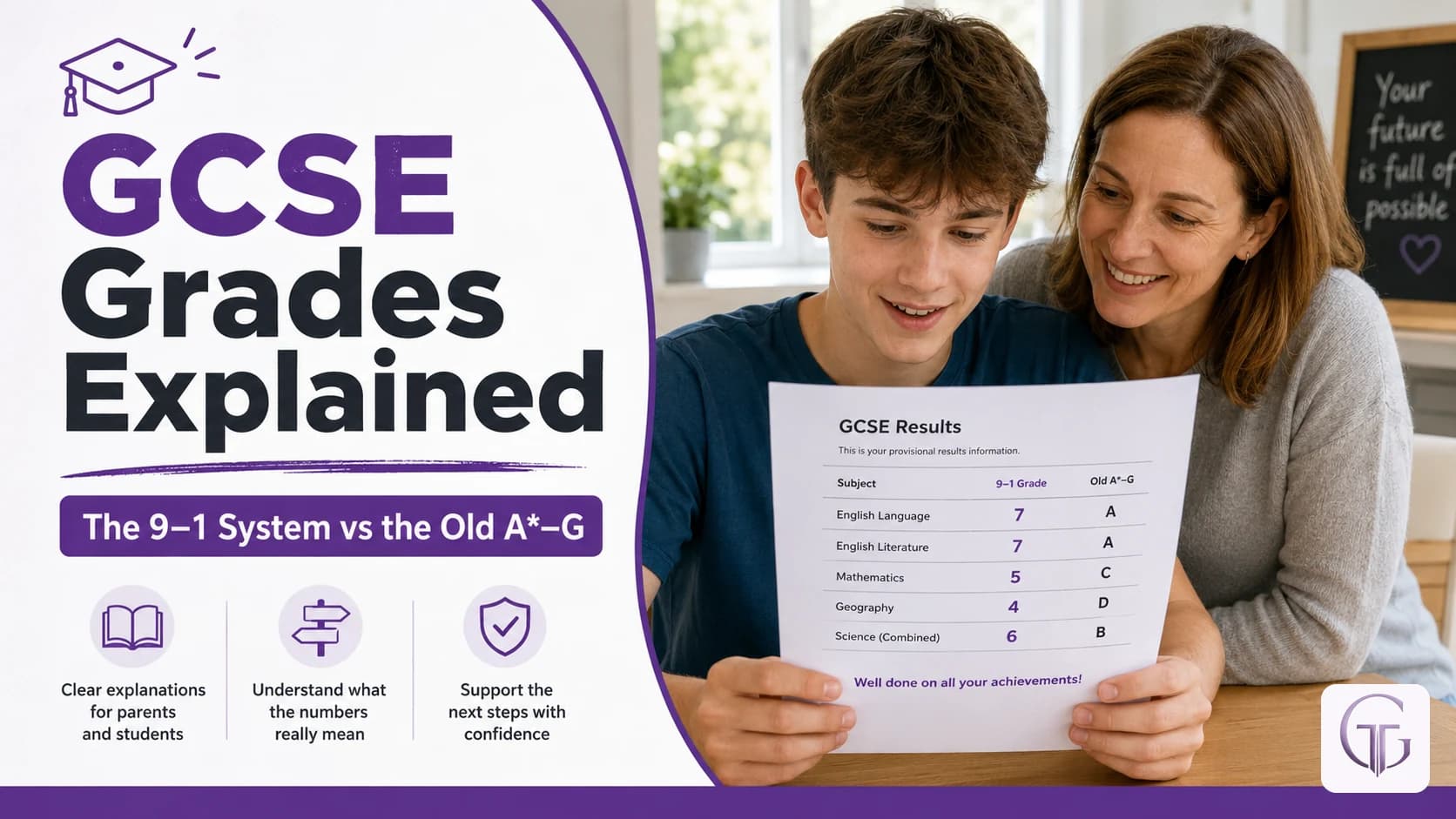
The results slip comes out of the envelope, and it’s a column of numbers. A 7 in English. A 5 in maths. A 4 in geography. If you sat your own exams before 2017, none of it lands on first read, you got letters, and you knew exactly where a B stood.
This is GCSE grades explained properly: what the 9–1 scale means, how it maps (and doesn’t map) onto the old A*–G letters, and what each number actually unlocks. It’s part of our wider guide to what a GCSE is and how it works, which covers subjects, structure and exam boards. One figure worth holding onto from the start: in summer 2025, 67.4% of UK GCSE entries achieved a grade 4 or above (Pearson School Report, 2025). That grade 4, the “standard pass” is the line most decisions get made around.
And a warning before we go further. Half the conversion tables online are more confident than the official mapping allows. Ofqual, England’s exams regulator, fixes only three exact points between the two scales. Everything else is an approximation, and treating it as gospel causes real mistakes, especially around grades 5 and 6.
What is the 9–1 GCSE grading system?
/i
The 9–1 system is the grading scale for GCSEs in England. Grade 9 is the highest, grade 1 the lowest, and U means ungraded. It replaced the A*–G letters between 2017 and 2020, one group of subjects at a time.
The scale arrived as part of a bigger GCSE reform. Courses were rewritten to be tougher, coursework was largely stripped out, and the government wanted the new qualifications to look instantly different from the old ones. Numbers did that job. A results slip full of digits tells any employer, at a glance, that the student sat the reformed exams.
Two grades on the scale carry official labels. Grade 4 is the standard pass. Grade 5 is the strong pass. That distinction sounds bureaucratic, but it decides sixth-form places and resit obligations, so we’ll come back to it.
The full scale at a glance
| Grade | What it signals | Rough old equivalent |
| 9 | Exceptional — reserved for the very top performers nationally | Above A* |
| 8 | Outstanding | Between A* and A |
| 7 | Excellent | A (official anchor point) |
| 6 | Good, secure performance | Upper half of B |
| 5 | Strong pass | High C / low B |
| 4 | Standard pass | Bottom of C (official anchor point) |
| 3 | Below the pass line | D / high E |
| 2 | Well below the pass line | E |
| 1 | Minimum graded achievement | F–G (official anchor point at G) |
| U | Ungraded, below grade 1 | U (unchanged) |
How do the new 9–1 grades compare to the old A*–G letters?
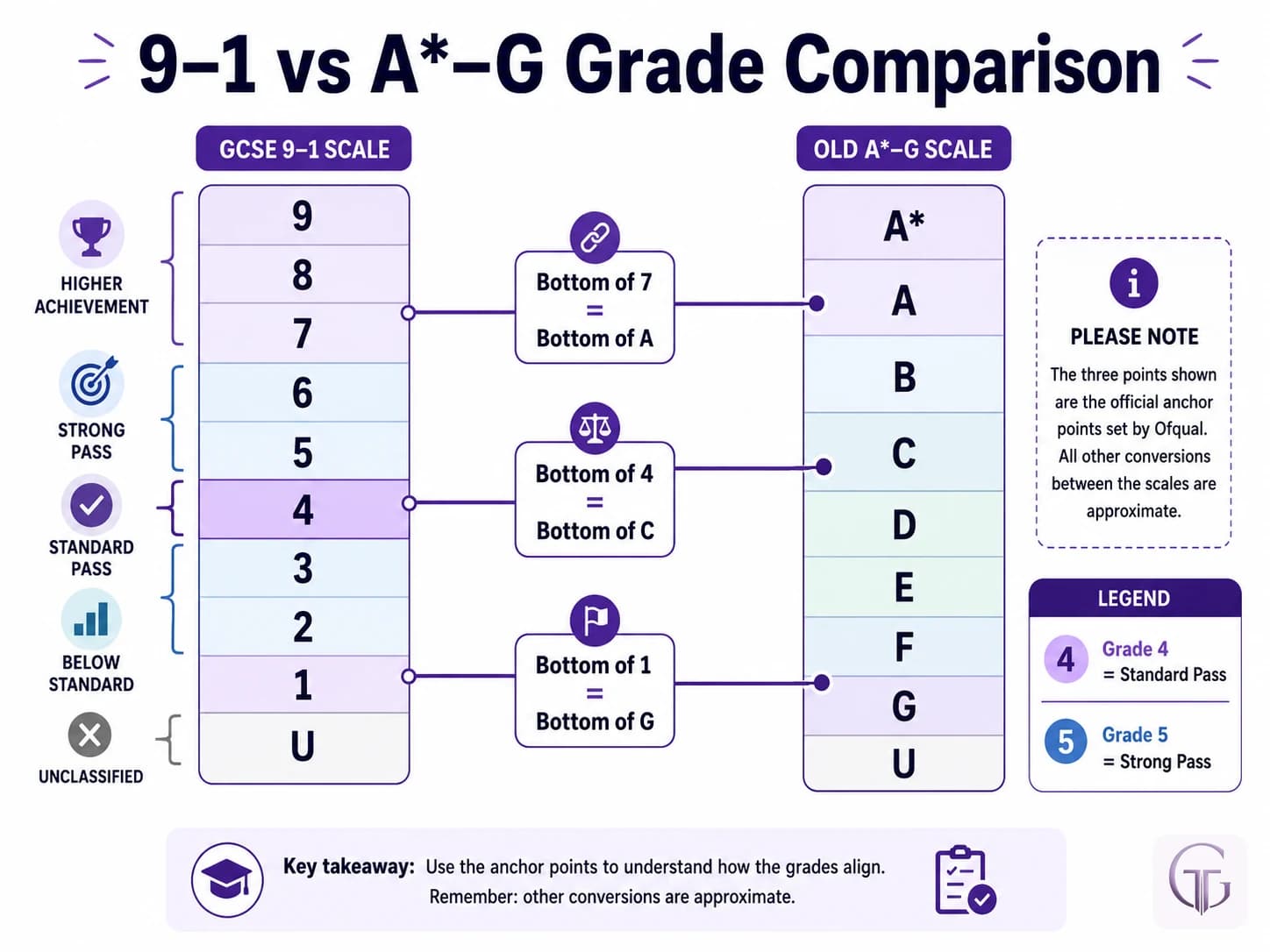
Only three points line up exactly. The bottom of grade 7 matches the bottom of an old A, the bottom of grade 4 matches the bottom of a C, and the bottom of grade 1 matches the bottom of a G.
The three official anchor points
Ofqual built the new scale around those three anchors and nothing else, the regulator sets this out in its official guide to the 9 to 1 grade scale on gov.uk. The boundaries for grades 5 and 6 are then positioned mathematically between the 4 and 7 boundaries, 5 sits a third of the way up, 6 sits two thirds. Nobody sat down and decided what a “6 standard” of work looks like in the way people imagine.
That’s why the tidy one-to-one conversion charts you see shared on results day are wrong at the edges. A grade 6 isn’t “a B.” It’s the upper chunk of the old B range. A 5 genuinely straddles two old letters. Small difference on paper; big difference when a sixth form asks for a 6 and a parent assumes their child’s old-money B would have cleared it.
Why nine numbers replaced eight letters
The scale wasn’t stretched evenly. The top was pulled apart and the bottom was squeezed together, on purpose.
- At the top: three grades (9, 8, 7) now cover the ground two letters (A*, A) used to cover.
- In the middle: the old C was split in two, the 4 and the 5 so a scraped pass and a solid pass stopped looking identical.
- At the bottom: four letters (D, E, F, G) were compressed into three numbers (3, 2, 1).
So a student with straight 4s hasn’t done “worse” than a sibling with straight Cs a decade earlier. They’re standing on roughly the same line. The ruler changed, not the wall.
Is a 4 or a 5 a pass at GCSE?
Both are passes. Grade 4 is the government’s standard pass, roughly the bottom of the old grade C. Grade 5 is the strong pass, between a high C and a low B. Many sixth forms ask for 5s in English and maths.
Standard pass vs strong pass, why two lines exist
The split was deliberate. Under the letters, a student who scraped a C and a student who nearly hit a B got the same grade, and it told colleges nothing. Splitting the C fixed that. School league tables now report both measures, which is also why schools push so hard at the 4/5 borderline.
In practice: a 4 satisfies most employers, apprenticeship providers and college courses. A 5 in English and maths is the typical sixth-form entry ask. And for the specific subjects a student wants to take at A-level, most schools want a 6 or higher. Those aren’t laws, entry requirements are set school by school but they’re the pattern you’ll meet most often. If mock results are hovering at the 4/5 borderline, that’s usually the moment to act rather than wait; our guide on when to start GCSE tutoring walks through the timing by year group.
What happens below a 4 in English or maths
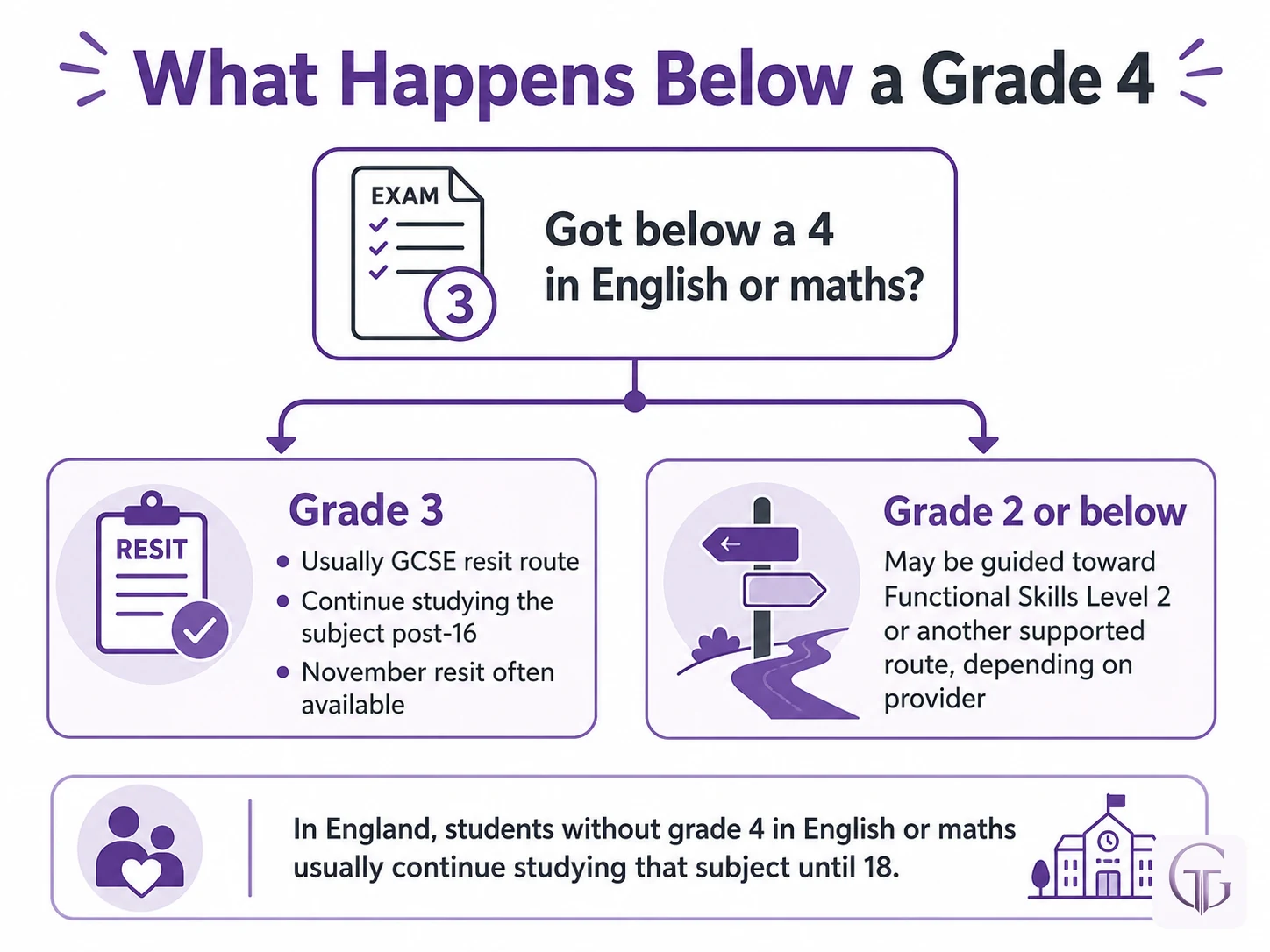
This is where grades stop being abstract. Any student in England who finishes Year 11 without a grade 4 in English or maths must keep studying that subject until 18, it’s the Department for Education’s maths and English condition of funding on colleges, not a suggestion. A grade 3 usually means a straight GCSE resit, with a November exam series available in both subjects. A grade 2 or below opens the alternative route of Functional Skills Level 2.
Around 40% of students start post-16 education without a grade 4 in at least one of the two (FE Week, 2026). It’s a far more crowded boat than most families assume on results morning. If your child is heading into a resit year, structured one-to-one help makes a measurable difference, that’s exactly what our GCSE resit tutoring is built for.
Why did GCSE grades change from letters to numbers?
Three reasons: too many students were reaching A and A*, so top performers had become hard to tell apart; ministers wanted the tougher reformed GCSEs to be instantly recognisable; and splitting the old C created a sharper pass line.
The A had a genuine inflation problem. By the mid-2010s, so many entries reached the top two letters that selective universities openly complained they couldn’t separate exceptional students from very good ones. Grade 9 fixed that with brute rarity in 2025, only around 5% of entries in England achieved one (Ofqual, 2025). It’s not “the new A.” It sits above it, and plenty of students who’d have collected an A* under the old system now land an 8.
How the rollout happened
- 2017: English language, English literature and maths were the first subjects awarded on 9–1.
- 2018: a second wave of around 20 subjects switched, including the sciences, history, geography and most languages.
- 2019: a further wave of smaller-entry subjects moved over.
- 2020: the last subjects converted, and every GCSE awarded in England became 9–1.
Students who sat exams mid-transition got mixed slips, numbers in some subjects, letters in others. If you’re looking at a 2018 certificate, that’s why it reads like two different documents stapled together.
How is a grade 9 actually decided?
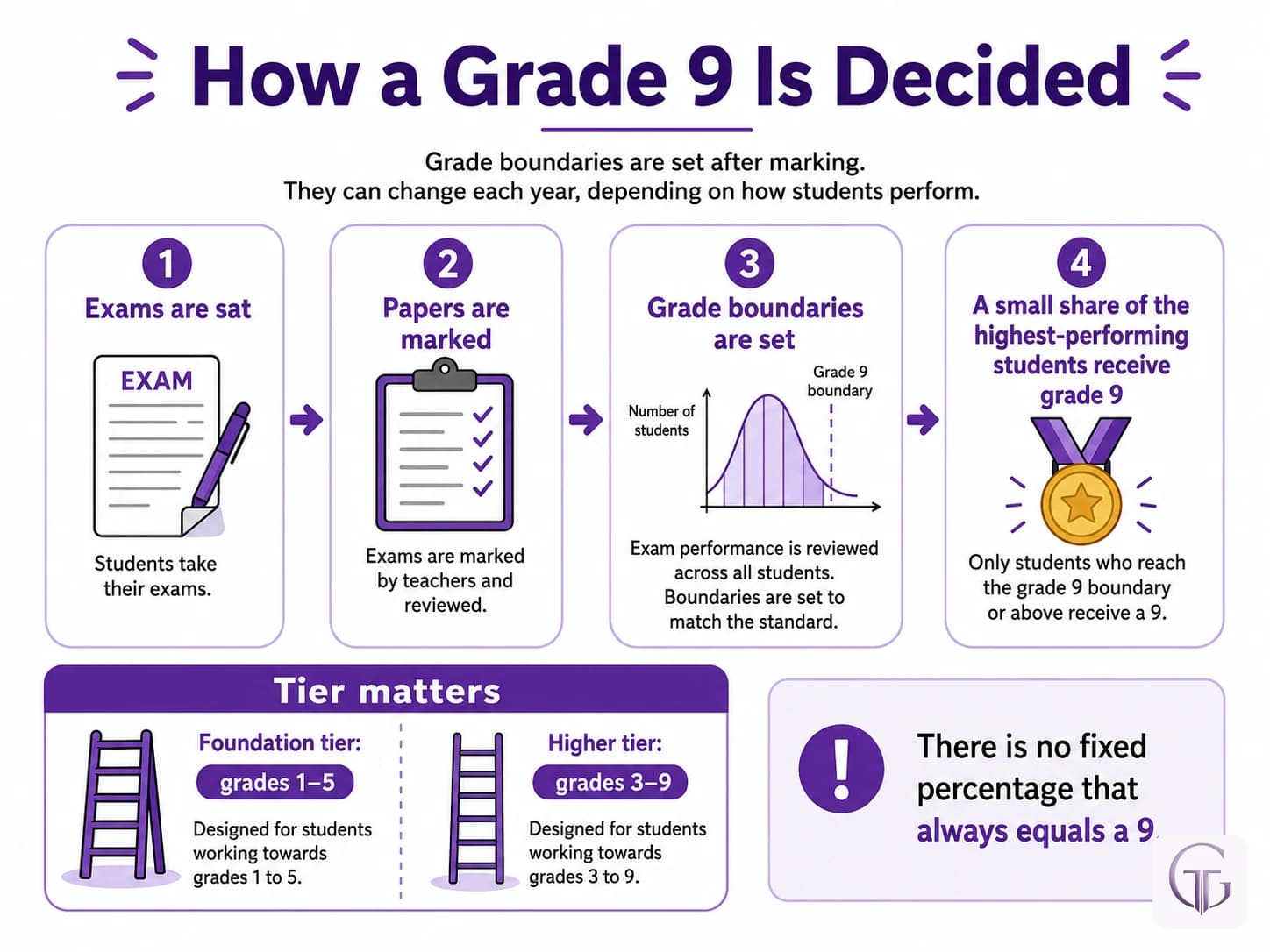
By formula. Roughly 20% of all grades at 7 or above in each subject become grade 9s, and the grade 8 boundary sits halfway between the 7 and 9 boundaries. About 5% of English entries hit a 9 in 2025.
There’s no percentage score that guarantees any grade. Boundaries are set after marking, every single year, using a system called comparable outcomes, the regulator holds the national grade distribution steady so a hard paper doesn’t punish a whole cohort. In a tough year, the marks needed for each grade drop. In a gentle year, they rise.
That’s also why the marks needed vary wildly between exam boards and tiers. Foundation tier papers in maths, science and languages have lower boundaries but cap the maximum grade at 5, a fact that catches out more families than any other single detail in this system, and one worth checking before Year 10 sets are locked in. We track how boundaries move each August in our guide to GCSE grade boundaries.
One thing our maths tutors see every year: students obsess over “what percentage is a 7” when the honest answer changes annually. The better habit is working from past-paper mark schemes, where you can see what a top-band answer physically looks like. For students chasing the very top of the scale, we’ve broken that approach down in how to get a grade 9 in GCSE maths.
Do Wales, Scotland and Northern Ireland use the 9–1 system?
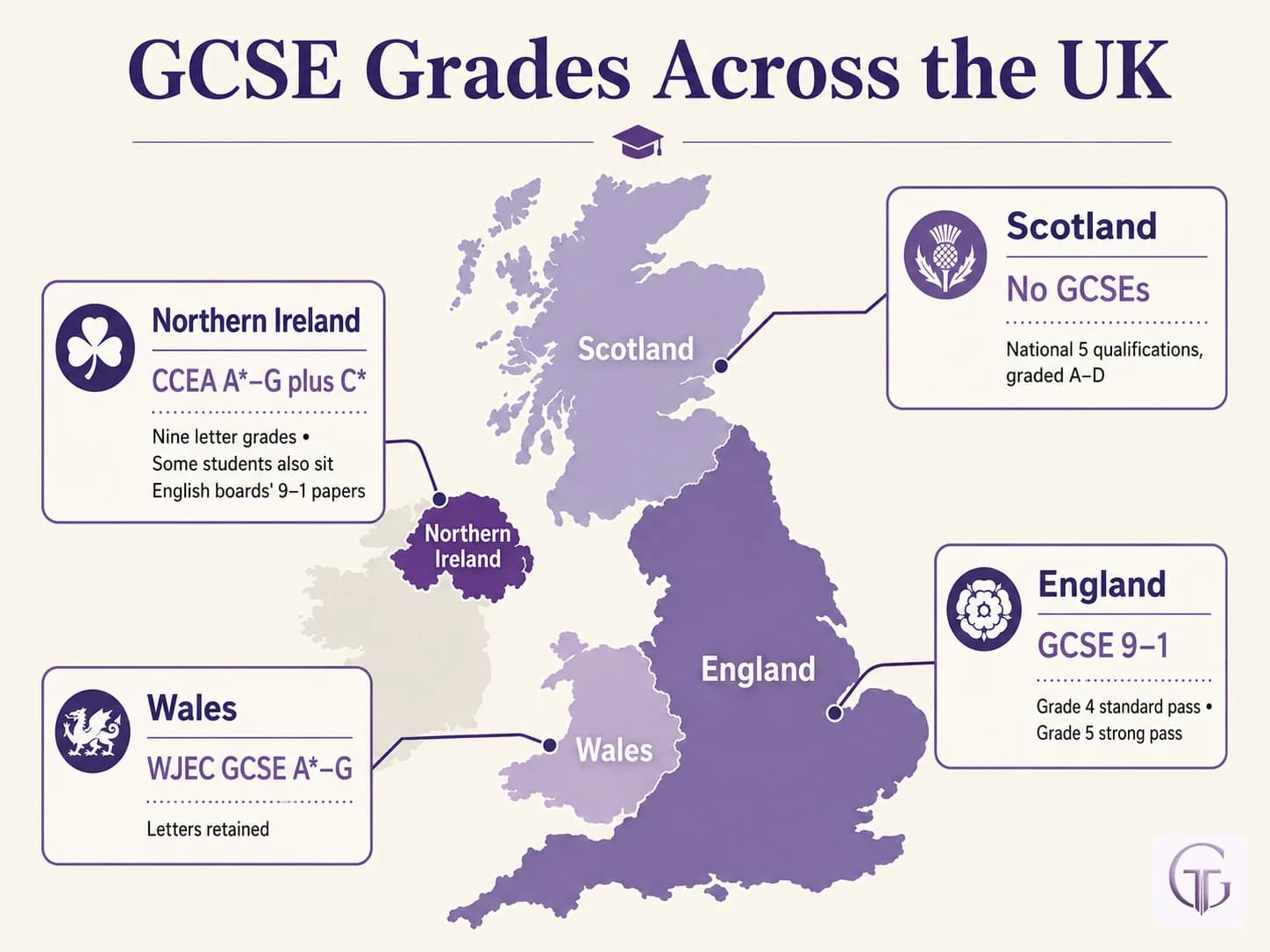
No. Wales kept A–G for WJEC GCSEs. Northern Ireland’s CCEA board uses a nine-grade letter scale, A–G plus a new C*, though some NI students sit English boards’ 9–1 papers. Scotland doesn’t have GCSEs at all.
This trips up a lot of online guides, several of which claim Northern Ireland adopted a “modified 9–1.” It didn’t. CCEA kept letters but added a ninth grade, C, specifically so its scale could line up with England’s: the C aligns with grade 5, the B with grade 6, and CCEA’s A* is calibrated against the 9, as set out in CCEA’s guide to GCSE grading changes. A minority of NI students take English exam boards’ papers and receive numbers, which is why some Northern Irish results slips mix both.
| Nation | Scale | The detail that matters |
| England | 9–1 | All GCSEs since 2020. Grade 4 standard pass, 5 strong pass |
| Wales | A*–G (WJEC) | Letters retained; C remains the benchmark pass |
| Northern Ireland | A–G including C (CCEA) | Nine letter grades; C aligns with a 5, A calibrated with a 9. Some students also sit 9–1 papers from English boards |
| Scotland | No GCSEs | National 5 qualifications, graded A–D; a National 5 C is broadly comparable to a grade 4 |
What do GCSE grades actually unlock?
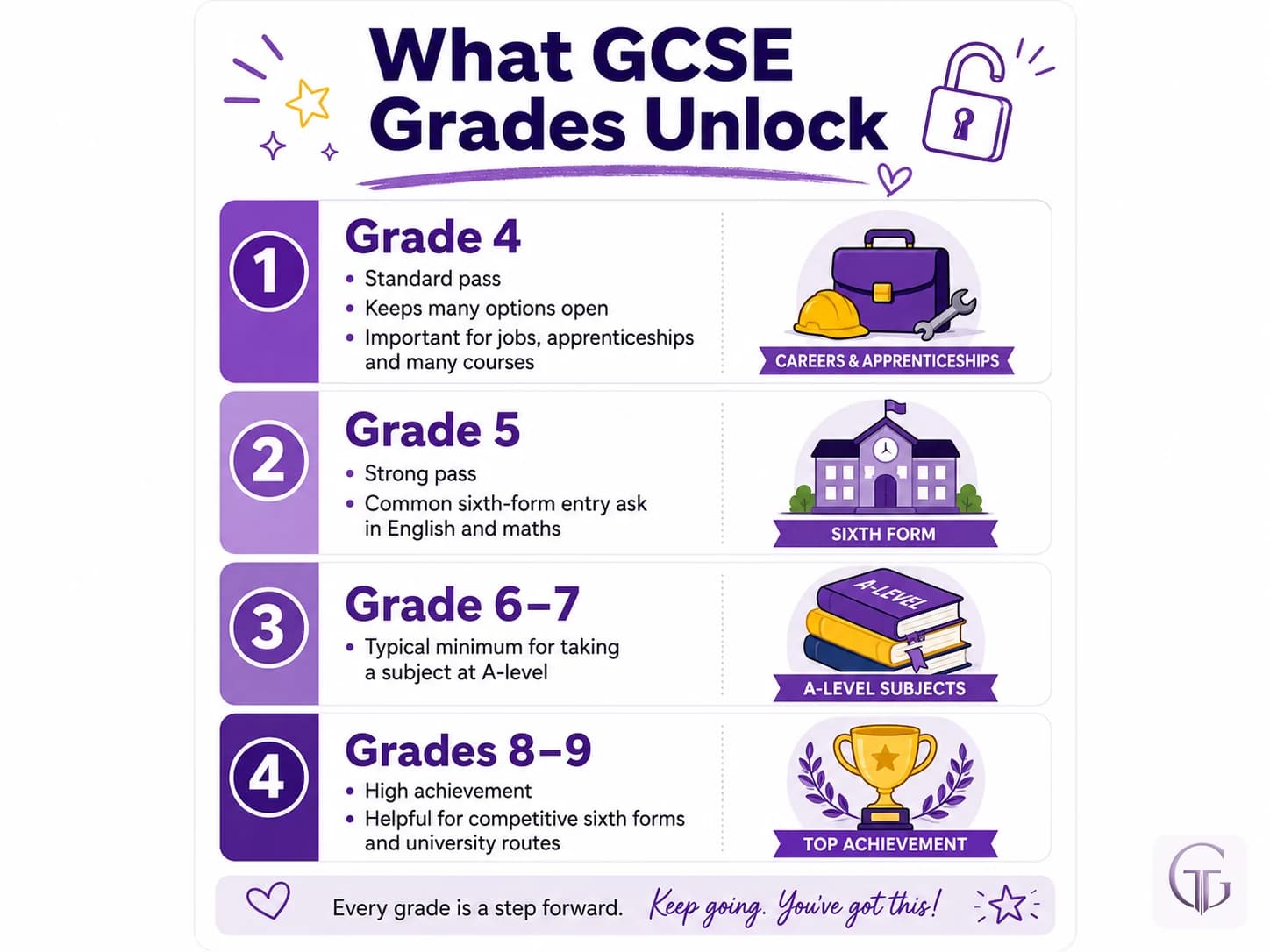
Grade 4 in English and maths keeps doors open: apprenticeships, college courses, most jobs. Grade 5 meets typical sixth-form entry. A 6 or 7 is the usual floor for taking a subject at A-level. Grades 8–9 mostly matter for competitive university courses.
Sixth form and A-levels
The standard ask is five GCSEs at grade 4 or above, with 5s in English and maths and a 6+ in each subject you want to study at A-level. Competitive sixth forms go higher. And GCSEs don’t vanish after Year 11: medicine, dentistry, law and Oxbridge applications all look back at the GCSE profile, sometimes with hard subject minimums.
Employers and apprenticeships
For most jobs and apprenticeship programmes, grade 4 English and maths is the screening line, often checked automatically before a human reads the application. Higher and degree apprenticeships tend to ask for more. Adults sitting on a 3 from years ago aren’t stuck, either; GCSEs can be retaken at any age.
If results day doesn’t go to plan
A disappointing slip is a fork, not a wall. Papers can be reviewed and appealed, English and maths can be resat in November, and everything else can be resat the following summer. The worst move is deciding anything in the first hour of results morning. The second worst is repeating the same revision approach that didn’t work, our guide on how to revise for GCSEs covers what to change.
Will the 9–1 scale change again?
Not soon. The Curriculum and Assessment Review, published in November 2025, is reshaping GCSE content and cutting exam time, with reformed courses first taught from 2029 or 2030 but none of the accepted recommendations replaces the 9–1 grade scale.
Parents sometimes hear “GCSEs are changing” and assume the letters are coming back. They aren’t. The current reform programme changes what’s taught and how much exam time students face, not how results are graded. Anyone sitting GCSEs this decade will get numbers.
Frequently asked questions
What is a grade 9 equivalent to in old GCSE grades?
Nothing, exactly, it sits above the old A. Grades 8 and 7 absorb the old A and A range, with the bottom of a 7 pinned to the bottom of an A. A 9 marks the top few per cent nationally.
Is a grade 3 a fail?
Officially it’s “below a standard pass” rather than a fail, but in practice it doesn’t meet most entry requirements. In English and maths, a 3 means continued study and a resit; in other subjects, it simply carries less weight on applications.
What percentage do you need for each GCSE grade?
There’s no fixed percentage. Grade boundaries are set after every exam series and vary by subject, exam board and tier, sometimes dramatically. Past-paper boundaries are a rough guide only; treat any chart claiming exact percentages with suspicion.
Can old letter grades be converted to numbers for job applications?
State the grades you were actually awarded. Employers and universities understand both scales, and Ofqual’s official position is that the systems don’t convert one-to-one. Claiming a specific number equivalent on an application can misrepresent the grade.
Does Foundation tier limit the grade you can get?
Yes. In tiered subjects, maths, the sciences and most languages, Foundation papers cap the result at grade 5. Higher tier papers award 9 down to 4, with a narrow safety-net 3. Tier choice is worth an active conversation with the school, not a default.
Are 9–1 GCSEs harder than the old A*–G ones?
The course content became harder with the 2015 reforms, more material, tougher questions, almost no coursework. The grading itself was held steady, though: comparable outcomes means roughly the same share of students passes as before. Harder exams, same pass rate.
Need GCSE Support?
Get one-to-one online GCSE tutoring for Maths, English, Science and other GCSE subjects from home.