
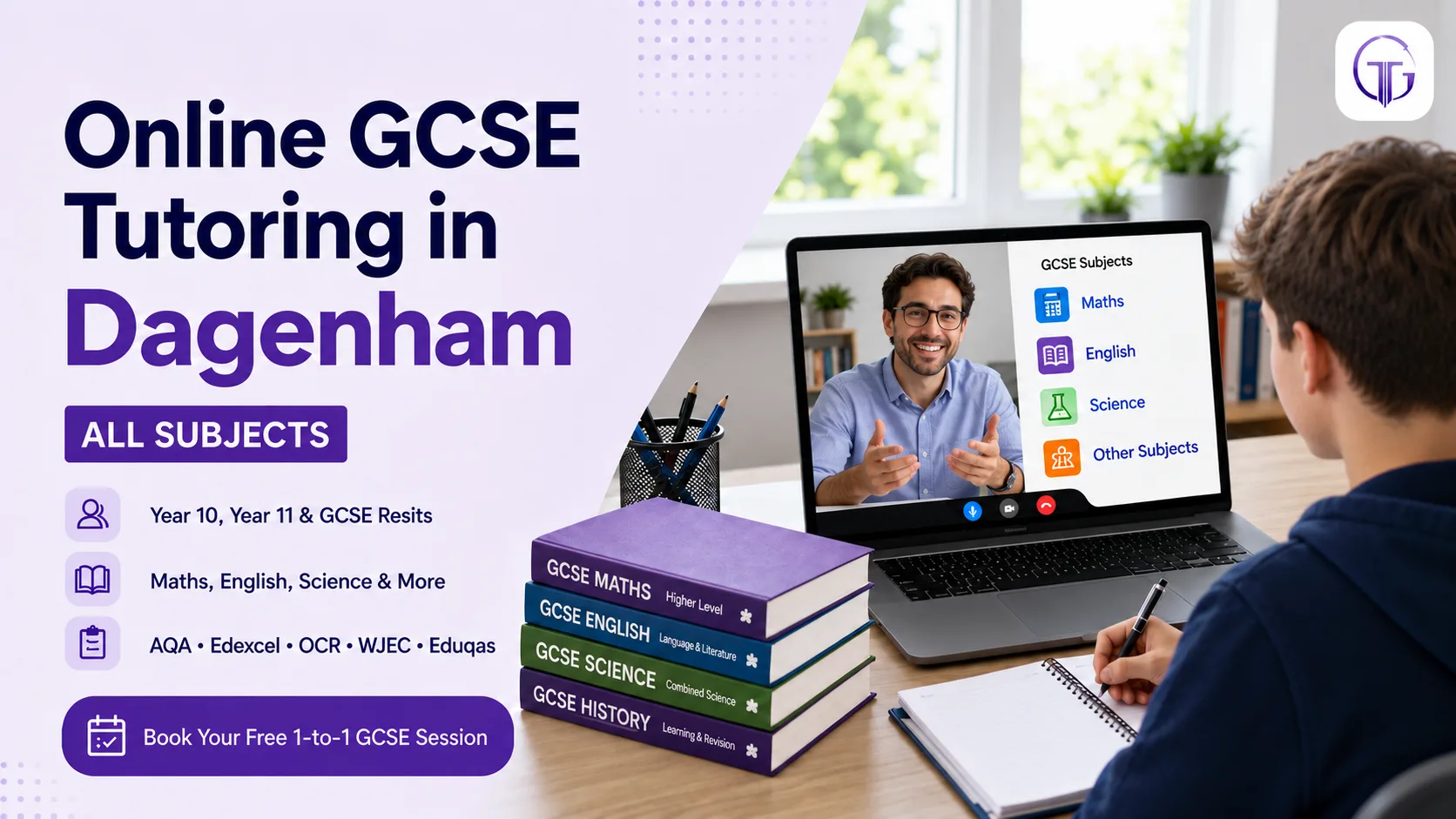
Online GCSE Tutoring in Dagenham
One-to-one lessons for Year 10, Year 11 and resit students, £30 per lesson
Online GCSE tutoring in Dagenham, in every main subject. Many of the enquiries we get from RM8, RM9 and RM10 come with a quiet admission halfway through: I have not actually asked my son yet, because I know what he will say.
It is one of the most common situations in tutoring and one of the least discussed. The parent can see the problem. The student either cannot, or can and does not want help with it.
This page is about that gap: why students say no, how to have the conversation, and the cases where the student’s instinct is sound. The first session is free, and it only happens if they agree to it.
What Dagenham parents ask
- How to raise tutoring without a row.
- Why my child is so against it.
- Whether to book anyway.
- What a trial should look like.
- When to accept the answer is no.
Why do students say no to a tutor?
Rarely laziness. The refusal usually has a specific reason behind it, and the reason decides what to do next.
The most frequent one is what tutoring seems to say about them. To a fifteen year old, being given a tutor can feel like an announcement that they are failing, especially if friends do not have one.
Next comes tiredness. A Year 11 timetable, homework, a part-time job or football training leaves very little, and another hour of school on a Tuesday evening looks like the last of their free time disappearing.
Then there is history. A student who had a tutor before who talked at them, or who made them feel stupid, is not refusing tutoring in general. They are refusing a repeat of that experience, which is entirely reasonable.
If a previous tutor was the problem, our Neasden page covers how to tell a bad match from a hard subject.
What the refusal usually means
| What they say | What it often means |
|---|---|
| I do not need it | I do not want to look like I need it |
| I have no time | I need some evenings that are mine |
| Tutors are boring | The last one did not work |
| I will do it myself | Let me have some control |
Patterns from our own enquiries, not a survey.
How do you raise it without a fight?
Start from the problem they already recognise, offer real choices, and set an end date.
Begin with something the student already cares about. A sixth form that wants a 6 in Maths, a mock grade they were unhappy with, a college course with an English requirement. That is their problem, and a tutor is one possible answer to it, not a verdict on them.
Then hand over real decisions. Which subject, which evening, whether the camera is on for the first session. Choices that seem small to an adult are often what turns a no into a reluctant yes.
Finally, put a boundary on it. Agreeing to try four lessons and then review is a much smaller ask than signing up until June. Most students who agree to a defined trial stay, because by the end of it they can see whether it is helping.
The Education Endowment Foundation’s summary of parental engagement is a useful read here: the approaches that help most support learning at home rather than simply adding pressure.
A conversation that tends to work
Name their goal
Not yours.
Ask what is getting in the way
And listen.
Offer help as an option
One of several.
Give them the choices
Subject, time, format.
Agree a short trial
With a review date.
When might the student be right?
More often than parents like to hear. Not every slipping grade needs a tutor.
Sometimes the student has a plan and simply has not shared it. A Year 11 who is going to the school’s after-school revision sessions, working through past papers and asking their teacher for feedback may genuinely not need anything else yet.
Sometimes the problem is not academic. Exhaustion, anxiety, friendship trouble or something at home will not be fixed by an extra lesson, and adding one can make it worse.
And sometimes they are right about timing. Tutoring in the autumn of Year 10 to fix a grade that is fine for now can wait until there is a clearer reason. Agreeing to revisit after the mocks respects their judgement and keeps the door open.
The problems money does not solve are set out on our Hampstead page. Dagenham students come from schools including Robert Clack, Jo Richardson, Eastbrook and Sydney Russell, most of which run their own after-school support that is worth checking first.
Signs to wait
- They have a credible plan of their own.
- The school support has not been tried.
- The real issue is wellbeing, not content.
- The grade is on track for their goal.
- They will agree to review after the mocks.
Which GCSE subjects can your child get help with?
Whichever one they choose to start with.
Maths
Foundation and Higher. See GCSE Maths tutoring.
English Language and Literature
Both qualifications. See GCSE English tutoring.
Combined and Triple Science
Specialist tutors. See GCSE Science tutoring.
Computer Science
Programming and theory. See GCSE Computer Science tutoring.
Business Studies
Theory and numbers. See GCSE Business Studies tutoring.
History, Geography and RS
Subject to availability.
What about a reluctant resit student?
Resistance is often strongest here, because the subject already feels like a defeat.
A sixteen year old resitting Maths has often decided they are bad at it. The first job is not content, it is showing them a question they can now do that they could not before.
The resit itself is not optional. The 16 to 19 maths and English condition of funding keeps a student studying English or Maths after a grade 3, with Functional Skills level 2 an option for those at grade 2 or below.
For resit students
- Entry is decided by the college.
- November covers Maths and English Language.
- Early wins matter more than coverage.
- Lessons fit around college hours.
See GCSE resit tutoring and the exam dates page.
How does an online lesson run?
From the student’s own room, on video with a shared whiteboard, at a time they helped choose.
Student agrees to a free session
Not booked behind their back.
They pick the subject to start with
Usually the one that bothers them most.
A slot that protects their free time
Agreed with them.
Four-lesson trial
Then an honest review.
Continue, change or stop
Their view counts.
See how it works for more. Barking and Dagenham lists term dates and planned closures for 2026 to 2027, and each school sets its own training days.
What does a GCSE tutor in Dagenham cost?
£30 for each one-to-one lesson, with no block to commit to.
Not having to sign up for a term is what makes a trial possible. A student is far more willing to try something they know they can walk away from.
The GCSE tutoring cost guide sets out the wider market, and our online and in-person comparison is honest about where each format works best.
What £30 covers
- A one-to-one lesson with a subject specialist.
- A slot the student helped choose.
- No contract or minimum term.
- No registration fee.
- A different tutor if this one does not click.
Tell us where things stand at home
Including whether your child knows you are asking. That is fine either way.
- Year group and subject.
- Whether the student is on board yet.
- Latest grades and targets.
- Any previous tutoring.
- Times the student might accept.
Want to talk first? WhatsApp us or use the contact page.
Send an enquiry
Frequently asked questions
Is it worth booking a tutor if my child refuses?
Not as a first move. A student who sits through a lesson they did not agree to usually learns very little. It is better to find out what the refusal is about first, because the answer changes what helps.
Why do teenagers resist tutoring?
The common reasons are embarrassment, tiredness, a bad previous experience, feeling that it signals failure, or simply wanting some say. Most of those can be addressed once they are named.
How do I raise it without a row?
Lead with the problem the student already recognises, such as a mock grade or a sixth form condition, rather than the solution. Offer a choice of subject, time or format, and agree a trial with an end date.
What if they agree to one session and then want to stop?
Ask what did not work, and take the answer seriously. Sometimes it is the tutor, sometimes the timing, and sometimes the student was right that they did not need it.
Does online tutoring help with a reluctant student?
It can. There is no journey, no one else sees them go, and the lesson happens at home at a time they helped choose. Those small things lower the cost of saying yes.
Which subjects do you cover?
Maths, English Language and Literature, Combined and Triple Science, Computer Science and Business Studies. Humanities if a specialist is free.
What does a lesson cost?
£30 a lesson, one to one, and the student gets a say in the slot.
Are you based in Dagenham?
No. All lessons are online, and the business is registered in Feltham, west London, not RM10.
Book a free GCSE session for your child in Dagenham
One free one-to-one session, no card details and no obligation, booked once your child has agreed to try it. If they would rather ask us questions first, they are welcome to message us themselves.