
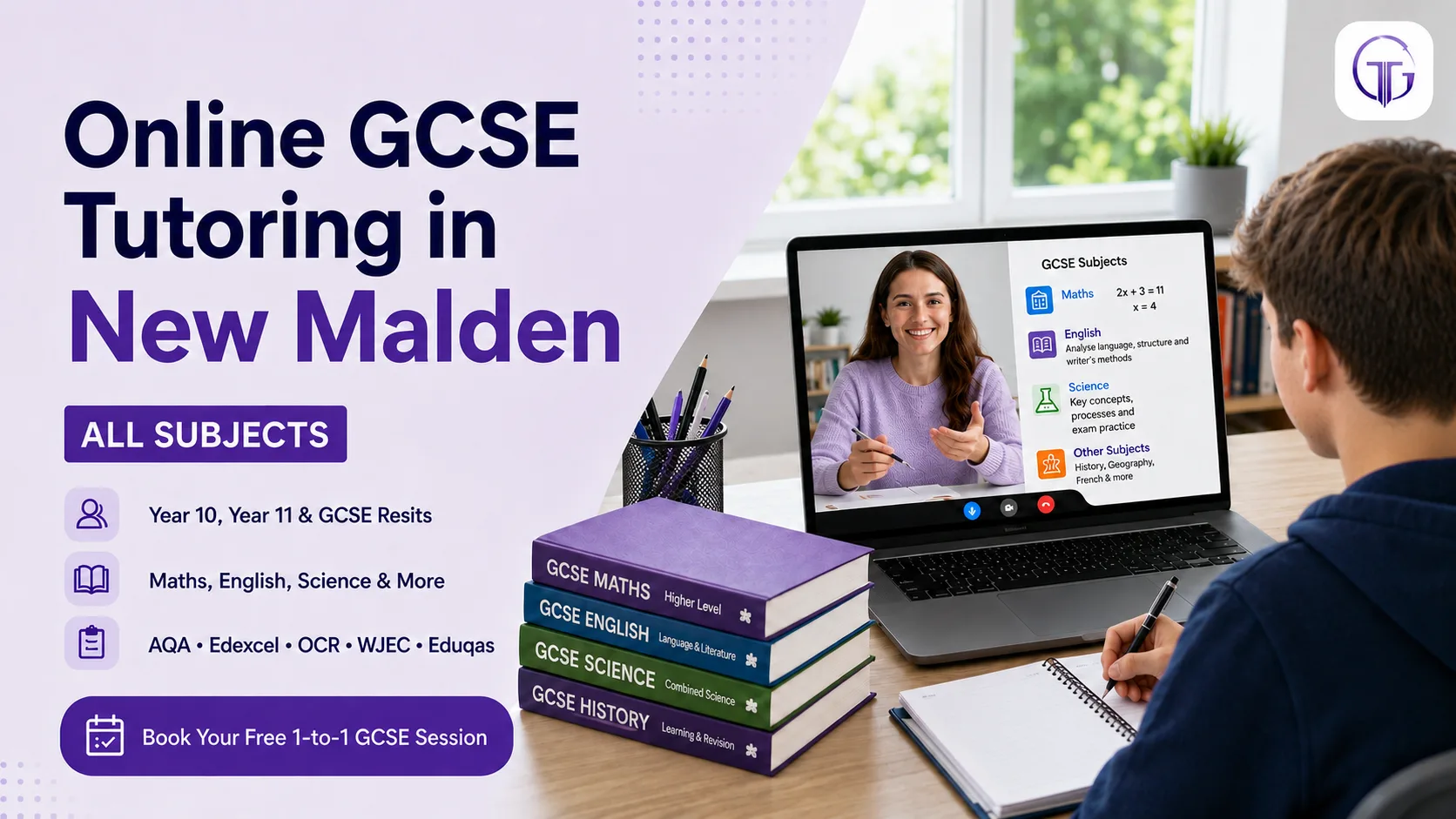
Online GCSE Tutoring in New Malden
One-to-one lessons for Year 10, Year 11 and resit students, £30 per lesson
Online GCSE tutoring in New Malden across every subject we teach. A lot of the questions we get from KT3 are not about tutoring at all. They are about what a parent should be doing on the evenings in between.
Lessons run one-to-one over video from your own table, which has a side effect parents like: you can hear how your child is being taught without sitting in the room.
The first session is free and it is a real lesson. Afterwards the tutor will tell you what would genuinely help at home, which is usually less than families expect.
What New Malden parents ask
- How much to help without taking over.
- What to do when they ask for the answer.
- Whether to check homework, and how closely.
- How to help in a subject you never studied.
- Maths and English before the Year 11 mocks.
What can a parent actually do that helps?
Three things, none of which require knowing the subject, and all of which are more useful than explaining the content.
The first is holding the mark scheme. A student answers a past paper question, hands you the mark scheme, and you read out whether each point was earned. You do not need to understand a word of it. What the student gets is the experience of being marked by somebody who is not sympathetic to their reasoning, which is precisely what an examiner is.
The second is running the clock. Almost nobody practises under real time at home, and time pressure is where a large share of marks disappear. Setting a timer and taking the paper away when it goes off is a job any parent can do, and it produces information nothing else does.
The third is asking them to explain it back. When a student is stuck and asks for the answer, ask them to tell you what the question is asking. A good proportion answer themselves partway through, because the difficulty was in reading the question rather than knowing the content.
What does not help is explaining the content, particularly if you learned it thirty years ago under a different syllabus. Methods change, mark schemes reward specific working, and a parent teaching an older method leaves a student with two competing versions and no confidence in either.
The line between helping and doing
| Helps | Does not |
|---|---|
| Reading out the mark scheme | Marking it generously yourself |
| Timing a paper | Letting it run over "just this once" |
| Asking them to explain the question | Explaining the question to them |
| Checking homework happened | Correcting it before it is handed in |
| Being in the house | Being at the desk |
Does homework support actually make a difference?
At secondary level, yes, and more than at primary. What matters is what happens in the time rather than how much of it there is.
The Education Endowment Foundation, which reviews evidence for the Department for Education, rates homework as having a positive impact for secondary students, with the important qualifier that quality and purpose matter far more than quantity. Long sessions of unfocused work produce very little.
That lines up with what a tutor sees. A student doing forty minutes on the specific question type that went wrong last week gains more than one doing two hours of general revision, and considerably more than one copying notes out neatly.
It also explains why the parental job above works. Marking, timing and questioning all push the work towards being purposeful, which is the variable the evidence points at, and none of them require you to teach anything.
Our guide on how to revise for GCSEs covers the methods themselves, and the revision timetable guide covers structuring the week.
A workable weekly rhythm
- One timed past paper question per subject, marked properly.
- A short list of anything that came out wrong twice.
- That list handed to the tutor or the teacher, not solved at home.
- Homework checked for existence, not for accuracy.
- One evening a week with nothing scheduled at all.
The last one is not sentimental. Students who never stop revise worse by February.
Which GCSE subjects can your child get help with?
All of them from this one page, with a specialist for each subject.
Maths
Foundation and Higher tier, and the subject where practice beats reading by the widest margin. See GCSE Maths tutoring.
English Language and Literature
Reading questions, structured writing and the set texts. See GCSE English tutoring.
Combined and Triple Science
Three strands with three specialists, required practicals included. See GCSE Science tutoring.
Computer Science
Programming, algorithms and the written paper. See GCSE Computer Science tutoring.
Business Studies
Case studies, calculations and evaluation answers. See GCSE Business Studies tutoring.
Humanities
History, Geography and Religious Studies, when a specialist is free.
What happens if maths or English falls short?
The subject carries on after Year 11. It is a funding condition rather than a school preference.
The 16 to 19 maths and English condition of funding, updated in July 2026, means a student who starts post-16 study without grade 4 in maths or English has to carry on with that subject. Grade 3 means a GCSE route. Grade 2 or below allows Functional Skills level 2 as well.
The home role changes a little for a resit student, because they are usually managing it alongside a full college timetable and nobody is chasing the homework. Timing a paper once a week matters more, not less.
Two series
- November takes Maths and English Language only.
- Roughly ten weeks from results day.
- All other subjects wait for the following summer.
- The provider decides entry timing.
See GCSE resit tutoring and the exam dates page.
How does an online lesson run?
Video, a shared whiteboard, and paper at the student’s end. You can hear it happening from the next room, which several parents say is the point.
Tell us what home looks like
Where they work, and what usually goes wrong in the hour.
Free one-to-one session
A real lesson, no card details, then a straight report.
A short list for the week
One topic to practise, not a syllabus to revise.
You hold the mark scheme
Marking, timing, and nothing else.
Review what came back wrong twice
That is what the next lesson covers.
The full process is on how it works. Kingston publishes its school term dates through Achieving for Children, and academies set their own, so check the school itself.
What does a GCSE tutor in New Malden cost?
One to one at £30, with no admin fee and no prepaid bundle.
Weekly and steady works better than intensive and occasional, which happens to be the cheaper of the two as well.
Lesson length is worth checking on any quote, since an hourly price and a per-lesson price are not the same thing. Our guide to GCSE tutoring costs sets out the market.
What £30 covers
- A full one-to-one lesson with a subject specialist.
- Planning against your child’s exam board and tier.
- Marked practice against the real mark scheme.
- A clear job for the week, for the student and for you.
- A tutor change if the match is wrong.
Tell us how the evenings go
What happens at the desk is often the useful information. We reply during the day.
- Year group and subject.
- How long homework takes, and how it goes.
- Exam board and tier, if you know them.
- Current grade and target grade.
- Days and times that work at home.
Rather talk than type? WhatsApp us, or use the contact page.
Send an enquiry
Frequently asked questions
Should I sit with my child while they revise?
Nearby, usually not beside them. Being in the room removes the loneliness that makes revision hard to start. Sitting close enough to see the page turns you into a supervisor, and the student starts performing effort rather than producing it.
My child asks me for the answer. What should I say?
Ask them to explain the question back to you first. Most of the time they answer it themselves halfway through, because the difficulty was in reading it rather than in knowing the content. If they genuinely cannot, that topic goes on a list for the tutor or the teacher.
I do not understand the subject. Can I still help?
Yes, and arguably better than a parent who does. You can hold the mark scheme and read out whether an answer earned the point, which is the single most useful thing anyone can do at home, and it requires no subject knowledge at all.
How much should I be checking their homework?
Check that it happened, not that it is right. Marking your child’s work yourself removes the information the teacher needs, and it turns every evening into an argument you cannot win.
Which GCSE subjects do you cover?
Maths, English Language and English Literature, Combined and Triple Science, the three sciences taught individually, Computer Science and Business Studies, plus humanities subject to availability.
Do you have tutors based in New Malden?
No. All lessons are online and the business is registered in Feltham. Local schools are named as context only.
What does it cost?
£30 a lesson, one to one. No joining fee, and no block booked in advance.
English is not our first language at home. Does that limit how we can help?
Hardly at all for the things that matter most. Holding a mark scheme, timing a paper and asking a student to explain their reasoning all work in any language, and are worth more than help with the content itself.
Book a free GCSE session for your child in New Malden
One free one-to-one session, no card details and no obligation. Ask the tutor afterwards what would help at home, and expect a short answer.