

Somewhere in a warehouse right now there are envelopes with your name on them, already printed, already sealed. They have been sitting there for weeks.
That’s the part students find hardest to get their heads around. The decision was made in July. The morning in August is just when you find out.
GCSE results day 2026 falls on Thursday 20 August 2026. Ofqual recorded 5,661,970 GCSE results issued in England on results day in August 2025 (Ofqual, Qualification results in England: summer 2025), which gives you a sense of how many households are having the same Thursday morning.
This guide walks through what actually happens on the day: when the doors open, what the new results app does, how to read the slip, what each grade opens up in September, and what your options are if the numbers aren’t what you hoped for.
When is GCSE results day 2026, and can the date change?
GCSE results day 2026 is Thursday 20 August 2026 for England, Wales and Northern Ireland. The date is fixed nationally by the exam boards through JCQ. It does not shift because your school breaks up early or runs a different holiday pattern.
A level, AS and T Level students get theirs a week earlier, on Thursday 13 August 2026.
One detail that causes friction every August: your school already has your grades on Wednesday 19 August. Exam boards release results to centres a day early under what’s called restricted release, so exams officers can print slips, stuff envelopes and spot anything missing before the doors open.
Your teachers know. They’re not allowed to say. Asking a favourite teacher to hint at it puts them in a genuinely difficult position, so please don’t.
Here’s the full run of dates worth putting in a phone calendar:
- Thursday 13 August 2026: A level, AS and T Level results day.
- Wednesday 19 August 2026: restricted release to schools and exam centres.
- Thursday 20 August 2026: GCSE results day. Exam boards publish grade boundaries from 8:00am.
- Thursday 20 August 2026, 11:00am: results appear on the Education Record app at participating schools in England.
- Thursday 3 September 2026: AQA deadline for a priority copy of a marked GCSE script.
- Thursday 24 September 2026: deadline for clerical re-checks and reviews of marking.
- 2 to 18 November 2026: JCQ November resit series.
- Thursday 14 January 2027: November resit results day.
Grade boundaries are the most overlooked item on that list. They tell you the minimum mark needed for each grade in your exact paper and series, and boundaries move every summer depending on how hard the papers turned out to be. Knowing you were three marks off a 5 is a completely different situation from being thirty marks off.
What time can you collect your GCSE results on 20 August?
Exam boards permit release from 8:00am, and most schools open the results hall somewhere between 8:00am and 10:00am. The precise time is decided by your own school or exam centre, not nationally, so check their email or website before the day.
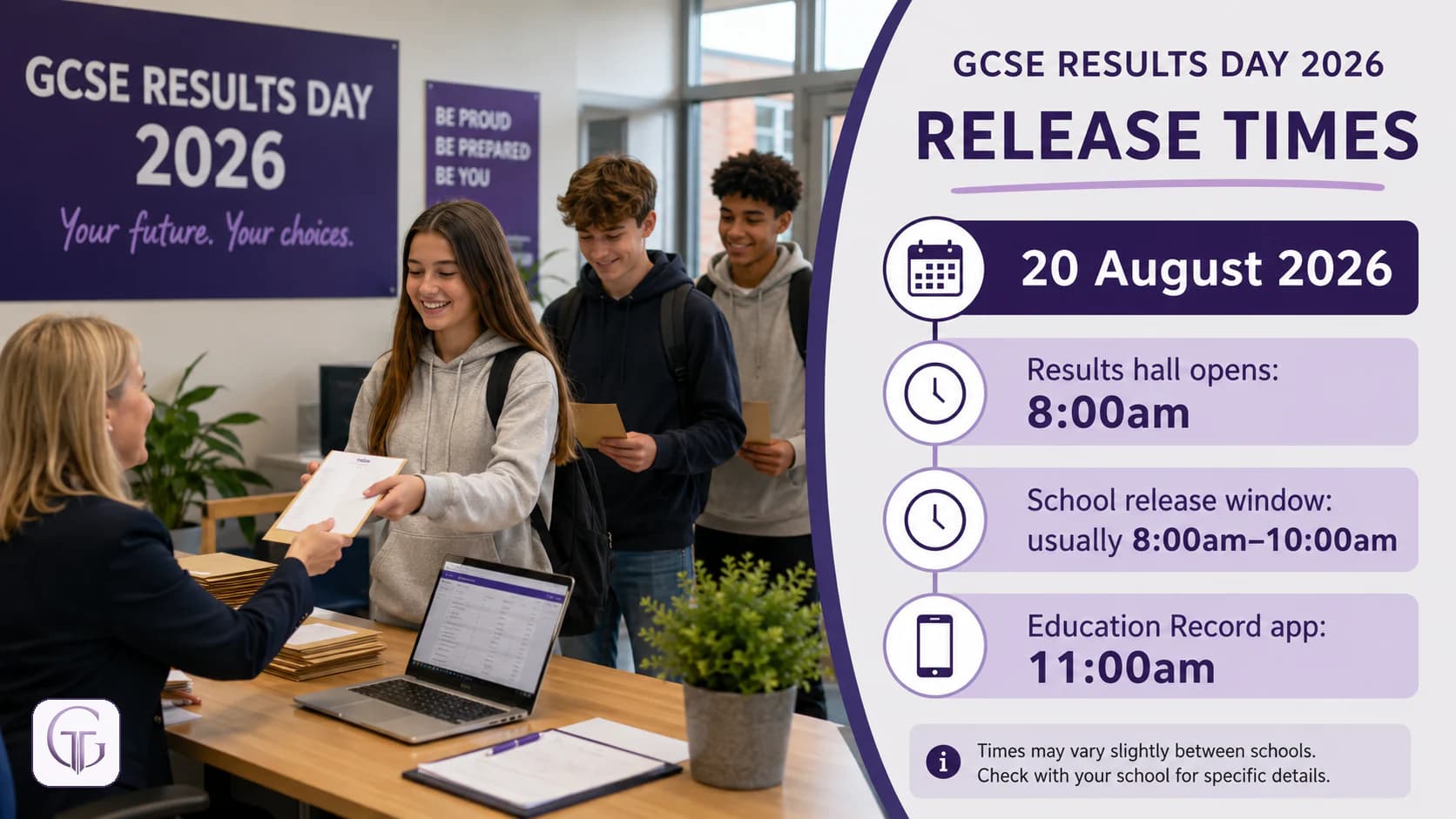
There is no single UK-wide opening time, which trips up a lot of families. Some schools open at 8:00am sharp for Year 11 and run a separate slot for external candidates. Others start at 9:30am because staff are driving in during their holiday. Attached sixth forms often begin enrolment interviews the same morning, so the queue you join at 8:15 may not be the queue you need.
If nothing has landed in your inbox by the week before, phone the school office. Two minutes on the phone beats standing outside a locked gate wondering.
What is the Education Record app, and will your school be using it?
The Education Record app is a Department for Education service that shows Year 11 students in England their GCSE results digitally from 11:00am on results day. It sits alongside the paper slip rather than replacing it, and schools still expect students to collect in person that morning.
This is the one genuinely new thing about results day this year.
The DfE piloted the app in Greater Manchester and the West Midlands, where roughly 4,000 pupils across 29 schools accessed results digitally, following earlier technical trials in Coventry and Oldham. A national rollout for summer 2026 has since been confirmed. The government estimates the system will save schools and colleges around £30 million a year once fully in place.
Its real purpose is enrolment. The app gives you a verified digital record that a college can read straight from your phone, instead of squinting at a folded slip. Barnfield College has told incoming students that arriving with the app set up speeds enrolment up, and that turning up without it means a longer manual check.
Three limits you should know before you rely on it:
- Independent schools were outside the pilot, because they don’t submit the pupil-level census data the record is built from.
- Private candidates and home-educated students may not be covered yet.
- Your school has to have signed up. If it hasn’t, 11:00am will come and go with nothing on the app.
My honest advice is to go into school anyway. The app hands you five numbers. A subject teacher standing in front of you can tell you what those numbers mean for the course you applied to, and that’s the part worth having.
How do you get your results if you’re away or sat exams privately?
Contact your school before 20 August to agree an alternative. Most centres will send results by email, release them through a secure portal, or hand them to a named adult carrying written permission and ID. Every centre sets its own rules.
August is holiday season, and this comes up constantly. If you’ll be abroad, ask for the email or portal route and work out the time difference so you’re not refreshing an inbox at 3am. If a parent or older sibling is collecting on your behalf, most schools want your written permission plus their photo ID.
Private candidates should go back to the centre that entered them. That centre holds the results and handles any post-results requests later, and it cannot be swapped for a more convenient one afterwards.
One thing worth resisting: asking a friend to open your envelope and text you a photo. It happens every year, and hearing your grades secondhand from someone standing in a noisy hall rarely goes the way people imagine.
What does each GCSE grade actually unlock in September?
GCSEs in England are graded 9 to 1, where 9 is highest, 4 is a standard pass and 5 is a strong pass. Wales and Northern Ireland use A* to G for most subjects. English Language and Maths carry far more weight than any other subject on the slip.
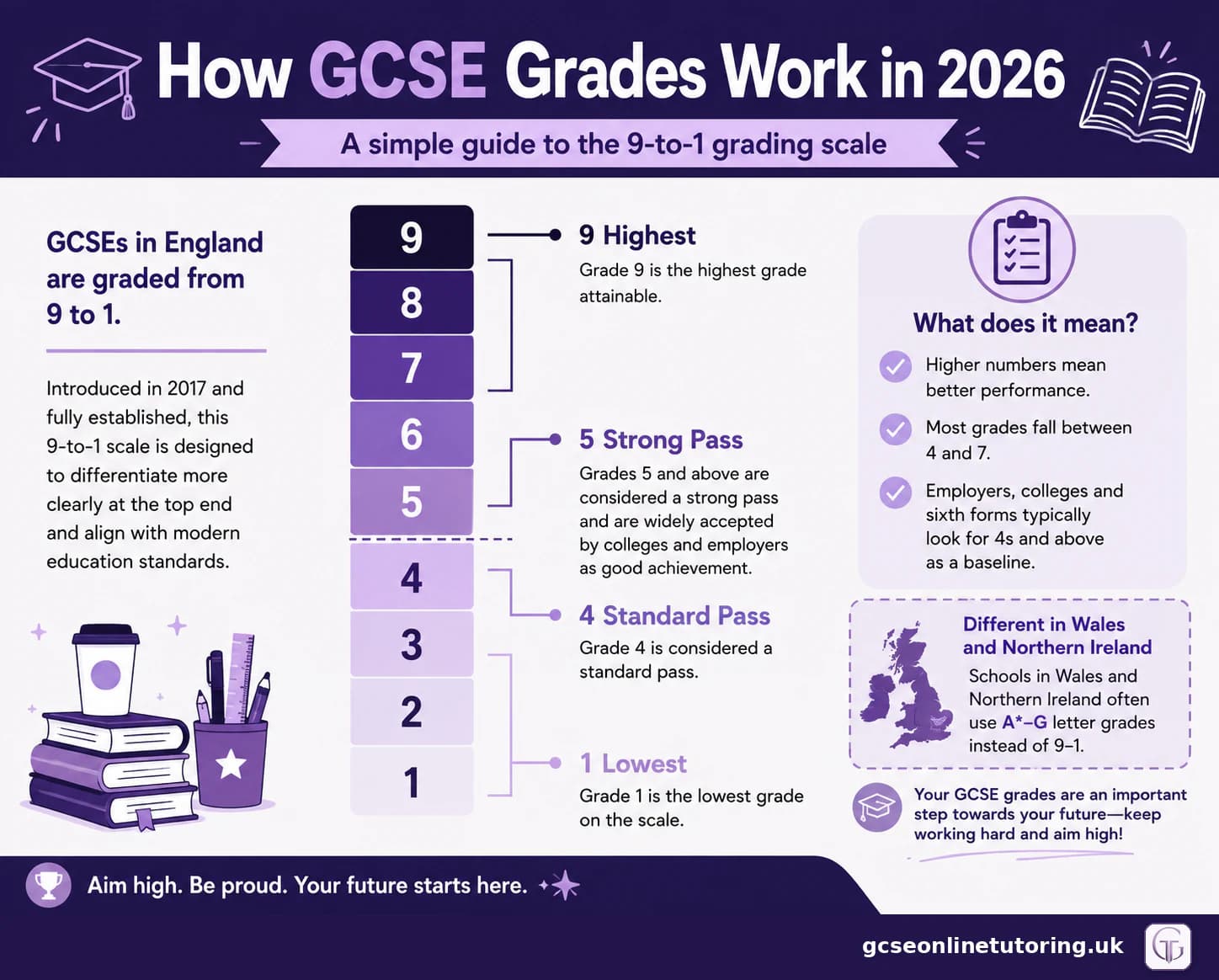
For context on where you sit nationally: 67.1% of GCSE entries in England reached grade 4 or above in summer 2025, and 21.9% of UK entries hit grade 7 or above (JCQ). A grade 6 is comfortably above average, whatever it feels like when a friend is waving an 8 around.
Table 1: What your GCSE grades typically open up
| Grade | What it means | What it usually unlocks |
| 8 to 9 | Top of the scale | Competitive sixth forms, further maths and triple science routes, selective A level combinations |
| 7 | Strong performance | Most A level courses, including subjects that set a grade 7 entry requirement such as maths and sciences |
| 5 to 6 | Strong pass and above | The majority of sixth form and college courses, and most A level subjects |
| 4 | Standard pass | Meets the condition of funding in English and Maths, opens many Level 3 courses, may fall short of specific A level requirements |
| 3 or below | Below a standard pass | Level 2 courses, BTECs, apprenticeships, plus a compulsory English or Maths resit if you are 16 to 19 in England |
The pass thresholds are the part parents most often misread, so it’s worth being clear on how the 9 to 1 scale lines up against the old A* to G letters, because the two don’t map neatly at every point. And if the whole system is new to you, perhaps because your family moved to the UK recently, what a GCSE actually is covers the structure from the beginning.
Two more things about the slip itself. What you receive on the day is a Candidate Statement of Provisional Results, not your certificate. Certificates reach schools roughly 12 weeks later, usually November or December. Keep the slip regardless, because colleges and employers ask for it far more often than you’d expect.
And watch for symbols. An X or a Q means a result is being withheld or is still pending. A hash symbol usually indicates partial absence. Any of those, find an exams officer before you leave.
Which questions should you ask before leaving the results hall?
Read every line of the slip, not just the subject you were anxious about. Query anything missing or marked X or Q, ask for your raw marks in any subject that landed just short, and take the name and email of whoever handles post-results questions.
The building empties fast. By 11:00am most of the people who can help you have gone back to their holidays.
Work through this before you walk out:
- Read the whole slip, including subjects you felt confident about.
- Flag anything marked X, Q or with a hash symbol to an exams officer straight away.
- Ask for raw marks in any subject that came in one grade below expectation.
- Write down the name, email and direct number of the post-results contact.
- Confirm your sixth form or college place, in writing if you can get it.
- Speak to the provider the same morning if a grade puts an offer at risk.
- Photograph the slip before folding it into a pocket.
Point three does the heavy lifting. Without your raw marks and the published boundaries, any conversation about a remark is guesswork.
Is it worth asking for a remark?
Speak to your school first. From there you can request a copy of the marked script, a clerical re-check, a review of marking, or plan a resit. All requests go through your centre, and a review can lower your grade as easily as raise it.
Post-results services for summer 2026
| Service | What it checks | Deadline | Can your grade drop? |
| Access to scripts | Nothing. It sends you the marked paper so you can judge whether to go further | Priority copy of a GCSE script: 3 September 2026 (AQA) | No |
| Clerical re-check | Whether marks were added, recorded and transferred correctly | 24 September 2026 | Possible, though rare |
| Review of marking | Whether the mark scheme was applied correctly to your answers | 24 September 2026 | Yes. Up, down or unchanged |
| Review of moderation | Moderation of coursework and non-exam assessment across a cohort | 24 September 2026 | Applies to the cohort, not one student |
| Appeal | A formal stage after a review decision | Usually 30 days from the review outcome | Varies by board |
Students cannot approach AQA, Pearson Edexcel, OCR, WJEC or CCEA directly. Your centre submits on your behalf, and it needs your written consent first, precisely because grades can fall. A review of marking takes up to 20 calendar days, which matters if a college place is waiting on the answer.
Here’s the view I’d offer, having read a lot of these stories from families: a remark makes sense when you came out of the exam certain it had gone well and the grade contradicts that. It rarely makes sense when you knew during the paper that it was going badly. Reviewers check whether the mark scheme was applied properly. They do not re-mark you more generously. The JCQ post-results services page sets out the official rules for each board.
If the problem is a grade 3 in English or Maths, put the money towards a resit instead. The odds are better and the outcome is in your hands.
How soon can you resit GCSE English or Maths?
English Language and Maths resits run in the November 2026 series, with the JCQ common timetable covering 2 to 18 November 2026 and results on 14 January 2027. Every other GCSE subject waits for the summer 2027 exam season.
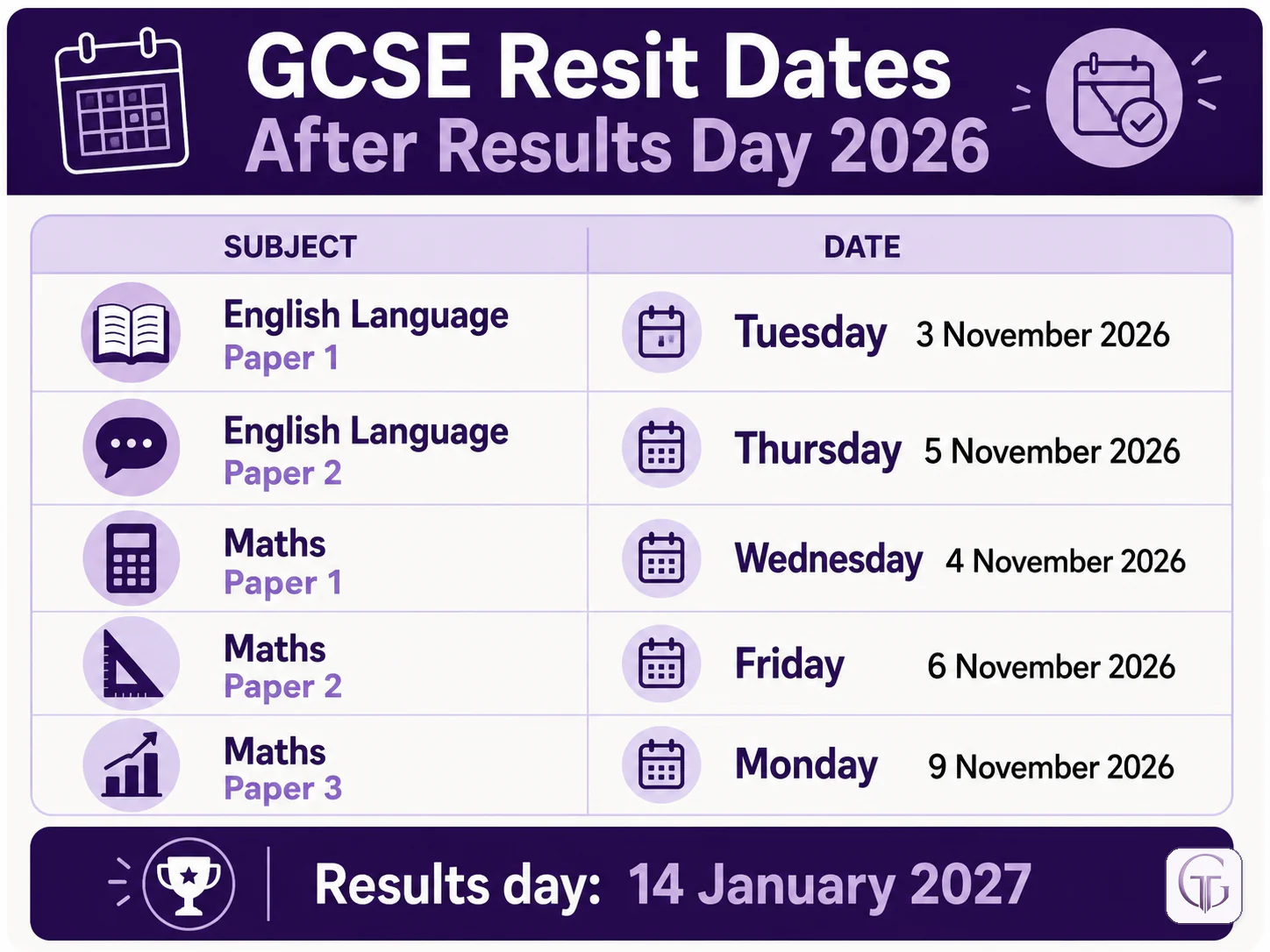
Table 3: November 2026 GCSE resit dates
| Subject | Paper | Date | Boards |
| English Language | Paper 1 | Tuesday 3 November 2026 | AQA, Edexcel, OCR |
| English Language | Paper 2 | Thursday 5 November 2026 | AQA, Edexcel, OCR |
| Maths | Paper 1 (non-calculator for AQA and Edexcel) | Wednesday 4 November 2026 | AQA, Edexcel, OCR |
| Maths | Paper 2 | Friday 6 November 2026 | AQA, Edexcel, OCR |
| Maths | Paper 3 | Monday 9 November 2026 | AQA, Edexcel, OCR |
Entry deadlines land in early October 2026, usually around 4 October. Your college handles entry if you’re enrolled there. Private candidates arrange it themselves through an exam centre.
On cost: if you’re 16 to 19 in England without a grade 4 in English Language or Maths, the resit is normally funded and you won’t pay a fee. If you already hold a grade 4 and want a 6 for a competitive course, expect to cover the entry fee yourself. Fees differ between centres, so ask first. If you’re weighing up paid support alongside the resit, what GCSE tutoring costs in the UK sets out realistic hourly rates before you start ringing round.
Ten weeks is genuinely enough to lift a grade 3 to a grade 4 in Maths. It is not enough to lift a 3 to a 6. Set the target honestly and plan backwards from 3 November.
What works in that window is narrow and repetitive: identify four or five topics that cost you the most marks, then drill those with past paper questions until they stop being scary. Re-reading the whole specification feels productive and achieves very little. How to revise for GCSEs covers the techniques with evidence behind them, and a structured revision timetable stops the autumn drifting away. Focused GCSE English or GCSE Maths support, or a dedicated GCSE resit tutor, tends to help most when it’s aimed at those specific gaps rather than the whole course again.
What if your child opens the envelope and falls apart?
Let them have the first ten minutes without a plan attached. Ask what they want to do before offering an opinion, keep the big decisions for the afternoon, and remember that enrolment desks at most colleges stay open all week.
Results morning is a terrible moment for a family strategy meeting. Emotions are high, half the information is still missing, and nothing has to be settled by lunchtime.
A few things that do help:
- Find out the school’s opening time and whether parents are allowed into the hall.
- Save the college admissions number before you leave the house.
- Say something specific about the effort rather than something general about being proud.
- Put the slip somewhere safe the same day.
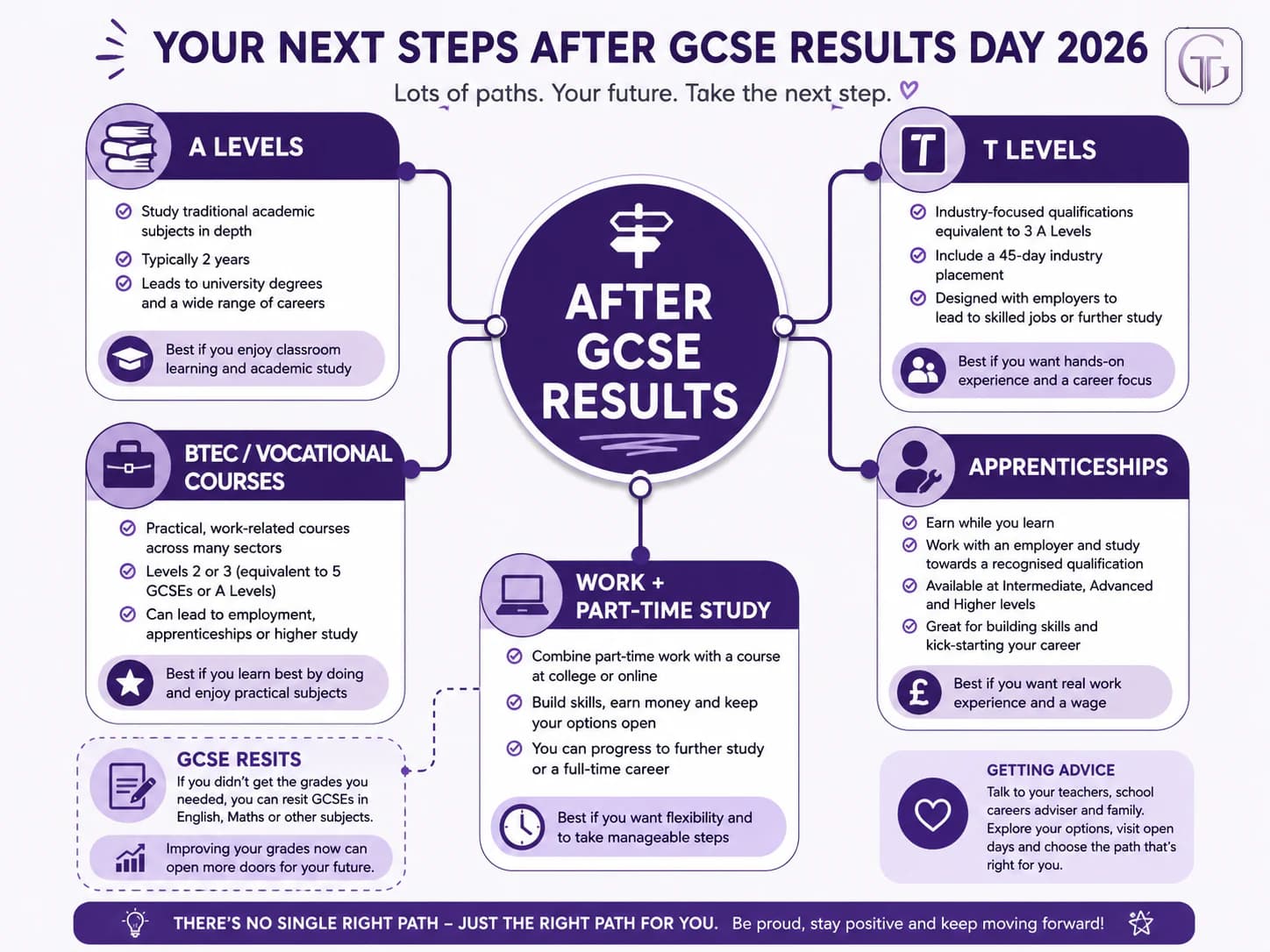
And keep some perspective on where a disappointing set of grades actually leads. A levels are not the only route. T Levels are equivalent to three A levels and include a 45-day industry placement. BTECs are assessed in units across the year rather than in one exam fortnight, which suits a lot of students far better. Apprenticeships pay a wage while you study. In England you must stay in education or training until 18, but that duty says nothing about which form it takes.
If the plan is a resit or a stronger run at Year 11 next year, the timing of support matters more than the amount of it. When to start GCSE tutoring explains why September beats February, and how our online lessons work covers what a first session involves. For students who already have a solid grade and want the top band next time, getting a grade 9 in GCSE Maths is a different project from passing, and it needs a different plan.
For official guidance on entitlements and next steps, the Ofqual student guide on GOV.UK is the document your school will be working from.
If the distress lasts beyond results week, or your child has been anxious for months rather than days, that’s worth raising with a GP or the school’s pastoral team rather than waiting to see whether it passes.
Frequently Asked Questions
What date is GCSE results day 2026?
Thursday 20 August 2026, across England, Wales and Northern Ireland. Schools receive results the day before under restricted release, but no student can be given grades until the Thursday.
Why does my school get GCSE results before I do?
Exam boards send results to centres on Wednesday 19 August so exams officers can print slips, prepare envelopes and identify missing or pending results before students arrive the following morning.
Do I need to bring anything to collect my GCSE results?
Photo ID if your school asks for it, and written permission if someone else is collecting on your behalf. Rules vary by centre, so check with your school in the week beforehand.
What time do grade boundaries get published in 2026?
Exam boards publish grade boundaries on results day itself, with AQA releasing its tables from 8:00am. You need your raw marks from the school to make use of them.
Can I still get into sixth form if I miss a grade?
Often, yes. Speak to the sixth form or college the same morning, because many will consider a student who missed a requirement narrowly, particularly if the rest of the profile is strong.
How long do GCSE certificates take to arrive?
Around 12 weeks after results day, usually November or December, and they are sent to your school rather than to you. Keep your results slip in the meantime.
Is a GCSE resit free?
For 16 to 19 year olds in England without a grade 4 in English Language or Maths, the resit is normally funded. Improving an existing grade 4, or resitting other subjects, usually means paying the entry fee.
Need GCSE Support?
Get one-to-one online GCSE tutoring for Maths, English, Science and other GCSE subjects from home.