
Three folders can sit in one Year 11 student’s bag: AQA Science, Pearson Edexcel Maths and OCR Computer Science. That mix is normal. Yet using revision material for the wrong board can waste an evening and teach the wrong paper routine.
The difference between AQA, Edexcel and OCR GCSE exams lies mainly in each subject specification, paper structure, question wording, optional content and mark scheme. The standard is regulated across England. In summer 2026, schools and colleges made 5,840,185 GCSE entries, according to Ofqual’s provisional entries data. That scale explains why accurate board and specification details matter.
This guide compares the three boards without pretending one is automatically easy. It uses current examples from GCSE Maths, English Language and Combined Science, then shows how to find the right materials and revise efficiently.
What is the difference between AQA, Edexcel and OCR GCSE exams?
AQA, Pearson Edexcel and OCR are awarding organisations that create GCSE specifications and assessments. They follow regulated subject requirements, but can organise content, papers, timings, optional topics and mark schemes differently. The meaningful comparison is therefore between exact subject specifications, not board names alone.
AQA stands for Assessment and Qualifications Alliance. Pearson owns the Edexcel awarding brand. OCR originally stood for Oxford, Cambridge and RSA, and its current public branding also uses Cambridge OCR.
Each organisation publishes a specification. That document states what students must learn, how the qualification is assessed and which assessment objectives apply. A qualification code, such as AQA Maths 8300 or OCR Maths J560, identifies the exact course.
| Comparison point | AQA | Pearson Edexcel | OCR |
|---|---|---|---|
| Organisation type | Regulated awarding organisation | Regulated awarding organisation owned by Pearson | Regulated awarding organisation within Cambridge University Press & Assessment |
| Common short name | AQA | Edexcel | OCR |
| What can vary | Paper design, content grouping, options and mark schemes | Paper design, content grouping, options and mark schemes | Paper design, content grouping, options and mark schemes |
| What does not vary freely | National subject content and regulated grade standards | National subject content and regulated grade standards | National subject content and regulated grade standards |
| Best identifier | Subject plus specification code | Subject plus specification code | Subject plus specification code |
Schools choose boards subject by subject. A student does not normally select a board independently, and a school does not have to use one organisation for every GCSE.
What do GCSE exam boards actually do?
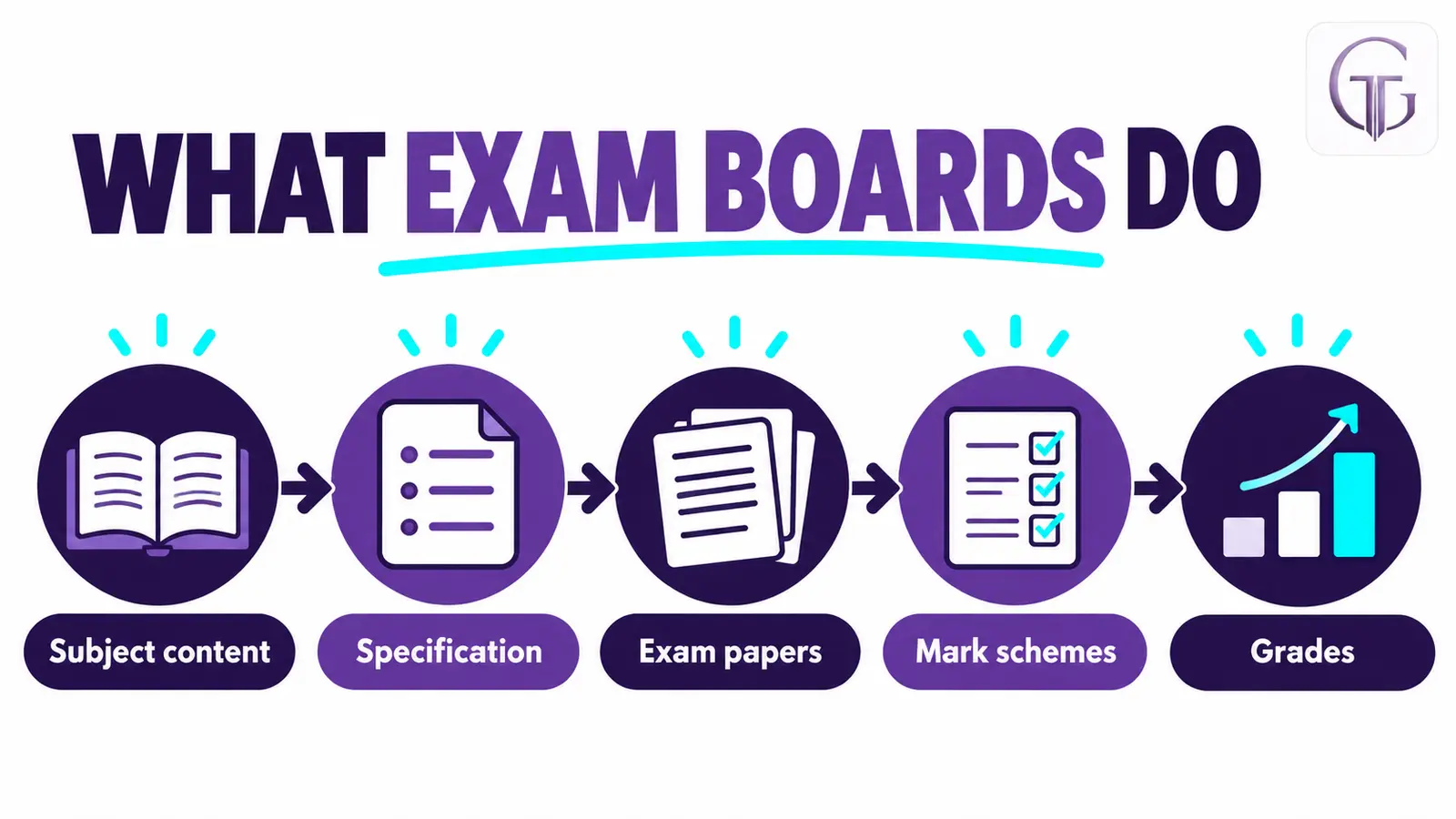
GCSE exam boards turn national subject requirements into teachable specifications and assessable papers. They approve centre entries, produce examination materials, train markers, mark scripts, award grades and publish results. Schools teach the chosen specification, while Ofqual regulates standards in England.
The Department for Education sets GCSE subject content for qualifications in England. Awarding organisations decide how to arrange that content inside an accredited specification and how to test it within the permitted assessment model.
An exam board’s work includes:
- Publishing specifications and assessment objectives
- Producing sample papers, past papers and mark schemes
- Setting live exam papers and secure materials
- Training and standardising examiners
- Marking scripts and moderating relevant non-exam assessment
- Setting grade boundaries after marking evidence is available
- Issuing results and supporting post-results services
A specification is not a textbook. It is the course contract. Revision resources should help a student meet it, but they should never replace it.
Are AQA, Edexcel and OCR GCSEs the same standard?
Yes. GCSEs from AQA, Pearson Edexcel and OCR must meet the same regulated qualification level and national subject requirements in England. Their assessments can look different, but awarding and statistical evidence are used so a grade should represent a comparable standard across boards.
Comparable does not mean identical. One English paper might last longer, and one Maths board might place its non-calculator paper second rather than first. Different texts, optional historical periods or practical contexts can also change the learning experience.
The grade printed on the certificate still carries the same GCSE level. Universities, sixth forms and employers do not treat an AQA grade 6 as a different qualification level from an OCR grade 6.
Students sometimes confuse familiarity with difficulty. A paper looks easier when its layout, command words and timing have been practised repeatedly. A first attempt from another board can feel odd even when the underlying subject demand is similar.
Is AQA, Edexcel or OCR the easiest GCSE exam board?
No board is universally easiest. Difficulty depends on the subject, specification, paper, student strengths and that year’s assessment. Grade boundaries respond to paper demand, so a harder paper may require fewer marks for a grade. Choose resources by specification fit, not internet rankings.
Claims that one board “always has nicer questions” are usually anecdotes dressed as analysis. A student who likes extended writing may prefer one paper design, while another prefers short, stepped prompts. Neither preference proves lower academic demand.
Grade boundaries are not fixed pass percentages. After scripts are marked, awarding teams use evidence to place boundaries so standards remain stable over time. Ofqual’s guide to GCSE grading explains why raw marks can change between exam series.
Our plain view is this: stop shopping for an “easy board” once a school has entered the student. Learn the actual specification and paper better than the competition.
How do AQA, Edexcel and OCR GCSE Maths exams differ?
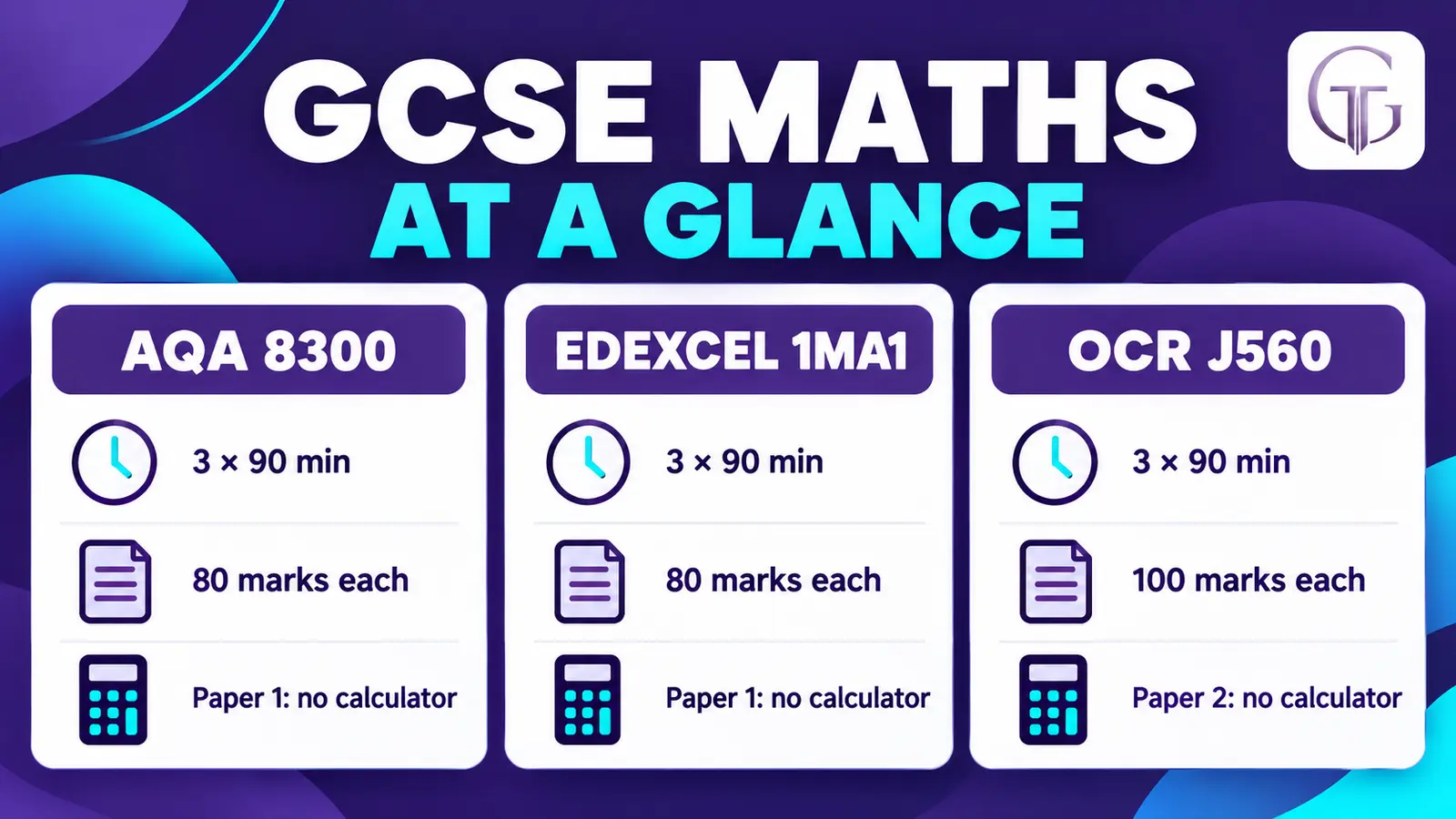
All three current GCSE Maths specifications use three 90-minute papers and Foundation or Higher tiers. AQA and Edexcel make Paper 1 non-calculator, while OCR makes Paper 2 non-calculator. OCR papers carry 100 marks each; AQA and Edexcel papers carry 80.
| Board and code | Papers | Calculator arrangement | Marks | Weighting | Tiers |
|---|---|---|---|---|---|
| AQA 8300 | 3 × 1 hour 30 minutes | Paper 1 non-calculator; Papers 2 and 3 calculator | 80 per paper | 33.3% each | Foundation and Higher |
| Pearson Edexcel 1MA1 | 3 × 1 hour 30 minutes | Paper 1 non-calculator; Papers 2 and 3 calculator | 80 per paper | 33.3% each | Foundation and Higher |
| OCR J560 | 3 × 1 hour 30 minutes | Papers 1 and 3 calculator; Paper 2 non-calculator | 100 per paper | 33.3% each | Foundation and Higher |
Content is sampled across the papers rather than assigned to a predictable topic list for each one. Students should not revise algebra only for Paper 1 or statistics only for Paper 3.
The calculator order changes practice. An OCR student who automatically brings calculator habits to Paper 2 can lose time. AQA and Edexcel students need that non-calculator discipline immediately on Paper 1.
Foundation and Higher tier choices matter more than board folklore. The online GCSE Maths tutoring page explains how board, tier and weak topics should shape support. Students aiming high can also use the site’s grade 9 Maths guide for harder problem-solving practice.
How do AQA, Edexcel and OCR GCSE English Language exams differ?
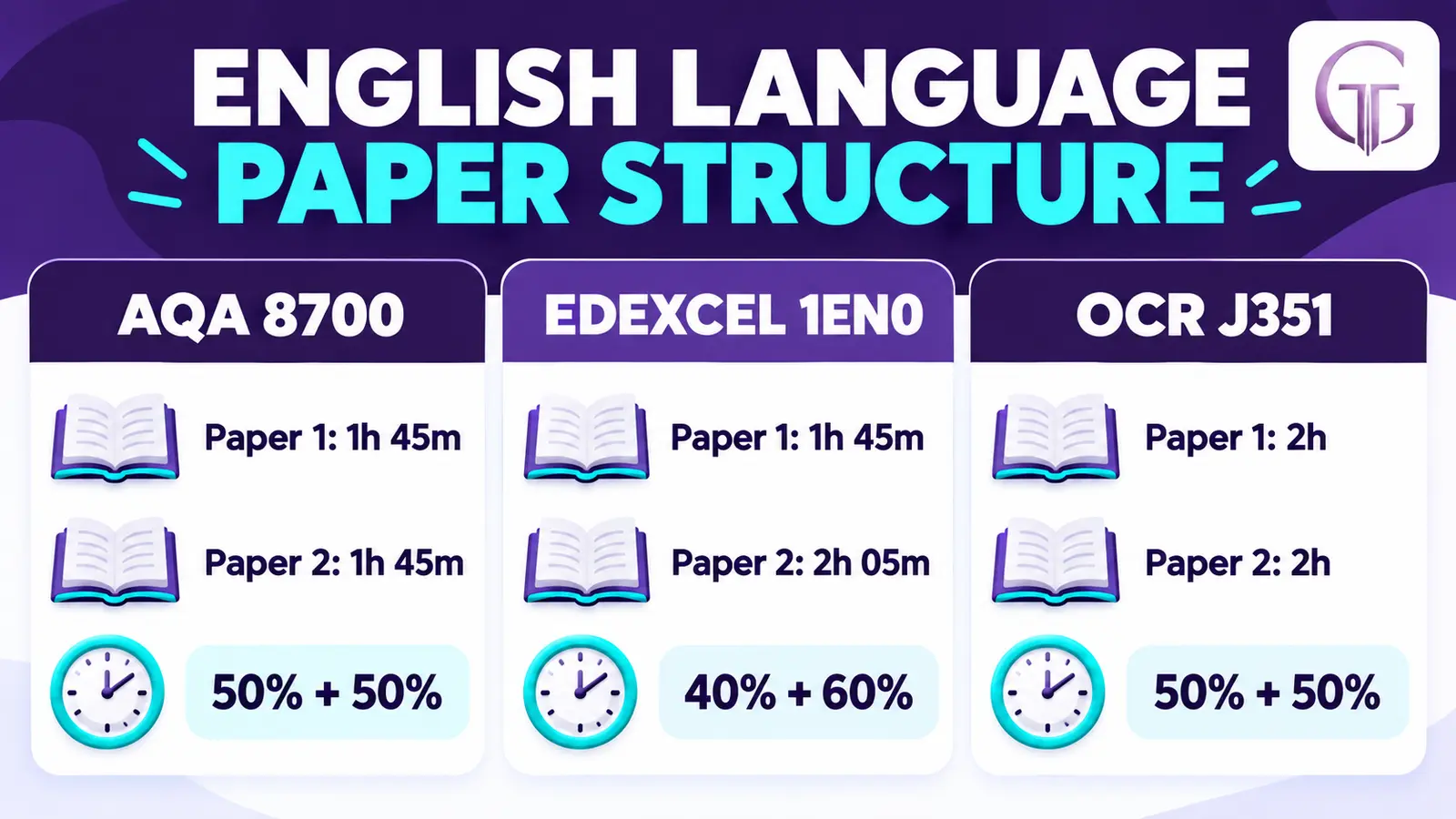
The boards assess reading and writing through two written papers plus a separately reported spoken-language endorsement, but timings and weightings vary. AQA uses two equally weighted 1-hour-45-minute papers, Edexcel weights its longer second paper at 60%, and OCR uses two two-hour papers.
| Board and code | Paper 1 | Paper 2 | Written weighting | Spoken language |
|---|---|---|---|---|
| AQA 8700 | 1 hour 45 minutes, fiction reading and creative writing | 1 hour 45 minutes, non-fiction reading and viewpoint writing | 50% + 50% | Separate endorsement |
| Pearson Edexcel 1EN0 | 1 hour 45 minutes, fiction and imaginative writing | 2 hours 5 minutes, non-fiction and transactional writing | 40% + 60% | Separate endorsement |
| OCR J351 | 2 hours, non-fiction reading and transactional writing | 2 hours, literary prose reading and imaginative writing | 50% + 50% | Separate endorsement |
Those differences alter timing plans. Edexcel Paper 2 carries more weight and more available marks than Paper 1. OCR students face two longer sessions. AQA students need two balanced paper routines.
Reading skills overlap, but question order and labels do not transfer neatly. Practising a random “Question 5” without naming the board is sloppy revision. Use the GCSE English tutor page for board-aware support, and see the detailed guide to revising English Language Papers 1 and 2 for timing and writing drills.
How do AQA, Edexcel and OCR GCSE Combined Science exams differ?
Each example uses six written papers across Biology, Chemistry and Physics, with Foundation and Higher routes. AQA Combined Science: Trilogy papers last 75 minutes and carry 70 marks. Pearson Edexcel and OCR Gateway papers last 70 minutes and carry 60 marks.
| Board and code | Written papers | Time per paper | Marks per paper | Broad structure |
|---|---|---|---|---|
| AQA Combined Science: Trilogy 8464 | 6 | 1 hour 15 minutes | 70 | Two papers each for Biology, Chemistry and Physics |
| Pearson Edexcel Combined Science 1SC0 | 6 | 1 hour 10 minutes | 60 | Two papers each for Biology, Chemistry and Physics |
| OCR Gateway Combined Science A J250 | 6 | 1 hour 10 minutes | 60 | Two papers each for Biology, Chemistry and Physics |
The headline numbers look similar, but the topic organisation, required practical wording and question sequence still follow each specification. AQA Trilogy is not the same course document as OCR Gateway.
Students must also confirm whether they take Combined Science or separate Biology, Chemistry and Physics. That single detail changes the qualification codes, content depth, papers and final awards. The site’s GCSE Science tutoring page covers Combined and Triple Science support across boards.
Do GCSE grade boundaries differ between exam boards?
Yes. Each board sets grade boundaries for each specification and exam series after marking. Raw-mark boundaries can differ because papers are not identical. A lower boundary does not prove that a board is easier; it may reflect a more demanding paper that year.
A raw mark is the number of marks earned. A grade boundary is the minimum raw mark needed for a particular grade. The board combines component marks according to the specification weighting before awarding the qualification grade.
Do not use last year’s boundary as a guaranteed target. It can help with rough practice-paper interpretation, but the live series will have its own boundary. Track accuracy, topic coverage and mark-scheme performance instead.
For a broader explanation of numbered grades, standard passes and strong passes, read GCSE grades explained.
How can a student find their exam board and specification?
Ask the subject teacher or exams officer first, then confirm the board, subject title, qualification code, tier and exam series on the school timetable or course documents. Never rely on a textbook colour, a friend’s course or a search result with a similar title.
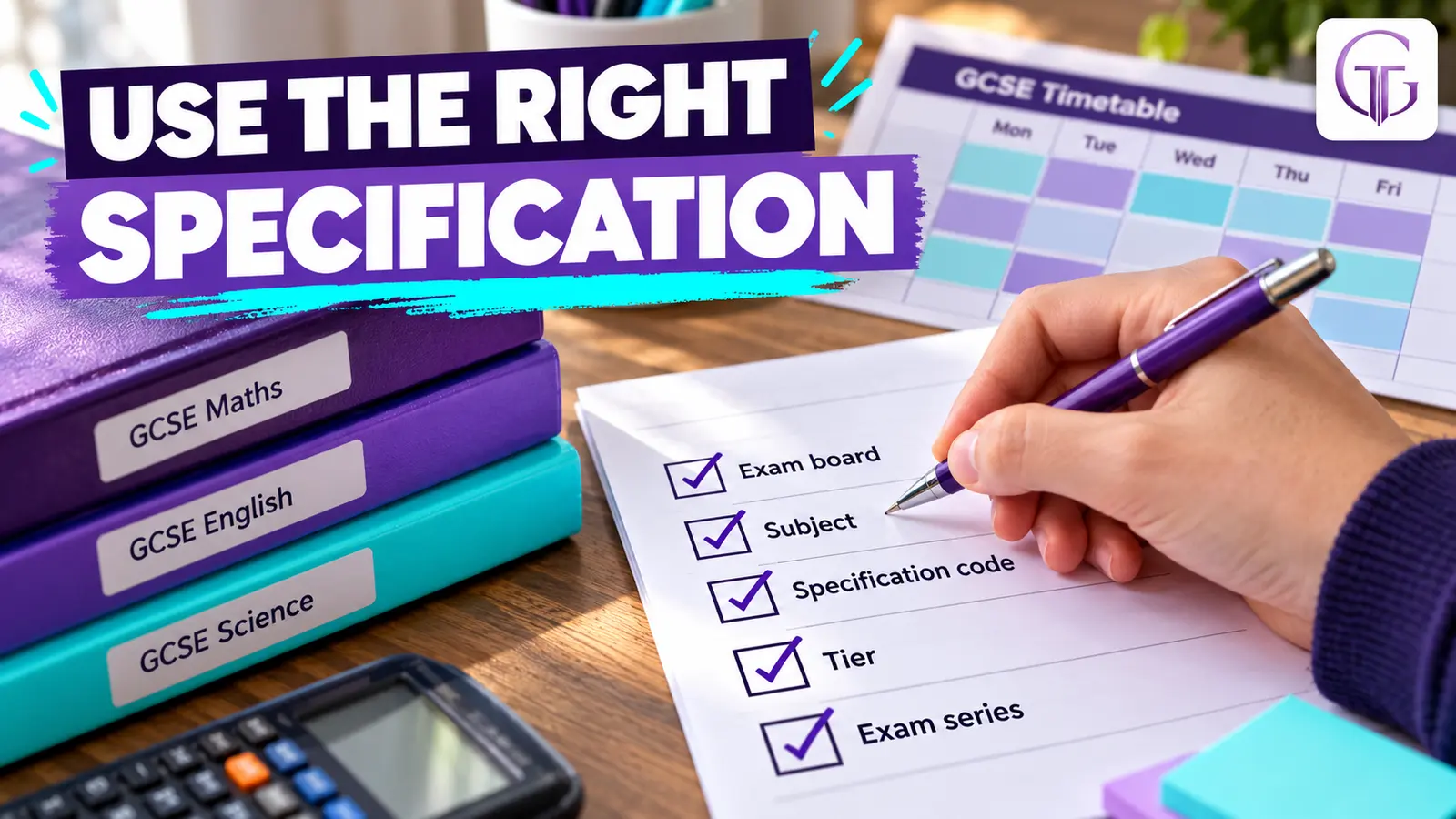
Use this five-point check before downloading a paper:
- Write the awarding organisation: AQA, Pearson Edexcel or OCR.
- Record the exact subject, such as Mathematics or Combined Science: Trilogy.
- Find the specification code, such as 8300, 1MA1 or J560.
- Confirm Foundation or Higher tier where the subject is tiered.
- Check the paper number and exam series before printing.
The school’s personal timetable is the final authority for a student’s entries. Our GCSE exam dates guide explains how board, paper code and tier appear alongside national dates.
What happens if a student changes school or exam board?
A school move can create content gaps even when both courses lead to the same GCSE subject. Compare both specifications immediately, identify missed topics, texts or options, and ask the new teacher which assessments remain. Do not assume previous classwork maps across perfectly.
Maths often transfers more cleanly because national content is tightly defined, though sequencing can differ. English Literature, History, Geography and Religious Studies may involve different texts, periods, case studies or options. Science topic order and practical records may also need checking.
Parents should ask the new school for:
- The full qualification title and code
- The taught options or set texts
- A topic checklist showing work already completed
- Any non-exam assessment or spoken-language records
- Mock results and marked work
- A catch-up plan with dates and priorities
Students moving close to exams need triage, not a new shelf of books. A GCSE resit tutor can also help older learners map prior knowledge onto a current entry.
How should revision change for AQA, Edexcel or OCR?
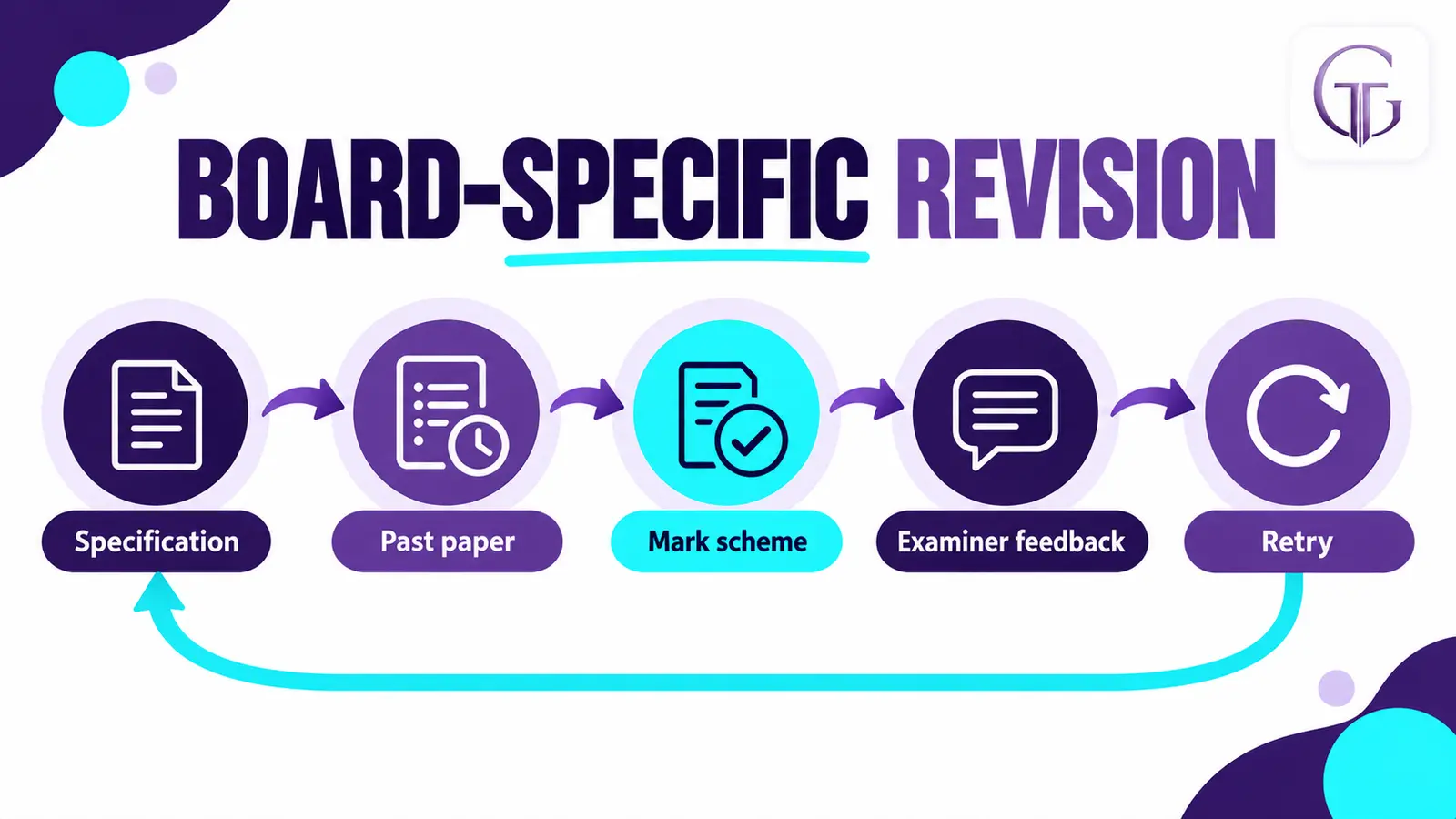
Revision methods stay broadly the same, but practice materials must match the exact specification. Learn content from the specification, attempt the correct board’s questions, mark with its scheme, study examiner feedback and retry mistakes. Board-specific practice matters most for timing and response style.
Start with the complete GCSE revision guide, then make the resources precise. A useful weekly cycle is:
- Choose one specification point.
- Recall the knowledge without notes.
- Complete board-matched questions.
- Mark with the official scheme.
- Label each error as knowledge, method, interpretation or timing.
- Rewrite or recalculate the weak response.
- Retry it several days later.
Mixing boards can be useful after core preparation, especially for extra Maths practice. But the student should first master their own board’s structure and language. Near mocks, use the correct papers under timed conditions.
A realistic GCSE revision timetable should name the board-specific task, not merely “revise English”. Write “Edexcel 1EN0 Paper 2 transactional writing, 35 minutes” and the next action is obvious.
How should private candidates choose an exam board?
Private candidates should begin with an exam centre, not a preferred textbook. Confirm which boards, specifications and components the centre accepts, plus entry deadlines and fees. Choose a qualification only when every required written, spoken, practical or non-exam component can be completed.
Availability can be the deciding factor. A course may look perfect online, but a local centre might not accept its speaking test, practical arrangement or non-exam assessment. International GCSE and UK GCSE are also different qualification families, so check the title carefully.
Ask the centre in writing for the specification code, entry option, tier, component arrangements and total cost. Keep that confirmation. Private entry gets expensive when one small code is wrong.
When does an exam-board specialist tutor help?
A specialist tutor helps when a student knows the subject but loses marks through board-specific timing, question interpretation or mark-scheme demands. The tutor should confirm the specification code, diagnose marked work and teach transferable knowledge alongside the exact response style required.
Board familiarity matters, but subject teaching comes first. A weak tutor with a stack of matching papers is still a weak tutor. Look for someone who can explain the content, analyse errors and connect each lesson to school teaching.
Before lessons begin, share the board, code, tier, recent mock paper and target areas. The online tutoring process shows how those details support better matching and planning. If paper pressure is getting in the way of practice, the guide to tackling GCSE exam anxiety offers a calmer starting point.
What questions do students and parents ask about GCSE exam boards?
Students and parents usually ask whether one board is harder, whether schools can mix boards, how to identify a specification and whether resources transfer. The short answers below separate regulated standards from the practical paper differences that genuinely affect teaching and revision.
Can a student take AQA for one GCSE and Edexcel for another?
Yes. Schools commonly choose different awarding organisations for different subjects. The student’s personal timetable and subject documents should show each board and paper code.
Is Edexcel harder than AQA?
Not as a general rule. Compare the exact subject specifications, paper demands and the student’s strengths. Grade boundaries adjust for differences in paper demand across each series.
Is OCR recognised by universities?
Yes. OCR GCSEs are regulated qualifications and are recognised alongside equivalent AQA and Pearson Edexcel GCSEs.
Can I revise with another exam board’s past papers?
Yes, after mastering your own specification. Other-board questions can provide extra subject practice, but they should not replace correct-board papers for timing, content coverage and mark-scheme preparation.
Do all three boards use grades 9 to 1?
Yes, for reformed GCSEs in England. Grade 9 is the highest grade and grade 1 is the lowest numbered grade.
Does the exam board appear on a GCSE certificate?
The certificate identifies the awarding organisation and qualification. Schools may issue results documents first, followed by formal certificates later.
Can a student switch exam boards in Year 11?
The school or exam centre controls entries. A late switch is possible only if the centre agrees and the remaining teaching, assessment and administration can be completed. It should never be treated as a quick route to easier papers.
Need GCSE Support?
Get one-to-one online GCSE tutoring for Maths, English, Science and other GCSE subjects from home.