
A student opens an unseen extract, recognises every word and still has no idea what to write for Question 3. That is the odd frustration of English Language. You are not revising a story that will appear in the exam. You are rehearsing what to do with whatever appears.
Knowing how to revise for GCSE English Language Paper 1 and Paper 2 means learning each question’s job, practising one skill at a time and using feedback to improve the next attempt. Copying model paragraphs is not enough. The exam asks you to make decisions under pressure.
The scale matters. Ofqual recorded 819,260 students receiving GCSE English Language results in England in summer 2026, making it the second-largest GCSE subject by student count. Ofqual’s official results release provides the subject figures.
This guide covers both papers, the current AQA question format, useful drills, past-paper marking and a weekly revision plan. If your school uses Edexcel, OCR, Eduqas or WJEC, keep the methods but replace the question sequence and timings with those from your board.
What should you revise for GCSE English Language?
Revise the paper structure, assessment objectives, reading methods, writing forms, timing and your own repeated mistakes. You cannot memorise the unseen extracts, but you can practise selecting evidence, analysing effects, comparing viewpoints, planning writing and checking technical accuracy under timed conditions.
English Language revision is skills practice. Paper knowledge tells you what each question rewards. Deliberate practice makes the response quicker and more controlled.
Build revision around six components:
- Question knowledge: Know the marks, text focus and assessment objective.
- Evidence selection: Find short quotations that directly support the task.
- Reading analysis: Explain how words, structure and viewpoint create meaning.
- Writing control: Match content, tone and organisation to purpose and audience.
- Technical accuracy: Improve sentences, punctuation, spelling and paragraphing.
- Timing: Finish both sections without stealing time from the 40-mark writing task.
The wider guide to revising for GCSEs explains active recall and spaced practice across subjects. English needs those habits, but it also needs frequent writing. You cannot highlight your way to a stronger paragraph.
Does the GCSE English Language exam board change how you revise?
Yes. AQA, Pearson Edexcel, OCR, Eduqas and WJEC assess similar reading and writing abilities, but their paper lengths, source types, question order, marks and writing tasks differ. Confirm the specification code before using a past paper, video, template or timing plan.
The question-by-question sections below use AQA GCSE English Language 8700, because that format dominates the current UK search results. AQA gives each paper 80 marks and 1 hour 45 minutes. Reading and writing receive 40 marks each, so the writing section is worth half of every paper.
AQA changed parts of Paper 1 for examinations from 2026. Question 1 became multiple choice, Question 3 now directs students towards a specific structural effect, Question 4 has clearer evaluation wording, and one Question 5 option asks for a story opening rather than a complete story. Paper 2 kept its established structure.
Check the AQA specification at a glance against your course. Old practice remains useful for the underlying skills, but outdated prompts should not become your only rehearsal.

What is the difference between English Language Paper 1 and Paper 2?
For AQA, Paper 1 uses one fiction extract and ends with creative writing. Paper 2 uses two linked non-fiction sources from different periods and ends with viewpoint writing. Both last 1 hour 45 minutes, carry 80 marks and divide marks equally between reading and writing.
| AQA feature | Paper 1 | Paper 2 |
|---|---|---|
| Official title | Explorations in Creative Reading and Writing | Writers’ Viewpoints and Perspectives |
| Reading material | One 20th or 21st-century prose fiction extract | Two linked non-fiction or literary non-fiction sources from different periods |
| Main reading skills | Retrieval, language, structure and evaluation | Retrieval, synthesis, language and comparison |
| Writing task | Description or opening of a story | Present a viewpoint for a stated audience, purpose and form |
| Reading marks | 40 | 40 |
| Writing marks | 40 | 40 |
| Total time | 1 hour 45 minutes | 1 hour 45 minutes |
Paper 1 asks how a writer constructs an experience. Paper 2 asks how two writers communicate experiences or opinions. Students often revise them as one vague subject, then wonder why comparison or structure keeps going wrong.
Use the current GCSE exam dates guide to place full-paper practice before the real Paper 1 and Paper 2 dates. Dates are useful only after you have confirmed the board on your school timetable.
How should you revise AQA English Language Paper 1 reading?
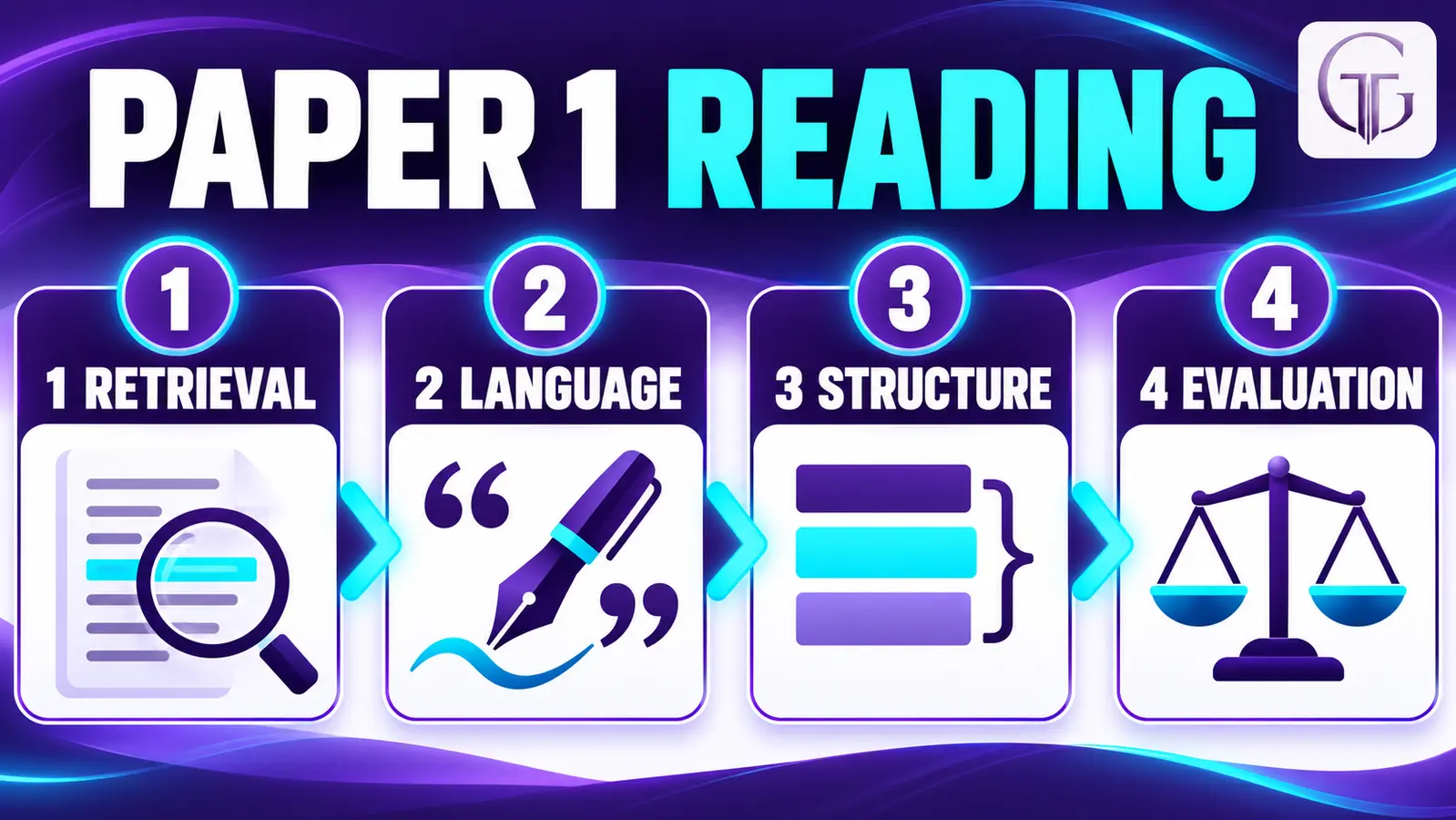
Revise Paper 1 reading by practising its four jobs separately: accurate retrieval, language analysis, structural analysis and evaluation. Use short drills before full sections, quote precisely and explain effects in relation to the question rather than listing techniques or retelling the extract.
| Question | Marks | What it tests | Useful revision drill |
|---|---|---|---|
| Q1 | 4 | Four multiple-choice retrieval items | Complete four sets and prove each choice from the named lines |
| Q2 | 8 | Language analysis | Select three short quotations and write effect-focused explanations |
| Q3 | 8 | Structure and a named effect | Track the beginning, shifts and ending on one page |
| Q4 | 20 | Critical evaluation | Decide your view, then build three developed evidence paragraphs |
Practise the question, not a memorised paragraph
For Question 2, choose evidence before naming terminology. A precise verb with a clear effect is better than a decorative list of devices. The examiner rewards analysis, not a scavenger hunt for alliteration.
Question 3 is about the order and movement of the whole extract. Track focus, viewpoint, pace, contrast, withheld information and shifts in setting or mood. Current AQA wording names an effect, such as tension, so every structural observation must return to that effect.
Question 4 needs a judgement. Start with what you think about the statement, then support that position with evidence and analysis. Agreement alone earns little. Evaluation means judging how convincingly the text supports the given view.
How should you revise Paper 1 creative writing?
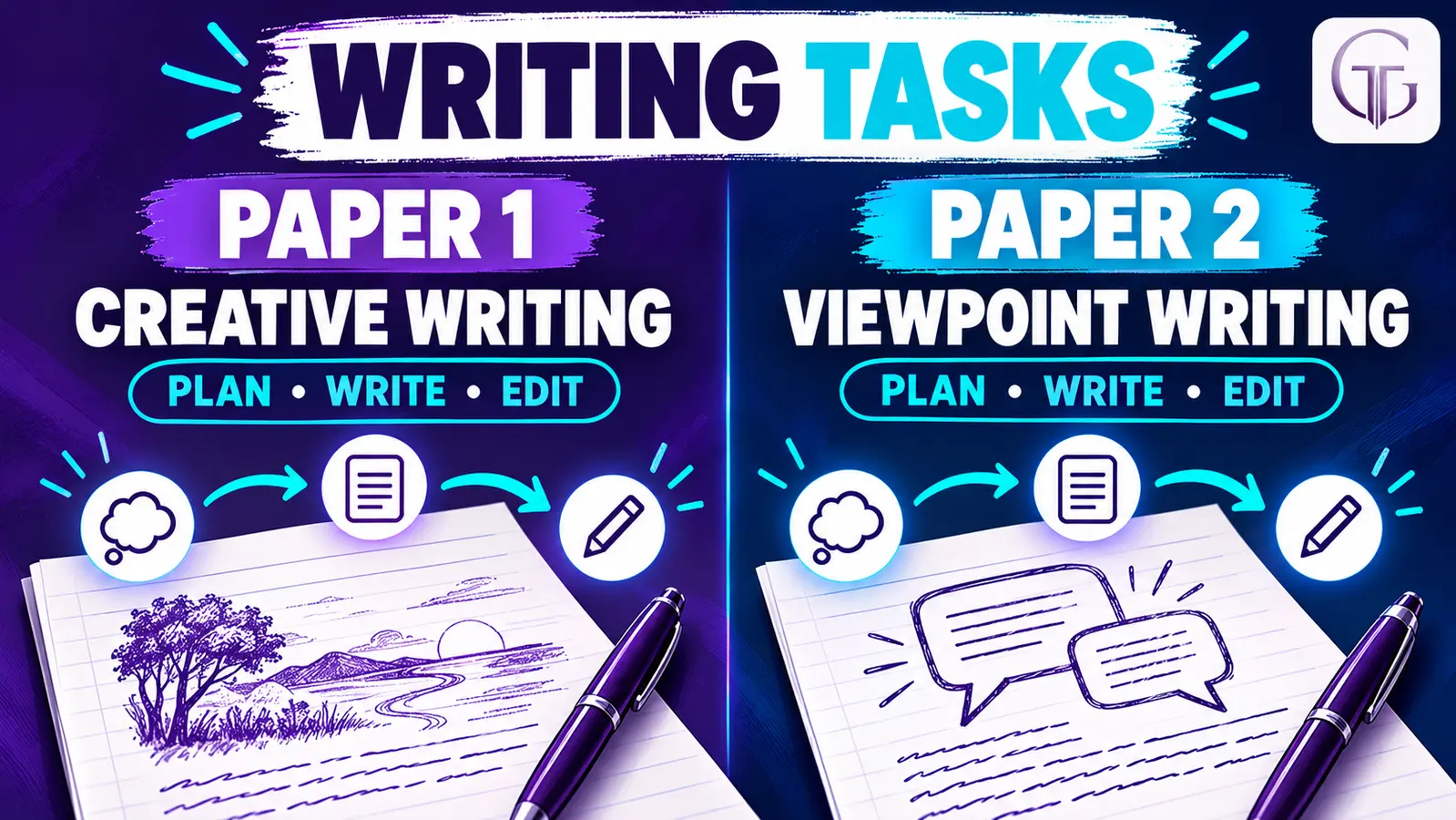
Revise Paper 1 writing by planning and producing descriptions or story openings within 45 minutes. Build a small bank of settings, characters, moods and sentence patterns, then adapt them to unfamiliar prompts while protecting organisation, vocabulary, punctuation, spelling and a controlled ending.
Question 5 is worth 40 marks: 24 for content and organisation under AO5, and 16 for technical accuracy under AO6. That is one quarter of the entire qualification. Treating it as whatever time remains is a bad bargain.
Use this practice sequence:
- Spend five minutes planning a clear shape.
- Write for 32 to 35 minutes.
- Leave five minutes to edit.
- Circle one weak paragraph after marking.
- Rewrite that paragraph without copying the model.
A description still needs movement. Shift the focus from wide view to detail, change light or sound, or reveal something that alters the mood. A story opening needs control rather than a complete adventure. Establish character, setting and tension, then end at a purposeful point.
Keep a personal accuracy list. If comma splices, missing full stops and tense shifts repeat, practise those exact problems in short paragraphs. Fancy vocabulary will not rescue writing that the examiner has to untangle.
How should you revise AQA English Language Paper 2 reading?
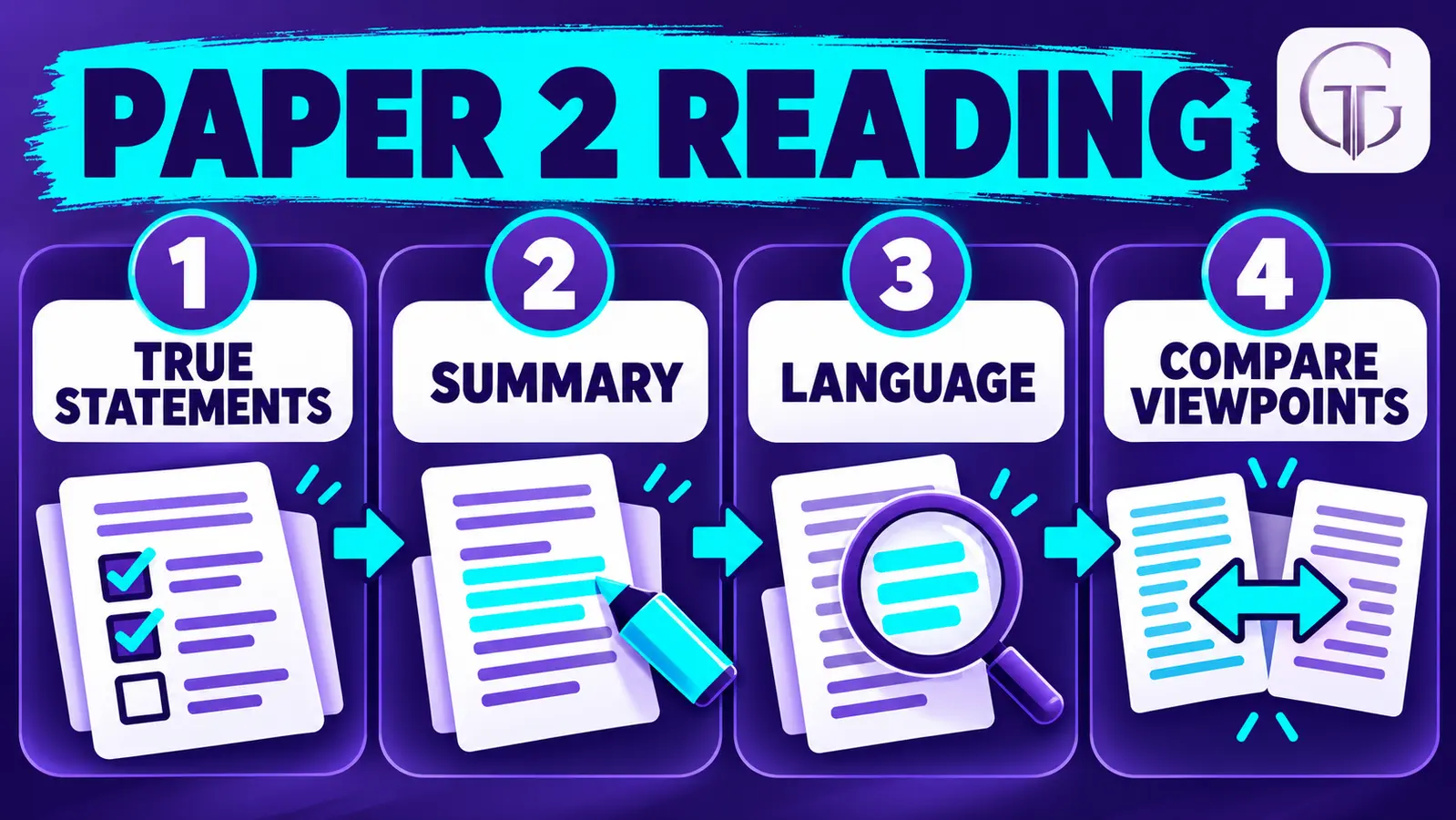
Revise Paper 2 reading by practising retrieval, synthesis, language analysis and comparison across two non-fiction sources. Train yourself to separate what each writer says from how each writer communicates it, then connect evidence through clear similarities, differences and viewpoint-focused comparisons.
| Question | Marks | What it tests | Useful revision drill |
|---|---|---|---|
| Q1 | 4 | Four true statements from Source A | Prove every selection with the named part of the source |
| Q2 | 8 | Summary and synthesis | Pair two differences and support each side with evidence |
| Q3 | 12 | Language analysis from one source | Analyse three or four choices in depth |
| Q4 | 16 | Comparison of viewpoints and methods | Build a two-column comparison grid before writing |
Question 2 is not a technique question. Compare the relevant content and make inferences from both sources. “Source A says this, whereas Source B says that” is only the start; explain what the difference reveals.
Question 4 brings viewpoints and methods together. Name each writer’s attitude, select evidence and explain how the method communicates that attitude. Compare throughout. Two separate mini-essays with a sentence saying “both are different” at the end will not do much.
Older non-fiction can feel slow at first. Read one short 19th-century article, letter, diary or travel extract each week. Paraphrase one paragraph in modern English, then identify the attitude behind it.
How should you revise Paper 2 viewpoint writing?
Revise Paper 2 writing by practising arguments for a named audience, purpose and form. Plan a firm viewpoint, order three or four developed ideas, use persuasive methods deliberately and edit for clarity. A convincing voice matters more than forcing every remembered technique into one response.
Paper 2 Question 5 may ask for an article, speech, letter, essay or another viewpoint text. Check the exact task. A speech should sound speakable. A letter needs an appropriate relationship with its recipient. An article needs a clear reader and purposeful organisation.
Plan an argument as movement:
- open with a clear position or engaging problem;
- develop the strongest reasons in a logical order;
- use an example, contrast or brief counterargument;
- vary paragraph length for emphasis;
- finish with a decision, challenge or practical consequence.
Persuasive methods are tools, not a checklist. A rhetorical question that you answer can sharpen a point. Five unanswered questions in a row sound like panic. The same applies to statistics: use accurate information provided by the task or frame an example honestly rather than inventing a suspiciously precise percentage.
How can you improve language, structure, evaluation and comparison answers?
Improve reading answers by matching each paragraph to one assessment skill, choosing brief evidence and explaining an effect. Replace feature spotting with reasoning: identify the choice, interpret it in context, connect it to the question and judge or compare only when that task requires it.
Use a four-part paragraph process without turning it into a rigid acronym:
- Make a direct point that answers the question.
- Add a short quotation or precise reference.
- Analyse a word, structural choice or method.
- Explain the effect, viewpoint or judgement required.
Weak answers often have enough quotations but too little explanation. Ask “why this word here?” or “why reveal this now?” Those questions move analysis beyond labelling.
Record repeated weaknesses by skill, not by paper. Useful error labels include:
- evidence does not match the question;
- explanation repeats the quotation;
- terminology replaces analysis;
- comparison appears only at the end;
- evaluation has no clear judgement;
- paragraph spends too long on one small mark.
Marks matter, but they need context. The guide to GCSE grade boundaries explains why a raw practice mark is not a fixed grade and why improvement should be tracked in both marks and response quality.
Students unsure what grades 4, 5, 7 and 9 represent can also use the site’s GCSE grades explainer before setting a realistic practice target.
How should you use past papers and mark schemes?
Use past papers in a cycle: attempt, mark, diagnose, rewrite and reattempt. Begin with single questions, progress to timed sections and finish with complete papers. Always use the correct board and current format, and obtain teacher or tutor feedback for extended responses.
AQA publishes current papers, sample materials, mark schemes and supporting resources through its official assessment resources page. Use official materials before buying another pack of guessed questions.
Follow this five-stage cycle:
- Attempt: Work without notes and record the time.
- Mark: Apply the official level descriptors honestly.
- Diagnose: Name the main reason marks were lost.
- Rewrite: Improve one paragraph or section from memory.
- Reattempt: Try a fresh question testing the same skill several days later.
Mark schemes describe levels, but they do not always tell a student why their explanation is thin. Save two versions of important answers: the first attempt and the improved response. The difference between them becomes a personalised revision guide.
A full paper every evening is unnecessary and usually wasteful. Short, marked drills create more improvement early on. Full papers become valuable once methods are secure and stamina or timing needs testing.
What weekly GCSE English Language revision plan works?
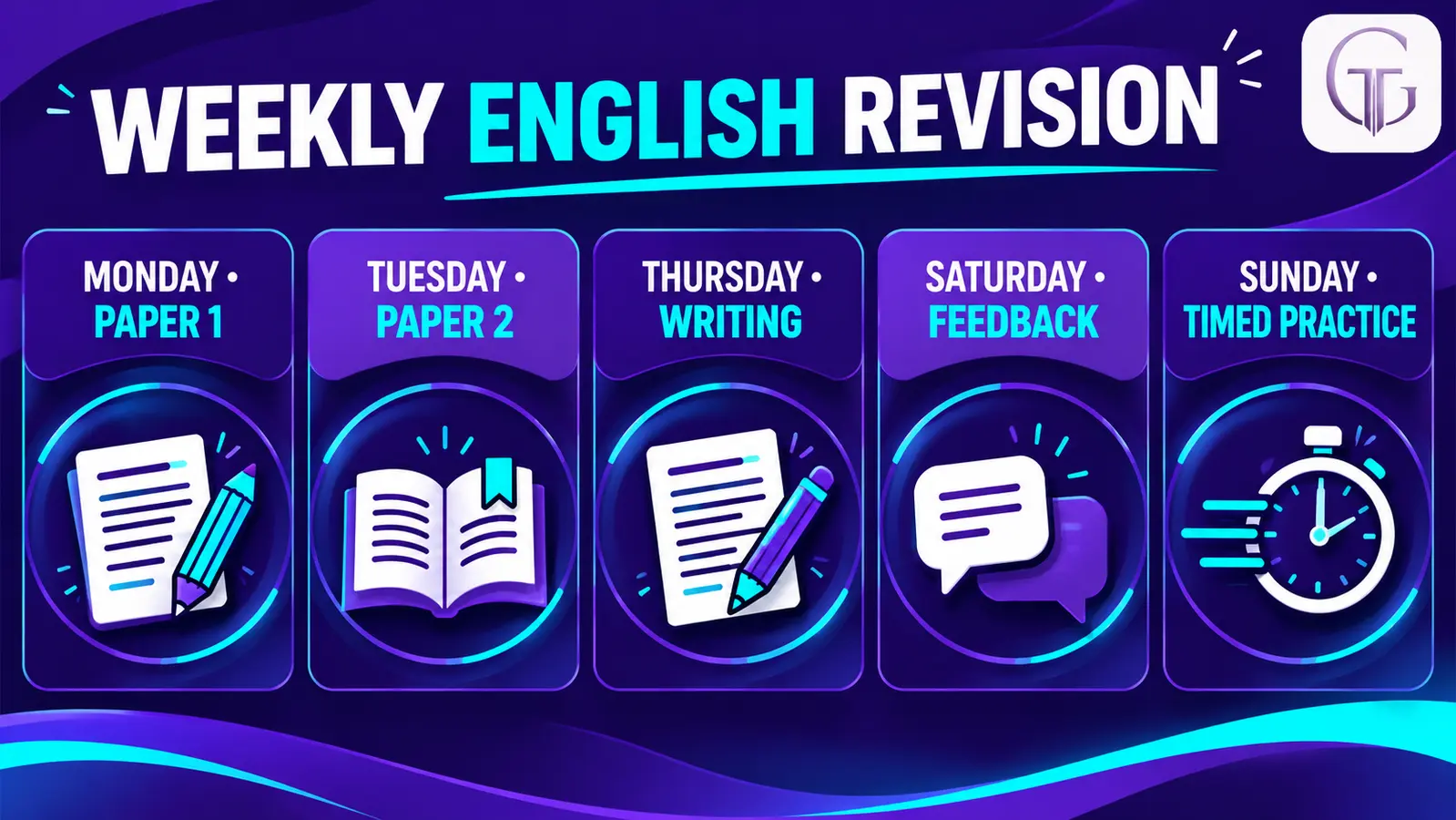
A useful weekly plan mixes short reading drills, one writing task, feedback, correction and timed practice across both papers. Four focused sessions of 30 to 50 minutes beat one unfocused three-hour block because each session can target a specific question and produce evidence of progress.
| Day | Focus | Task | Time |
|---|---|---|---|
| Monday | Paper 1 reading | Q2 language and Q3 structure from one extract | 35 minutes |
| Tuesday | Paper 2 reading | Q2 summary and a comparison grid for Q4 | 35 minutes |
| Thursday | Writing | Plan and complete one Q5 response | 50 minutes |
| Saturday | Feedback and correction | Mark, rewrite one paragraph and update error log | 40 minutes |
| Sunday | Timed rotation | One reading section or full paper on alternate weeks | 45 to 105 minutes |
Move sessions around school and rest rather than pretending every evening is free. The GCSE revision timetable guide helps turn this pattern into a wider subject plan.
Alternate the writing focus. Use Paper 1 creative writing one week and Paper 2 viewpoint writing the next. Keep weaker skills in the schedule more often, but revisit stronger ones before they fade.
How should you manage time in the GCSE English Language exam?
Reserve roughly half the paper for the 40-mark writing task, then divide reading time by marks and difficulty. Read the questions before annotating, write stop times on the booklet and move on when a question begins taking marks from a more valuable task.
A practical AQA timing plan is:
| Stage | Paper 1 working time | Paper 2 working time |
|---|---|---|
| Read and annotate source material | 15 minutes | 15 minutes |
| Q1 | 5 minutes | 5 minutes |
| Q2 | 10 minutes | 10 minutes |
| Q3 | 10 minutes | 12 to 15 minutes |
| Q4 | 20 minutes | 15 to 18 minutes |
| Q5, including planning and checking | 45 minutes | 45 minutes |
Treat these as a working plan, not an official rule. Practise until you know whether you need two minutes shifted between reading questions. Do not quietly take 15 minutes from Question 5 because Question 4 feels unfinished.
Write the planned stop time beside each question. Finishing a sentence and moving on can feel uncomfortable, but an unfinished low-value point costs less than an untouched 40-mark task.
Students sitting in 2027 can use the exam-date guide to schedule final timed papers. Resit learners should also check the GCSE resit tutoring and preparation page because November preparation has a shorter runway.
When is targeted English support useful?
Targeted support is useful when a student repeatedly loses marks for the same reason, cannot interpret feedback, avoids timed writing or remains stuck despite regular practice. A teacher or tutor should diagnose a narrow problem and build independence, not simply provide more worksheets.
Bring a marked mock, the correct specification and one recent writing sample. Useful support starts with evidence. “English is weak” is too broad; “Paper 2 comparison lacks method analysis” gives a tutor something to fix.
The guide on when to start GCSE tutoring helps families judge whether a repeated gap needs intervention now or can be managed through school feedback and independent practice.
The online GCSE English tutoring page explains the reading, writing and exam skills lessons can cover. Families can also see how online lessons work and compare online with in-person GCSE tutoring before deciding whether either format suits the student.
Parents can help without becoming the marker. Ask the student to explain the question’s job, time a practice response and help organise papers. Leave detailed judgement to a teacher or experienced tutor.
Start with the smallest repeated loss. Four marks rescued every week soon stop looking small.
Frequently asked questions about revising GCSE English Language
Can you revise for GCSE English Language if the extracts are unseen?
Yes. Revise the methods used on unseen material rather than trying to predict the text. Practise finding evidence, analysing language and structure, comparing viewpoints, evaluating statements and producing controlled writing within the paper’s time limit.
Is this guide suitable for Edexcel, OCR, Eduqas and WJEC students?
The core reading and writing methods transfer, but the question tables and timing plan are AQA-specific. Students on other boards must use their own specification, official past papers and mark schemes for question order, marks, source types and writing forms.
How many past papers should I complete before the exam?
Quality matters more than a fixed number. Complete enough sections to practise every question type, then sit several full papers under timed conditions. Every attempt should be marked, corrected and followed by another task targeting the weakness found.
Should I memorise a story for Paper 1 Question 5?
No. Memorising a complete story can produce an answer that barely fits the prompt. Build adaptable characters, settings, moods and openings instead, then practise shaping them around different tasks while keeping the writing coherent.
What is the best order for answering the questions?
The printed order works for most students because it moves through the source logically. A different order can work if it has been tested in timed practice. Do not invent a new sequence on exam morning.
How can I improve English Language quickly?
Choose one repeated weakness and practise it several times with feedback. A week spent fixing Paper 2 comparison or sentence punctuation is usually more valuable than completing random full papers without correction.
Do spelling and punctuation matter in both papers?
They matter most directly in each 40-mark writing task, where AO6 rewards sentence control, punctuation, spelling and vocabulary. Clear expression also helps the examiner follow reading answers, even when those questions assess different objectives.
What should I do if I run out of time?
Use timed question drills, write stop times before starting and protect the writing section. Diagnose whether the problem comes from slow reading, overlong plans, oversized quotations or writing too much for low-mark questions, then practise that exact bottleneck.
Need GCSE Support?
Get one-to-one online GCSE tutoring for Maths, English, Science and other GCSE subjects from home.