
A student learns simultaneous equations in class, watches the teacher's worked example again at home, practises five questions on a shared screen with a tutor, then completes a paper version without help. That is a useful answer to what is blended learning. The parts work together instead of competing for attention.
Technology alone does not improve a grade. The Education Endowment Foundation has reported that studies of digital technology are associated with an average of four additional months of progress, with considerable variation between approaches. The method, teaching quality and follow-up matter far more than owning a smart device.
For GCSE students, blended learning can connect school lessons, independent revision and live online tutoring around one exam specification. This guide explains how the model works, where it helps, what can go wrong and how to build a sensible weekly routine without spending every evening on a screen.
What is blended learning?
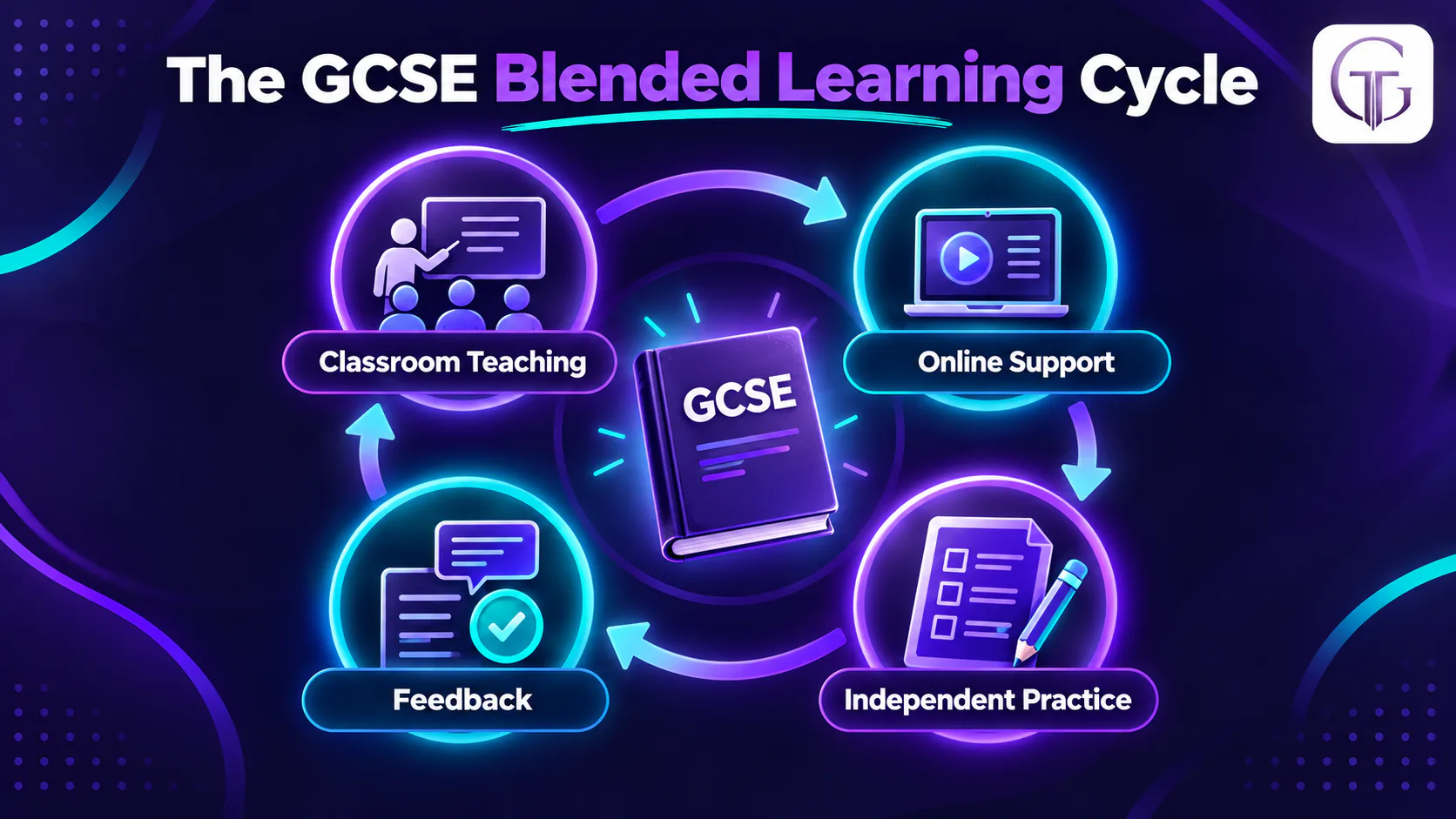
Blended learning combines face-to-face teaching with remote, digital or independent study in one planned learning sequence. Students might learn a concept at school, revisit it through a video or online lesson, practise independently, and receive feedback that shapes the next task.
The important word is planned. Watching an unrelated revision clip after school does not automatically create a blended approach. Each activity should support the same learning goal and lead naturally to the next one.
The UK government's explanation of effective remote and blended education describes blended learning as a mix of face-to-face and remote methods. A flipped classroom is one example: students meet new material before the lesson, then use classroom time for practice, questions and guidance.
Is blended learning the same as online learning?
No. Online learning may happen entirely through a website, video call or digital course. Blended learning deliberately combines online and offline experiences. A printed past paper, classroom explanation and live digital whiteboard can all belong to the same plan.
Is blended learning the same as hybrid learning?
People often use the two terms as if they mean the same thing, but they can describe different arrangements. Hybrid learning sometimes means that one group attends in person while another joins the same lesson remotely. Blended learning is broader and focuses on combining learning modes over time.
| Learning model | Where teaching happens | Typical GCSE example |
|---|---|---|
| Face-to-face learning | School, centre or home with a teacher present | A teacher explains quadratic equations in class |
| Online learning | Fully through digital platforms | A student completes a remote GCSE course |
| Hybrid learning | Students join the same lesson in different locations | Half the class attends while others join live online |
| Blended learning | A planned mix of face-to-face, online and independent work | Classroom teaching, a live tutor session and a marked past paper |
What are the main parts of blended learning?
Effective blended learning has four connected parts: clear teaching, guided online support, independent practice and useful feedback. The exact balance changes by student and subject, but every part should target the same curriculum knowledge or exam skill rather than becoming separate piles of work.
Face-to-face teaching
Classroom teaching gives students direct explanation, discussion, practical work and immediate opportunities to ask questions. Teachers can notice confusion that a quiz score may miss. Science experiments, spoken-language work and group discussion often benefit from being handled in person.
Live or recorded online teaching
Live lessons allow real-time questions, shared whiteboard work and feedback. Recorded explanations let students pause, rewind and revisit a difficult step. Neither format is automatically better. A clear five-minute explanation beats a rambling 45-minute video every time.
Independent practice
Students need to retrieve and apply knowledge without constant prompts. That might include flashcards, a printed worksheet, essay planning, exam questions or a timed paper. Independent practice shows what a student can actually do, not what feels familiar while notes are open.
Assessment and feedback
Quizzes, marked answers and tutor comments identify what should happen next. Feedback has little value when it arrives as a vague “good effort” or a score with no correction. Useful feedback names the error, explains the better method and gives the student another chance to use it.
How does blended learning work for GCSE students?
Blended learning works for GCSE students by linking each activity to the exam specification. Teachers introduce and model content, digital resources reinforce it, students practise retrieval and exam questions, and feedback identifies the next gap. The sequence repeats until performance becomes reliable.
A student studying GCSE Biology might follow this sequence:
- Learn cell division in a classroom lesson.
- Review a labelled animation or short recorded explanation at home.
- Summarise mitosis from memory without looking at notes.
- Complete three specification-aligned exam questions.
- Discuss errors during a live session with a GCSE Science tutor.
- Attempt a similar question independently one week later.
That final step matters. A correct answer immediately after help can show short-term performance. Answering a similar question later provides better evidence that learning has stuck.
What role does the GCSE specification play?
The specification lists the content and skills assessed by the exam board. Every video, worksheet and tutoring task should connect to it. Random resources can feel productive while quietly leaving gaps.
Students should also use the right exam board, tier and paper style. An AQA Higher Maths student and an Edexcel Foundation Maths student may share core knowledge, but their question formats, topic weightings and level of demand are not identical.
Where does online GCSE tutoring fit?
Tutoring can provide the guided part between classroom learning and independent performance. During online GCSE tutoring, a tutor can diagnose a misconception, model a method, watch the student try it and set a related task for later practice.
Families can review how one-to-one online lessons work before deciding how tutoring should fit around school and revision. The point is coordination, not adding another disconnected lesson to an already crowded week.
How does blended learning help GCSE students?
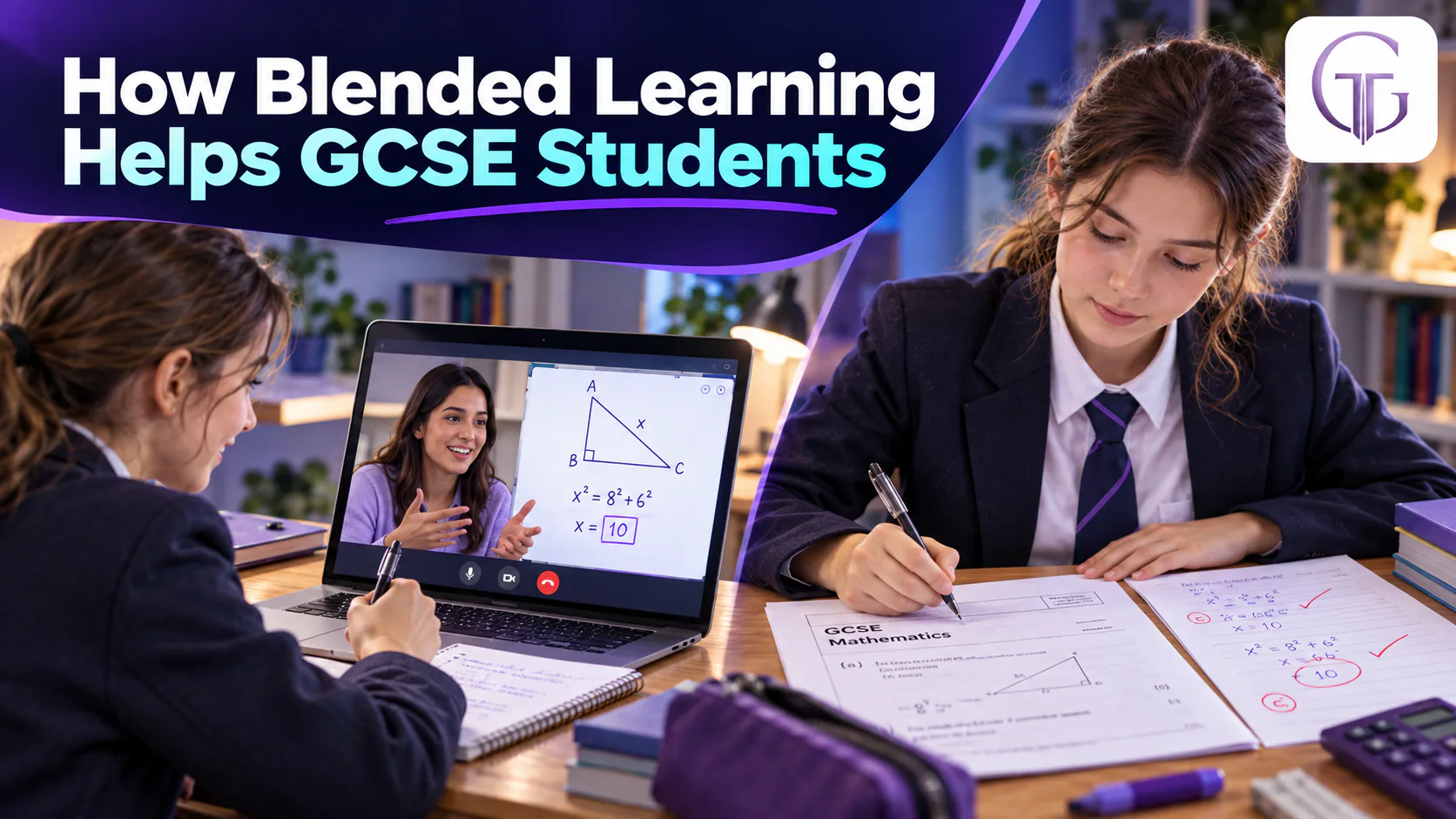
Blended learning helps GCSE students revisit difficult explanations, practise at an appropriate level, receive faster feedback and connect revision to classroom teaching. It can build independence and expose gaps earlier, provided the work remains structured, active and aligned with the correct exam specification.
Students can revisit difficult material
A classroom explanation happens once. A recorded worked example can be paused and replayed. That is particularly helpful when one missed algebra step or unfamiliar command word blocks everything that follows.
Rewatching should lead to action. After viewing an explanation, students can close it and reproduce the method, explain the idea aloud or answer a question. Otherwise, recognition can masquerade as understanding.
Practice can match the student's current level
Whole-class teaching must move at a workable pace for the group. Blended learning creates space for targeted tasks. One student may review fractions before ratio, while another moves to multi-step problem solving.
Personalisation should not trap students in easy work. A good plan supports weak foundations and then raises the level of challenge.
Feedback can arrive while the mistake is still useful
Digital quizzes can reveal gaps quickly, while teachers and tutors can explain why an answer failed. A student who repeatedly loses marks for missing units in Physics needs that pattern identified before the next full paper.
Students learn to manage their own work
GCSE revision requires decisions about priorities, time and methods. A structured blend gives students controlled practice in making those decisions. They learn to check a topic list, select a task, review errors and plan the next session.
Our guide on how to revise for GCSEs explains active methods such as retrieval practice, past-paper work and spaced review. Those methods are the engine. The device is just one place to use them.
Online and offline resources can support different needs
Captions, adjustable playback speed, typed notes, printed worksheets and live verbal explanations give students several routes into a topic. Scotland's national education guidance also notes that blended learning extends beyond online learning and can include research, projects, discussion and practical activities away from a screen.
What does blended learning look like in different GCSE subjects?
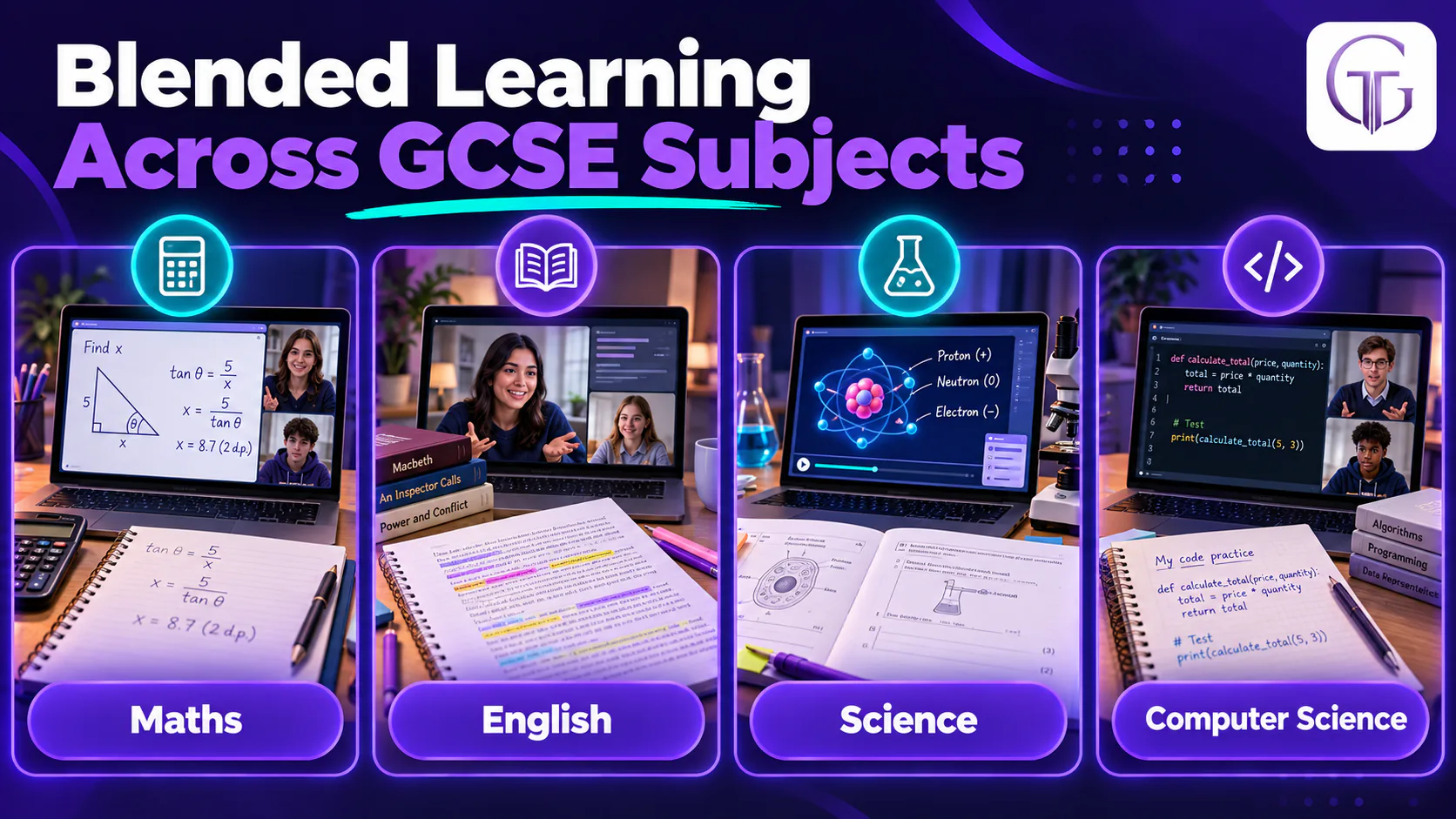
Blended learning looks different across GCSE subjects because each one assesses different knowledge and skills. Maths needs worked methods and repeated problem solving, English needs reading and extended writing, while Science combines factual recall, calculations, data handling and practical understanding.
GCSE Maths
A student may watch a worked example, solve a similar question on a shared whiteboard, then complete a mixed problem set alone. The tutor checks the reasoning, not only the final number. A GCSE Maths tutor can then revisit the exact step where the method broke down.
GCSE English
English works well when reading, discussion and writing have separate purposes. A student might annotate a passage independently, discuss interpretations live, plan an answer with guidance and write the full response offline under timed conditions.
Recorded comments can help a student hear how an argument develops, but the student still needs to produce sustained writing. Our GCSE English tutoring page explains how one-to-one work can address language, literature and exam technique.
GCSE Science
Animations can make microscopic or abstract processes visible. Live teaching can correct misconceptions, while printed exam questions build calculation and written-response skills. Practical demonstrations should support, not replace, knowledge of variables, methods, results and evaluation.
GCSE Computer Science and Business Studies
Computer Science can combine code demonstrations, live debugging and independent programming. Business Studies can connect theory to a short case study, followed by a structured exam response. In both subjects, watching someone else solve the task is the easy part. Producing the answer alone is the test.
| Subject | Guided element | Independent element | Useful feedback focus |
|---|---|---|---|
| Maths | Worked example on a shared whiteboard | Mixed exam questions | Method, notation and accuracy |
| English | Discussion and model paragraph | Timed analytical response | Evidence, structure and explanation |
| Science | Explanation or demonstration | Calculations and exam questions | Scientific vocabulary and application |
| Computer Science | Live coding and debugging | Write or trace code independently | Logic, syntax and efficiency |
| Business Studies | Case-study discussion | Six, nine or twelve-mark response | Application, analysis and judgement |
What are the disadvantages of blended learning?
Blended learning can fail when students lack a suitable device, reliable internet, quiet study space, clear instructions or timely support. Too much screen time, weak motivation and poorly matched resources can turn a flexible model into fragmented work that is easy to avoid.
Passive screen time can look like revision
Watching three videos feels busy, but it provides little evidence of recall. Every digital input should lead to an output: a summary from memory, a question, a diagram, a calculation or a written paragraph.
Technology can create access problems
Students may share devices, rely on weak internet or struggle with platforms that demand too many logins. Printed alternatives and downloadable resources still matter. A polished platform is useless when a student cannot reach the lesson.
Independent work can expose weak routines
Flexibility helps organised students, but open-ended tasks can overwhelm students who procrastinate or struggle to judge time. Short deadlines, visible checklists and scheduled feedback make the model safer.
Different resources may contradict each other
An online explanation may use unfamiliar terminology or a method that differs from school. The answer might still be valid, but switching styles can confuse a student under pressure. Keep the exam board, specification and teacher guidance as the reference points.
More material does not mean better learning
Resource overload is a real problem. Twelve apps, six folders and a heroic collection of bookmarked videos create more decisions. A textbook, topic checklist, past papers and one reliable source of guidance may be enough.
Students who feel overwhelmed can use the practical steps in our guide to tackling GCSE exam anxiety. Adding another digital platform is rarely the cure for an overloaded plan.
How can students build a blended GCSE study week?
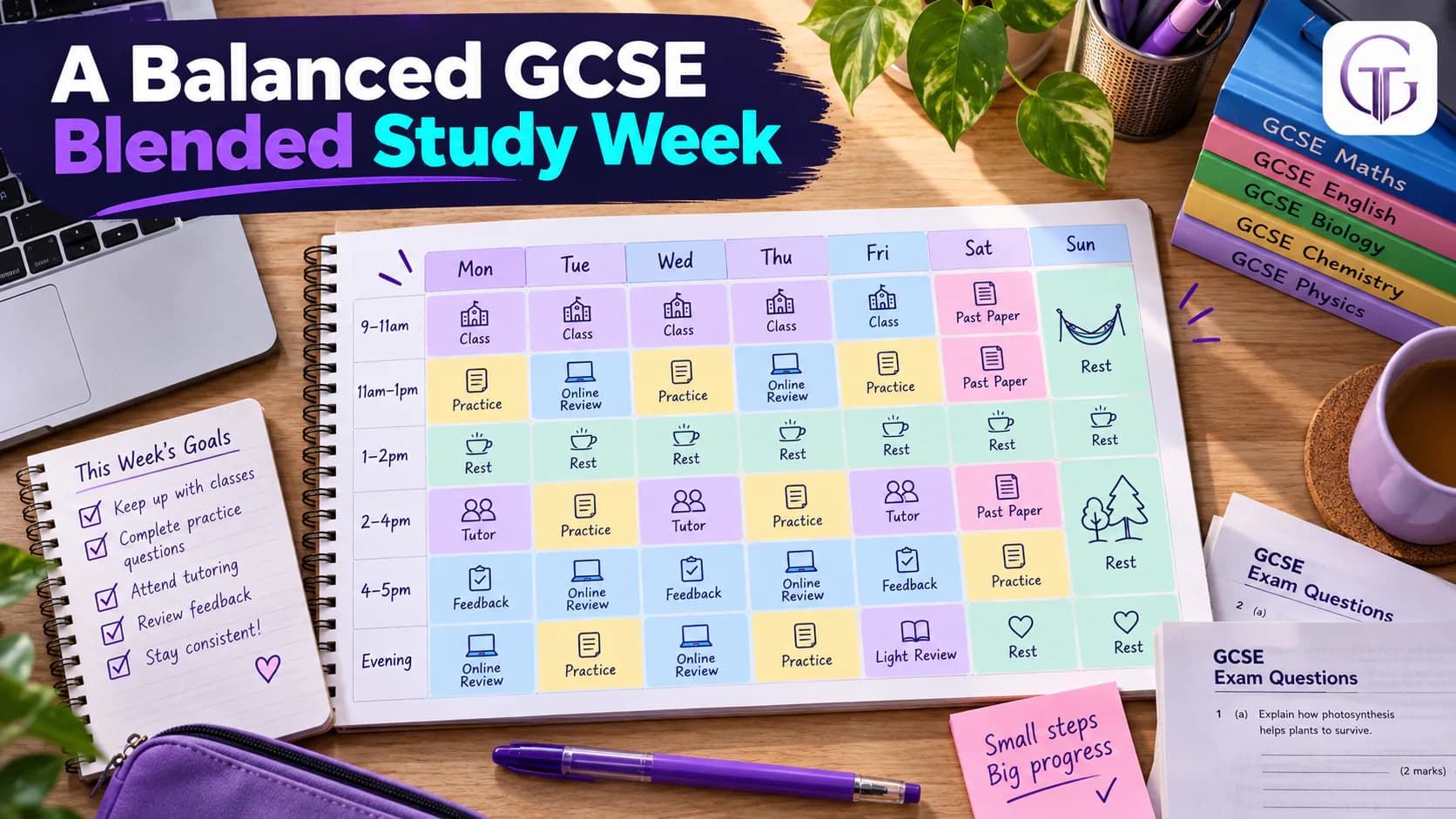
Students can build a blended GCSE week by assigning a purpose to each activity: learn, practise, test, receive feedback or review. A balanced plan uses short online inputs, substantial independent work and spaced returns to topics instead of placing every resource into every session.
Start with the current school timetable and upcoming assessments. Add only the extra work that addresses a real need. A realistic GCSE revision timetable should include rest, schoolwork and subject priorities rather than filling every free hour.
What could one topic cycle look like?
| Day | Activity | Mode | Purpose |
|---|---|---|---|
| Monday | Learn a topic in class | Face-to-face | Build first understanding |
| Tuesday | Review a short explanation and make notes from memory | Online and offline | Consolidate key ideas |
| Wednesday | Complete targeted questions | Independent | Apply knowledge |
| Thursday | Discuss mistakes with a teacher or tutor | Live support | Correct misconceptions |
| Saturday | Complete a timed mixed set | Independent | Test performance |
| Following week | Answer one related question | Offline review | Strengthen long-term recall |
How long should each online activity last?
Length should follow the task, not a fashionable timer. A seven-minute explanation may be enough before practice. A live tutoring session may need longer because it includes questioning, modelling and feedback.
Students should stop when attention has gone and the work has become clicking rather than thinking. A two-minute movement break is more useful than another 20 minutes of blank staring.
What roles do teachers, tutors, parents and students play?
Teachers set curriculum direction, tutors provide targeted explanation and feedback, parents support routines and access, and students complete the thinking and practice. Blended learning works best when responsibilities are clear and adults coordinate rather than duplicating tasks or monitoring every minute.
Teachers connect work to the curriculum
Teachers sequence content, explain new ideas and assess progress across the course. School expectations should remain visible when external resources are added.
Tutors diagnose and adapt
A tutor can slow down one step, test prior knowledge and choose a task at the right level. One-to-one support is most useful when it responds to actual work, such as a mock paper or teacher feedback, rather than starting a separate curriculum.
Parents wondering about timing can read when to start GCSE tutoring. Earlier is not always better. Support should answer a defined need.
Parents protect the routine
Parents can help by making sure the student has equipment, a workable study space and realistic stopping times. They do not need to become subject teachers or inspect every answer.
A useful question is, “What are you trying to complete?” A less useful one is, “How many hours have you revised?” Time at a desk is a poor measure of learning.
Students need to produce evidence of learning
Students should leave each session with an answer, corrected question, recall sheet, plan or score. Finished work makes progress visible and gives the next person something useful to discuss.
Is blended learning suitable for every GCSE student?
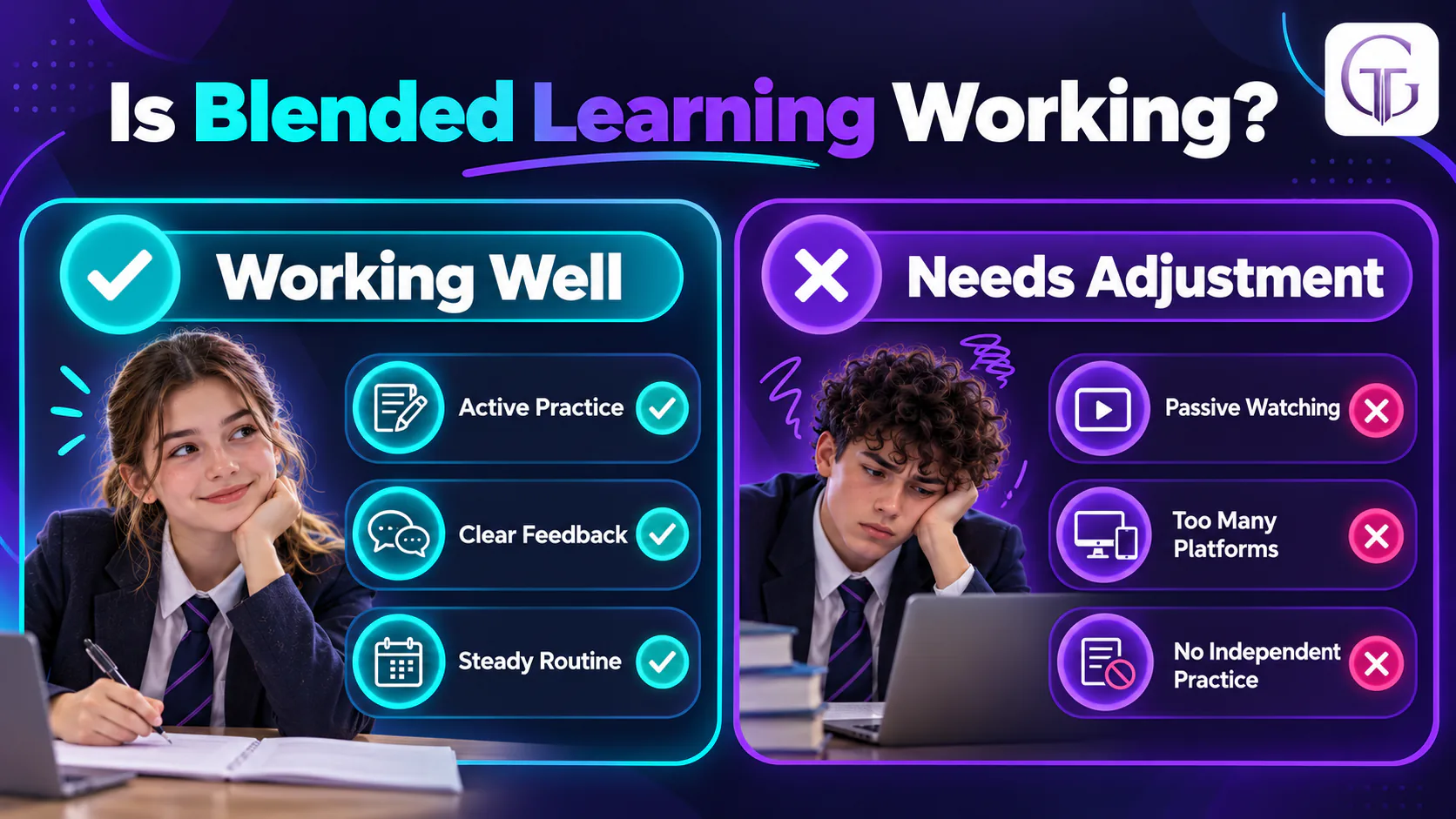
Blended learning can suit most GCSE students when the balance and support match their needs, but one model will not suit everyone. Students need sufficient access, structure and feedback. Those who struggle with attention or independent work may require shorter tasks and closer guidance.
Blended learning may suit a student who:
- benefits from replaying explanations
- needs subject support beyond normal lesson time
- can follow a short weekly plan
- learns well through a mixture of discussion, visuals and written practice
- wants access to a tutor who understands the correct exam board
- needs flexibility around school, health or family commitments
The model may need adjustment when a student:
- watches content but avoids answering questions
- becomes distracted whenever a device is open
- cannot access reliable technology or a quiet space
- receives too many tasks from school, tutors and parents
- needs practical or social learning that online work cannot reproduce
- feels more anxious because learning never seems to stop
Adjust the blend before abandoning the idea. Printed tasks, fewer platforms, scheduled check-ins or one live session a week may solve the problem. Families comparing delivery formats can also read our online versus in-person GCSE tutoring guide.
How should a GCSE student start blended learning?
A GCSE student should start with one subject, one learning goal and a simple weekly cycle. Choose a weak topic, connect school material to one reliable online explanation, complete independent questions, obtain feedback and review the same skill later before expanding the approach.
Use this starting process:
- Choose one subject where a clear gap exists.
- Confirm the exam board, tier and specification topic.
- Select one reliable explanation or live support session.
- Complete a short task without help.
- Mark the work and record the exact error.
- Ask a teacher or tutor about anything you cannot correct.
- Answer a similar question several days later.
- Keep the routine only if it produces better independent work.
A sensible blend often feels quite ordinary. Read, discuss, practise, correct, repeat. The value comes from the connections between those actions, not from turning revision into a technology demonstration.
Frequently asked questions about blended learning
What is blended learning in simple terms?
Blended learning is a planned combination of face-to-face teaching, remote or digital support and independent study. Each part contributes to the same learning goal.
Is blended learning good for GCSE revision?
Yes, blended learning can support GCSE revision when resources match the exam specification and students complete active practice. Videos and live lessons should lead to independent exam questions, recall or writing.
Does blended learning mean more screen time?
Not necessarily. A blended plan can include textbooks, handwritten recall, practical work, discussion and printed past papers. Digital tools should be used where they improve explanation, access or feedback.
What is a flipped classroom?
A flipped classroom introduces material before the lesson, often through a reading or video. Classroom time is then used for questions, application, discussion and guided practice.
Can blended learning replace a GCSE teacher?
No. Blended learning changes how activities are combined, but students still need curriculum direction, clear explanations, assessment and feedback from qualified or knowledgeable adults.
How can parents support blended learning at home?
Parents can support a consistent routine, suitable equipment, a workable study space and sensible breaks. They should ask about completed tasks and understanding rather than counting hours.
Can online tutoring be part of blended learning?
Yes. Online tutoring can provide live explanation, guided practice and feedback between school lessons and independent revision. The tutor's work should connect to the student's exam board and current needs.
Need GCSE Support?
Get one-to-one online GCSE tutoring for Maths, English, Science and other GCSE subjects from home.