
One student hears bonjour and instantly spots the English connection. Another reads hola once and says it correctly without thinking. That small contrast explains why the GCSE Spanish vs French debate never produces one honest winner.
The latest results add useful context, not a verdict. In 2026, 30.2% of French entries and 28.9% of Spanish entries achieved grade 7 or above, according to the Association for Language Learning's GCSE results analysis. The same source warns that the two cohorts have different and changing ability profiles.
So, French did slightly better nationally. That does not mean an individual child will find it easier.
This guide compares the assessed skills and explains how prior learning, teaching and revision affect the chance of reaching grade 8 or 9.
Is GCSE Spanish or French easier to get a top grade in?
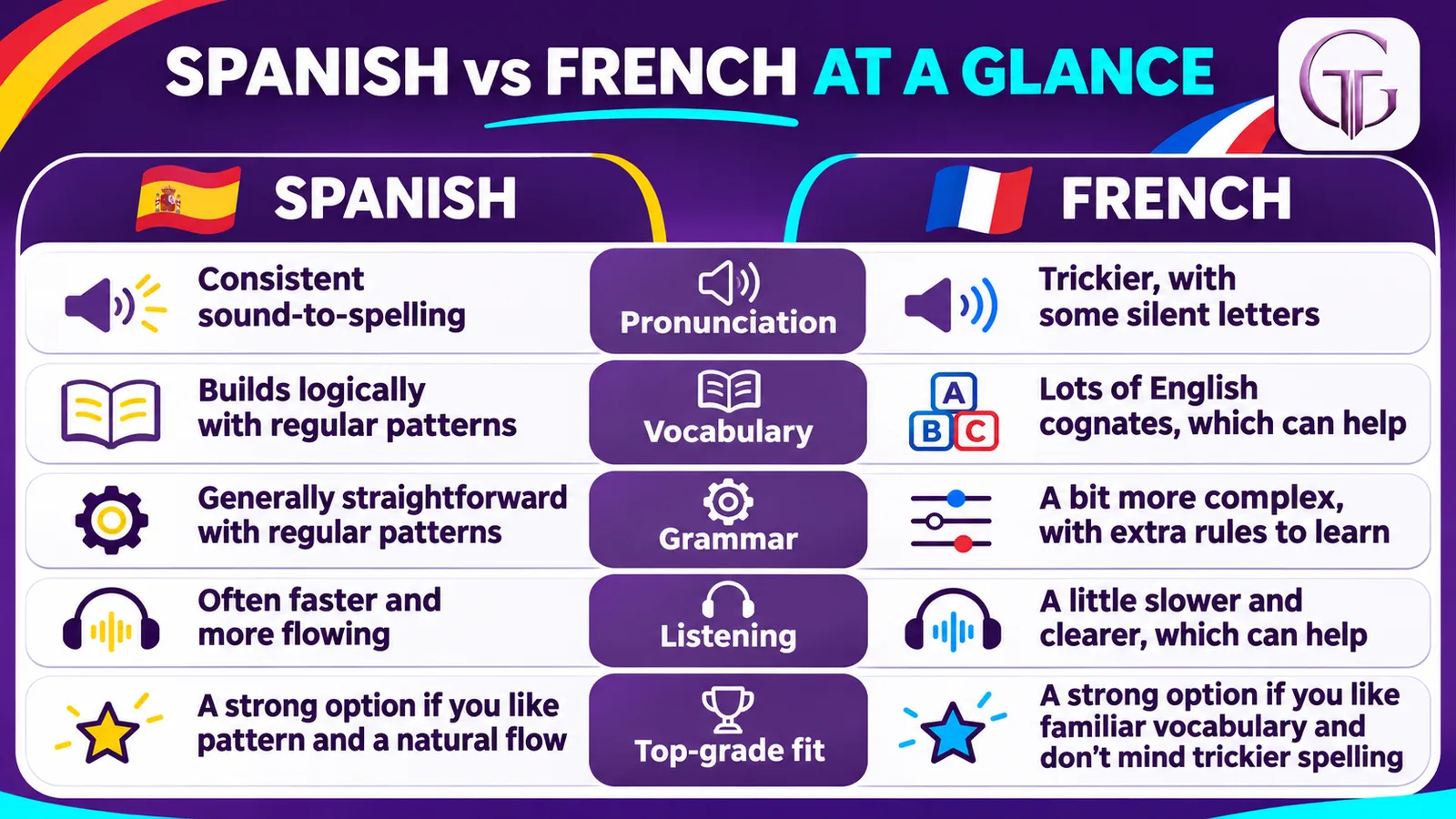
Neither language is universally easier. Spanish often feels more accessible because spelling and pronunciation connect more consistently. French offers more familiar vocabulary to English speakers. A top grade usually depends more on prior learning, teaching quality, confidence and regular practice than language choice.
Spanish has the cleaner start for students who like predictable sounds. Once the core rules are known, new words are easier to pronounce from the page.
French gives a different advantage. English contains a large amount of French-derived vocabulary, so words such as important, possible and restaurant feel familiar. Reading comprehension can improve quickly when a student learns to recognise genuine cognates, which are words with a shared form and meaning.
Spanish listening can sound fast, while French spelling and speech do not always match neatly. A student who practises the weaker skill usually beats one who chose the supposedly easier language and coasted.
What do the 2026 GCSE results really tell us?
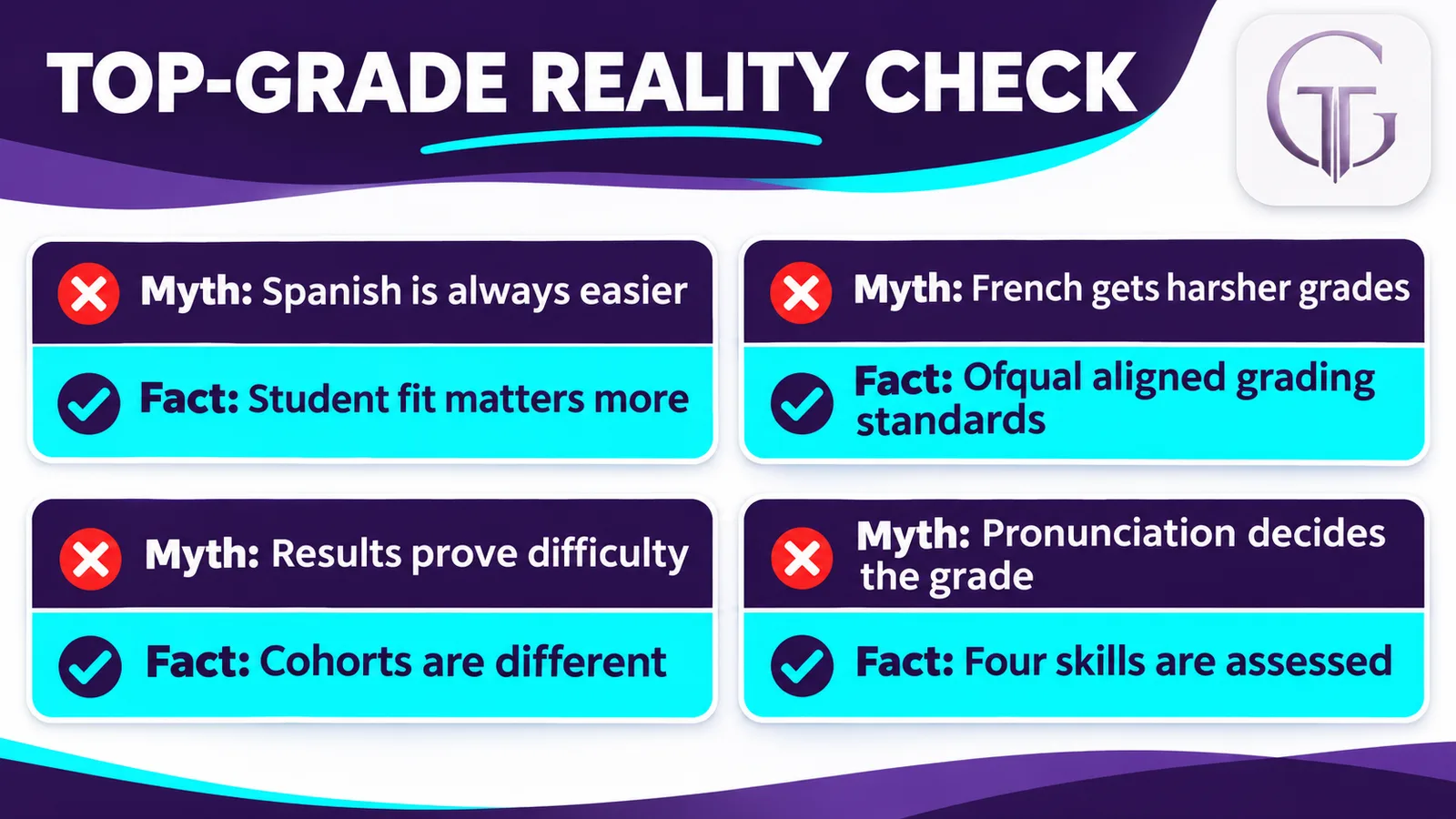
The 2026 results show a narrow French lead, with 30.2% achieving grade 7 or above compared with 28.9% in Spanish. They do not prove French is easier, because entry patterns, prior attainment, tier choices and school provision differ between cohorts.
The 1.3 percentage point gap is too small to guide a personal choice. National outcomes combine students with different starting points, schools, home-language backgrounds and prior attainment.
Older comparisons need even more care. Ofqual adjusted French and German grading in 2023 and 2024 to bring standards into closer alignment with Spanish. Its inter-subject comparability report confirms that change. Advice based on a 2019 or 2022 pattern is now stale.
Grade boundaries move after marking to reflect each examination series. A lower boundary may mean a harder paper, not an easier subject.
Do GCSE Spanish and French follow the same assessment model?
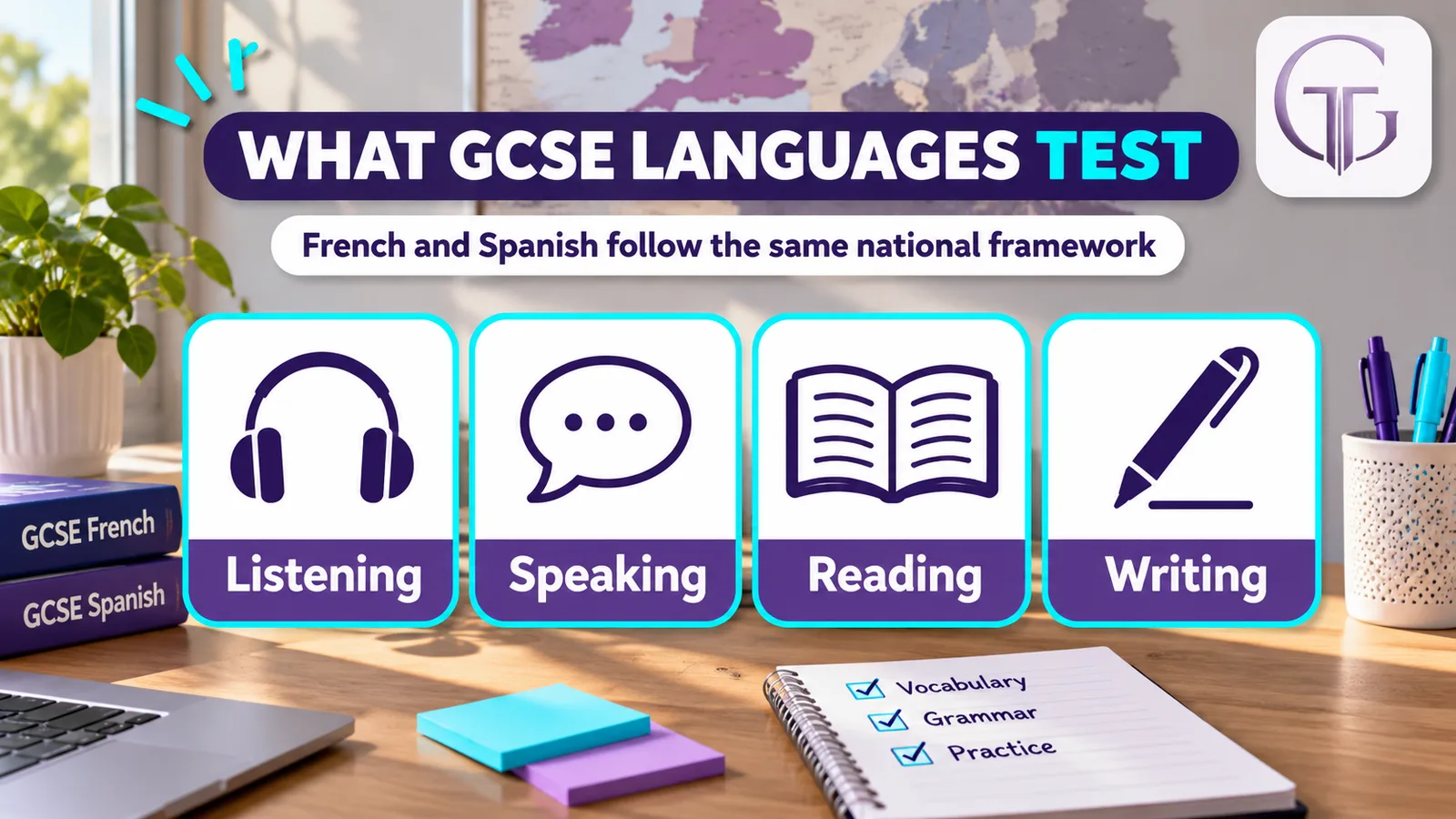
Yes. In England, current GCSE Spanish and French qualifications follow the same Ofqual framework. Both assess spoken language, written language, grammar and vocabulary, use Foundation and Higher tiers, and require students to develop listening, speaking, reading and writing skills.
Ofqual's current subject conditions for French, German and Spanish set the same assessment objectives for both languages:
| Assessment objective | What it covers | Weighting |
|---|---|---|
| AO1 | Understanding and responding to spoken language | 35% |
| AO2 | Understanding and responding to written language | 45% |
| AO3 | Accurate application of prescribed grammar and vocabulary | 20% |
Awarding organisations place 75% of marks in examinations and 25% in speaking. Foundation targets grades 1 to 5. Higher targets grades 4 to 9, with a possible grade 3 just below the 4/3 boundary.
Spanish does not offer a lighter route to grade 9, and French does not carry an automatic marking penalty.
Is Spanish pronunciation easier than French pronunciation?
Spanish pronunciation is generally easier for English-speaking beginners because letters and sounds match more consistently. French contains silent letters, nasal vowels and linking sounds. However, clear communication matters more than copying a native accent, and pronunciation alone cannot secure a top grade.
Spanish uses a relatively transparent sound system. Once a student knows the five vowel sounds and common letter combinations, they can usually make a sensible attempt at an unfamiliar word. That helps with reading aloud, dictation and spelling.
French has a bigger gap between the written and spoken word. Final consonants are often silent, written endings can sound alike, and liaison links words in connected speech.
A rolled Spanish r is not a gatekeeper. Intelligibility, accurate content and a range of language matter more than theatrical perfection.
Is French or Spanish grammar and vocabulary easier?
French vocabulary often looks more familiar to English speakers, while Spanish spelling and verb patterns can feel more regular. Both languages use gender, agreement and several tenses. French has frequent irregular forms, while Spanish adds demanding past-tense patterns and the subjunctive.
French can produce quick wins in reading through cognates. But false friends still bite: actuellement means currently, not actually.
Spanish verb families suit pattern learners, but the number of endings still takes work. Strong Higher-tier answers need confident movement between time frames and accurate agreement.
Both languages test gender and adjective agreement. Both reward precise high-frequency verbs more than impressive words used inaccurately.
Which language is easier for listening, speaking, reading and writing?
Spanish often gives beginners more confidence in pronunciation and spelling, while French can offer faster vocabulary recognition in reading. Listening, speaking and writing remain demanding in both. The easier option is the language in which the student performs more evenly across all four skills.
| Skill | Spanish may feel easier when... | French may feel easier when... | Top-grade risk |
|---|---|---|---|
| Listening | The student knows sound and spelling patterns well | The student has regular exposure to French speech | Missing negatives, tense shifts or small linking words |
| Speaking | The student likes predictable pronunciation | The student already speaks with confidence and hears French often | Over-rehearsed answers that collapse after an unexpected question |
| Reading | The student uses patterns and context carefully | The student recognises English-French cognates | Guessing false friends or ignoring precise detail |
| Writing | The student remembers regular verb families | The student controls familiar structures accurately | Repeating basic language or losing accuracy with ambitious grammar |
The weakest skill often caps the outcome. A balanced GCSE revision approach is more useful than spending every session on the comfortable paper.
Which GCSE language suits your child's strengths?
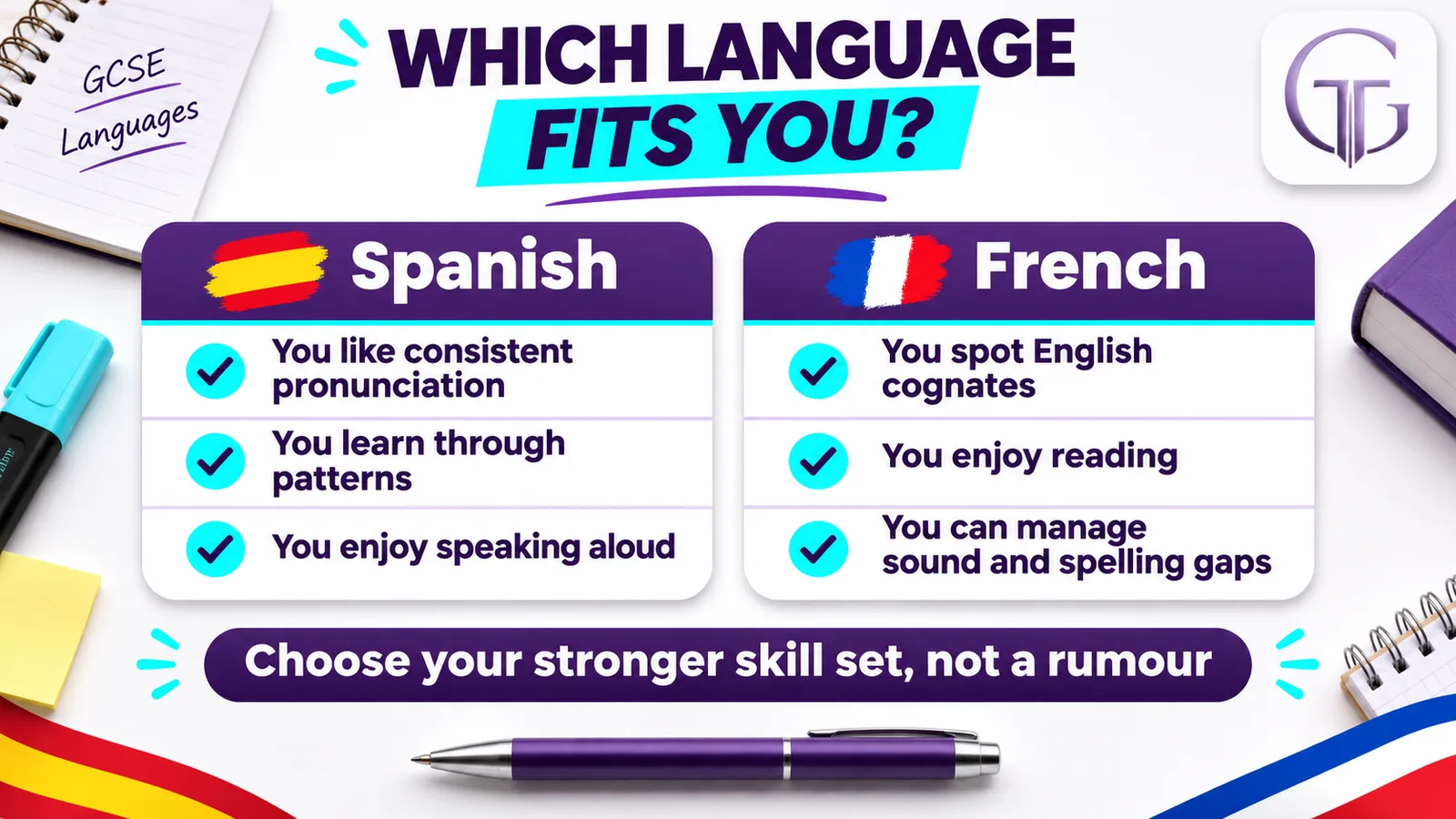
Spanish may suit a student who likes patterns, phonics and speaking aloud. French may suit one who recognises vocabulary quickly and enjoys reading. Prior attainment, enjoyment, teacher quality and access to practice should outweigh broad claims about which language is easier.
Choose Spanish more confidently if your child:
- likes consistent sound-to-spelling rules
- enjoys drilling verb patterns
- speaks willingly, even before every sentence is perfect
- has stronger prior Spanish results or regular exposure outside school
Choose French more confidently if your child:
- spots word families and cognates quickly
- enjoys close reading and precise spelling
- has already built several years of French vocabulary
- learns with a strong French department or teacher
Enjoyment matters. A student who voluntarily listens, speaks and notices language will accumulate far more useful practice.
Does the exam board change whether French or Spanish is easier?
The exam board changes paper wording, component structure and mark allocation details, but it does not make one language inherently easier. Current qualifications must meet the same national requirements. Students should revise the exact specification, vocabulary list and task formats used by their school.
AQA, Pearson Edexcel and Eduqas package the common requirements differently. Qualifications first awarded in 2026 replaced older versions, so legacy papers are not perfect replicas of current tasks.
Check four details before buying a revision guide or downloading papers:
- Confirm the awarding organisation and specification code.
- Confirm Foundation or Higher tier.
- Use the current vocabulary and grammar lists.
- Practise current speaking, dictation, reading-aloud and translation formats.
Students using one-to-one GCSE Spanish tutoring should share their board and tier from the start. Precise exam preparation must match the live specification.
How should a student choose between GCSE Spanish and French?
Choose the language with the stronger evidence: better recent assessment scores, more secure vocabulary, greater willingness to speak, stronger teaching and more consistent practice. A short comparison task can help, but several years of prior learning should not be discarded lightly.
Use this five-step decision rather than asking friends which subject is easy:
- Compare the last three assessed results in each language.
- Separate the scores by listening, speaking, reading and writing.
- Ask which department offers the stronger teaching and resources.
- Note which language the student uses voluntarily outside lessons.
- Discuss the likely tier and course with the current language teacher.
One weak test should not decide the choice. Look for a pattern across skills, enjoyment and teacher feedback.
Families choosing during Year 9 can also read when to start GCSE tutoring. Early support should repair foundations, not add pressure.
How can students get a grade 8 or 9 in either language?
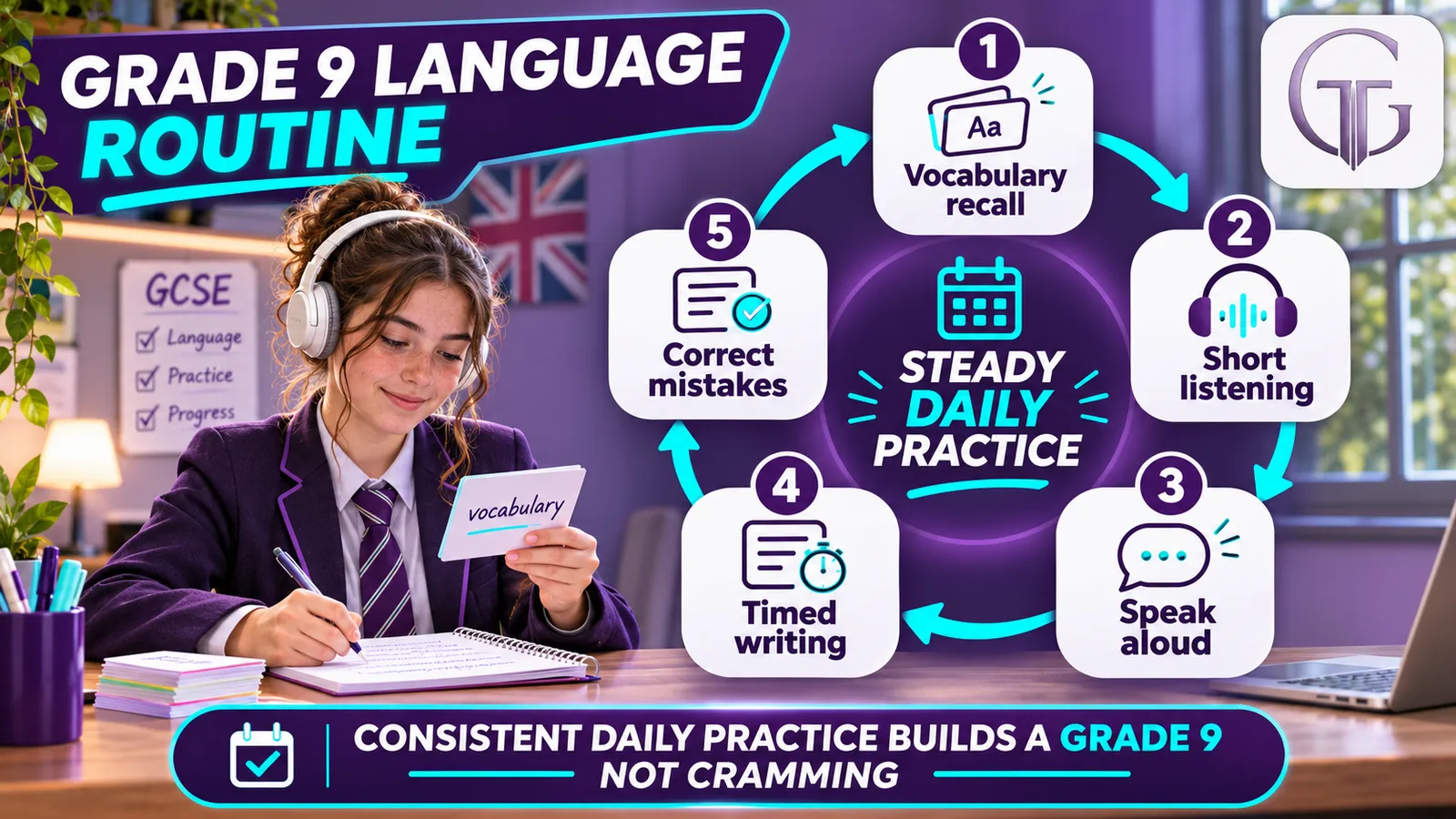
Grade 8 and 9 students build reliable vocabulary, accurate grammar and flexible responses across every skill. They practise little and often, use current exam tasks, speak without scripts, correct errors and revisit weak material. Cramming memorised paragraphs is not a dependable top-grade strategy.
A practical weekly routine looks like this:
- five to ten minutes of vocabulary retrieval on most days
- two short listening sessions, including dictation
- one speaking practice with unplanned follow-up questions
- one timed reading or translation task
- one writing task followed by careful correction
- one review of repeated errors from an error log
Strong students identify the cause of a mistake, rewrite the sentence and test the same point later.
Use a realistic GCSE revision timetable to spread practice across the week. Students who freeze under pressure may also benefit from guidance on managing GCSE exam anxiety.
When should a student avoid switching GCSE languages?
Avoid switching late when the student would abandon years of vocabulary, grammar and practice for a language they barely know. A move may be sensible after serious teaching disruption or a genuine mismatch, but convenience and rumours are weak reasons in Year 10 or 11.
Starting again means rebuilding recall, sound patterns, verb control and exam confidence while the calendar is already moving.
A switch deserves discussion if the student has substantial knowledge of the new language or an unresolved access problem. Otherwise, improving the existing language is usually safer.
Online GCSE lessons can target a narrow gap before a family makes a drastic decision.
What is the final verdict on GCSE Spanish vs French?
Spanish has an early advantage in predictable pronunciation, while French can offer easier vocabulary recognition for English speakers. Neither has a dependable top-grade advantage. Choose the language with the best combination of prior attainment, enjoyment, teaching and balanced four-skill performance.
French's 2026 results were slightly higher, but the difference does not prove easier grading or content. Both languages require accurate listening, speaking, reading and writing.
Choose the evidence in front of you. Then practise consistently.
Students who need structured support can book a free one-to-one GCSE class to discuss the current board, tier, weak skills and next steps.
What else do parents and students ask about GCSE Spanish vs French?
Parents and students usually ask about grade 9 difficulty, pronunciation, switching languages, native speakers and the value of each subject. The short answers below clarify those points without pretending that one language gives every learner the same advantage.
Frequently asked questions
Is Spanish GCSE easier than French GCSE?
Spanish is often easier to pronounce and spell, but it is not universally easier overall. French vocabulary may be more recognisable to English speakers, and individual results depend heavily on prior learning, teaching and practice.
Which language is easier to get a grade 9 in?
Neither language offers a reliable grade 9 shortcut. Higher-tier students need strong performance across listening, speaking, reading, writing, grammar and vocabulary in both French and Spanish.
Is GCSE French graded more harshly than Spanish?
Not under the current policy in the way older comparisons suggest. Ofqual adjusted French grading in 2023 and 2024 to support closer alignment with Spanish.
Is French vocabulary easier for English speakers?
French vocabulary can be easier to recognise because English and French share numerous cognates. Students still need to learn gender, spelling, pronunciation and false friends rather than relying on resemblance alone.
Is Spanish listening harder than French listening?
Spanish listening can feel fast, but difficulty depends on exposure and sound recognition. French connected speech, silent letters and similar-sounding endings create a different challenge rather than an automatically easier one.
Can a student switch from French to Spanish in Year 10?
A switch may be possible if the school agrees, but it is usually risky without substantial prior Spanish. The student must catch up on vocabulary, grammar and assessment formats while completing the rest of the GCSE timetable.
Do universities prefer GCSE French or Spanish?
Universities generally value both as recognised modern foreign language GCSEs. Course-specific entry requirements matter more than a broad preference for French or Spanish.
Need GCSE Support?
Get one-to-one online GCSE tutoring for Maths, English, Science and other GCSE subjects from home.