
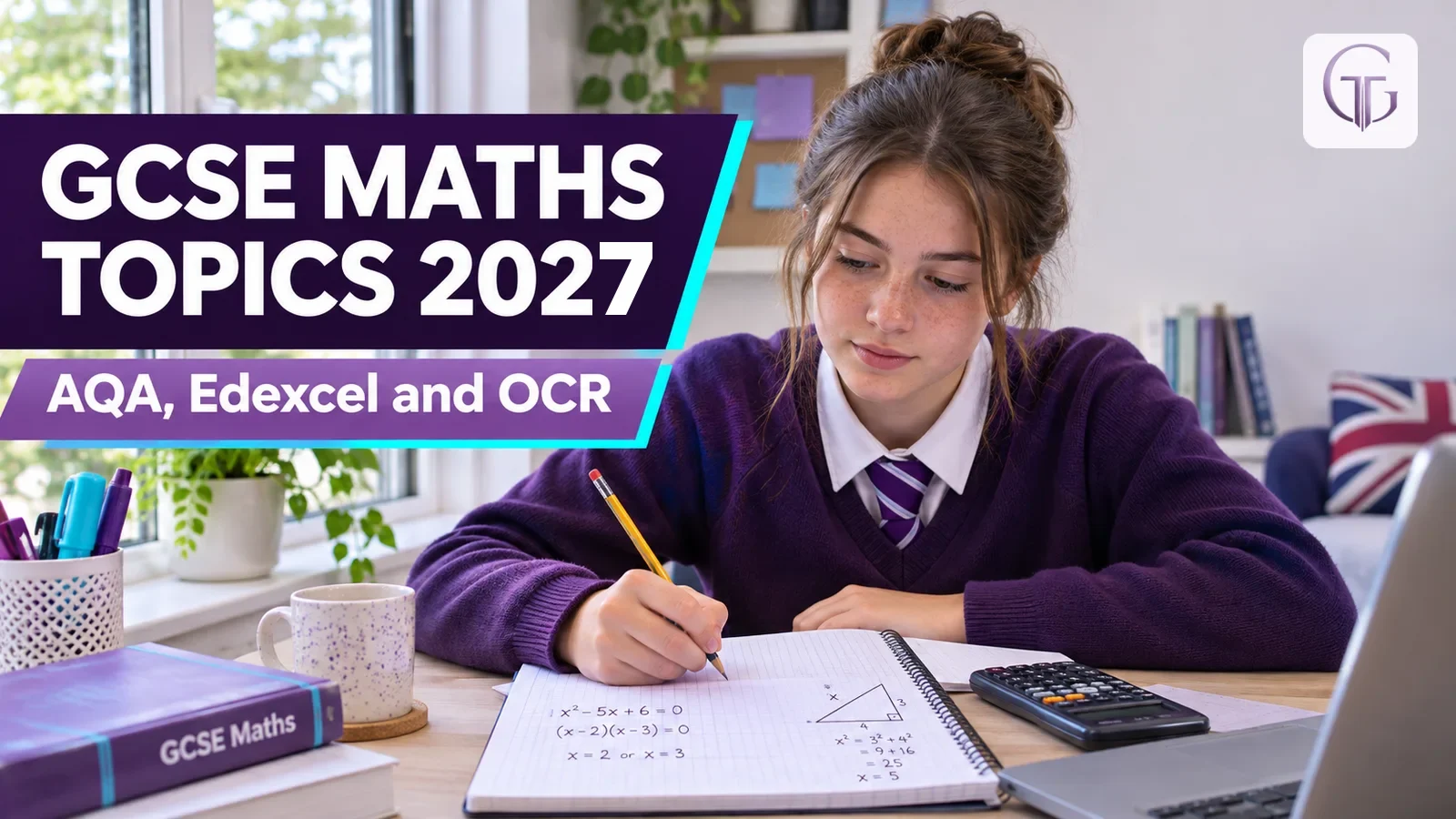
You can do a page of percentage questions and still lose marks on a sale-price problem. The arithmetic hasn't changed. The paper has stopped telling you what to do first. That's the difference between recognising the GCSE Maths topics in your notes and using them in an exam.
In summer 2026, more than 6,000 additional 16-year-olds achieved grade 7 or above in GCSE Maths compared with the previous year, according to the Department for Education's 2026 results release. Your best starting point is still your last marked paper: which marks could you win back next time?
This checklist is for students sitting GCSE Maths in summer 2027 under AQA 8300, Pearson Edexcel 1MA1 or OCR J560. The specifications are the same ones used in 2026, so the topic content carries straight over. The guide covers these three GCSEs in England, not International GCSE or other UK qualifications.
What are the main GCSE Maths topics for AQA, Edexcel and OCR?
GCSE Maths covers six areas: number, algebra, ratio and proportion, geometry and measures, probability, and statistics. AQA, Edexcel and OCR draw on the same national subject content. What you need within each area depends on your tier, so check that before you revise.
The Department for Education's GCSE Mathematics subject content is the starting point for the three specifications. Use the checklist below to spot gaps, then check your board's tier labels for the full detail. A heading like “vectors” can cover a basic skill at Foundation and a much harder proof at Higher.
1. Number
- Shared skills: Place value; ordering positive and negative numbers; the four operations; fractions, decimals and percentages; prime factors, highest common factor and lowest common multiple; powers and roots; standard form; rounding, estimates and error intervals.
- Higher additions: Surds, including rationalising a denominator; fractional indices; converting recurring decimals to fractions; calculating with upper and lower bounds.
Don't leave fractions until the week of the exam. They turn up in ratio, probability and algebra as well as number questions. If adding fractions on their own still trips you up, use the GCSE Maths number notebooks before trying algebraic fractions.
2. Algebra
- Shared skills: Simplifying expressions; substitution; expanding and factorising; rearranging formulae; solving linear equations and inequalities; finding the nth term of a linear sequence; plotting and interpreting straight-line and other familiar graphs; solving simple quadratics by factorising.
- Higher additions: Completing the square and using the quadratic formula; algebraic fractions; composite and inverse functions; quadratic sequences; a linear equation paired with a quadratic in simultaneous equations; tangents to curves and the equation of a circle centred at the origin.
Treat an expression and an equation as different jobs. You can simplify 3x + 2x to 5x, but there's nothing to solve until you know what it equals. The algebra and graphs notebooks let you practise those steps apart before mixing them.
3. Ratio, proportion and rates of change
- Shared skills: Simplifying and sharing ratios; recipes and scale drawings; best buys; percentage change and reverse percentages; simple and compound interest; direct and inverse proportion problems; compound measures such as speed, density and pressure.
- Higher extensions: Set up and use algebraic models for proportion, including relationships with squares and roots. Interpret a gradient on a curve as a rate of change at a point.
Write what each number represents. A ratio of 2:3 means the first share is 2 out of 5 parts, not 2 out of 3. The ratio and proportion practice notebooks cover both sharing and the less obvious questions where a ratio changes.
4. Geometry and measures
- Shared skills: Angle rules; bearings; scale drawings and constructions; congruence and similarity; transformations; area and perimeter; circles, arcs and sectors; surface area and volume; plans and elevations; Pythagoras and right-angled trigonometry.
- Higher additions: Circle theorems and proofs; negative scale factors in enlargements; links between length, area and volume scale factors; three-dimensional Pythagoras and trigonometry; sine and cosine rules; vector proofs.
Redraw a busy diagram if the right-angled triangle isn't obvious. Five seconds with a pencil can save a minute spent applying the right formula to the wrong shape. For practice, pick a topic from the geometry and measures notebooks.
5. Probability
- Shared skills: The probability scale; complements; relative frequency and expected outcomes; systematic lists; sample spaces; two-way tables, Venn diagrams and tree diagrams for combined events.
- Higher extensions: Work out conditional probabilities, where you're given information that changes the group or outcomes you should consider. Use tables, trees or Venn diagrams to show that change.
The word “given” is a useful signal. If a question says a pupil is chosen from those who cycle to school, the total is the group of cyclists, not the whole class. Try the probability notebooks with worked answers if that switch keeps catching you out.
6. Statistics
- Shared skills: Sampling and bias; averages and range; frequency tables; estimating a mean from grouped data; charts, time series and scatter graphs; interpreting correlation and comparing data sets.
- Higher additions: Histograms with unequal class widths; cumulative frequency; box plots and interquartile range, which measures the spread of the middle half of the data.
A histogram isn't a bar chart with the gaps filled in. The area of each bar represents frequency, so height alone won't tell you which group is largest when widths differ. Use the statistics notebooks to practise reading and drawing them.
How do Foundation and Higher GCSE Maths topics differ?
Foundation and Higher share core skills such as fractions, equations, ratio, angles and probability. Higher adds content and more complex problems. Foundation targets grades 1 to 5, while Higher targets grades 4 to 9. You sit all three papers at the same tier.
| Topic area | Foundation: approximate share | Higher: approximate share |
|---|---|---|
| Number | 25% | 15% |
| Algebra | 20% | 30% |
| Ratio, proportion and rates of change | 25% | 20% |
| Geometry and measures | 15% | 20% |
| Probability and statistics combined | 15% | 15% |
These figures apply across the assessment, not to each paper. Number and ratio together account for around half of Foundation, so they deserve time if you're aiming for a 4 or 5. Higher gives more weight to algebra, but fractions and percentages still show up inside other tasks.
What does a crossover topic look like?
Crossover topics are assessed at both tiers. A Foundation student might work out the value of an item after a 10% discount. A Higher student could use the same percentage multiplier in a longer task that includes a second price change or a comparison. The core skill is worth practising on either tier.
If you're on the border between tiers, ask your teacher to compare results from several papers rather than one mock. Higher is required for grades 6 to 9, but choosing it doesn't automatically make a grade 4 or 5 easier to reach.
What do the questions ask you to do?
Expect to do more than recall a method. The assessment objectives, also called AOs, describe three kinds of work: using standard methods, reasoning with maths and solving problems in context. A question might ask you to find a gradient, explain what it means, or decide whether two journeys take the same time.
Try all three when you revise a graph. Find the gradient of a straight line that rises 12 metres in 4 seconds. Then explain why the answer is 3 metres per second rather than 3 seconds per metre. Finally, work out how long it takes to cover another 9 metres at the same speed.
Which GCSE Maths papers allow a calculator?
AQA and Pearson Edexcel put the non-calculator exam first. OCR puts it second on both tiers, as Paper 2 at Foundation and Paper 5 at Higher. All three boards set three 90-minute papers, with a calculator allowed on the other two.
| Exam board | Specification | Non-calculator | Calculator | Marks per paper |
|---|---|---|---|---|
| AQA | 8300 | Paper 1 | Papers 2 and 3 | 80 |
| Pearson Edexcel | 1MA1 | Paper 1 | Papers 2 and 3 | 80 |
| OCR | J560 | Paper 2 Foundation; Paper 5 Higher | Papers 1 and 3 Foundation; Papers 4 and 6 Higher | 100 |
Do Paper 1, Paper 2 and Paper 3 have fixed topics?
No. Content from your tier can be assessed across the papers. A topic appearing on one paper doesn't officially rule it out of the next. Practise written calculations on non-calculator questions, then practise choosing a method and checking your answer on calculator questions. Pressing the right buttons won't rescue the wrong setup.
For 2027, use the GCSE exam dates guide to plan ahead, then confirm your board, tier and paper times on the timetable issued by your school or exam centre.
Do you get a GCSE Maths formula sheet?
Yes. Formula sheets were provided on both tiers in 2026, including for the non-calculator paper, and Ofqual has confirmed they will continue for the life of the current specifications. That means you should expect one in 2027 too. Practise with your board's sheet so you can use it without wasting time.
The Ofqual decision on formula sheets applies to the current specifications. Check the sheet issued by your board for your tier. A formula can tell you how to calculate the area of a circle. It won't tell you that the 12 cm on the diagram is the diameter and you need to put in 6 cm. Practise choosing the formula, labelling the values and checking the units.
Which GCSE Maths topics should you revise first?
Start with the shared skills that are costing you marks: fractions, percentages, ratio, equations, graphs and measurement are useful places to look. Use a marked mock to choose two weak areas. Higher students should then test how well they handle questions that combine topics.
For a grade 4 or 5
Pick two gaps that recur on the same paper. A student who mixes up percentages and has trouble with ratios could start with decimal multipliers and finding one share. Follow with a best-buy problem where the units don't match. That gives you more information than doing ten questions that all announce the method in the heading.
Take a £54 jacket after a 10% discount. The £54 represents 90% of the original price, so divide by 0.9 to get £60. Adding 10% to £54 gives £59.40, which is close enough to look right. Write down what makes up the whole before doing the calculation.
For a grade 7, 8 or 9
Practise shared skills under more demanding conditions before piling on new topics. Try proving a result with vectors, forming a quadratic from an area problem, or using a scale factor to link two volumes. Give yourself a question without a topic label and see whether you can pick the method without a nudge.
If you're targeting the top band, the grade 9 GCSE Maths guide goes further into timed practice and exam technique. Keep a record of why you lost a mark. “Used length scale factor for volume” tells you what to fix; “geometry” doesn't.
For example, take two similar solids with a length scale factor of 2. The larger solid has eight times the volume because it doubles in three directions. If the smaller one holds 35 cm³, the larger one holds 280 cm³. Now reverse the question: if two similar solids have volumes of 40 cm³ and 135 cm³, their volume ratio is 8:27, but their length ratio is 2:3.
Write a line to show why you've squared or cubed a scale factor. If you make an arithmetic slip later, a clear line of working helps show what you knew.
How can you turn this GCSE Maths checklist into a revision plan?
Mark each topic red, amber or green based on questions you've actually answered. Fix two gaps at a time, then revisit them in a mixed set without notes. Save full timed papers for checking whether the same skills hold up under exam conditions.
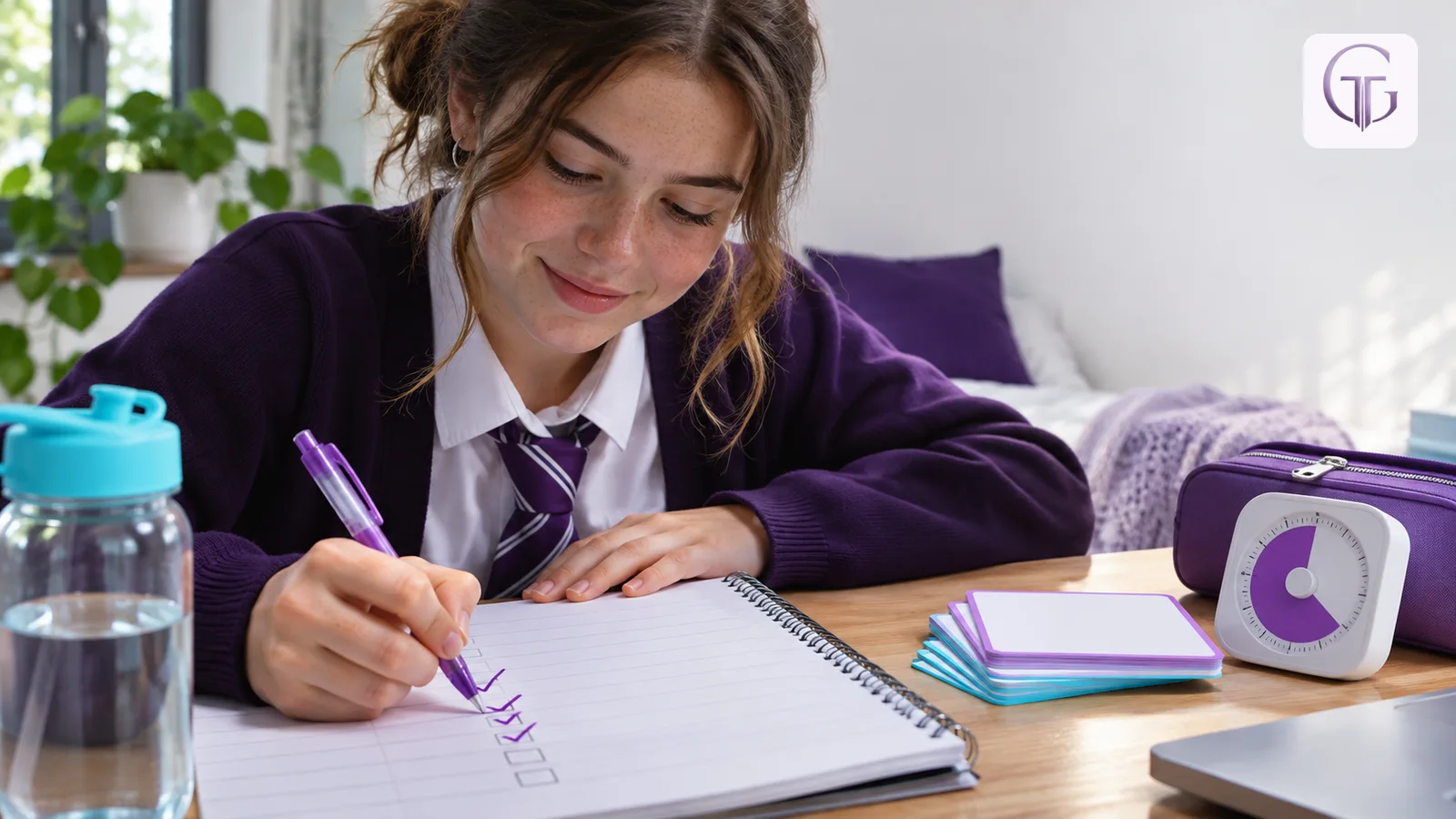
- Start with a short test. Pick six questions from recent classwork or a paper, one from each topic area. Close your notes before you start.
- Mark it and name the error. Did you not know the method, misread the question, slip in the arithmetic or run out of time? Note the cause next to the topic.
- Repair two specific gaps. Study one worked example for each gap, cover it, then solve a fresh question from scratch.
- Test again a few days later. Mix the topics and remove the headings. Move a topic to green only when you can do it without a reminder.
- Finish with a timed set from your board. Use your actual calculator rules and formula sheet. Mark the paper, then let the results pick next week's two priorities.
Put two short sessions into your GCSE revision timetable before booking out a whole Sunday. A teacher can help with the first gap if you're not sure where your method breaks down.
What else should students know about GCSE Maths topics?
Both tiers test the same six main areas, but they don't test every method at the same depth. Check your board and tier before picking resources, treat past papers as practice rather than predictions, and keep working on the basics even when aiming high.
Frequently asked questions
Are GCSE Maths topics the same for AQA, Edexcel and OCR?
The three boards use the same national subject content, but their specifications and papers organise it differently. Use shared topic practice to learn a method, then switch to your own board's papers to get used to the format.
What should I revise first for GCSE Maths Foundation?
Start with fractions, decimals, percentages, ratio and basic algebra if those are costing you marks. Follow with a mixed set that includes units, angles, data and probability so you don't mistake a short priority list for the whole course.
Is basic trigonometry on Foundation GCSE Maths?
Yes. Foundation includes using sine, cosine and tangent in right-angled triangles. Using the sine or cosine rule in a triangle without a right angle is Higher content.
Can the same topic appear on two GCSE Maths papers?
Yes. An exam board can assess the same area on more than one paper, including with a different kind of question. Don't drop a topic because a friend saw it on the first paper.
Can you get a grade 6 on Foundation GCSE Maths?
No. Grade 5 is the highest grade available on Foundation. To aim for a grade 6 or above, ask your teacher about Higher entry and review a set of marked Higher practice papers together.
Have the GCSE Maths topics changed for 2027?
No. AQA 8300, Pearson Edexcel 1MA1 and OCR J560 are the same specifications used in 2026, so topic lists and past papers from earlier years still work for practice. Use current resources for the 2027 exam timetable, formula sheet and any board guidance.
Need GCSE Support?
Get one-to-one online GCSE tutoring for Maths, English, Science and other GCSE subjects from home.