
A GCSE student gets three algebra questions wrong, pauses twice on rearranging formulae and skips a harder item. The next session does not simply serve another random worksheet. A useful platform notices the pattern and brings the missing step back at the right level.
That is AI personalised GCSE learning when it works well. Online tutoring platforms use performance data, curriculum maps and automated feedback to decide what a student should practise next. The aim is not to make learning effortless. Good personalisation makes the right effort easier to find.
Public confidence is still developing. A Department for Education and Department for Science, Innovation and Technology study involved 108 parents and pupils across three English locations. Participants saw opportunities for AI to support education, but remained cautious about direct pupil use and data sharing. The government research summarises those attitudes and conditions.
This guide explains the machinery behind AI personalisation, the GCSE examples that matter, the role of a human tutor and the checks every parent should make.
What does AI personalised GCSE learning mean?
AI personalised GCSE learning means using software to adjust topics, question difficulty, explanations, feedback or revision timing around an individual student’s recorded performance. The system should stay aligned with the correct subject, exam board and tier rather than offering generic study content.
“AI” covers several different tools. Adaptive learning uses rules or predictive models to select the next activity. Generative AI produces new language, such as an explanation or practice question. Automated marking estimates the quality of an answer. A platform may use one, two or all three.
Personalisation is not the same as letting a chatbot improvise. Strong systems connect each task to a defined GCSE specification and keep a record of what the student has attempted. Parents comparing formats can also read how online GCSE tutoring works before judging where AI fits.
What information does an AI tutoring platform use?
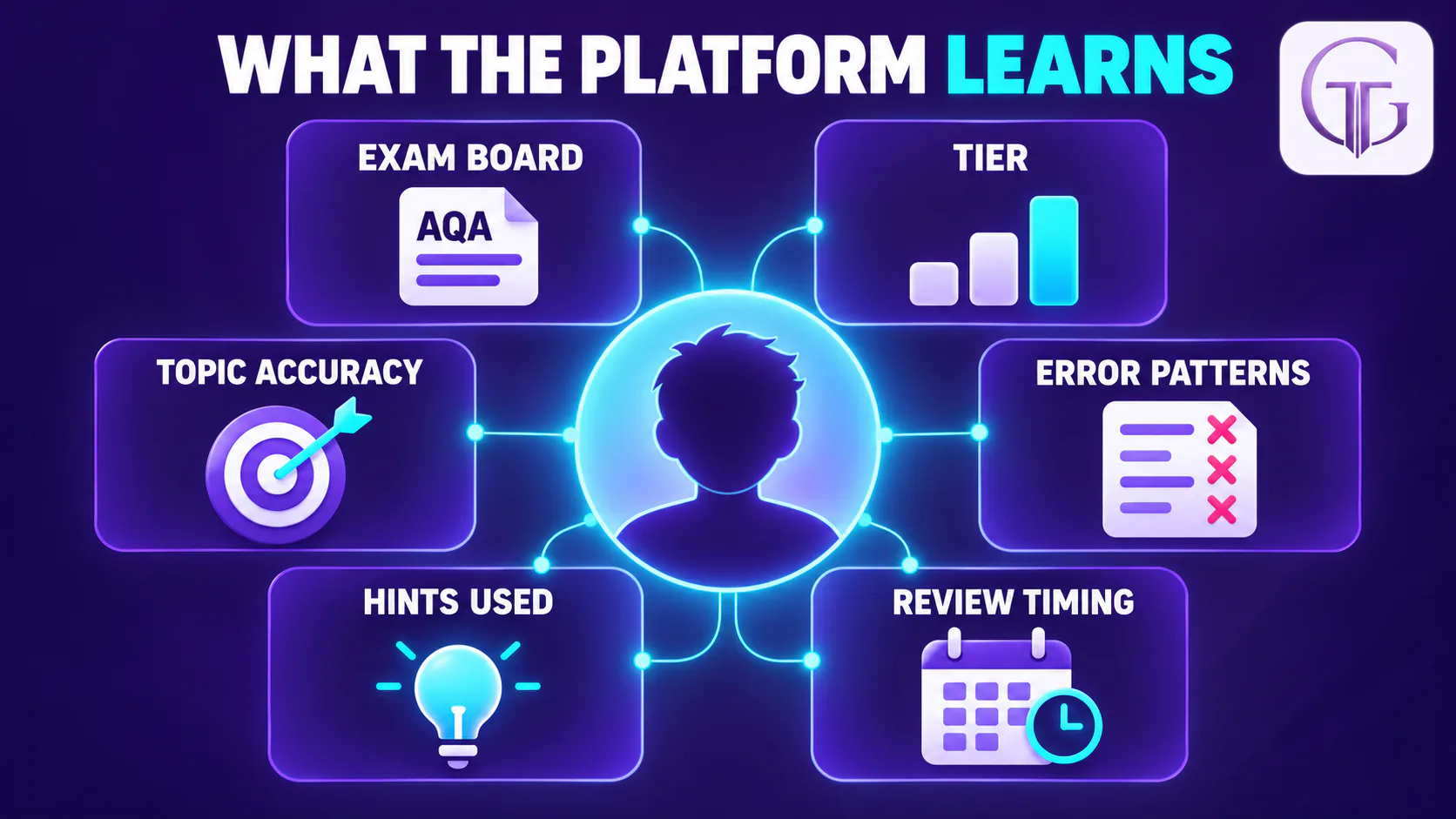
An AI tutoring platform can use the student’s subject, exam board, tier, diagnostic results, previous answers, recurring errors, response time and revision history. Responsible platforms collect only what they need, explain why it is used and protect identifiable information about children.
The central record is often called a student model. That means the platform’s changing estimate of what a learner knows, partly knows or has not yet mastered. It is an estimate, not a complete picture of the child.
Useful inputs include:
- the chosen GCSE specification and target exam series;
- accuracy by topic and question type;
- steps shown in Maths or Science working;
- marks gained against an essay or short-answer rubric;
- hints requested before a correct answer;
- time since a topic was last recalled;
- teacher or tutor corrections.
Response time needs careful handling. A slow answer may show uncertainty, but it may also reflect careful thinking, dyslexia, distraction or a poor connection. Sensible systems use several signals instead of treating speed as ability.
How does adaptive learning decide what a student should do next?
Adaptive learning compares recent performance with a mapped sequence of GCSE knowledge and skills. It then selects a suitable next task, which may revisit a prerequisite, repeat a weak question type, increase difficulty or schedule the topic for later retrieval practice.
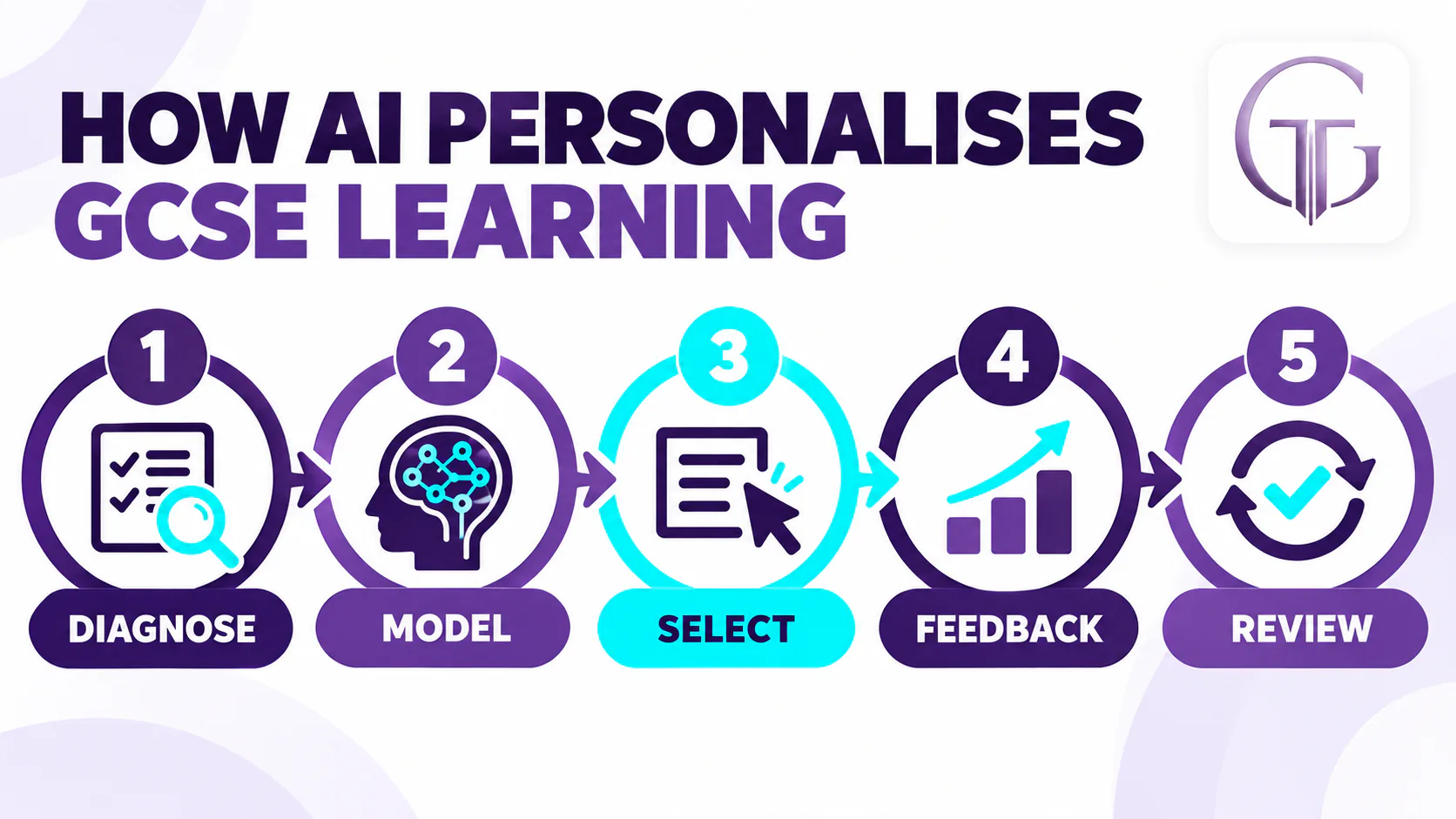
A common process looks like this:
- The student completes a short diagnostic or set of questions.
- The platform links each answer to a topic and skill.
- The system estimates confidence or mastery for those skills.
- A recommendation engine selects the next useful task.
- New performance updates the student model.
Spaced repetition brings a topic back after a planned gap. Retrieval practice asks the learner to produce an answer from memory. Both can be scheduled by software, but neither needs an AI label to be effective. The value lies in the learning design.
Students still need an overall plan. A personalised queue works best inside a realistic GCSE revision timetable, not as a stream of endless notifications.
How does AI personalise GCSE practice and feedback?
AI can personalise practice by changing question choice, difficulty, scaffolding and timing. It can personalise feedback by identifying the step where an error began, offering a smaller hint, comparing an answer with assessment criteria and generating another task that tests the same skill.
Scaffolding means temporary support that helps a student complete work they cannot yet manage alone. A platform might show the first algebra step, define a command word or offer a sentence prompt. Good scaffolding fades. If every answer arrives half-written, independence never develops.
Feedback should be specific enough to act on. “Try again” tells a student almost nothing. “You converted the percentage correctly but applied it to the wrong starting value” points to the repair.
The best systems also preserve productive struggle. That is the useful effort involved in thinking, testing and correcting. Instant answer-dumping feels efficient, but it quietly removes the part where learning happens.
What does AI personalisation look like across GCSE subjects?
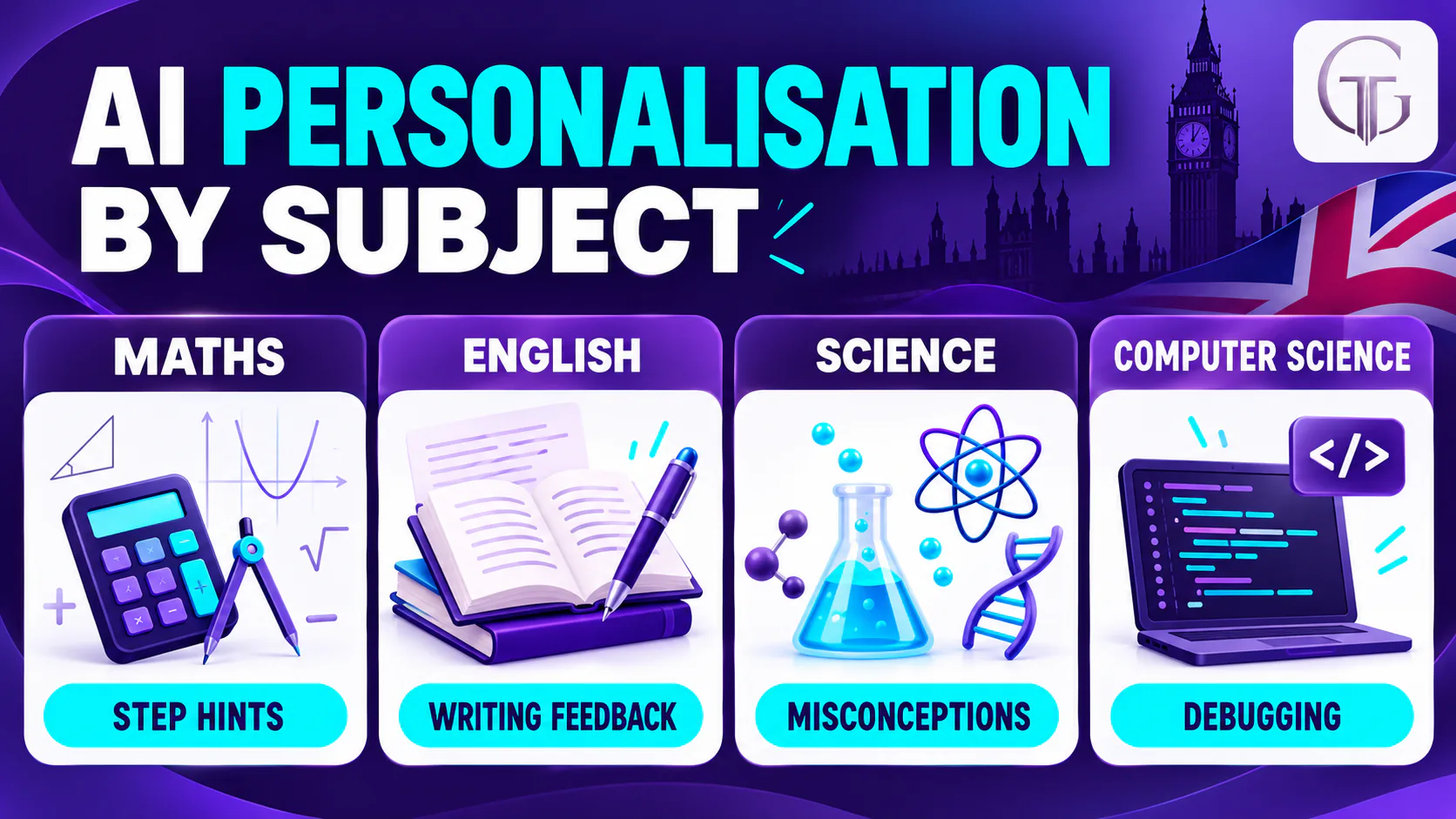
AI personalisation changes by subject because GCSE knowledge and assessment differ. Maths platforms can analyse working and prerequisite skills, English tools can compare written responses with criteria, and Science systems can combine calculations, practical reasoning, vocabulary and extended explanations.
| GCSE subject | Useful AI personalisation | Human check still needed |
|---|---|---|
| Maths | Detects repeated algebra errors, adjusts difficulty and supplies step-level hints | Whether the method is efficient, clearly set out and suitable for the board |
| English | Highlights missing evidence, weak explanation or unclear structure | Interpretation, originality, tone and whether feedback oversimplifies a valid argument |
| Science | Targets misconceptions, units, equations and practical variables | Scientific accuracy, acceptable wording and context-specific mark-scheme judgement |
| Computer Science | Tests trace tables, logic, code reading and debugging | Code quality, alternate valid solutions and specification language |
A student struggling with simultaneous equations may need fractions revisited first. An English student may know the quotation but fail to explain its effect. A Biology student may recall osmosis yet confuse concentration with the direction of water movement.
Those cases explain why subject-specific support matters. See the site’s guides to GCSE Maths tutoring, GCSE English tutoring and GCSE Science tutoring for the human skills each subject still requires.
How can AI work with a human GCSE tutor?
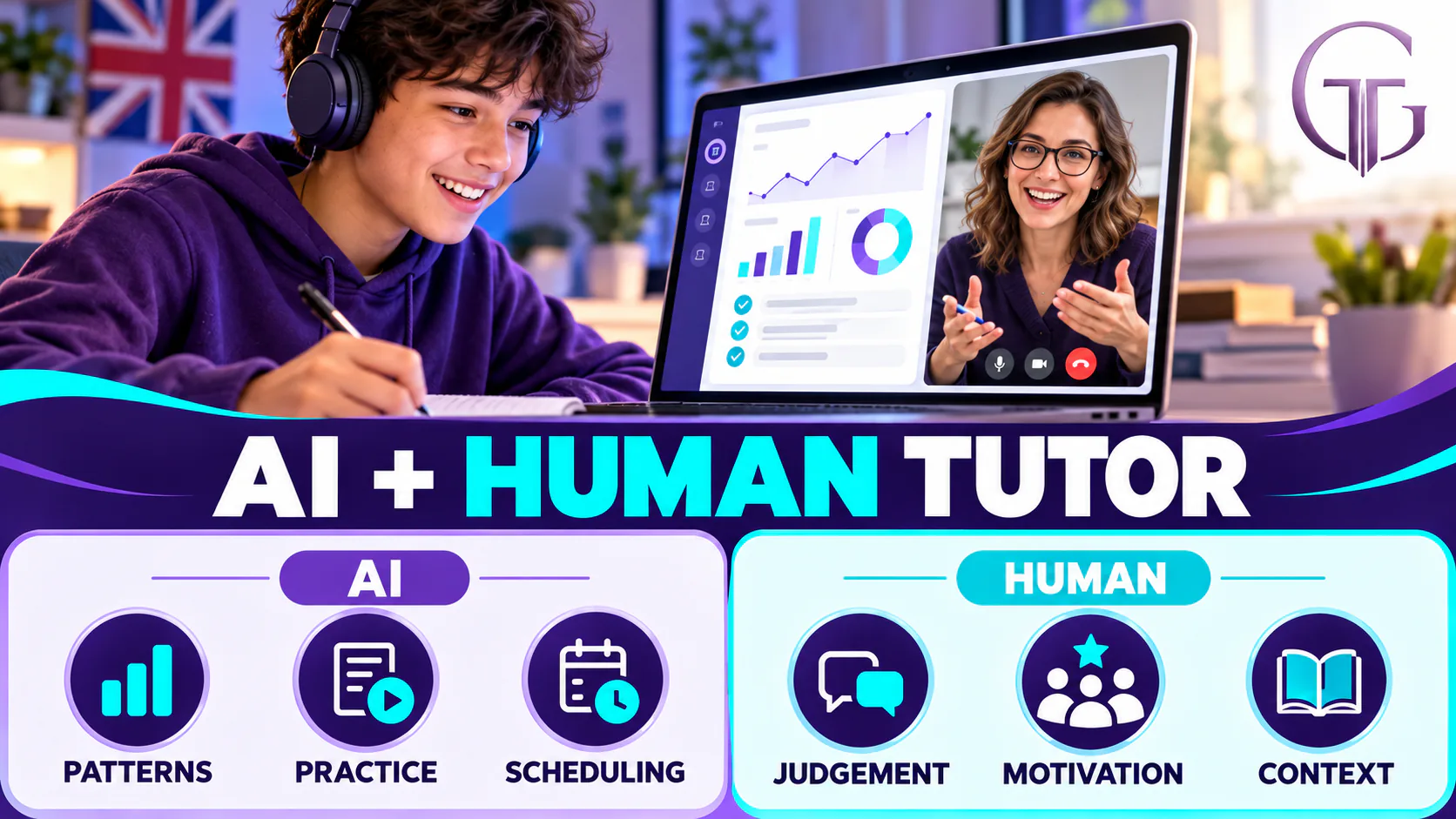
AI works best as a preparation and practice layer around human teaching. Software can surface error patterns, schedule retrieval and produce extra questions. A tutor can judge why the error happened, notice frustration, change the explanation and decide when the platform’s recommendation is wrong.
A practical hybrid session might work like this:
- the platform identifies two weak topics before the lesson;
- the tutor checks whether the diagnosis matches the student’s written work;
- both focus on one underlying misconception;
- the student completes fresh questions without prompts;
- the platform schedules a short follow-up three days later;
- the tutor reviews whether the improvement held.
Human tutors also read hesitation, confidence and motivation. Those signals rarely fit neatly into a dashboard. The Department for Education says technology should not replace the valuable relationship between teachers and pupils. Its current guidance on generative AI in education also notes that evidence about pupil use is still emerging.
Families weighing delivery models can compare online and in-person GCSE tutoring. The format matters less than accurate diagnosis, active student thinking and accountable feedback.
What are the limits and risks of AI tutoring?
AI tutoring can produce inaccurate explanations, invented facts, biased feedback, poor curriculum matches and confident but incorrect marking. It can also encourage dependency or expose children’s data when a platform lacks suitable safeguards. Personalisation does not remove the need for verification.
Generative AI can hallucinate, which means it presents false information as if it were true. A polished explanation is not proof of accuracy. Marking is especially difficult for nuanced essays, alternative methods and answers that require professional judgement.
Watch for five practical risks:
- Wrong specification: The task uses content or terminology from another board.
- False certainty: Feedback gives a precise grade without enough evidence.
- Answer dependency: The student stops attempting questions before asking AI.
- Narrow optimisation: The platform drills what is easy to measure and neglects deeper writing or practical reasoning.
- Unclear data use: The privacy notice does not explain storage, retention or model training.
AI-generated work submitted as a student’s own can also become malpractice. Revision support and assessment submission are different contexts. Schools and exam centres set the rules, and students should ask when the boundary is unclear.
How should parents assess an AI tutoring platform?
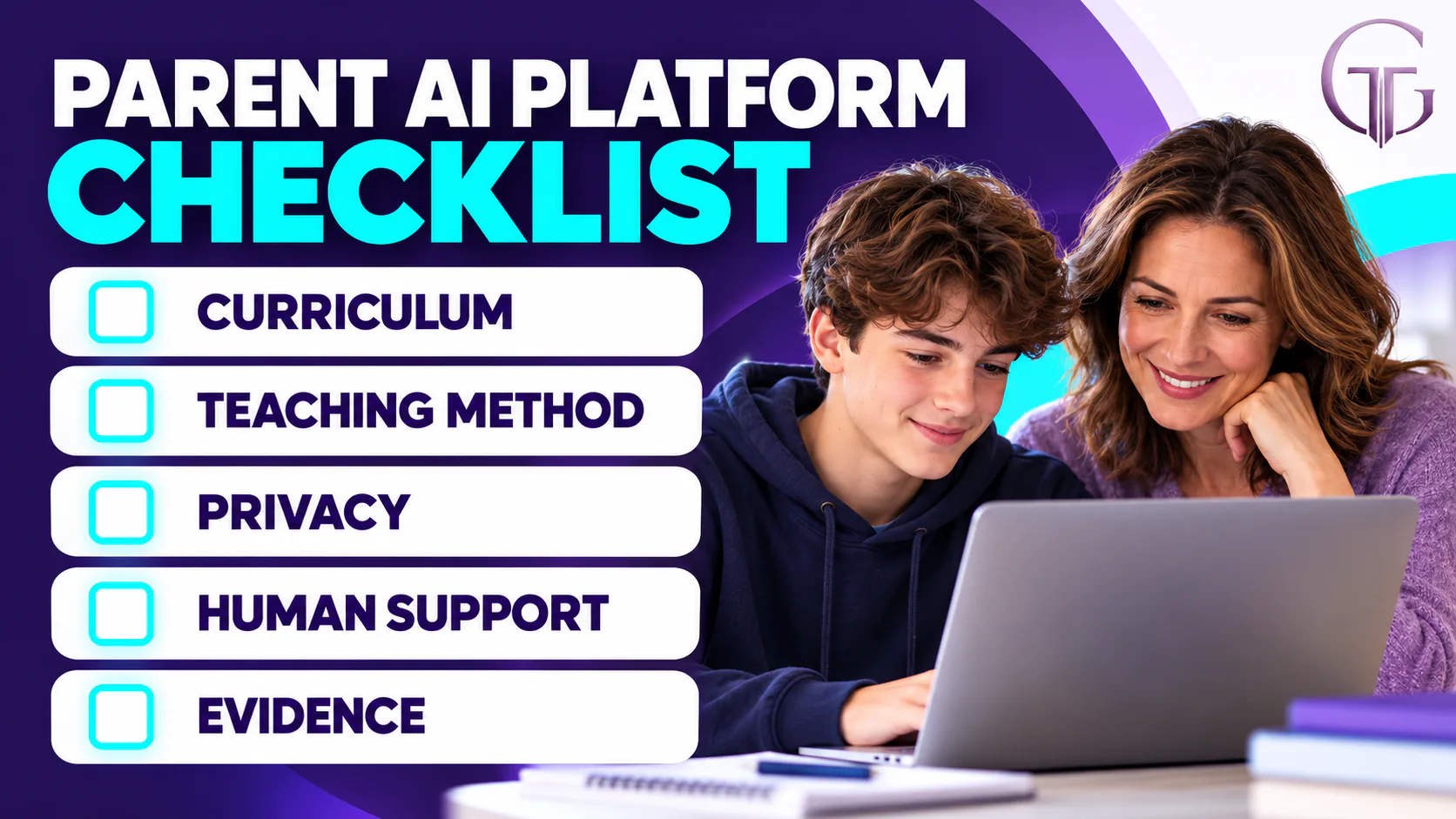
Parents should check curriculum alignment, teaching method, evidence, data handling, age suitability and access to human support. Ask the platform to demonstrate how it responds to mistakes, protects student information, handles unsafe prompts and corrects inaccurate feedback before relying on its claims.
Use this checklist:
- Does it support the correct exam board, subject and tier?
- Does it guide thinking or simply provide finished answers?
- Can the student report an incorrect explanation or mark?
- Are human educators involved in content review?
- Can parents see progress without reading private conversations unnecessarily?
- Does the privacy notice explain what data is collected and why?
- Can data be deleted, and is student work used to train models?
- Are age restrictions, filtering and safeguarding arrangements clear?
- Does the company show evidence beyond testimonials?
England’s Department for Education updated its generative AI product safety standards in January 2026 to include cognitive development, emotional and social development, mental health and manipulation. A serious education platform should be able to discuss those risks plainly.
How can students use AI without weakening independent thinking?
Students should use AI for questions, hints, explanations and feedback after making a genuine attempt. They should verify important facts, rewrite ideas in their own words, practise without assistance and keep AI away from work that must represent their independent assessment performance.
A simple rule works well: attempt, ask, check, redo.
- Attempt the question without AI.
- Ask for one hint or an explanation of the stuck point.
- Check the response against notes, a textbook, mark scheme or tutor.
- Redo the question with the tool closed.
The final step matters most. Recognition is not recall. A student who understands an explanation on screen may still be unable to produce the method in an exam.
The complete GCSE revision guide explains how active recall, practice questions and correction should work together. AI belongs inside that process, not above it.
Is AI personalised GCSE learning suitable for every student?
AI personalised GCSE learning can help students who benefit from frequent practice, immediate hints and flexible pacing. It may be less suitable when a learner needs strong emotional reassurance, specialist SEND support, close accountability or nuanced feedback that the platform cannot provide reliably.
Suitability also changes by task. A student might use adaptive quizzes well for Chemistry vocabulary but need a tutor for six-mark explanations. Another may benefit from instant Maths practice yet become distracted by an open-ended chatbot.
Run a two-week test with one clear goal. Track completed work, errors corrected and unaided performance, not minutes logged or streaks earned. If the student cannot do more independently at the end, the personalisation has not delivered much.
Tutoring may be useful when the same gap continues despite independent practice. The guide on when to start GCSE tutoring explains how needs differ across Years 9, 10 and 11.
AI can make online learning more responsive. It cannot supply judgement, trust or effort on the student’s behalf. That is the honest version.
Frequently asked questions about AI personalised GCSE learning
What is an AI GCSE tutor?
An AI GCSE tutor is software that provides curriculum-linked explanations, questions, hints or feedback. Better systems use a student’s previous performance to adjust what appears next rather than delivering the same sequence to everyone.
How does AI identify a GCSE student’s weak topics?
AI systems link answers to specific topics and skills, then look for repeated errors, hint use and changes over time. A short diagnostic can provide a starting estimate, which should improve as the student completes more work.
Can AI mark GCSE answers accurately?
AI can offer useful provisional feedback, especially for structured questions, but it can still mark incorrectly. Extended writing, unusual valid methods and nuanced judgement need checking against official criteria and, where possible, a qualified teacher or tutor.
Is AI tutoring safe for children?
AI tutoring can be used safely when the product has age-appropriate design, filtering, clear privacy terms, limited data collection and human oversight. Parents should never assume that an education label guarantees those protections.
Can an AI tutor replace a human GCSE tutor?
No. AI can provide frequent practice and instant responses, but it cannot reliably replace professional judgement, relationship-building, motivation or safeguarding. The strongest model uses technology to extend human teaching rather than remove it.
Does AI know which GCSE exam board a student follows?
Only if the platform supports and correctly applies that specification. Students should select the exam board and tier explicitly, then check that topic names, command words and assessment advice match school materials.
Is using AI for GCSE revision cheating?
Using AI to explain a topic or generate practice is not automatically cheating. Submitting AI-generated work as the student’s own, or using prohibited assistance in an assessment, can be malpractice. Follow school and exam-centre rules.
Need GCSE Support?
Get one-to-one online GCSE tutoring for Maths, English, Science and other GCSE subjects from home.