
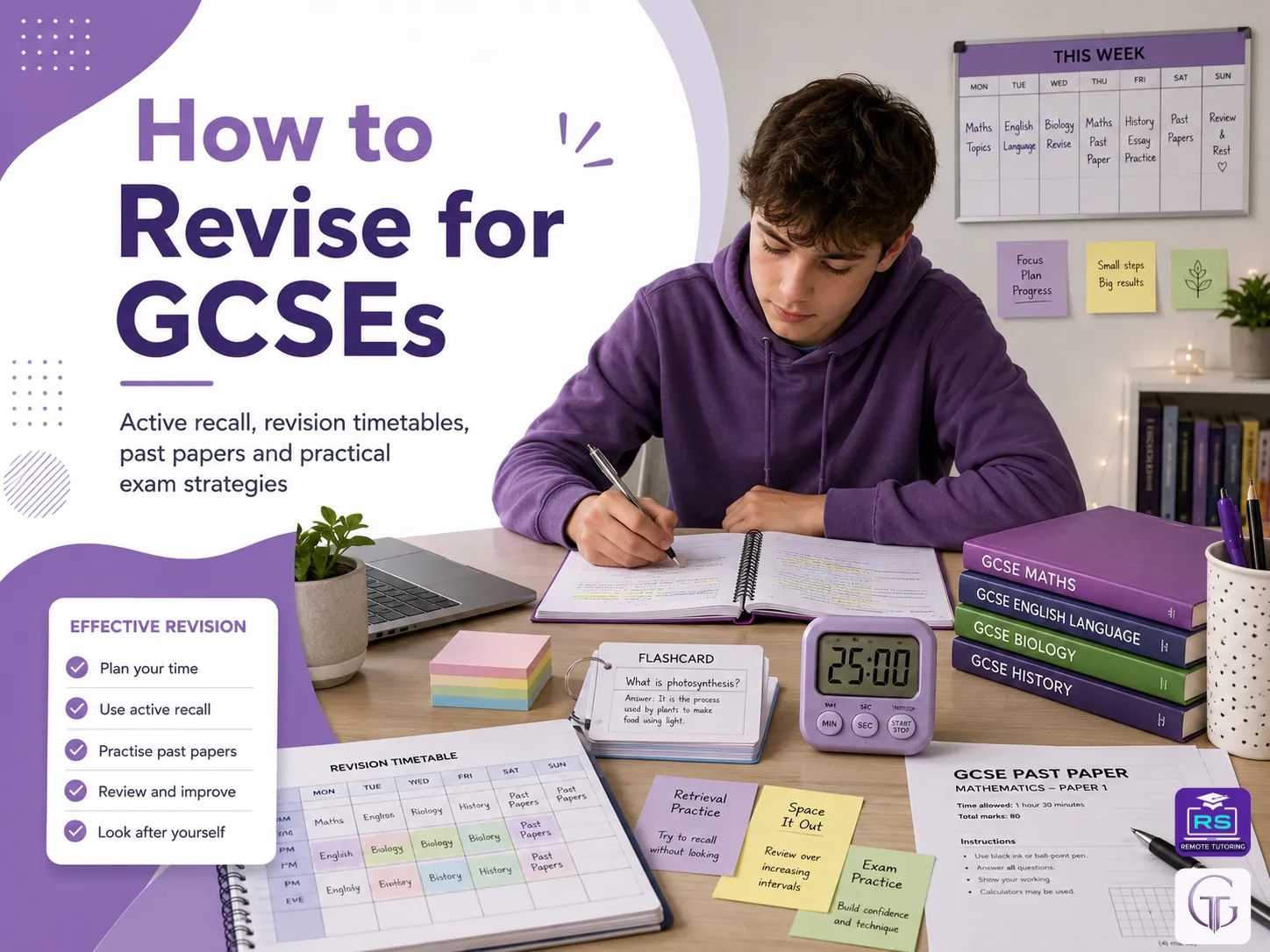
A student can sit at a desk for three hours, highlight six pages and still finish the evening unable to answer a single question without looking at the book.
That is the difference between spending time on revision and revising effectively.
Knowing how to revise for GCSEs means building a routine that makes you recall information, apply it to questions and correct mistakes. It does not mean producing beautiful notes or filling every free hour with study.
The scale of the task can feel intimidating. In summer 2025, 5,661,970 GCSE results were issued across 133 qualifications in England. Yet every student’s revision problem is smaller and more practical: identify what you do not know, practise it, check it and return to it later.
I’m Daniel Harris, Senior GCSE Education Writer at GCSE Online Tutoring. One of the most common revision mistakes I see is starting with resources rather than a diagnosis. Students download timetables, buy flashcards and open past papers before working out where the real gaps are.
This guide begins with that diagnosis.
Jump to Section
What Is the Best Way to Revise for GCSEs?
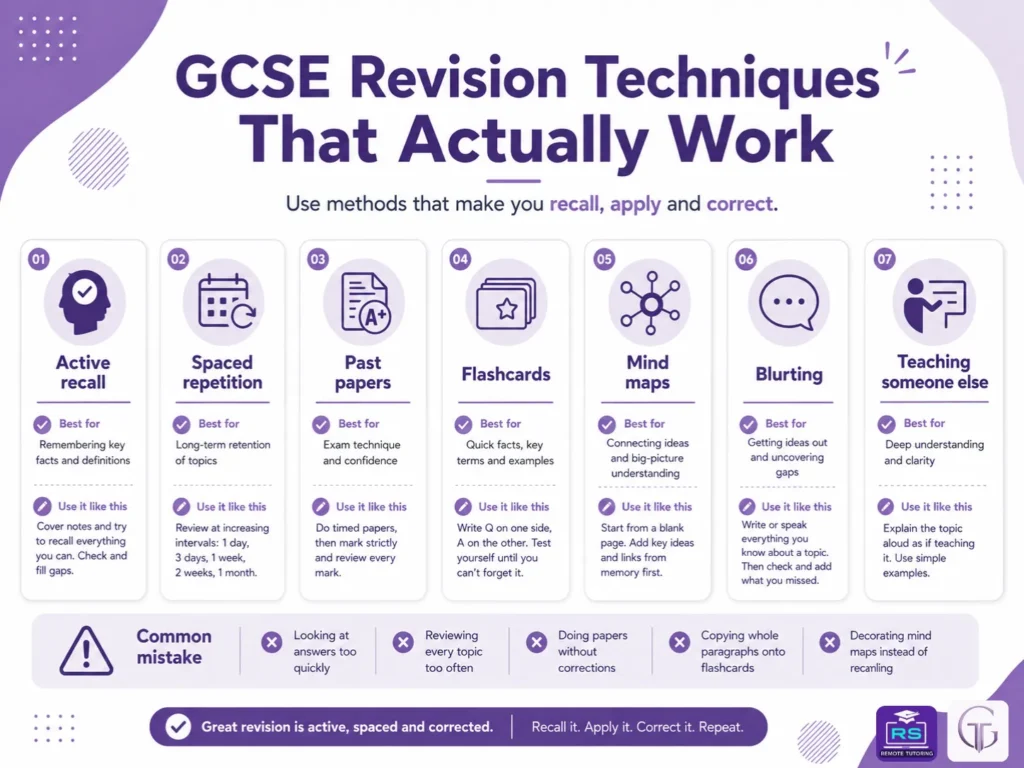
The best GCSE revision combines active recall, spaced practice, targeted question work and regular error correction. Start with the specification, identify weak topics, schedule short focused sessions and test yourself without notes before checking answers and revisiting mistakes later.
Revision should have three stages:
- Remember: Can you retrieve the fact, formula, quotation or method?
- Apply: Can you use it in an unfamiliar or exam-style question?
- Correct: Can you explain why your answer lost marks and avoid repeating the error?
Reading notes may help at the beginning of a topic. It should not be the whole session.
Retrieval practice means trying to bring previously studied information back to mind. The Education Endowment Foundation describes deliberate retrieval as a way to strengthen available knowledge and reduce the working-memory demand of related tasks.
A practical revision cycle looks like this:
- Choose one specific topic.
- Spend five minutes recalling what you know.
- Check the specification or notes.
- Complete several questions.
- Mark them.
- Record mistakes.
- Schedule the topic again.
That cycle is more useful than writing “Revise Science” in a timetable.
When Should You Start Revising for GCSEs?
Students should build light revision habits during Year 10 and begin structured preparation during Year 11. The exact starting point depends on mocks, knowledge gaps and target grades, but regular revision over months is more manageable than intensive preparation in the final weeks.
Year 10 revision does not need to resemble exam-season revision.
It can include:
- Reviewing one recently completed topic each week
- Creating a clear topic checklist
- Correcting assessment mistakes
- Building formula or vocabulary flashcards
- Keeping useful notes organised
- Practising weak foundational skills
By autumn of Year 11, revision should become more deliberate. Students can begin rotating subjects, completing exam-style questions and using mock feedback to change their priorities.
After the winter mocks, the plan should become more precise. A weak grade alone is not enough. Look at the paper and ask:
- Which topics caused difficulty?
- Was knowledge missing?
- Did the student misunderstand the question?
- Was timing the problem?
- Were marks lost through incomplete working?
- Did revision focus on the wrong material?
A student starting late should not conclude that revision is pointless.
Late starters need a narrower plan:
- List the papers and topics.
- Identify high-priority gaps.
- Stop rewriting full sets of notes.
- Use short recall sessions followed by questions.
- Correct every past-paper attempt.
- Ask teachers for help deciding what matters most.
There may not be time to make everything perfect. There is usually time to make preparation better.
How Many Hours Should You Revise for GCSEs Each Day?
There is no fixed daily number that suits every student. On school days, one or two focused sessions may be enough; weekends and holidays may allow more. The quality, consistency and purpose of each session matter more than recording a large number of hours.
A student with ten subjects, several weak areas and exams approaching will need a different routine from a Year 10 student consolidating classwork.
A sensible starting point might be:
- Year 10: Two to four short sessions across the week
- Early Year 11: Around one focused session on several school evenings
- After mocks: One or two focused blocks on most days, adjusted around homework
- Study leave: Several planned blocks divided by proper breaks
- During exams: Short, targeted preparation for the next papers
A focused block might last 25–45 minutes. Some students work well for longer, especially on full papers or essays. Others lose attention after half an hour.
Do not turn suggested hours into a competition.
Two useful questions are:
- What did you complete?
- What can you now do without help?
Those tell you more than the clock.
Sleep also belongs in the plan. NHS guidance says most teenagers need around eight to ten hours each night and warns that all-night cramming is usually less useful than sleeping before an examination.
How Do You Make a GCSE Revision Timetable?
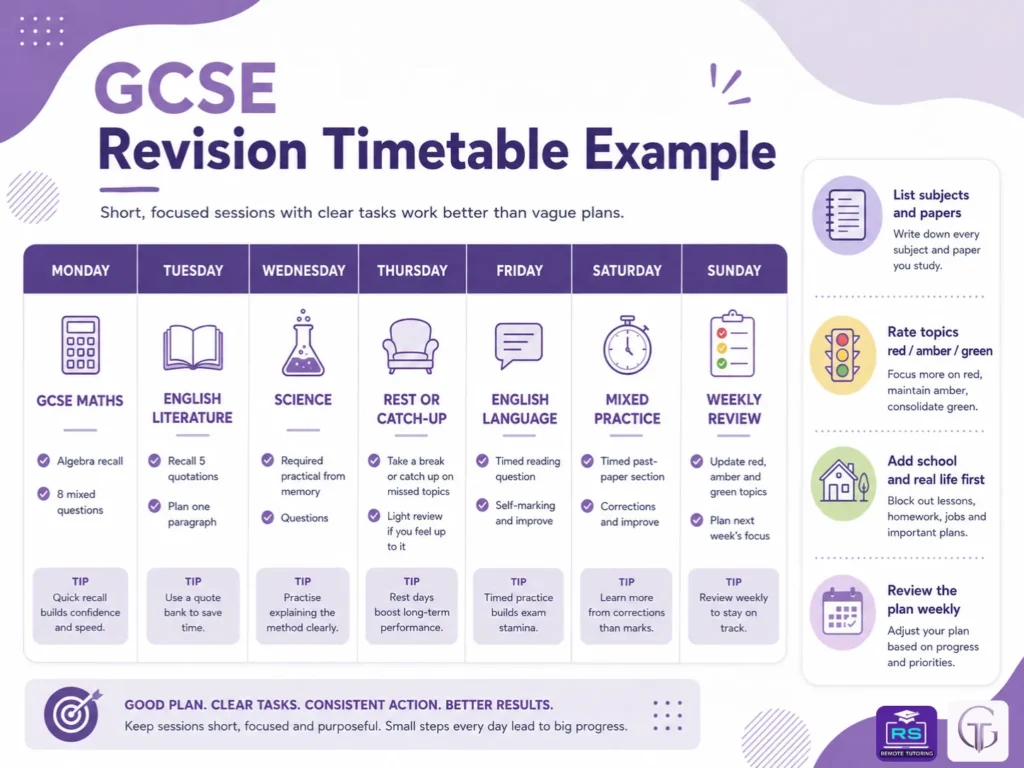
Build a timetable around available time, subject priorities and specific tasks. Add school, homework, meals, activities and rest first. Then schedule short sessions with clear outcomes, leaving spare space so one missed evening does not ruin the entire plan.
Step 1: List Subjects and Papers
Write the exact qualification where possible:
- AQA GCSE Mathematics Higher
- Pearson Edexcel English Language
- OCR Combined Science
- Eduqas English Literature
International families should confirm whether the student is taking a UK GCSE or an International GCSE. The content and assessment materials may differ.
Step 2: Break Subjects Into Topics
“Revise Maths” is too vague.
Use tasks such as:
- Solve five simultaneous-equation questions.
- Recall electrolysis rules and complete two exam questions.
- Plan a Macbeth ambition paragraph.
- Mark English Language Paper 1 Question 5.
- Revisit mistakes from the Biology mock.
Step 3: Rate Each Topic
Use a simple system:
- Red: Cannot explain or answer questions
- Amber: Partly secure but inconsistent
- Green: Can recall and apply independently
Do not ignore green topics completely. Revisit them less often.
Step 4: Add Real Life First
Block out:
- School
- Homework
- Meals
- Sport or clubs
- Family commitments
- Travel
- Rest
- Sleep
Then add revision to the time that genuinely remains.
Step 5: Review the Plan Weekly
A timetable should change when the evidence changes.
If Chemistry improves but English timing remains weak, move some time. If the student misses Tuesday, reschedule the task rather than declaring the week a failure.
Example GCSE Revision Timetable
| Day | Revision Focus | Specific Task | Time Needed |
| Monday | GCSE Maths | Algebra recall and eight mixed questions | 40 minutes |
| Tuesday | GCSE English Literature | Recall five quotations and plan one paragraph | 35 minutes |
| Wednesday | GCSE Science | Draw a required practical from memory and answer questions | 40 minutes |
| Thursday | Rest or catch-up | Complete one missed task only if needed | Flexible |
| Friday | GCSE English Language | Timed reading question and self-marking | 35 minutes |
| Saturday | Mixed practice | One timed past-paper section plus corrections | 75 minutes |
| Sunday | Weekly review | Update red, amber and green topic list | 30 minutes |
A timetable is useful only when it tells the student what to do next.
If planning is taking longer than studying, simplify it.
If your child knows revision is needed but cannot turn the workload into clear weekly tasks, structured GCSE revision support can help establish priorities before the plan becomes overwhelming.
What Revision Techniques Actually Work for GCSEs?
Effective techniques make students retrieve, organise or apply knowledge rather than merely look at it. Active recall, spaced repetition and exam questions should form the core routine, while flashcards, blurting, mind maps and teaching can support particular subjects and topics.
The EEF’s cognitive-science work identifies retrieval practice, spaced learning and interleaving among the approaches used to understand how pupils learn and remember. It also warns, in its revision guidance, that rereading and extensive highlighting can produce false confidence when students are not required to retrieve anything.
GCSE Revision Techniques Compared
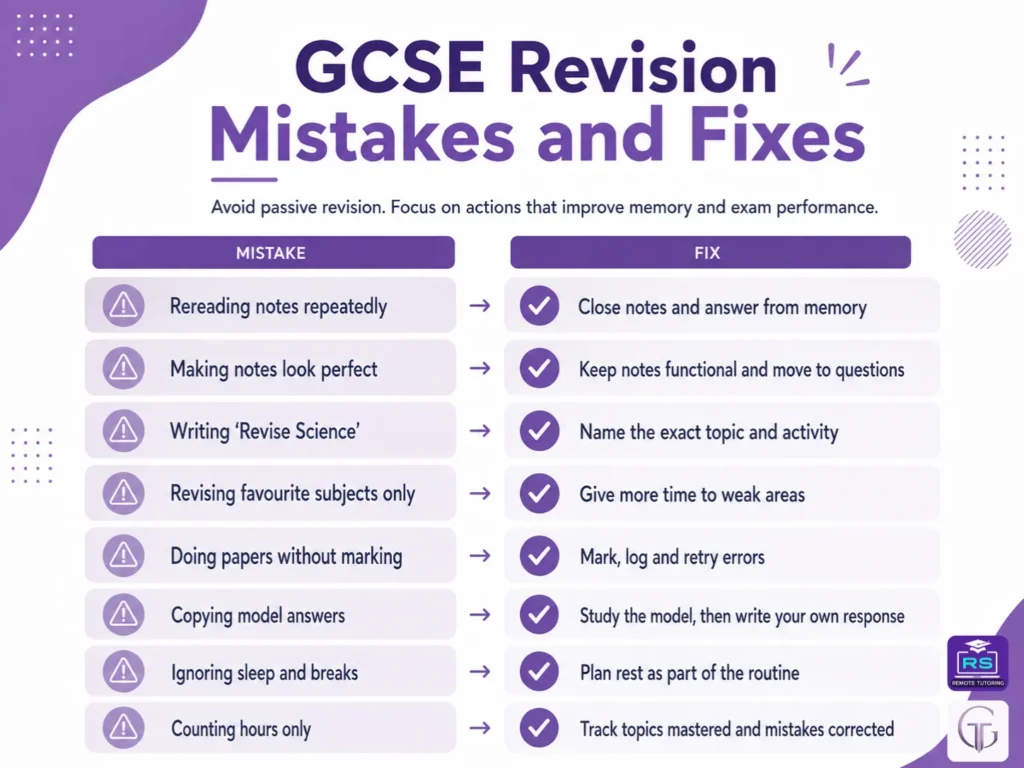
| Revision Method | Best For | How to Use It | Common Mistake |
| Active recall | Facts, formulas, quotations and processes | Close the notes and answer questions from memory | Looking at the answer too quickly |
| Spaced repetition | Long-term retention | Revisit material after increasing gaps | Reviewing every topic at the same frequency |
| Past papers | Application, timing and exam style | Attempt, mark, diagnose and redo | Completing paper after paper without corrections |
| Flashcards | Small pieces of retrievable information | Put one clear question on each card | Copying paragraphs onto cards |
| Mind maps | Relationships, themes and connected processes | Draw links from memory, then check | Spending time decorating rather than recalling |
| Blurting | Topic audits | Write everything recalled, compare and correct | Treating the first blurt as finished revision |
| Teaching | Testing understanding | Explain a method or idea in simple language | Reading notes aloud and calling it teaching |
Active Recall
Active recall means answering without looking.
Examples include:
- Writing a formula from memory
- Listing causes of an event
- Recalling quotations for a character
- Drawing a biological process
- Explaining how to solve an equation
- Answering a flashcard before turning it over
The difficulty is part of the method. A struggle to retrieve does not automatically mean the session is failing. It reveals what still needs attention.
Spaced Repetition
Spaced repetition means returning to information over time.
A student might revise a topic:
- On Monday
- Again on Thursday
- The following week
- Two weeks later
- Shortly before the examination
The spacing should respond to performance. Difficult information returns sooner; secure information can wait longer.
Past Papers
Past papers test whether knowledge survives contact with an examination question.
They help students practise:
- Question wording
- Paper structure
- Timing
- Selecting methods
- Extended responses
- Showing working
- Switching between topics
Official awarding organisations publish past papers, mark schemes and, in some cases, examiner reports. Students should select the correct subject, specification and tier rather than using a random paper carrying the same subject name.
Flashcards
Good flashcards are small tests.
Effective examples:
- Front: What is the quadratic formula? / Back: The formula written accurately
- Front: What does “evaluate” require in an English question? / Back: Make a judgement supported by evidence and reasoning
Avoid cards that contain an entire textbook page. If the answer cannot be recalled clearly, split the card.
Mind Maps
Mind maps are useful when connections matter.
They can work well for:
- Literary themes
- Historical causes and consequences
- Geography case studies
- Biological cycles
- Links between Science topics
Try drawing the map from memory first. Looking at a completed diagram and copying it is mostly a note-making exercise.
Blurting
Blurting is a quick knowledge audit:
- Choose a narrow topic.
- Put all materials away.
- Write everything remembered.
- Check it against reliable notes.
- Add omissions in another colour.
- Turn the omissions into questions.
- Revisit the topic later.
Blurting is useful at the beginning and end of a topic cycle. It is less suitable for practising extended calculations or full essay technique.
Teaching Someone Else
Explaining a topic can expose unclear thinking.
Ask the student to explain:
- Why an equation method works
- How a quotation supports an interpretation
- What happens during electrolysis
- Why a historical event had a particular consequence
The listener does not need to know the subject. Their job is to ask, “Why?” and “What does that mean?”
How Should You Revise GCSE Maths?
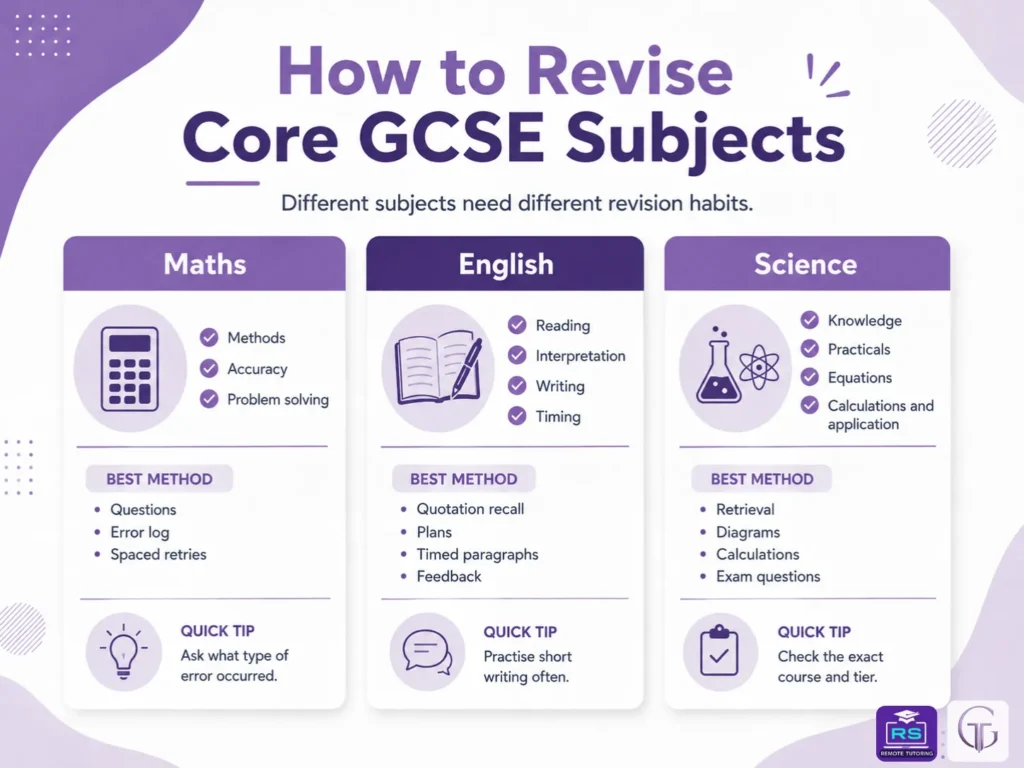
GCSE Maths revision should combine fluent methods, mixed problem solving, timed questions and careful error analysis. Students should practise calculations rather than only watch solutions, show full working and use the correct exam board’s Foundation or Higher materials.
Maths revision is performance-based. You cannot revise it effectively by reading examples alone.
A strong session might include:
- Recall the method or formula.
- Complete a few straightforward questions.
- Attempt mixed or unfamiliar questions.
- Mark every answer.
- Identify whether the error was knowledge, method or accuracy.
- Redo the question without the solution.
Prioritise:
- Number fluency
- Fractions, decimals and percentages
- Ratio and proportion
- Algebraic manipulation
- Equations
- Graphs
- Geometry and measures
- Probability
- Statistics
- Multi-step problem solving
Students aiming for grades 7–9 still need secure basic marks. Hard questions matter, but repeated losses on signs, units, rounding and arithmetic can be just as costly.
Keep an error log with four columns:
| Question | Error | Correct Method | When to Retry |
| Simultaneous equations | Subtraction sign error | Align terms and subtract line by line | Thursday |
| Circle theorem | Wrong theorem selected | Identify angle relationship first | Next Monday |
How Should You Revise GCSE English?
GCSE English revision should develop reading, interpretation, writing and timing. Students need a small bank of flexible textual knowledge, regular paragraph and essay planning, timed responses and feedback that explains how to improve the quality of analysis or communication.
English Literature
Do not memorise dozens of isolated quotations without understanding them.
Organise revision by:
- Character
- Theme
- Relationship
- Turning point
- Context that genuinely supports interpretation
- Flexible quotations usable in several arguments
Practise three levels:
- Recall the quotation.
- Explain what it suggests.
- Use it to support a focused argument.
Full essays are useful, but they are not needed every day. Timed plans, introductions and individual paragraphs let students practise more frequently.
English Language
Revision should follow the correct exam board’s question structure.
Students can practise:
- Identifying what a question asks
- Selecting evidence quickly
- Analysing language or structure
- Evaluating a viewpoint
- Planning transactional or creative writing
- Controlling paragraphs and punctuation
- Managing time
Mark schemes can clarify assessment objectives, but students also need human feedback. A mark alone does not explain why an argument became repetitive or a paragraph lost focus.
How Should You Revise GCSE Science?
GCSE Science revision should combine factual retrieval, equations, calculations, required practicals, data interpretation and exam questions. Students should revise Biology, Chemistry and Physics separately, then use mixed questions to practise switching between knowledge and application.
Begin by confirming whether the student takes:
- Combined Science
- Separate Biology, Chemistry and Physics
- Foundation tier
- Higher tier
- AQA, Pearson Edexcel, OCR, WJEC or Eduqas
Use active recall for:
- Definitions
- Processes
- Equations
- Units
- Required-practical variables
- Chemical tests
- Key diagrams
Then apply the knowledge.
A student may be able to recite a practical method but fail to explain:
- Why a variable is controlled
- How accuracy could improve
- Which graph should be drawn
- What a result shows
- Why a conclusion is valid
Science questions often require movement between knowledge, calculation and interpretation. Mixed practice matters.
GCSE Subject Revision Guide
| Subject | What to Focus On | Best Revision Method | Parent Tip |
| Maths | Methods, accuracy and problem solving | Questions, error log and spaced retries | Ask what type of error occurred, not simply whether the answer was wrong |
| English Language | Reading skills, writing and timing | Timed sections, plans and feedback | Encourage regular short writing rather than one occasional long essay |
| English Literature | Text knowledge and argument | Quotation recall, theme maps and essay plans | Test flexible quotations, not entire model essays |
| Science | Knowledge, practicals and application | Retrieval, diagrams, calculations and exam questions | Check the exact course and tier before buying resources |
After covering the three core areas, the most useful next step is diagnosis. Focused online GCSE tutoring can help identify whether the student needs subject knowledge, examination technique or a clearer revision routine rather than simply assigning more work.
How Do You Use GCSE Past Papers Properly?
Use past papers in four stages: attempt, mark, diagnose and repeat. Start with topic questions or untimed sections, progress to timed papers and use the mark scheme to understand awarded steps. Reattempt missed questions after a delay rather than reading the solution once.
Stage 1: Choose the Correct Paper
Confirm:
- Exam board
- Specification
- Subject
- Tier
- Paper number
- Current course
Stage 2: Match the Paper to the Student’s Stage
Early revision:
- Topic questions
- Open-book questions
- Untimed paper sections
Later revision:
- Closed-book sections
- Timed components
- Full papers
- Examination conditions
Stage 3: Mark Honestly
Use the official mark scheme.
Do not add a mark because the answer was “basically right”. Equally, do not remove method marks that the scheme allows.
Record:
- Total mark
- Topic weaknesses
- Misread questions
- Timing problems
- Missing working
- Weak command-word responses
Stage 4: Correct and Reattempt
For every lost mark:
- Explain the error.
- Write the correct approach.
- Complete a similar question.
- Return to the original question several days later.
A stack of completed papers is not proof of improvement.
A shrinking list of repeated mistakes is.
How Can You Revise for GCSEs When You Feel Overwhelmed?
When revision feels overwhelming, reduce the size of the next decision. List subjects, choose one narrow task and work for a short fixed period. Do not rebuild the entire timetable while anxious; complete one useful action, then plan the next step.
Overwhelm often sounds like:
- “I have too much to do.”
- “I don’t know where to start.”
- “Everyone else is ahead.”
- “I’ve left it too late.”
- “I can’t remember anything.”
The answer is not a twelve-hour timetable.
Try this reset:
- Put every subject on one page.
- Circle the next three examinations or urgent assessments.
- Choose one weak topic in each.
- Select one 25–40 minute task.
- Put the phone away.
- Complete the task.
- Stop, mark it and decide the next action.
When procrastination is the issue, make the starting action almost embarrassingly small:
- Answer one flashcard.
- Write one formula.
- Complete the first part of one question.
- Plan one English paragraph.
- Draw one Science diagram.
Starting lowers the resistance.
Breaks, exercise and a realistic schedule can also support stress management. NHS guidance recommends a workable revision plan, physical activity and time away from books rather than allowing revision to consume every part of the day.
If exam pressure is affecting sleep, eating, daily functioning or emotional wellbeing, speak to a parent, school pastoral team, teacher, GP or another appropriate health professional. That is not a revision-technique problem to solve alone.
When uncertainty is the main barrier, targeted support can help a student identify the first priorities and turn a vague workload into manageable tasks.
What GCSE Revision Mistakes Should Students Avoid?
The biggest mistakes are passive rereading, overplanning, avoiding weak subjects, completing unmarked papers and measuring revision only in hours. Effective revision needs specific tasks, active retrieval, correction, repeated practice and a timetable flexible enough to survive ordinary school life.
Revision Mistakes and Fixes
| Mistake | Why It Hurts Progress | Better Approach |
| Rereading notes repeatedly | Creates familiarity without proving recall | Close the notes and answer from memory |
| Making notes look perfect | Uses time without necessarily improving retrieval | Keep notes functional and move to questions |
| Writing “Revise Science” | Gives no clear starting task | Name the topic and activity |
| Revising favourite subjects | Leaves the greatest gaps untouched | Allocate more sessions to weak areas |
| Doing full papers too early | Can overwhelm students with unfinished content | Begin with topic questions and paper sections |
| Doing papers without marking | Repeats errors without diagnosis | Mark, log and retry every significant error |
| Copying model answers | Produces imitation rather than independent performance | Study the model, close it and create a new response |
| Ignoring breaks and sleep | Reduces concentration and sustainability | Plan rest as part of the routine |
| Abandoning the timetable after one missed day | Turns a small disruption into lost weeks | Move the task into a catch-up slot |
| Counting hours rather than outcomes | Rewards sitting at the desk | Track topics mastered and errors corrected |
One thing that becomes clear quite quickly is that the student who looks busiest is not always revising best.
How Can Parents Support GCSE Revision?
Parents can support revision by protecting routines, helping students plan, reducing avoidable distractions and keeping conversations calm. They do not need to become subject teachers. The goal is to encourage independence while noticing when stress or confusion requires additional help.
Helpful parent actions include:
- Ask what the student plans to complete, not how many hours they will work.
- Help create a quiet, usable study area.
- Keep expectations realistic around chores during intensive periods.
- Provide meals, water and practical exam-day support.
- Encourage breaks without turning every break into an argument.
- Help obtain correct specifications and past papers.
- Notice patterns of avoidance or distress.
- Praise corrected mistakes and consistent effort.
- Avoid comparing siblings or classmates.
- Review the timetable once a week rather than every evening.
Parents should avoid:
- Testing the student without agreement
- Rearranging the timetable constantly
- Treating every low practice score as a crisis
- Buying large amounts of unused material
- Assuming the student is lazy when they may be confused
- Making grades the only topic of conversation
From experience, the most useful parent question is often:
“What is making the next step difficult?”
That can reveal whether the issue is knowledge, organisation, confidence or tiredness.
How Can Online GCSE Tutoring Help With Revision?
Online tutoring can help by identifying weak topics, structuring weekly work, modelling examination methods and providing feedback. It is most useful when linked to school content and followed by independent practice; it should strengthen a student’s revision rather than replace it.
A tutor may help when the student:
- Does not know which topics to prioritise
- Repeats the same mistakes
- Needs feedback on English writing
- Cannot understand a Maths method from notes
- Knows Science facts but cannot apply them
- Avoids timed work
- Has lost confidence after mocks
- Needs accountability and a realistic weekly plan
Evidence reviewed by the EEF suggests that one-to-one tuition can be effective when it is targeted to specific needs and explicitly linked with normal teaching. The review also stresses variation between programmes, so tutoring should not be treated as an automatic guarantee.
A productive lesson should leave the student with:
- A clearer understanding
- A short practice task
- Specific feedback
- A record of mistakes
- A defined next step
What Should a Final Four-Week GCSE Revision Plan Look Like?
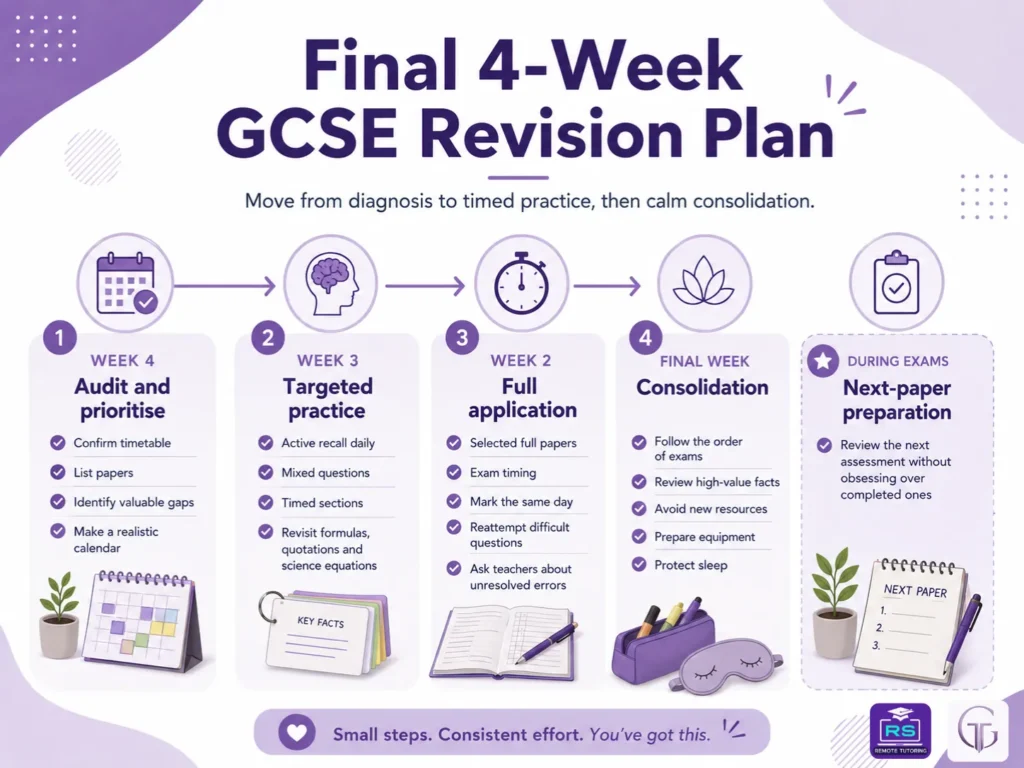
The final four weeks should move from diagnosis to mixed application and then calm consolidation. Students should prioritise upcoming papers, complete timed work, correct weaknesses and protect sleep. The final days are for retrieval and confidence, not rewriting the whole course.
Final Four-Week GCSE Revision Plan
| Week | Main Focus | Student Action |
| Four weeks before | Audit and prioritise | Complete topic checks, identify red areas and confirm exam-board papers |
| Three weeks before | Targeted practice | Use recall, topic questions and timed paper sections |
| Two weeks before | Full application | Complete selected papers, mark carefully and correct recurring errors |
| Final week | Consolidation | Short retrieval, key formulas and quotations, light timed practice and sleep |
| During exams | Next-paper preparation | Review the next assessment without repeatedly analysing completed papers |
Four Weeks Before
- Confirm the examination timetable.
- List every paper.
- Use specifications to check coverage.
- Complete diagnostic questions.
- Identify the most valuable gaps.
- Make a realistic calendar.
Three Weeks Before
- Increase mixed questions.
- Use active recall daily.
- Complete timed paper sections.
- Practise weak English responses.
- Revisit formulas, quotations and Science equations.
- Update the error log.
Two Weeks Before
- Complete carefully selected full papers.
- Practise examination timing.
- Mark work on the same day where possible.
- Reattempt difficult questions.
- Ask teachers about unresolved errors.
- Continue spaced review of earlier topics.
Final Week
- Follow the order of the actual examinations.
- Review high-value facts and methods.
- Avoid starting unnecessary new resources.
- Prepare equipment.
- Protect sleep.
- Keep the final evening calm.
The aim is not to feel as though every page has been memorised.
The aim is to walk into the examination knowing that the important material has been recalled, applied, checked and revisited.
FAQs
How do I start revising for GCSEs?
Start by listing your subjects and breaking each one into topics. Use the exam-board specification, mark each topic red, amber or green and choose one specific weak-area task. Begin with active recall followed by a few questions and corrections.
When should I start revising for GCSEs?
Light consolidation can begin in Year 10, with structured revision developing during Year 11. Many students increase revision after winter mocks, but those with significant gaps should begin earlier. Starting late is not hopeless; it simply requires stricter prioritisation.
How many hours a day should I revise for GCSEs?
There is no compulsory number. One or two focused sessions may be enough on a school day, while weekends and study leave can include more. Measure useful work completed and mistakes corrected rather than trying to reach an arbitrary hourly total.
Is two hours of revision a day enough for GCSEs?
Two focused hours can be enough for many students, particularly when spread across clear tasks and supported by regular schoolwork. A student with major gaps or several imminent examinations may need more, while another may progress with less.
What is the best revision method for GCSEs?
The strongest general approach combines active recall, spaced repetition and examination questions. Retrieve information without notes, revisit it over time and apply it to the correct exam board’s questions. Mark and correct every attempt.
How do I make a GCSE revision timetable?
Add school, homework, meals, activities and rest first. Divide each subject into specific topics, give more time to weak areas and schedule clear 25–45 minute tasks. Include a spare catch-up slot and review the plan weekly.
How do I revise GCSE Maths?
Practise Maths by solving questions, showing full working and keeping an error log. Begin with secure methods, move to mixed and unfamiliar problems, mark accurately and retry mistakes after a delay. Use the correct board and tier.
How do I revise GCSE English?
Revise English through quotation recall, reading analysis, essay planning, timed paragraphs and writing practice. Study the exact question structure for your exam board and obtain feedback that explains how to improve interpretation, organisation and accuracy.
How do I revise GCSE Science?
Use retrieval for definitions, processes, equations and required practicals, then apply the knowledge to calculations, data and exam questions. Revise Biology, Chemistry and Physics separately before completing mixed Combined Science or separate-science practice.
Are past papers the best way to revise for GCSEs?
Past papers are essential but should not be the only method. They test application, timing and question style, while active recall and topic practice build the knowledge needed to answer them. Every paper should be marked, diagnosed and corrected.
What should I do if I have left GCSE revision too late?
Stop trying to cover every topic equally. Confirm the papers, identify the largest and most relevant gaps, use short recall-and-question cycles and prioritise recurring errors. Ask teachers which topics and skills deserve immediate attention.
How can I revise without getting overwhelmed?
Reduce the next task until it feels manageable. Choose one subject, one topic and one short activity. Complete it before redesigning the whole timetable. Keep breaks, sleep and ordinary activities in the plan, and ask for help when stress affects daily life. If revision still feels like a collection of unfinished plans, focused support can help identify the next useful step rather than adding more material

Leave a Comment
Share your question or feedback below. Your comment will appear after approval.