
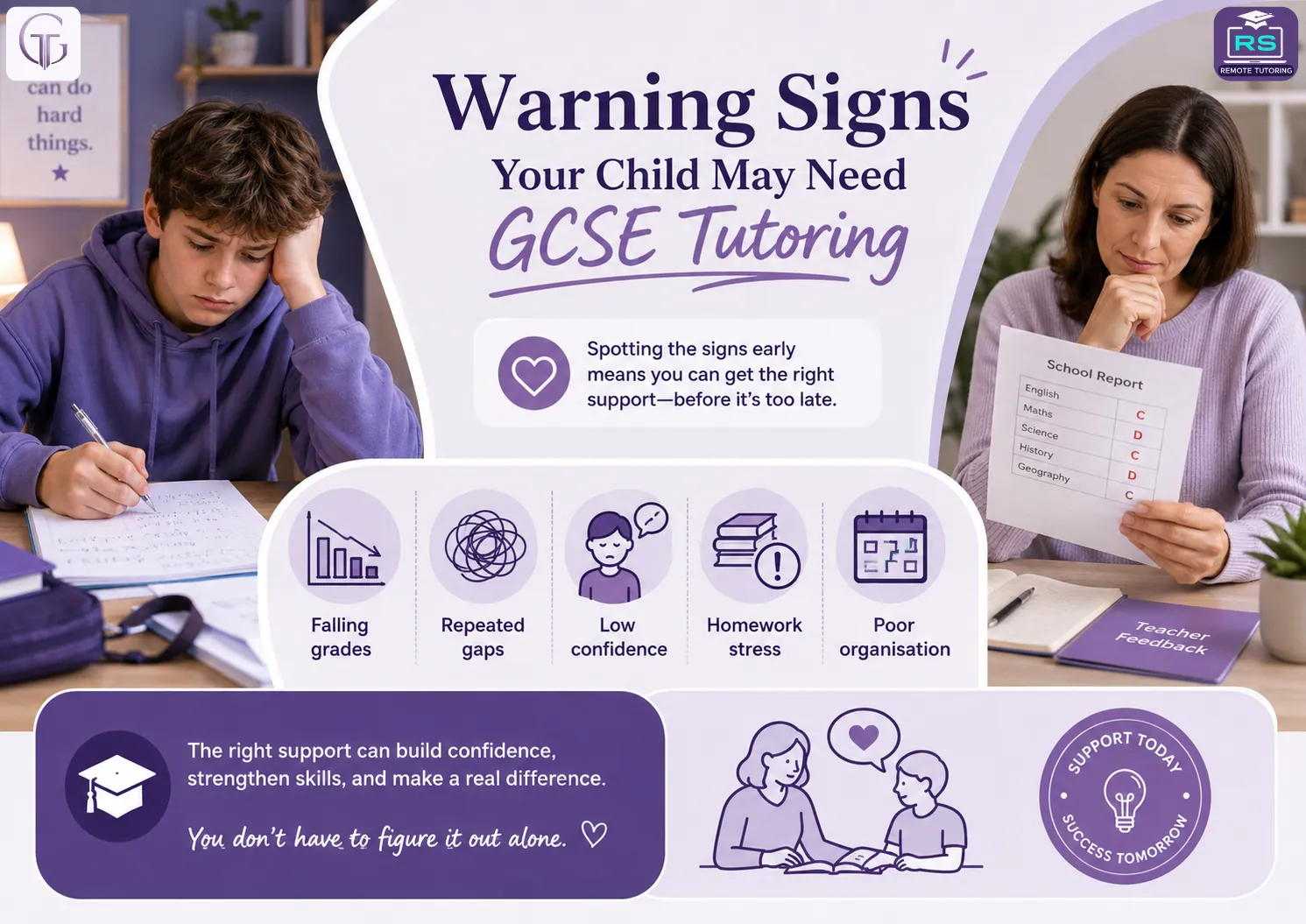
It often starts with something small. A Year 10 student suddenly avoids their Maths homework. An English essay returns with the same feedback as the previous one. Or a school report shows that a child who seemed comfortable is now slipping below their predicted grade.
That is usually when parents begin asking: when should you start GCSE tutoring?
There is no universal starting month. Year 9 may be right for a student with weak foundations, while another child may manage perfectly well until Year 11. What matters is whether the student has enough time to understand the problem, practise the right skills and rebuild confidence without turning every evening into exam preparation.
The scale of the GCSE stage helps explain why the timing matters. In summer 2025, 5,661,970 GCSE results were issued in England, and 67.1% were awarded at grade 4 or above. These qualifications affect progression into sixth form, college, apprenticeships and later study, but they should not become a source of panic years before the exams.
I’m Emily Thompson, a GCSE English and Study Skills Writer. One of the most common patterns I have seen is that parents wait for a dramatic warning sign when several smaller signs have already been present for months. The aim of this guide is not to persuade every family to start tuition early. It is to help you recognise when support would genuinely be useful.
Jump to Section
What Is the Best Time to Start GCSE Tutoring?
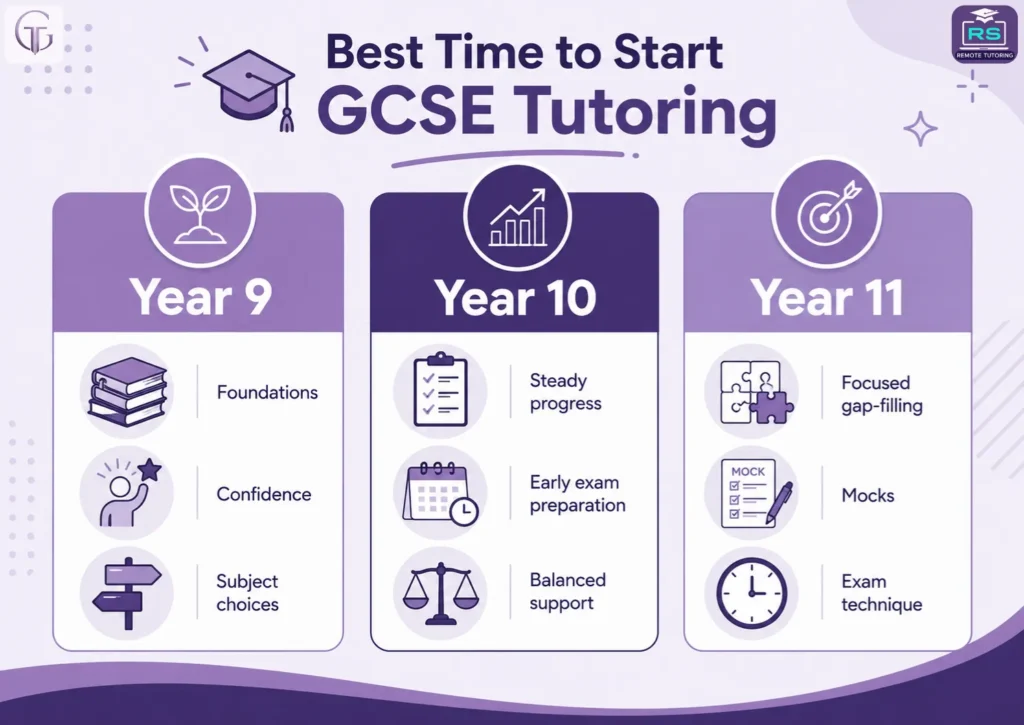
For many students, Year 10 is the best balanced time to begin. It allows enough space to strengthen subject knowledge, develop study habits and practise exam-style questions without the urgency of final Year 11 exams. However, need matters more than the calendar.
In England, Year 9 is normally part of Key Stage 3, while Years 10 and 11 form Key Stage 4, when most pupils work towards GCSEs or other national qualifications. Schools may organise courses differently, so parents should always check when GCSE content begins at their child’s school.
A useful rule is:
- Start in Year 9 when foundations, confidence or subject choices need attention.
- Start in Year 10 for steady subject development and early exam preparation.
- Start in Year 11 for focused gap-filling, mock response and exam technique.
- Start immediately when a student’s confidence, attainment or engagement is declining noticeably.
Year 10 is often the sensible middle ground. It is early enough to make meaningful changes but late enough for the tutoring to be clearly connected to GCSE work.
If your child is entering Year 10 and small difficulties are already repeating, structured support now is usually calmer than waiting for a poor mock result.
Is Year 9 Too Early for GCSE Tutoring?
Year 9 is not automatically too early, but most students do not need intensive GCSE tuition at this stage. Support makes sense when there are persistent gaps, poor confidence, difficult subject choices or weak study habits that could follow the student into Key Stage 4.
Year 9 should not feel like an extended GCSE revision year.
At this point, tutoring should usually be light, purposeful and focused on foundations. A student who cannot manipulate fractions confidently may struggle later with algebra and GCSE Science calculations. A child who cannot organise a paragraph may find English Language and Literature increasingly demanding.
But tutoring should solve a real problem. It should not be booked simply because GCSEs exist in the future.
When Year 9 Tutoring Makes Sense
Year 9 support may be worthwhile when:
- The student has recurring gaps in Maths or literacy.
- School reports repeatedly identify the same weakness.
- Confidence has fallen in a core subject.
- The student is considering Triple Science or higher-tier Maths but lacks secure foundations.
- GCSE option choices are creating uncertainty.
- Homework regularly becomes a family argument.
- The child needs help developing organisation and independent study habits.
I remember speaking with parents who assumed the issue was motivation, when the student was actually avoiding work because they did not understand the first step. That distinction matters. More pressure would not have solved it. A calm explanation and a manageable practice routine did.
When Year 9 Tutoring May Not Be Necessary
Tutoring may reasonably wait when the student:
- Is meeting school expectations
- Understands lessons and completes homework independently
- Has stable confidence
- Knows where to seek help in school
- Is not showing repeated gaps
- Would view tutoring as unnecessary punishment
A Year 9 student who is progressing well does not need a tutor merely to “get ahead”. Reading widely, practising basic numeracy, completing schoolwork and building good routines may be enough.
Early support is useful. Premature pressure is not.
Is Year 10 the Best Year to Start GCSE Tutoring?
Year 10 is often the strongest starting point because students are studying substantial GCSE content but are not yet under final-exam pressure. Tutors can address weak foundations, reinforce current lessons and introduce exam technique gradually rather than rushing after disappointing mocks.
Why Year 10 Is Often the Most Balanced Starting Point
By Year 10, the need becomes easier to assess.
Parents can compare:
- School reports
- Topic-test results
- Homework quality
- Teacher comments
- Working grades
- The student’s own confidence
- Performance in different question types
One poor test is not enough evidence. A pattern is.
Year 10 also gives a tutor time to work properly. In English, that might mean improving one writing skill at a time rather than repeatedly producing full essays. In Maths, it may mean repairing algebraic fluency before moving to harder problem solving. In Science, it may involve connecting knowledge to calculations and six-mark explanations.
What Year 10 GCSE Tutoring Should Focus On
Good Year 10 tuition should include:
- Identifying gaps accurately rather than starting the entire course again.
- Reinforcing current school topics so tutoring supports classroom learning.
- Building independent study habits before the Year 11 workload increases.
- Introducing exam-style questions gradually without making every lesson a mock exam.
- Tracking recurring errors in knowledge, method and written communication.
- Reviewing progress every half term and adjusting the focus.
One thing that becomes clear quite quickly is that students rarely need equal help across every topic. Effective tuition narrows the problem. That keeps the workload manageable and protects the family budget.
Is Year 11 Too Late to Start GCSE Tutoring?
Year 11 is not too late. Focused tuition can still improve understanding, exam technique, timing and confidence. However, there is less room to rebuild broad foundations, so lessons must prioritise the topics and question types most likely to affect the student’s target grade.
The phrase “too late” is unhelpful because it can make families give up just when targeted support may be valuable.
Year 11 tutoring can work particularly well when a student:
- Is one or two grades below a realistic target
- Understands content but loses marks in exams
- Needs help interpreting mark schemes
- Struggles with timing
- Has a small number of identifiable topic gaps
- Needs accountability for revision
- Has become anxious after mocks
What Year 11 Tutoring Can Still Improve
A focused Year 11 tutor can help a student:
- Prioritise weaker topics
- Correct recurring exam errors
- Plan answers more efficiently
- Use past papers properly
- Understand command words
- Manage time across a paper
- Build a realistic revision timetable
- Prepare for higher- or foundation-tier questions
- Regain confidence after a disappointing result
Many parents I have spoken to assume the tutor must cover the entire syllabus. Usually, that is not the best use of limited time. A sharper plan may focus on the few areas that are repeatedly costing marks.
What Year 11 Tutoring Cannot Fix Quickly
Late tutoring cannot instantly replace:
- Years of missed foundational learning
- Consistent homework and independent practice
- Regular attendance at school
- Reading required texts
- Memorising key knowledge
- Genuine engagement from the student
And it should not become panic-buying.
Three intensive lessons in one week may feel productive, but a student still needs time to practise independently, forget a little, retrieve the information and apply it again. Tutoring works best when it supports learning rather than attempting to compress an entire course into a few rushed sessions.
Should Tutoring Start Before or After GCSE Mocks?
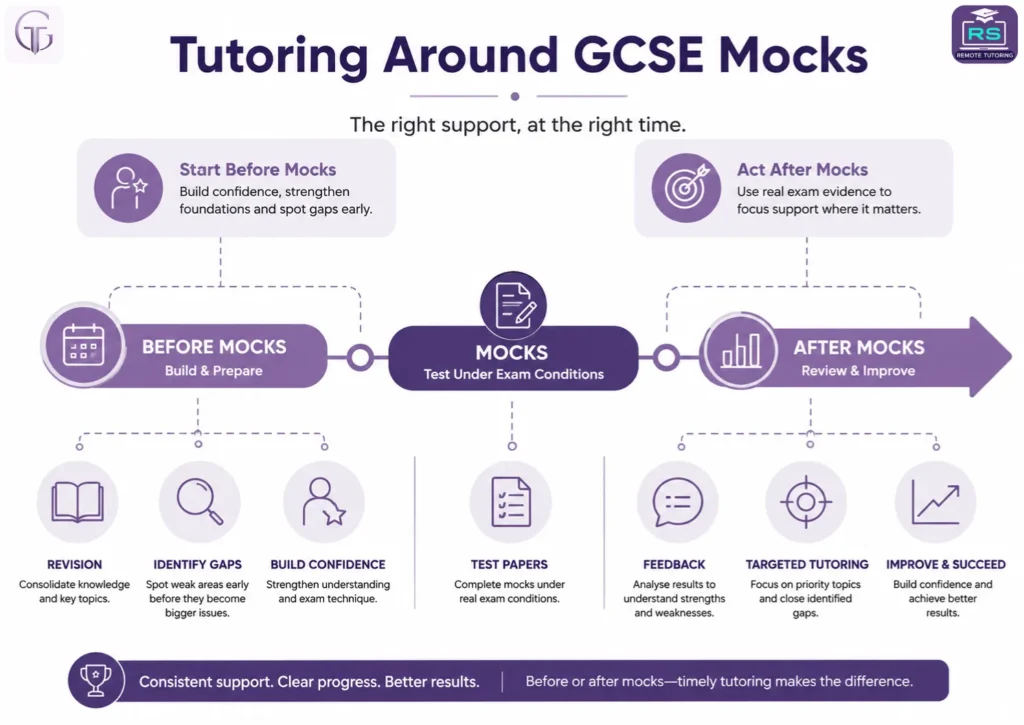
Tutoring does not have to wait until mock results. Starting before mocks can build confidence and reveal gaps early; starting afterwards allows lessons to respond to real exam evidence. The right choice depends on whether clear warning signs already exist before the mocks.
What Mock Results Can Reveal
Mocks can show more than a grade.
A marked paper may reveal that the student:
- Knows the content but runs out of time
- Performs well on short questions but struggles with extended answers
- Misses method marks by not showing working
- Misreads command words
- Has one concentrated topic gap
- Becomes less accurate under pressure
- Has revised passively rather than practising retrieval
That evidence helps a tutor plan precisely.
A mock grade alone is less informative. Parents should ask to see the paper, teacher feedback and individual question performance where available.
Why Waiting for Mocks Can Be Risky
Waiting is reasonable when the student is coping well and there is no evidence of difficulty.
It becomes risky when the child is already:
- Avoiding a subject
- Falling behind in class
- Repeating the same homework mistakes
- Becoming distressed by assessments
- Working well below a necessary sixth-form or college requirement
- Unable to revise independently
In those cases, the mock is unlikely to reveal a completely new problem. It may simply confirm one that has been visible for months.
How Many Months Before GCSEs Should Tutoring Start?
Six to twelve months before the exams is a practical period for many students. Those with deeper knowledge gaps may benefit from twelve to eighteen months, while students needing only targeted exam practice may benefit from a shorter block closer to the assessments.
Use the student’s situation rather than counting backwards mechanically.
| Student Situation | Best Time to Start | Why |
| Persistent gaps in core knowledge | Year 9 or early Year 10 | Allows time to rebuild foundations without rushing |
| Generally secure but inconsistent | Mid-Year 10 | Supports steady progress and early exam technique |
| High achiever targeting grades 7–9 | Year 10 or early Year 11 | Allows refinement of harder questions and precision |
| Below target after mocks | As soon as results are reviewed | Enables focused work on proven weaknesses |
| One grade below a required outcome | Year 11 may be sufficient | Targeted practice may close a specific gap |
| Several grades behind close to exams | Start immediately with realistic priorities | Full rebuilding may be unrealistic, but focused gains remain possible |
| Resit student | At the beginning of the resit course | Creates structure and avoids repeating the same preparation |
The honest answer is that twelve calm lessons can be more useful than twenty rushed ones when each session is connected to independent practice.
What Signs Show Your Child May Need a GCSE Tutor?
A tutor may be useful when difficulty becomes persistent rather than occasional. Falling results, repeated misconceptions, avoidance, weak organisation and declining confidence are stronger indicators than one disappointing test or a temporary dip during a demanding school term.
Academic Signs
Look for patterns such as:
- The same topic appears in several poor assessments.
- Homework takes far longer than expected.
- The student cannot explain methods they recently studied.
- Written answers do not reflect their verbal understanding.
- Predicted or working grades are moving away from course requirements.
- Teacher feedback repeatedly mentions accuracy, structure or exam technique.
Confidence and Behaviour Signs
Difficulty is not always visible in grades.
A student may still appear to be coping while:
- Saying “I’m just bad at Maths”
- Refusing to read teacher feedback
- Avoiding homework until late at night
- Becoming unusually defensive about school
- Giving up quickly on unfamiliar questions
- Revising for long periods without a clear plan
From experience, these signs deserve attention before the student begins to see the weakness as part of their identity.
Parent Warning Signs
Parents should also notice when:
- Every homework session becomes an argument.
- They are reteaching large parts of the course themselves.
- The child relies on answer websites without understanding.
- School support is available but the student will not use it.
- Revision plans are repeatedly made and abandoned.
- The family cannot identify what the actual academic problem is.
A good tutor should reduce confusion, not simply add another demand to the week.
If your child is in Year 10 or Year 11 and small gaps are turning into confidence problems, structured one-to-one support can make the next step clearer before exam pressure builds.
Which GCSE Subjects Should You Prioritise First?
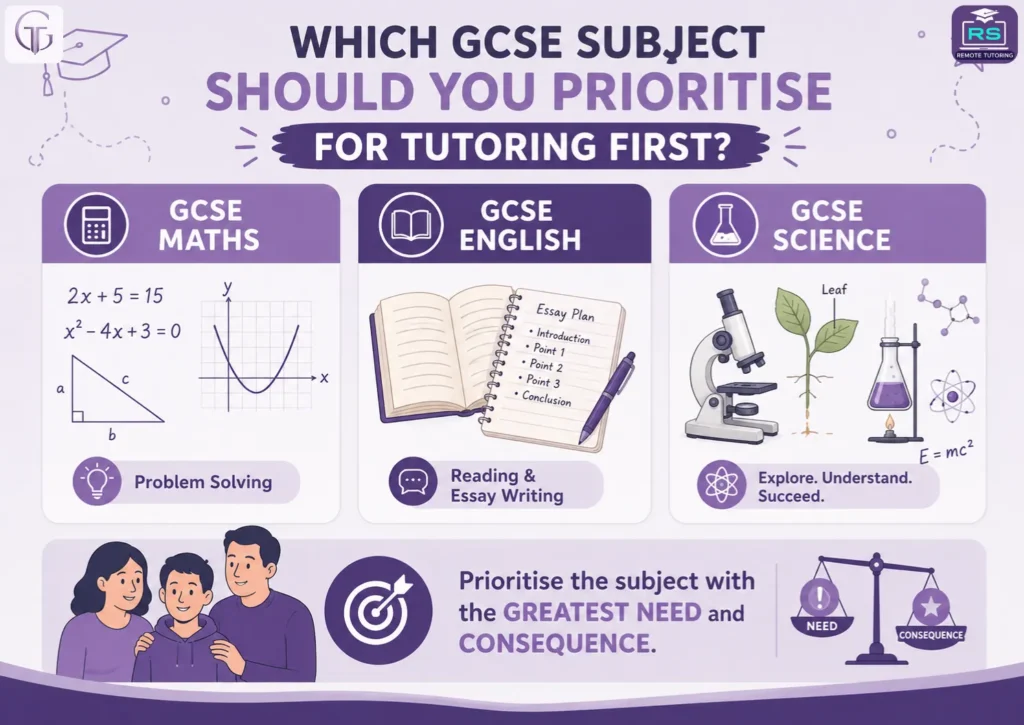
Prioritise the subject that combines the greatest need with the greatest consequence. English and Maths often affect post-16 progression, while Science may need early support where concepts and calculations are accumulating. Do not automatically book tuition for every weak subject.
In England, English, Maths and Science are core Key Stage 4 curriculum subjects. Schools and courses may set their own post-16 entry expectations, so families should check the requirements for relevant sixth forms, colleges or apprenticeships.
| GCSE Subject | When to Start Support | What Tutoring Should Focus On |
| Maths | As soon as recurring foundational gaps appear | Fluency, algebra, problem solving, working methods and paper strategy |
| English Language | When writing, comprehension or timing repeatedly limits marks | Reading analysis, paragraph structure, writing control and exam timing |
| English Literature | Once texts and assessment expectations are known | Quotation use, interpretation, essay planning and comparison |
| Combined Science | When knowledge is not transferring to exam questions | Retrieval, calculations, practical knowledge and extended explanations |
| Separate Sciences | Earlier when several subjects or higher-tier content are weak | Biology, Chemistry and Physics gaps treated separately |
| Optional subjects | When the subject is important for progression or causing disproportionate stress | Course-specific content and examination demands |
GCSE Maths Tutoring
Maths skills often depend on earlier methods. A weakness in fractions may later affect algebra, ratio, probability and Science calculations.
Earlier tutoring makes sense when gaps are cumulative. A student aiming for grades 7–9 may need different support: unfamiliar problem solving, efficient methods and reducing careless losses.
GCSE English Tutoring
English improvement is rarely about memorising one correct method.
Students need repeated practice in reading closely, selecting evidence, shaping paragraphs and controlling their time. Online shared documents can work particularly well because a tutor can annotate a paragraph live, explain why it is unclear and help the student redraft it.
GCSE Science Tutoring
Science combines knowledge, application, calculations and practical understanding. A student may remember facts but still struggle to interpret data or explain a method.
Support should identify whether the difficulty lies in Biology, Chemistry, Physics or general exam technique rather than treating “Science” as one broad weakness.
How Often Should GCSE Tutoring Sessions Happen?
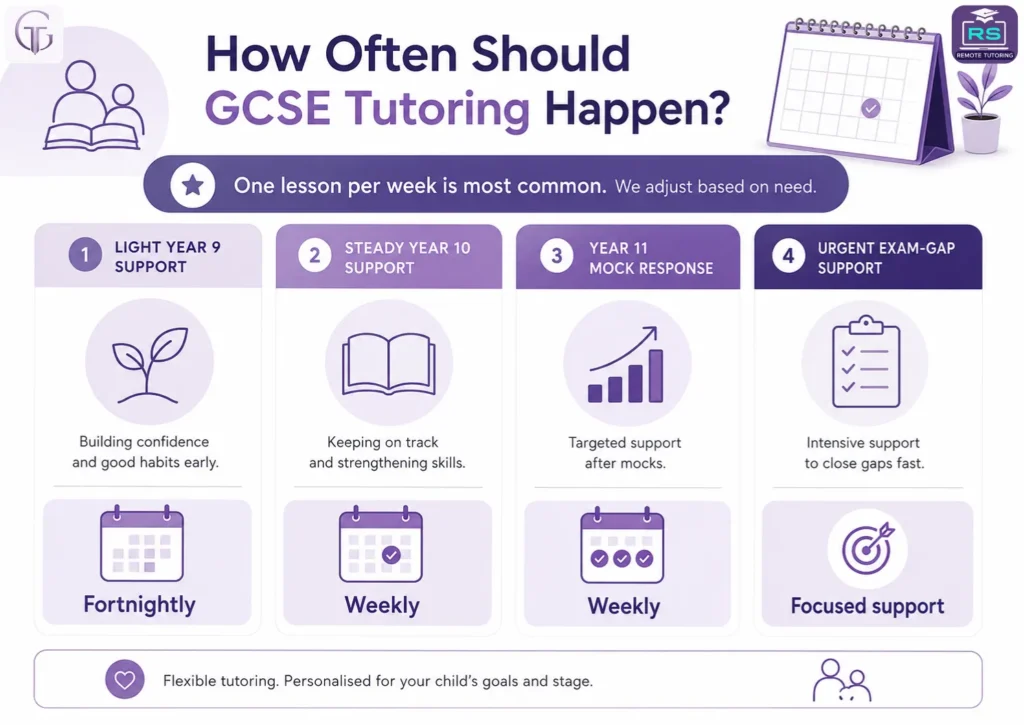
One lesson per week is enough for many students receiving steady support, provided they practise between sessions. More frequent lessons may suit urgent Year 11 gaps, multiple subjects or resit preparation, while fortnightly tuition can work for confident students needing occasional guidance.
| Student Need | Suggested Frequency | What to Review |
| Light Year 9 foundation support | Fortnightly or short-term weekly block | Confidence, basic skills and school progress |
| Steady Year 10 support | Weekly | Current topics, recurring gaps and study habits |
| High-achieving refinement | Weekly or fortnightly | Harder questions, precision and feedback |
| Year 11 mock response | Weekly | Specific paper errors and exam technique |
| Significant gaps close to exams | One or two lessons weekly for a defined period | Priority topics, workload and student stress |
| Resit preparation | Weekly with independent work | Past-paper errors and missed foundations |
The Education Endowment Foundation’s evidence review finds that one-to-one tuition can produce positive average progress when it is targeted, structured and linked to normal teaching. That is population-level evidence, not a promise for an individual student, and it reinforces the importance of lesson quality and follow-up practice.
A student should leave each session knowing what to practise before the next one. Otherwise, the family is paying repeatedly for the tutor to restart the same learning.
Is Online GCSE Tutoring Suitable for Years 9, 10 and 11?
Online GCSE tutoring can work well at every stage when lessons are interactive, focused and supported by feedback. It is particularly useful for busy families, students in areas with limited tutor availability and learners who benefit from shared documents, digital whiteboards and recorded resources.
The format should match the age and purpose.
- Year 9: Shorter, interactive work may suit concentration better than a long lecture.
- Year 10: Digital whiteboards and shared documents support regular subject teaching.
- Year 11: Screen sharing makes past-paper analysis, timed work and live marking efficient.
Online support also removes travel from the timetable. That can make it easier to start with one manageable weekly lesson rather than postponing help because local tutors or suitable appointment times are unavailable.
The student still needs:
- A quiet workspace
- A suitable device
- Reliable internet
- Their camera, microphone and materials ready
- Clear expectations
- Independent work between lessons
GCSE Online Tutoring.uk offers structured online support at £30 per lesson across GCSE subjects, giving families a clear way to plan help without adding regular travel.
What Should Tutoring Focus on in Each School Year?
The purpose should change as the student moves through school. Year 9 is about foundations, Year 10 about developing GCSE knowledge and habits, and Year 11 about turning understanding into marks through focused revision, timing and exam practice.
| School Year | Main Tutoring Focus | Best For | Parent Tip |
| Year 9 | Foundations, confidence and study routines | Students with early gaps or difficult subject choices | Keep support light and review whether it remains necessary |
| Year 10 | GCSE content, weak topics and early exam technique | Most students who need regular support | Ask the tutor to connect lessons with current school topics |
| Year 11 | Mocks, past papers, timing and priority gaps | Students approaching final assessments | Avoid trying to reteach every topic; agree clear priorities |
This is the most useful distinction in the whole decision.
The year group does not simply change the urgency. It changes the job.
How Can Parents Tell If GCSE Tutoring Is Working?
Tutoring is working when the student becomes clearer, more accurate and increasingly independent. Grades may take time to move, so parents should also monitor confidence, homework quality, error patterns, organisation and whether tutor feedback is being applied outside lessons.
| Sign | What It Means | What Parents Should Do Next |
| The student can explain methods more clearly | Understanding is becoming secure | Ask for occasional explanations without turning home into another lesson |
| Homework errors become less repetitive | Feedback is transferring | Continue targeted practice |
| Revision becomes more organised | Study skills are improving | Let the student take greater ownership |
| School assessments stabilise or improve | Learning may be transferring to formal work | Compare several results, not one test |
| The student attempts harder questions | Confidence and resilience are growing | Praise the process, not only the score |
| Tutor updates are specific | Lessons are being planned around evidence | Review targets each half term |
Parents should be cautious when:
- Every lesson appears identical.
- The tutor cannot describe the student’s main weaknesses.
- No work is completed independently.
- Feedback remains vague.
- The student becomes more dependent rather than less.
- Months pass without reviewing the plan.
What stayed with me most from many parent conversations is that progress often appears first in behaviour: less avoidance, faster starts and a willingness to correct mistakes. The grade may follow later.
So, When Should You Start GCSE Tutoring?
Start when a persistent need becomes clear, not when anxiety alone says you should. Year 10 is the best balanced point for many students; Year 9 suits genuine foundation gaps, and Year 11 remains useful when support is focused and realistic.
The decision can be reduced to four questions:
- What is the problem? Knowledge, confidence, organisation or exam technique?
- How long has it been present? One week is different from two school terms.
- What outcome is needed? A secure grade 4, entry to a particular course or top-grade refinement?
- How much time remains? Enough to rebuild foundations, or only enough for priority work?
Do not arrange tutoring because everyone else seems to be doing it.
Do arrange it when your child needs an explanation, structure or feedback that they are not currently receiving elsewhere.
FAQ Section
Frequently Asked Questions
When should you start GCSE tutoring?
For many students, Year 10 is the best balanced starting point. It provides time to strengthen knowledge and introduce exam technique without final-exam pressure. Students with earlier gaps may benefit in Year 9, while targeted Year 11 tutoring can still be useful.
Is Year 9 too early for GCSE tutoring?
Year 9 is not too early when a student has persistent gaps, declining confidence or weak study habits. However, students who are progressing well usually do not need intensive GCSE tuition. Any Year 9 support should be light, focused and regularly reviewed.
Is Year 10 the best time to start GCSE tutoring?
Year 10 is often the most practical time because students are studying GCSE content but still have time to correct weaknesses gradually. It is particularly useful for recurring subject gaps, weak organisation, higher-tier preparation and developing exam skills before Year 11.
Is Year 11 too late to start GCSE tutoring?
No. Year 11 tutoring can still improve weak topics, timing, past-paper technique and confidence. However, there is less time to rebuild broad foundations, so lessons should concentrate on the problems most likely to affect the student’s required grade.
How many months before GCSEs should tutoring start?
Six to twelve months is a useful period for many students. Twelve to eighteen months may suit deeper knowledge gaps, while a shorter block can help students needing targeted exam practice. The student’s starting point matters more than a fixed number.
Should GCSE tutoring start before or after mocks?
Start before mocks when clear difficulties already exist. Start afterwards when the student is coping reasonably well and the mock papers will provide useful diagnostic evidence. Waiting for mocks is risky when confidence or attainment has already been declining for several months.
Is one GCSE tutoring lesson per week enough?
One weekly lesson is enough for many students if it is supported by independent practice. Students with major gaps, several subjects or limited time before exams may temporarily need more. Confident students receiving top-grade refinement may manage with fortnightly support.
Which GCSE subject should my child get tutoring for first?
Prioritise the subject with the largest gap and greatest effect on future options. English and Maths often affect sixth-form, college and apprenticeship entry, but Science may need earlier help when calculations or core concepts are accumulating.
Can GCSE tutoring still help close to exams?
Yes, but the aim must be realistic. Close-to-exam tuition is best used for priority topics, paper strategy, timing and recurring errors. It cannot quickly replace years of missing knowledge or independent revision.
Should high-achieving students start GCSE tutoring early?
Only when there is a specific purpose. A high-achieving student may benefit from harder problem solving, stronger essay analysis or top-grade exam technique. Tutoring is unnecessary when school provision and independent study already meet those needs.
Structured support should make a student more independent, not create reliance. That is the standard parents should use when deciding whether to continue.
The right time to arrange tutoring is before a manageable weakness becomes a crisis.
GCSE Online Tutoring.uk provides structured one-to-one online GCSE tutoring across Maths, English, Science and other subjects at £30 per lesson. Support can be shaped around Year 9 foundations, Year 10 progress or focused Year 11 exam preparation without adding regular travel to an already busy week.

Leave a Comment
Share your question or feedback below. Your comment will appear after approval.