
GCSE maths is one of the few subjects that everyone studies at school, and for high‑achieving students it carries a special allure: the elusive grade 9. Since 2017, GCSEs in England have been graded 9–1 instead of A*–G; grade 9 is the highest grade and is deliberately designed to recognise the very top performers. Only around 3–5 % of entries achieve it in any given year, and the mark required changes with every paper and exam board.
That does not mean grade 9 is reserved for “naturally gifted” mathematicians. From working with many Year 10 and Year 11 pupils, I’ve seen students move from grade 6 or 7 all the way to a secure grade 9 when they adopt the right habits and mindset. This guide explains what grade 9 really means, why it’s different from grade 7 or 8, and lays out a structured, practical plan to reach it.
As a GCSE maths tutor and education writer, I often reassure parents that chasing a number on a mark scheme isn’t the point. The important part is building fluency, problem‑solving, confidence and exam technique. The mark follows from that. Throughout this article I’ll share insights from my own teaching, things that students only realise after sitting multiple past papers and what parents often misunderstand about the 9–1 grading system. If you’re a parent or student aiming for the top grade, you’re in the right place.
Jump to Section
What Does a Grade 9 in GCSE Maths Actually Mean?
The 9–1 grading scale
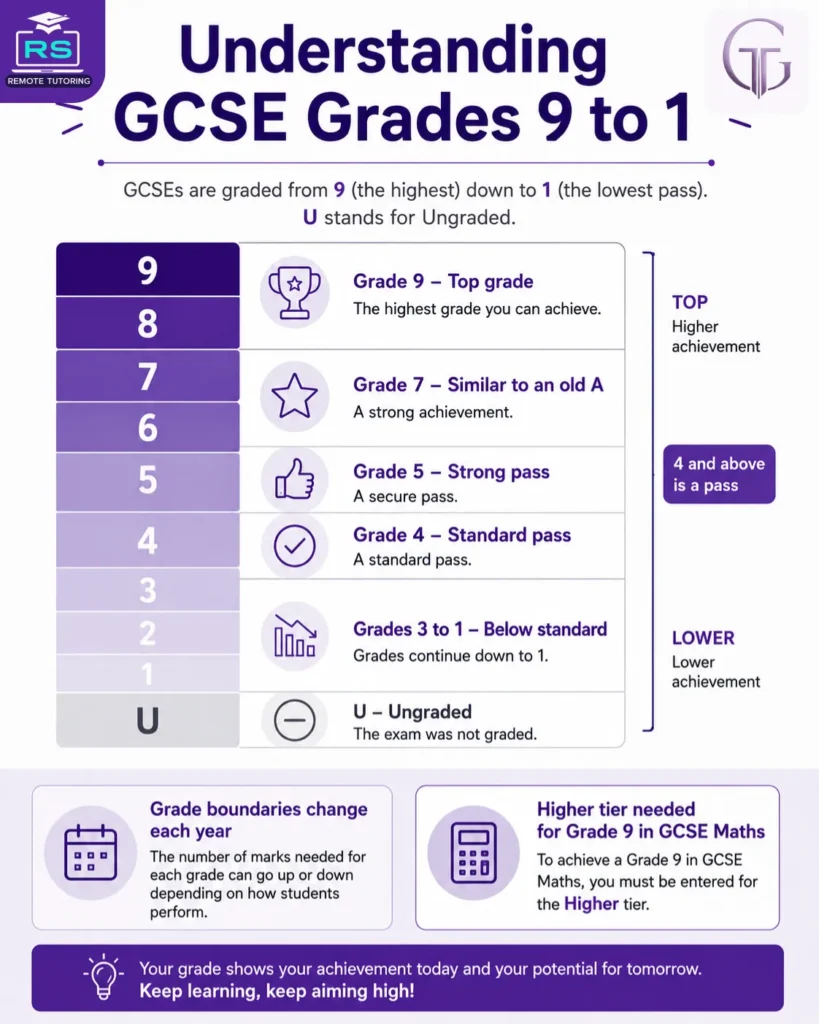
In England GCSEs are graded on a 9–1 scale, with 9 as the highest grade and 1 the lowest pass; “U” means ungraded. The new scale is not directly equivalent to the old A*–G scale, but you can think of certain points as comparable: the bottom of grade 7 lines up with the bottom of the old grade A, the bottom of grade 4 aligns with the old grade C (a standard pass) and the bottom of grade 1 aligns with the old grade G.
The government has said that grade 4 is a “standard pass” and grade 5 is a “strong pass”; a student who earns a grade 4 in maths and English does not need to resit them after Year 11.
Grade 9 is for the top performers
Grade 9 isn’t just “better than an A*”; it’s a new grade created to reward the very highest‑performing students. In the first year of the reformed GCSEs, Ofqual set the grade 9 boundary using a tailored formula so that roughly 20 % of students achieving grade 7 and above would be awarded a grade 9. In subsequent years exam boards use predictions to maintain this standard across each subject. That’s why the proportion of students achieving grade 9 remains small, around 3–5 % of entries and why it’s a realistic goal only for those who aim far above the “good pass” threshold.
Grade boundaries change every year
One of the biggest misconceptions I hear is that a specific percentage, such as 90 %, always equals a grade 9. Grade boundaries are not set in advance; exam boards set them after marking to reflect how difficult that year’s papers were. Ofqual warns schools not to rely on predicted boundaries because even examiners can’t anticipate exactly how challenging students will find a paper.
This means that the marks required for a grade 9 can vary by exam board, tier (Foundation vs Higher), paper and year. In practice, grade 9 usually requires a very high mark often above 75 %, but the number isn’t fixed. Instead of chasing a percentage, focus on securing marks across the paper and minimising errors.
Higher tier only
GCSE maths is offered at two tiers: Foundation and Higher. The Higher tier awards grades 9 to 4 (with a narrow safety‑net grade 3 for pupils who narrowly miss a 4), while the Foundation tier awards grades 5 to 1. In other words, you cannot achieve a grade 9 on the Foundation paper. Students targeting grade 9 should be entered for Higher tier by their school and must be comfortable tackling material across the full specification.
How Hard Is It to Get a Grade 9?
Only a small fraction of students achieve grade 9 each summer, around 3 to 5 % of entries in recent years. That statistic can be daunting, but it’s important to understand why grade 9 is so rare. First, grade 9 recognises consistent excellence across the whole paper, not just brilliance on one or two topics. A grade 9 student drops few marks on the medium‑difficulty questions and still gains method marks on the hardest ones. Second, grade 9 requires not only knowledge but also speed, accuracy, reasoning and exam technique.
High‑level problem‑solving questions require you to make connections between topics, choose efficient methods and justify your reasoning. Finally, the bar is high because boundaries are set relative to how the cohort performs. If a paper turns out to be easier, boundaries may rise; if it’s harder, they may fall. That’s why it’s unhelpful to fixate on “I need 90 %.”
From experience, I find that many Grade 7 or 8 students have the content knowledge to answer grade‑9 questions but lose marks on exam skills: misreading questions, skipping working, making unit errors or running out of time. The remainder of this guide focuses on the behaviours and strategies that separate grade 9 students from the rest.
What Percentage Do You Need for Grade 9?
Because GCSE grade boundaries vary every year and by exam board, there is no single percentage that guarantees a grade 9. Ofqual is clear that exam boards wait until after papers are marked to set boundaries, so any mid‑year predictions are speculative. As a rough guide, in recent years grade 9 has often required about three‑quarters of the available marks across all three papers, but the mark can be higher or lower depending on the difficulty of the papers.
Instead of chasing a number, use mock exams and past papers to understand the mark distribution. For example, on an 80‑mark paper there might be 25–30 “easy” marks accessible to everyone, 25 to 30 medium‑difficulty marks and 20–25 harder marks. Grade 9 students aim to secure almost all of the easy and medium marks and pick up method marks on the hardest questions. Focus on building accuracy and consistency so that you’re confident you’ve secured those marks whatever the boundary ends up being.
Why Grade 9 Students Revise Differently
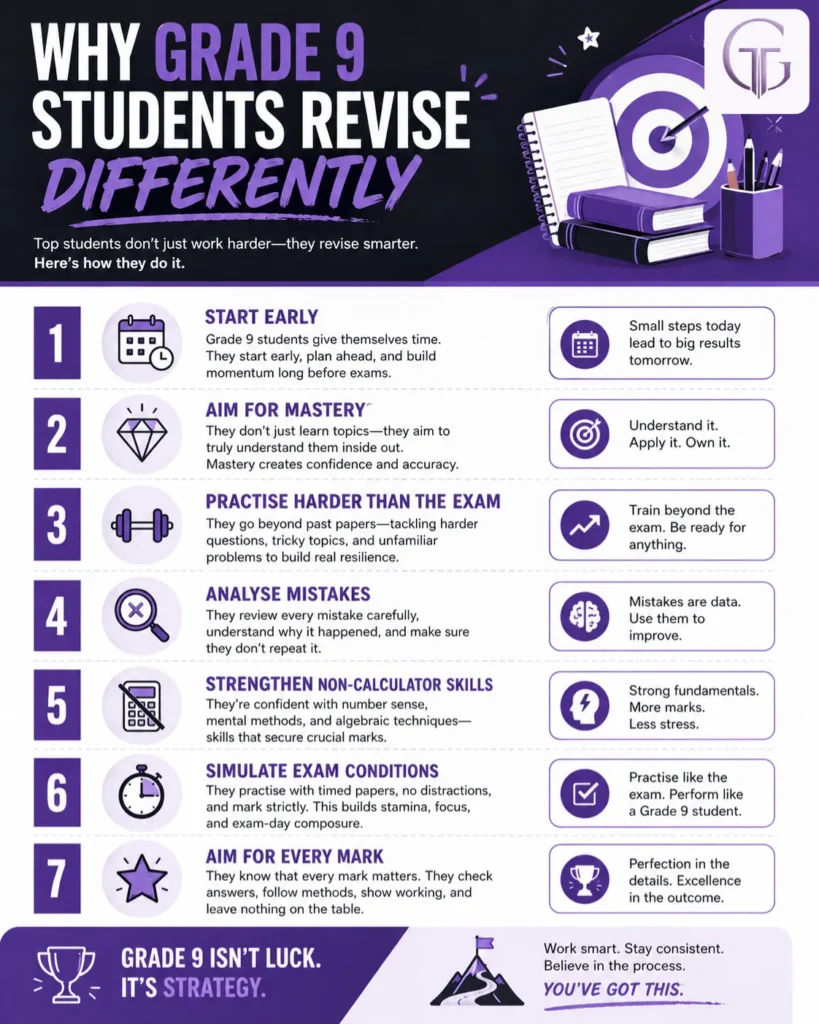
Over the past decade I’ve tutored many high‑achieving pupils, and one pattern stands out: grade 9 students don’t merely revise more, they revise differently. Here are some of the behaviours I observe:
- They start early: Grade 9 students don’t wait until Easter of Year 11 to take revision seriously. By the end of Year 10 they’ve covered the specification once and completed several past papers at their own pace.
- They aim for mastery, not “good enough”: When learning circle theorems, they don’t stop after getting three questions right; they practise until they can recognise which theorem applies instantly and explain why it works. The difference between a grade 7 and a grade 9 student is often speed and depth of understanding.
- They practise harder than the exam: Beyond standard past papers, grade 9 students use questions from other exam boards, IGCSE papers and extension resources. This “over‑preparation” makes the actual exam feel manageable.
- They analyse mistakes obsessively: After every paper they categorise errors (misreading, method error, gaps in knowledge, time pressure) and create targeted practice sessions. They don’t simply “do another paper” without reflecting.
- They practise non‑calculator skills: Although papers 2 and 3 allow a calculator, grade 9 students practise mental arithmetic and efficient written methods to save time and reduce errors.
- They simulate exam conditions: They practise past papers under timed, no‑pause conditions and review their performance honestly. Time management is treated as a skill to be trained.
- They aim for 100 %: Rather than thinking “I only need 75 %”, grade 9 students aim to answer every question properly. If they end up losing 20 % of marks, they still meet the boundary.
10 Steps to Achieve a Grade 9 in GCSE Maths
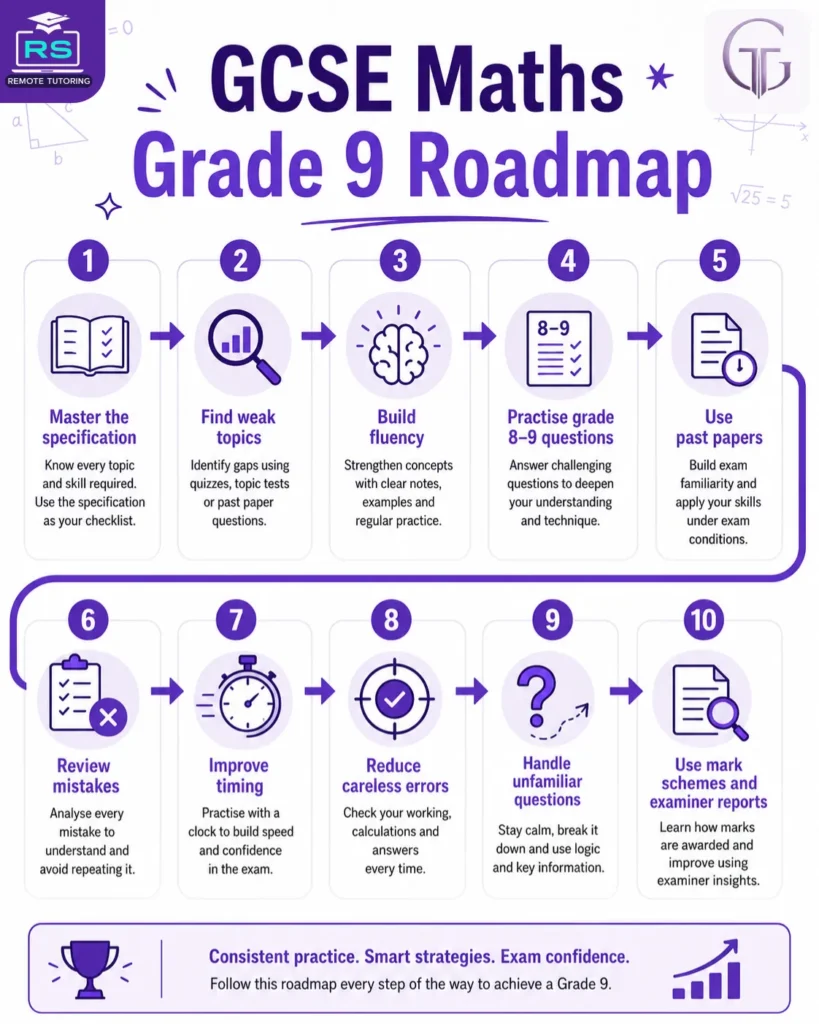
Step 1: Master the Specification
Every exam board (AQA, Pearson Edexcel, OCR, WJEC/Eduqas) publishes a specification that lists the topics you’re expected to know. This document is your blueprint. Read through it and check off each point as you learn it. Understanding the specification stops you from being surprised by a question and helps you organise revision.
Don’t assume that because you “did it in class” you’ve mastered it; grade 9 demands more than superficial coverage. Use the specification as a living document, highlight topics you’re confident with and those you need to revisit.
Step 2: Identify Strengths and Weaknesses Honestly
It’s tempting to spend hours on topics you enjoy and avoid those you find hard. Grade 9 students do the opposite: they hunt out their weak points and confront them. Start by doing a diagnostic paper or a set of topic‑wise questions.
Mark it carefully and note down the types of mistakes: did you misread the question? Did you forget a method? Did time pressure cause errors? Use your teacher’s feedback and your own analysis to create a personalised list of topics to target. Revisit this list regularly as your weak areas change.
Step 3: Build Fluency Before Tackling Hard Questions
High‑level problem solving requires a foundation of fluency. If you’re still uncertain about algebraic manipulation, surds or percentage changes, you’ll struggle with multi‑step questions. Spend time consolidating core skills:
- Number & arithmetic: work with surds, fractions, percentages (including reverse and compound), ratio and bounds. Practise without a calculator to improve speed and accuracy.
- Algebra: factorising quadratics (including completing the square), solving equations, rearranging formulae, algebraic fractions and simultaneous equations. Focus on understanding why each method works, not just following steps.
- Geometry & measures: recall formulae for area, volume and surface area; practise Pythagoras and trigonometry in right‑angled triangles until it becomes second nature.
Once these skills are automatic, you can devote mental bandwidth to the reasoning required for grade‑9 questions.
Step 4: Practise Grade 8–9 Problem‑Solving Questions
Grade 9 students go beyond textbook exercises. Seek out multi‑step problems that connect different areas of maths, such as combining algebra with circle theorems or probability with algebraic fractions. Use past papers from all exam boards: Edexcel questions often have a different style to AQA or OCR, and exposing yourself to varied wording helps you adapt.
I also recommend tackling IGCSE extended papers and harder problems from resources like Dr Frost Maths or UKMT intermediate challenges. The idea is to practise at a level slightly above the exam so that the real paper feels familiar.
Step 5: Use Past Papers Properly
Past papers are the single most effective revision tool when used correctly. Follow these steps:
- Start untimed: At first, do past papers without time pressure to familiarise yourself with question types.
- Mark with the official mark scheme: Don’t guess how many marks you’d get; use the scheme to understand what examiners look for. Note where method marks are awarded even if the final answer is wrong.
- Review thoroughly: Categorise your errors: was it a silly mistake, a forgotten method, misreading or running out of time? Identify patterns (e.g., always losing marks on completing the square) and schedule targeted practice.
- Introduce timing gradually: As exams approach, simulate the 90‑minute conditions for each paper. Remove distractions, don’t pause and stop when the time is up. Time yourself strictly on the full set of three papers to practise stamina.
- Use papers from different boards: Each board emphasises topics differently and uses distinct phrasing. Doing a variety broadens your experience and reduces the risk of being caught off guard.
Step 6: Review Mistakes Like a Grade 9 Student
When I ask students how a mock paper went, they often say, “I lost marks on silly mistakes.” Grade 9 students do more than acknowledge mistakes, they dissect them. After each paper, write down every question you lost marks on and categorise why.
Was it misreading the question? A negative sign error? A method you didn’t know? Did you run out of time? For each category, devise a fix. For misreading, practise underlining key words; for sign errors, double‑check operations; for unknown methods, revisit the specification. Re‑attempt the exact question without looking at the mark scheme. This process is exhausting but transformative.
Step 7: Improve Exam Technique and Timing
Exam technique is just as important as content knowledge. Here are key habits:
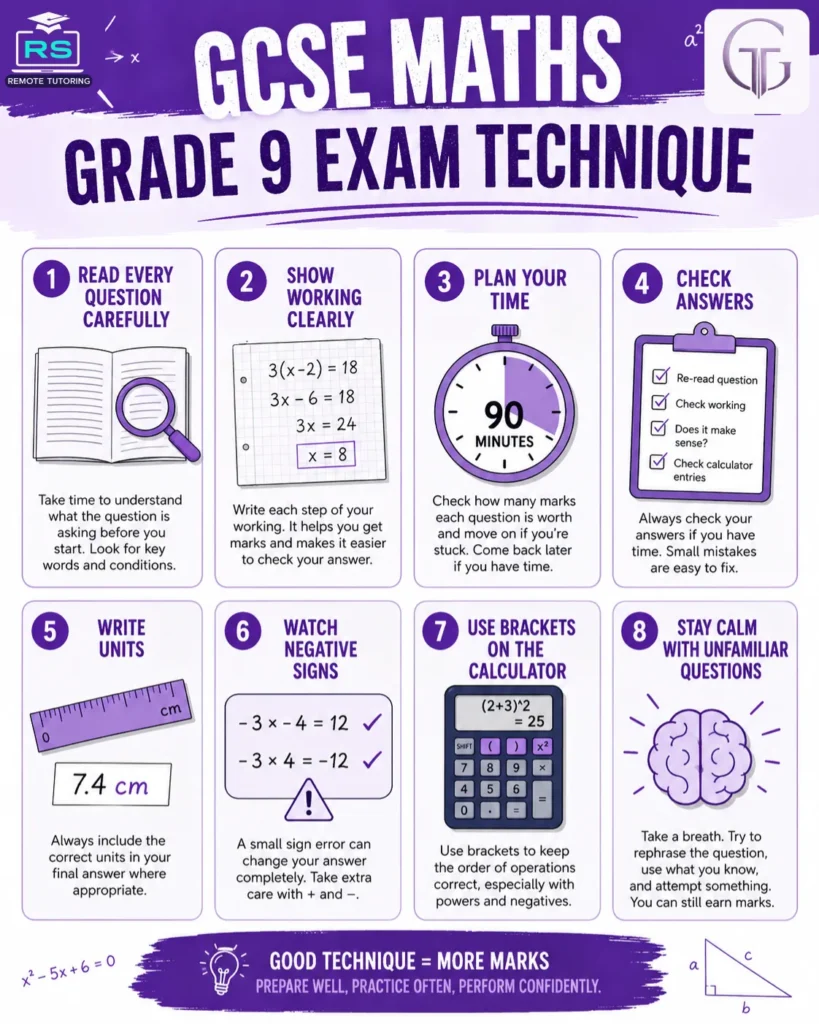
- Read every question carefully: Underline units and command words (“show”, “calculate”, “prove”) and annotate diagrams.
- Show your working clearly: Method marks can rescue you if you make an arithmetic error. Write down the formula you’re using, substitute values and show each step.
- Plan your time: On a 90‑minute paper, spend roughly one minute per mark as a guide. If a question is worth 6 marks, aim to spend about 6 minutes. If you’re stuck after two minutes, move on and come back later.
- Check answers: If you finish early, re‑read the questions, check units, scan for omitted working and ensure your answers make sense (e.g., angles in a triangle should add to 180°). Grade 9 students often gain extra marks by catching and correcting errors in this final sweep.
Step 8: Reduce Silly Mistakes
Careless mistakes cost even the strongest students. Strategies that help:
- Write units: Always include units (cm², m/s, £, etc.) where required. Examiners award marks for correct units and penalise missing or incorrect ones.
- Watch negative signs: When expanding brackets or solving simultaneous equations, take extra care with negative numbers and subtractions.
- Use brackets on your calculator: Entering fractions and indices incorrectly is a common source of lost marks. Get comfortable using your calculator’s fraction button and replay function.
- Highlight key information: Draw a quick diagram for geometry problems; underline information like “prime numbers” or “integer values”.
- Practise neat handwriting: Examiners need to read your work. Messy working can lead to lost marks even if you know the method.
Step 9: Learn How to Handle Unfamiliar Questions
Grade 9 papers often include questions that combine multiple topics or present information in a novel way. Don’t panic when you see something unfamiliar. Instead:
- Identify the underlying skills: Ask yourself which topics might apply (e.g., is this about ratios? algebraic proof? similar triangles?).
- Break the problem down: Simplify numbers where possible, draw diagrams, or test simple cases to see patterns.
- Write down known formulae: Even if you can’t see the final path immediately, writing relevant formulae (e.g., sine rule, area of a sector) can trigger the right method.
- Show any progress: Even partial working can earn method marks.
Practising unfamiliar questions from a variety of sources trains your brain to recognise these underlying structures.
Step 10: Use Mark Schemes and Examiner Reports
Mark schemes are not just for checking answers; they teach you how examiners allocate marks. Read them to see which steps attract method marks, how alternative approaches are credited and where marks are lost for missing reasoning. Examiner reports, published after each exam, summarise common student errors and misconceptions.
For example, reports often mention that students forget to include reasons in geometry proofs or mix up sine and cosine rules. Building these insights into your practice saves marks on the actual exam. Although reading reports might sound dry, the tips are gold for pushing from grade 7/8 to grade 9.
Key GCSE Maths Topics for Grade 9 Students
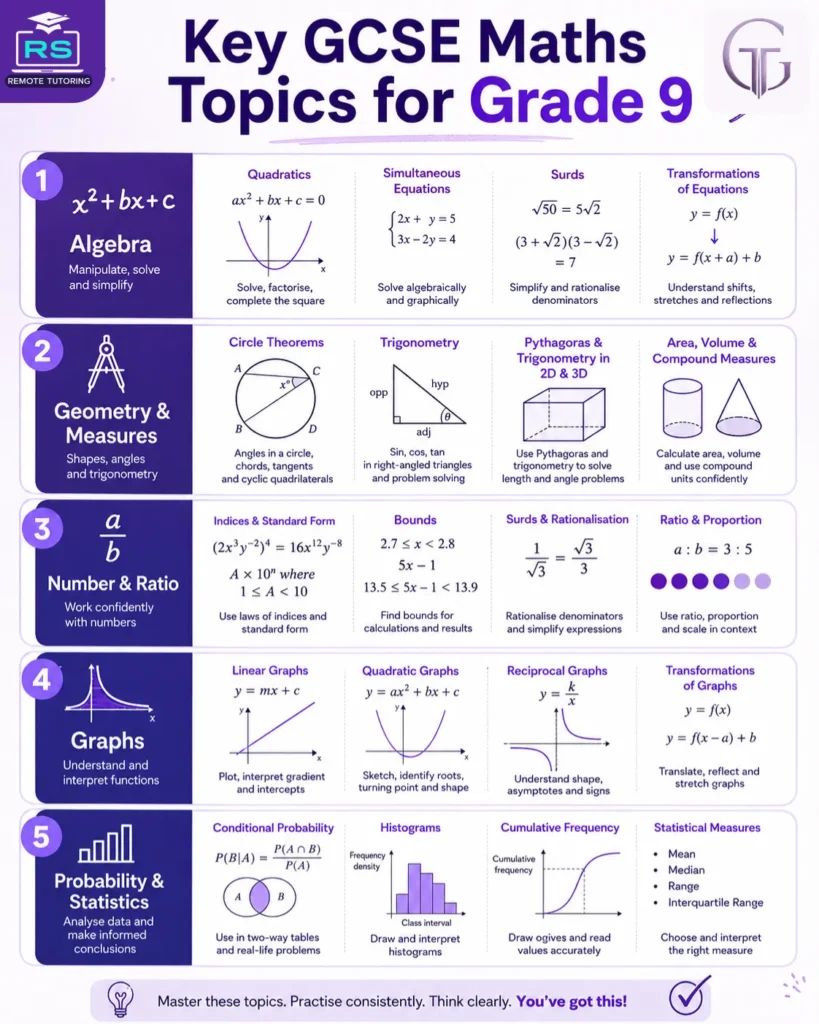
Grade 9 students master the entire specification, but certain topics carry a high “grade 9 load.” The table below highlights areas that appear frequently at the hardest end of the paper, why they matter and how to practise them.
| Topic Area | Grade 9 Challenge | Practice Advice |
| Algebra (quadratics, functions, algebraic fractions, simultaneous equations, rearranging formulae) | Solving complex equations, completing the square, manipulating algebraic fractions and interpreting function notation swiftly and accurately | Practise deriving quadratic formulae, solving simultaneous equations (linear–quadratic), simplifying algebraic fractions and sketching & transforming graphs; use past papers and extension questions |
| Geometry & Measures (circle theorems, trigonometry including sine/cosine rule, vectors, similarity & congruence) | Applying the correct theorem quickly, proving relationships and solving multi‑step vector problems | Complete sets of circle‑theorem questions until you recognise each type; practise non‑right‑angled trigonometry problems; work through vector proofs and transformations |
| Number & Ratio (surds, bounds, standard form, percentage change, ratio & proportion) | Performing complex calculations accurately without a calculator; handling compound percentage problems; working with limits of accuracy | Drill surds manipulation and rationalising denominators; practise reverse percentage and compound interest questions; use bounds to find maximum/minimum values |
| Graphs (quadratic, cubic and reciprocal graphs, sketching, interpreting) | Sketching and interpreting graphs quickly; solving equations graphically; understanding transformations | Sketch graphs by hand and interpret intersections; practise drawing and interpreting reciprocal and exponential graphs; explore transformations of functions |
| Probability & Statistics (conditional probability, Venn and tree diagrams, histograms, cumulative frequency & box plots) | Combining probability rules with algebra; interpreting data representations accurately | Practise constructing and interpreting Venn diagrams and tree diagrams; use exam‑style questions to interpret histograms and cumulative frequency curves; link probability with algebraic expressions |
If any of these feel shaky, revisit them before focusing on rarer topics. Grade 9 students don’t drop marks on high‑frequency areas.
Calculator vs Non‑Calculator Paper Strategy
GCSE maths has three papers: Paper 1 is non‑calculator, while Papers 2 and 3 allow a calculator. Grade 9 students excel on both. On the non‑calculator paper, fluent arithmetic and algebraic manipulation are essential. Practise mental methods for percentages, fractions, surds and rearranging formulae.
On the calculator papers, the calculator is a tool, not a crutch. Know how to use features such as the fraction button, memory functions and equation solver, but don’t rely on it for simple calculations, you’ll waste time. Always estimate before using the calculator to check that your answer is sensible.
A Realistic Grade 9 Revision Plan
Planning is critical. Below is a sample weekly revision plan for students already familiar with the full specification. Adapt the time and order to fit your schedule. Notice how each session has a purpose: building knowledge, applying it and reviewing mistakes.
| Day | Revision Task | Purpose |
| Monday | Review one topic from the specification (e.g., algebraic fractions) using notes and textbook; summarise key methods | Refresh understanding and identify any gaps |
| Tuesday | Practise 10–15 mixed questions on that topic, ranging from basic to extension level | Build fluency and apply methods without notes |
| Wednesday | Work through a set of harder problem‑solving questions involving multiple topics | Develop flexibility and problem‑solving skills |
| Thursday | Attempt one past‑paper section (around 30 marks) under timed conditions | Practise exam technique and timing |
| Friday | Mark the section with the official mark scheme; categorise mistakes and set targets for next week | Learn from errors and plan targeted revision |
| Weekend | Complete a full past paper or a combination of Papers 1, 2 and 3 across the weekend; rest appropriately | Build stamina and simulate exam conditions |
In Year 10, aim for one paper every fortnight; by the start of Year 11, increase to one full paper each week. In the final months, many grade 9 students complete 20 to 30 full sets of papers. While this workload sounds intense, spread over a year it’s manageable and makes the real exams much less daunting.
Moving from Grade 7 or 8 to Grade 9
If you’re currently working at grade 7 or 8, you already have a strong foundation. The leap to grade 9 requires refinement rather than wholesale change. Here’s how to make that leap:
- Identify where marks are lost: Analyse past papers to find patterns. Grade 8 students often lose 10 to 15 marks per paper on careless errors or skipped reasoning. Focus on eradicating these first.
- Speed up the medium questions: Practice so that 2 to 4‑mark questions are answered quickly and accurately, leaving you more time for the hardest questions.
- Increase problem‑solving depth: Tackle questions that feel uncomfortable. Work through A‑level transition problems or UKMT questions to stretch your reasoning.
- Strengthen non‑calculator skills: Many grade 8 students rely heavily on calculators. Practise performing algebraic manipulation and arithmetic by hand.
- Adopt a grade 9 mindset: Aim for full marks on every paper. If you score 80 %, ask “where did the other 20 % go?” and work to eliminate those errors.
What Parents Can Do to Help
Parents often feel powerless when their child is aiming for a top grade. You don’t need to understand every method to provide meaningful support. Here are ways to help:
- Provide structure: Help your child create a realistic revision timetable and encourage them to stick to it. Balanced routines reduce stress.
- Encourage honest reflection: Ask them which topics they find difficult and what they’re doing to improve. Encourage them to seek help early rather than waiting until mock results.
- Create a supportive environment: Offer a quiet study space, limit distractions and recognise their effort rather than focusing solely on grades.
- Celebrate progress: When your child moves from grade 6 to 7 or improves their score on a past paper, acknowledge it. Small wins keep motivation high.
- Seek external support if needed: If your child is stuck at grade 7/8 or struggles with specific topics, consider targeted tutoring. A professional can identify subtle misconceptions and provide high‑level questions. However, ensure that tutoring complements, rather than replaces, independent practice.
When a GCSE Maths Tutor Can Help
Not every student needs a tutor to achieve grade 9, but personalised guidance can be transformative, especially when you’ve plateaued at grade 7 or 8. A tutor can:
- Diagnose specific weaknesses by marking past papers in detail;
- Provide targeted practice beyond standard textbooks;
- Teach efficient methods and non‑calculator techniques;
- Offer accountability and structured revision plans;
- Provide feedback on reasoning and written communication.
Tutoring should be a partnership. The student still does the heavy lifting, completing practice, reflecting on mistakes and maintaining discipline. A tutor acts as a guide, not a magician.
Frequently Asked Questions
How hard is it to get a 9 in GCSE Maths?
Grade 9 is challenging because it recognises the very top performers. Only about 3–5 % of students attain it each year. However, it’s not reserved for “geniuses.” Students who build deep understanding, practise problem‑solving across topics, manage their time and minimise errors consistently can achieve it. Start early, aim for mastery and treat exam technique seriously.
What percentage do you need to get a 9 in GCSE Maths?
There is no fixed percentage for grade 9. Exam boards set grade boundaries after papers are marked to ensure fairness. In recent years a grade 9 has often corresponded to roughly three‑quarters of the marks, but the exact number changes with the difficulty of the papers. Focus on securing as many marks as possible rather than chasing a specific percentage.
What is the easiest GCSE to get a 9 in?
There’s no universally “easy” GCSE to get a grade 9. Difficulty depends on your strengths and interests. Some students find languages easier; others excel in sciences or humanities. Grade 9 requires exceptional performance relative to other students in that subject, so choose subjects you enjoy and are willing to invest time in.
What grade is 42 % or 37 % in GCSE Maths?
You cannot definitively convert a percentage to a grade without knowing the exam board, year, tier and paper. Grade boundaries are set after each exam series and vary by difficulty. A mark like 42 % might be a grade 5 in one year and a grade 4 or 6 in another. Use official grade boundaries from your exam board after results day to interpret your mark.
Can I get a grade 9 in GCSE Maths if I’m currently on a grade 6?
Yes, many students make this jump. You’ll need to start early (preferably from the beginning of Year 10), address every weak topic, complete many past papers and refine your exam technique. Improving from grade 6 to 9 requires systematic effort, but with discipline and the right support it’s achievable.
How long does it take to get a grade 9?
There’s no set timeline. For most students, the journey to grade 9 starts in Year 10 or earlier. By the end of Year 10 you should have covered the specification and started past papers. Year 11 is spent intensively practising, analysing and refining. Some students need two years; others build up over three or four years if they begin extension work early.
Is GCSE Maths grade 9 only for naturally gifted students?
No. Natural aptitude helps, but grade 9 is chiefly about systematic effort, depth of understanding and exam skills. Many top students weren’t exceptional in Year 9; they became exceptional by building habits that most students don’t maintain, early preparation, mastery, hard practice and relentless self‑analysis.
Do I need to do past papers to get a grade 9?
Past papers are essential. They familiarise you with exam style, allow you to practise under timed conditions and reveal where you lose marks. They also teach you how examiners award marks via the mark scheme. Completing past papers from multiple exam boards is one of the best ways to prepare for grade 9.
Which GCSE Maths topics are most important for grade 9?
All topics can be examined, but high‑yield areas at the hardest end include algebra (quadratics, functions, algebraic fractions), circle theorems, trigonometry including sine/cosine rules, vectors, surds and bounds, graphs (quadratic, cubic, reciprocal), probability with algebra and advanced data analysis. Master these thoroughly before worrying about rarer topics.
How do I stop making silly mistakes in GCSE Maths?
Develop checking habits: underline units and key words, write working clearly, slow down on algebraic signs, use brackets on your calculator and allocate time at the end to review answers. Categorise your mistakes after each paper (e.g., misreading, arithmetic error, missing units) and create a plan to address each category.
Is Higher tier needed for grade 9 in GCSE Maths?
Yes. The Higher tier awards grades 9 to 4 (with a narrow safety‑net grade 3). The Foundation tier awards grades 5 to 1, so grade 9 is not available on Foundation. Students aiming for grade 9 must be entered for Higher tier and should be comfortable with the full specification.
Can a GCSE Maths tutor help me get a grade 9?
An experienced tutor can accelerate your progress, especially if you’re stuck at grade 7 or 8. A tutor provides targeted practice, marks papers rigorously, corrects misconceptions and holds you accountable. However, the student’s own effort is still the deciding factor.
How many hours should I revise for GCSE Maths grade 9?
Quality matters more than quantity. In Year 11, many grade 9 students dedicate around an hour a day to maths, with more at weekends for full papers. Spread your study into short, focused sessions and integrate maths with other subjects to avoid burnout. Regular practice over a long period is far more effective than last‑minute cramming.
Should I revise every GCSE Maths topic or only the hardest topics?
Revise every topic. Grade 9 students don’t drop marks on straightforward questions. Secure all the easy and medium marks first, then spend extra time on the hardest topics. A well‑rounded mastery ensures you don’t miss marks simply because a question came from an “easy” part of the syllabus.
Conclusion
Achieving a grade 9 in GCSE maths is challenging, but it’s not a mystery. It requires depth of understanding, extensive practice, meticulous error analysis, excellent exam technique and a mindset that demands the best from yourself.
Start early, master every topic, practise beyond the exam, and turn each mistake into a lesson. As someone who has supported many students on this journey, I’ve seen that those who embrace these habits, not just for a few weeks but consistently across Year 10 and Year 11, are the ones who walk into the exam room confident and leave with the top grade.

Leave a Comment
Share your question or feedback below. Your comment will appear after approval.