
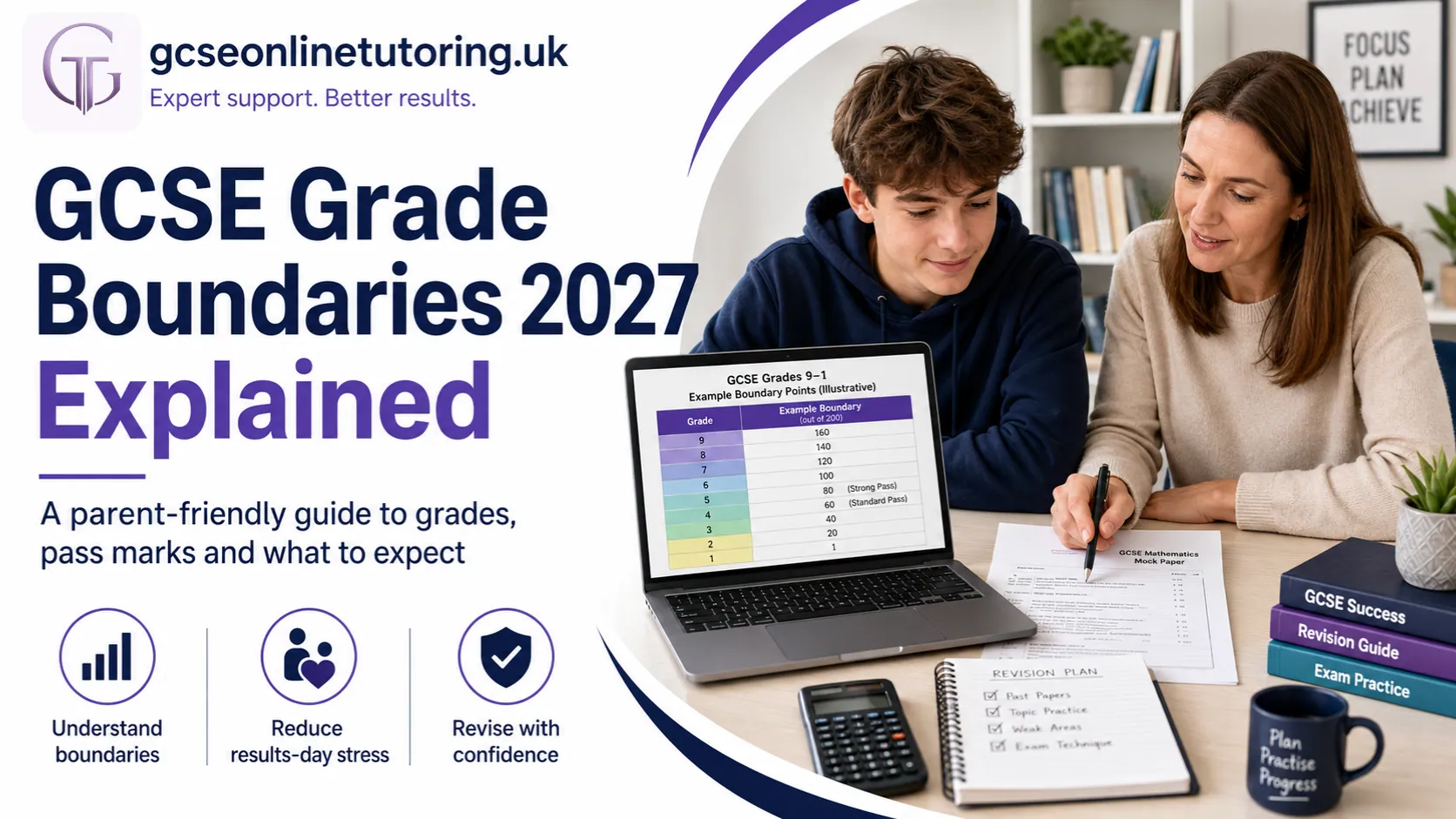
Choosing GCSEs and waiting for results can be stressful for young people and their families. When you’re worried about marks and trying to understand whether a grade 4 is enough to get onto the next course, the phrases “grade boundaries” and “strong pass” can feel mysterious. I’m Daniel Harris, Senior GCSE Education Writer at gcseonlinetutoring.uk, and over the years I’ve guided many families through GCSEs, subject choices, predicted grades and results day nerves.
I’ve seen how students get hung up on rumours about next year’s boundaries or whether the paper will be “harder”, and how misunderstandings can distract from what matters most: preparation and resilience. In this guide I’ll explain how GCSE grade boundaries work, why they change each year, and what parents and students should realistically expect from GCSE grade boundaries 2027.
We’ll focus on Maths, English and Science because they’re the core subjects that most students sit and where grade boundaries are discussed most. Everything here is based on official guidance from Ofqual and exam boards, combined with what I’ve learned from supporting GCSE students and parents. You’ll also find practical advice for revising when you don’t yet know where the boundaries will fall and how to respond if you’re near a boundary in your mocks.
Jump to Section
What Are GCSE Grade Boundaries?
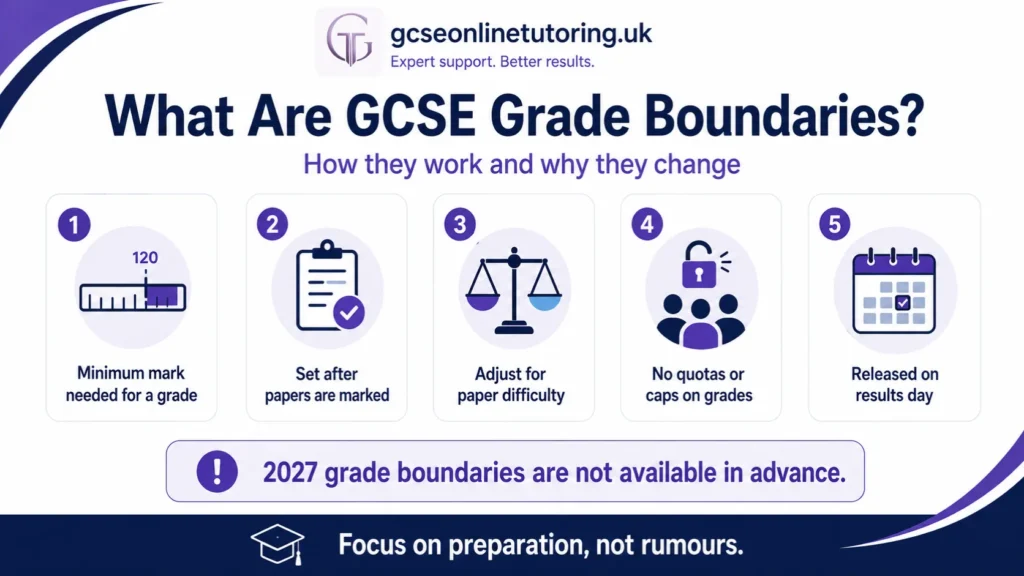
A grade boundary is the minimum mark needed to achieve a particular grade. The Pearson Edexcel exam board explains that a grade boundary is “the minimum mark at which a numbered grade (between 9 and 1) can be achieved”. For example, if the boundary for a grade 6 in a particular paper is 70 marks, a student scoring 70 will be awarded grade 6, while 69 marks falls into grade 5.
Unlike older GCSEs with modular exams, today’s GCSEs are linear. You take all the assessments at the end of the course, and the mark from each paper contributes to an overall raw mark. Grade boundaries are then set for the entire qualification.
Why Are Grade Boundaries Needed?
Because exam papers vary slightly in difficulty from year to year, grade boundaries make sure results are fair. After all papers have been marked, senior examiners review how hard the paper turned out to be and compare students’ performance with previous cohorts. Ofqual explains that grade boundaries are never set in advance. After marking is nearly complete, exam boards convene senior examiners to make recommendations about where to set the boundaries. They consider statistics, predicted performance and actual examples of student work to ensure standards are consistent.
This process means that if a paper is harder than expected, the grade boundaries may be lower; if it’s easier, the boundaries may be higher. The Ofqual lesson plan clarifies that boundaries are set after exams when marking is nearly complete, not before, and that exam boards use data and expert judgement to recommend the boundaries.
No Quotas or Caps
A common myth I often hear from parents is that there’s a limit on how many students can achieve each grade. In fact, there are no quotas or caps on grades. Ofqual stresses that there is no limit on how many students can get each grade; stable results year‑on‑year simply reflect stable student performance. Grade boundaries are adjusted to ensure fairness, not to restrict high achievers.
When Are Grade Boundaries Released?
Exam boards publish grade boundaries on GCSE results day. Until 2019 it was common to release them in advance, but this practice changed to reduce anxiety and speculation. Third Space Learning notes that grade boundaries are released on results day and not before. Families should avoid any unofficial “leaked” boundaries online; these are usually guesses based on limited information.
Are 2027 Grade Boundaries Available Yet?
No. Grade boundaries for 2027 GCSE exams cannot be confirmed until after the exams have been sat and marked. As the Ofqual blog explains, exam boards wait until marking is nearly complete before setting the boundaries. Rumours about the next year’s boundaries are speculation and don’t help students prepare.
Given that 2027 GCSE papers haven’t even been written yet, it is impossible to predict exact marks for grade 6 in Maths or grade 5 in English. Instead, students should focus on practising past papers, understanding mark schemes and strengthening subject knowledge.
How GCSE Grade Boundaries Are Set
The awarding process balances statistical data with human judgement. Senior examiners look at many factors:
- Exam difficulty: If the paper is harder than previous years, boundaries come down; if it’s easier, they go up. This keeps standards consistent across cohorts.
- Student performance: Boards compare how this year’s cohort performed in earlier assessments to predict expected performance and adjust boundaries accordingly.
- Expert judgement: Examiners review actual student scripts around the provisional boundaries to decide whether the work meets the standard expected.
- Comparable outcomes: Boards use statistical modelling to align their boundaries with other exam boards so that a grade A in one board isn’t easier to obtain than in another.
These checks ensure that the grade a student receives in 2027 has the same value as the same grade in previous years.
Why Grade Boundaries Change Every Year
Even with strict processes, no two exam series are identical. The Ofqual lesson plan points out that boundaries change because it’s impossible to make papers exactly the same difficulty each year. Here are the main reasons:
| Reason | What It Means | Example |
|---|---|---|
| Paper difficulty | Some exam papers end up harder or easier than intended. Boundaries adjust to ensure fairness. | If the 2026 maths paper contained unusually challenging algebra questions, boundaries might drop so that a grade 4 still reflects similar proficiency as in 2025. |
| Cohort performance | Student performance varies slightly each year. Boards use previous data to ensure this doesn’t advantage or disadvantage a particular cohort. | A cohort with higher prior attainment may produce slightly higher raw marks; boundaries adjust so grades remain comparable. |
| Changes in specifications | Occasional specification updates or new topics can influence performance. | When the reformed 9‑1 GCSEs were introduced, boundaries were carefully set to align with the new content and grading scale. |
| COVID-19 or exceptional circumstances | In recent years, special arrangements (such as formula sheets in Maths) have affected boundaries. | During pandemic years, boundaries and allowances were adjusted to reflect disruptions in teaching. |
From experience, I’ve noticed that families often worry that a harder exam year will unfairly lower their child’s grade. In reality, the grading system compensates for such variations so that the percentage of students achieving each grade remains broadly stable.
Subject‑Specific Considerations
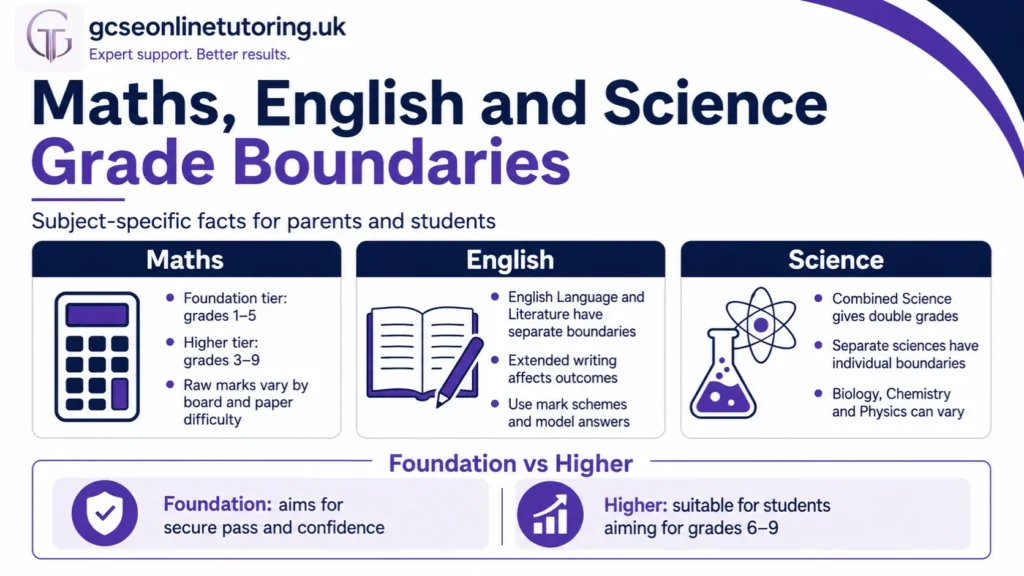
While the process is similar across subjects, grade boundaries differ between Maths, English and Science. Each subject has its own characteristics, tier structure and mark allocations.
Maths Grade Boundaries
Mathematics papers are offered at Foundation and Higher tiers. Ofqual rules specify that in a higher tier paper, half of the marks should target grades 9 to 7 and the other half grades 6 to 4. For foundation papers, half of the marks target grades 5 to 4 and the top of grade 3, with the rest targeting lower grades. This design means grade boundaries differ between tiers.
On higher papers, a grade 4 can be achieved with a lower percentage of marks because much of the paper is aimed at high‑ability questions. On foundation papers, a grade 5 or strong pass is the top grade available.
When looking at past years, boundaries for Maths vary between exam boards. For example, Third Space Learning’s analysis shows that in 2025 the AQA higher maths paper required 63 marks for a grade 4 and 130 for a grade 6, while Edexcel required 53 and 121 marks respectively. However, these figures fluctuate slightly each year. Students should use them as a general guide rather than a prediction for 2027.
English Grade Boundaries
English Language and English Literature are separate GCSEs with different components (reading, writing, speaking & listening). Boundaries tend to be higher in English because marks are often more evenly distributed across abilities. For example, the DoodleLearning article provided AQA boundaries for 2025 showing that 73 marks (out of 160) secured a grade 4 in English Language and 82 for a grade 5.
English papers involve extended writing and comprehension, and boundaries can be influenced by the overall quality of responses. Students should practise with mark schemes and exemplar answers to understand what examiners reward.
Science Grade Boundaries
Students either take Combined GCSE Science (two GCSEs) or separate sciences (Biology, Chemistry and Physics). Combined science awards a double grade (e.g. 9 to 9, 8 to 7). Each board combines marks from multiple papers; boundaries for combined science often sit higher than for individual sciences because marks are aggregated over several papers.
In separate sciences, boundaries vary between Biology, Chemistry and Physics. Historically, Physics papers sometimes have lower boundaries due to challenging calculations, whereas Biology boundaries can be higher because more marks are accessible via knowledge recall. Again, boundaries change each year and by board, so treat past figures as illustrative.
Foundation vs Higher Tier
For GCSE Maths and many Science papers, students choose between Foundation and Higher tiers. Here’s a quick comparison:
| Tier | Typical Grade Range | Who It Usually Suits | Important Note |
|---|---|---|---|
| Foundation | Grades 1–5 | Students aiming for a standard pass (grade 4) or strong pass (grade 5), or those who find the subject challenging. | Grade 5 is the highest grade available. Papers contain more accessible questions but still require good understanding of core topics. |
| Higher | Grades 3–9 | Students aiming for grades 6 to 9, particularly if they plan to take the subject at A level. | Boundaries for lower grades (3–5) can be quite low because papers target higher grades. Students risk an unclassified (U) if they perform poorly, so the decision should be made with teacher guidance. |
I always tell parents that choosing a tier isn’t about ambition but about playing to strengths. A student who struggles with higher‑tier algebra might be better placed on the foundation tier to secure a solid grade rather than risk a U on the higher paper.
Understanding GCSE Grades 9 to 1
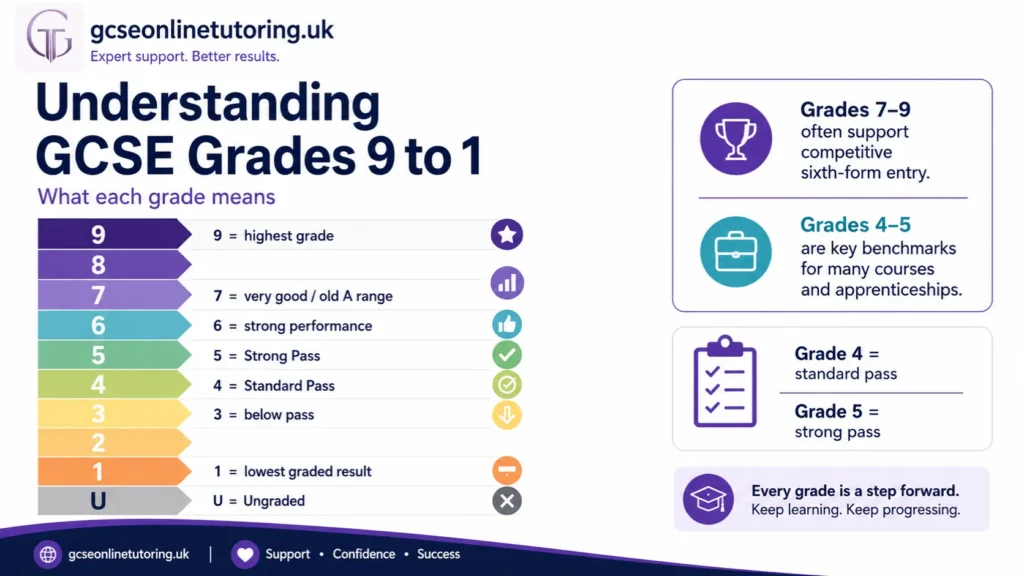
The reformed 9 to 1 grading scale introduced in 2017 replaced the old A* to G letters. The government’s GCSE 9 to 1 grade scale guidance explains that the new scale provides more differentiation and that the bottom of a grade 7 is comparable to the bottom of the old grade A, while the bottom of grade 4 is comparable to the bottom of the old grade C.
| GCSE Grade | Simple Meaning | Old Grade Comparison | What It Usually Means for Students |
|---|---|---|---|
| 9 | Highest grade, top performers | High A* | Exceptional understanding; often required for highly selective sixth forms or scholarships. |
| 8 | Between A* and A | Low A* / high A | Strong mastery of the subject; indicates readiness for A Level. |
| 7 | Low A grade | Mid A | Very good understanding; often meets entry requirements for A levels. |
| 6 | High B grade | High B | Above strong pass; demonstrates solid understanding and is competitive for many sixth‑form courses. |
| 5 | Strong pass | Low B / high C | Shows good understanding beyond the minimum. Schools are judged on the proportion of students achieving grade 5 or above. |
| 4 | Standard pass | Low C | Minimum required pass; often the benchmark for progressing to many sixth form or college courses and apprenticeships. |
| 3 | D / high E | D | Below pass but may still count as qualification in some contexts. |
| 2 | Low E / high F | E/F | Weak performance; students will usually need to resit core subjects. |
| 1 | Low F / G | F/G | Very limited understanding; resits required. |
| U | Ungraded | U | Did not meet the minimum standard for grade 1. |
The Education Secretary has officially designated grade 4 as a standard pass and grade 5 as a strong pass. Students who achieve grade 4 in GCSE English and Maths avoid compulsory post‑16 retakes. Grade 5 is used as the benchmark in school performance tables and the EBacc measure.
Will GCSEs Be Harder in 2027?
One common question I hear is whether GCSEs will get “harder” next year. Because grade boundaries adjust each year, exams are designed to maintain consistent standards. Ofqual’s grading process ensures that it is not easier or harder to get a grade in any given year. That means a grade 6 achieved in 2027 should represent the same level of performance as a grade 6 in previous years.
However, there can be changes to content or assessment. For example, formula sheets provided in Maths during the pandemic years may be withdrawn as teaching returns to normal. Similarly, exam boards occasionally update specifications. Students shouldn’t worry about rumours; instead, they should focus on understanding the specification and practising past papers.
Will Grade Boundaries in 2027 Be Lower Than 2026?
Since grade boundaries respond to the difficulty of the papers and student performance, nobody can guarantee that boundaries in 2027 will be lower or higher than in 2026. As a tutor, I’ve seen years where boundaries moved by only a few marks and others where a particularly challenging paper led to a noticeable drop. The key point is that any change simply reflects fairness across cohorts.
Instead of speculating about boundaries, students should treat the grade boundary from previous years as a rough guide. For example, if past AQA maths higher papers required around 130 marks for a grade 6, aim comfortably above this in your practice papers. But remember that in some years the grade 6 boundary may be higher or lower.
Why Mock Grade Boundaries Can Be Misleading
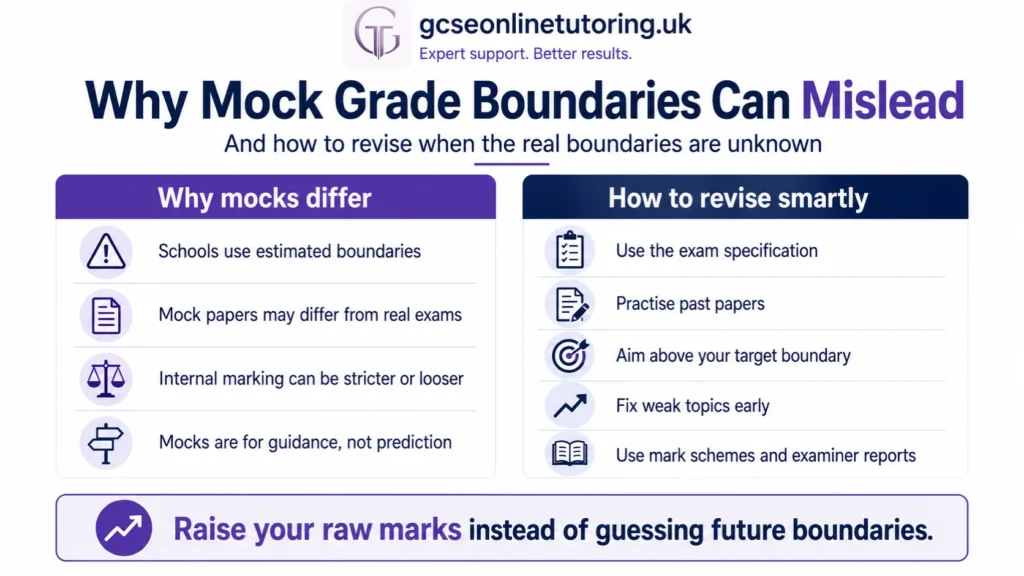
Schools often set their own “mock grade boundaries” based on past exam data or internal cut‑offs. These can be useful for setting goals, but they are not official. In my experience, students sometimes panic when their mock grade falls just below the boundary. Remember:
- Mocks may use different papers that were not calibrated in the same way as actual GCSE papers.
- Boundaries are based on national data, so a school’s cohort may perform differently.
- Internal marking may be more generous or strict than external marking.
Use your mock results to identify strengths and weaknesses, not as a precise predictor of your final grade. Talk to teachers about how close you are to your target grade and what specific areas need improvement.
Revising When Grade Boundaries Are Unknown
Uncertainty about grade boundaries shouldn’t change how you revise. Here are strategies I recommend:
- Focus on Specification Content: Make sure you can demonstrate knowledge of every topic listed on the exam board’s specification.
- Practise Past Papers: Use exam board past papers to familiarise yourself with question styles and pacing. Self‑mark using official mark schemes to understand where marks are awarded.
- Aim Above Your Target Grade: Because boundaries fluctuate, aim to achieve marks comfortably above the approximate boundary for your target grade. This gives you a buffer.
- Address Weak Topics Early: Don’t leave topics you find challenging until the last minute. Tackle them early, possibly with the help of a tutor.
- Use Mark Schemes and Examiner Reports: Examiner reports explain common mistakes and what distinguishes different grades. Reading them helps you understand how to improve.
From experience, one thing I didn’t expect when I first worked with GCSE students was how much confidence improved when they practised under timed conditions. Time management is often as important as subject knowledge.
What to Do If Your Marks Are Near a Grade Boundary
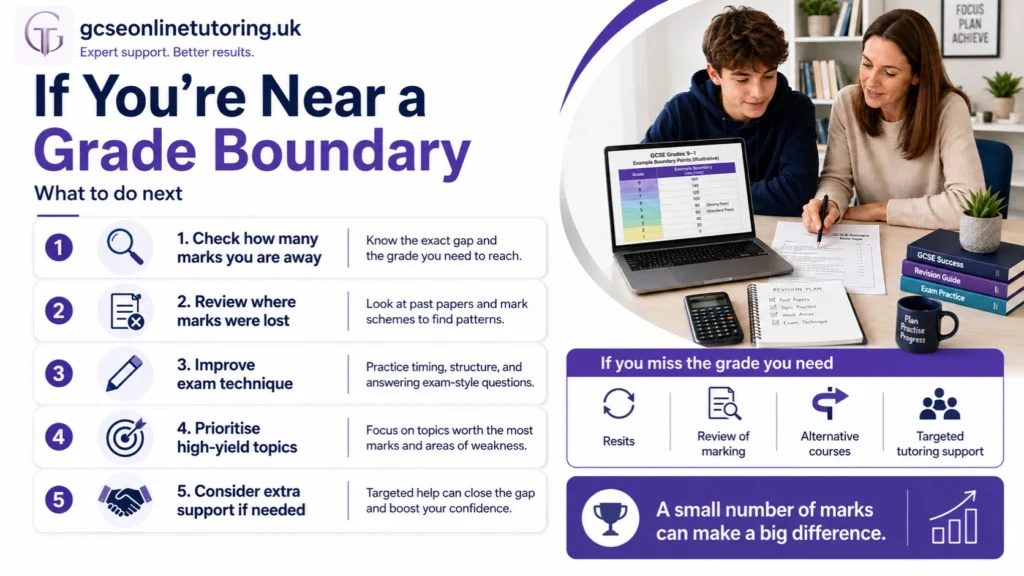
Being “on the boundary” is nerve‑racking. Whether it’s a mock or a final exam:
- Identify the mark gap: If you’re, say, 5 marks below your target grade in a past paper, focus on where you lost marks. Was it careless arithmetic or a misunderstood concept?
- Improve Exam Technique: Sometimes a few extra marks come from writing fuller explanations or structuring answers better.
- Prioritise High‑Yield Topics: In Maths, know your number skills, algebra basics and geometry formulas. In Science, memorise key definitions and practise calculations. In English, practise planning and paragraphing for extended writing.
- Consider Additional Support: If you’re consistently just below the boundary, targeted tutoring can make a significant difference. Working one‑to‑one with a tutor can help you secure those extra marks by addressing gaps and improving exam technique.
What Happens If You Miss the Grade You Need?
If you don’t achieve the grade required for sixth form or your chosen course, don’t panic. Options include:
- GCSE Resits: Students who fail to achieve a grade 4 in English Language or Maths must continue studying these subjects and usually resit the exams. Many colleges offer resit programmes alongside A level or vocational courses.
- Reviewing Marking (Review of Results): If you’re close to the boundary, your school can request a review of marking. There’s no guarantee the grade will change, but it’s worth discussing with teachers.
- Appealing Assessments: If there’s evidence of a procedural error in marking, your school can appeal. This is rare but possible.
- Alternative Courses: Some courses accept students with a grade 3 or allow entry based on other qualifications or interviews. Apprenticeships and vocational routes may focus more on aptitude and practical skills.
From experience, the most resilient students are those who see a setback as an opportunity to reflect and refocus. A student I worked with narrowly missed a grade 5 in English but then spent the summer improving reading and writing skills. He achieved a grade 6 in his resit and went on to study A level History.
How a GCSE Tutor Can Help
As an educator, I’ve seen the transformative effect of tailored support. A tutor can:
- Diagnose Specific Issues: Identify whether difficulties stem from gaps in knowledge, poor exam technique or anxiety.
- Provide Structured Practice: Offer targeted questions and past papers at the right level.
- Teach Revision Strategies: Help students create revision schedules and use active techniques (flashcards, spaced repetition).
- Build Confidence: Confidence often grows when students see improvement, leading to better performance on exam day.
A reminder from my tutoring experience: the biggest difference often comes from early intervention. Waiting until a few weeks before the exam leaves little time to build skills.
FAQs
Will GCSEs Be Harder in 2027?
GCSEs are designed to maintain consistent standards each year. Ofqual ensures that new grade boundaries are set each year to reflect the difficulty of the papers and ensure fairness. While specific topics may feel harder or easier, the overall grade a student receives should represent the same level of achievement as in previous years. Focus on the specification and practise widely instead of worrying about rumours.
What Will the Grade Boundaries Be in 2027?
Grade boundaries for 2027 cannot be known in advance. Exam boards set the boundaries only after all papers have been marked. They use data and expert judgement to ensure fairness. Past years’ boundaries (e.g. the 2025 maths higher boundary of around 63 marks for grade 4) can give a rough indication but are not predictions.
Will the 2027 Grade Boundaries Be Lower Than 2026?
Possibly, but there’s no guarantee. Boundaries move up or down depending on how difficult the papers are and how students perform. They are not deliberately raised or lowered to make exams harder or easier; the goal is to ensure consistency across years..
When Are GCSE Grade Boundaries Released?
Official grade boundaries are released on GCSE results day. Third Space Learning notes that grade boundaries were released on 20 August for the 2026 exams and 21 August for the 2025 exams. Students should check their exam board’s website on results day for the confirmed boundaries.
Do All Exam Boards Use the Same Grade Boundaries?
No. Each exam board (AQA, Pearson Edexcel, OCR, WJEC Eduqas) sets its own grade boundaries for each paper. Differences in paper structure mean boundaries vary. However, the boards coordinate through Ofqual to ensure standards are aligned, so a grade 6 in one board is equivalent in standard to a grade 6 in another.
Are GCSE Maths Grade Boundaries the Same for Foundation and Higher?
No. Foundation tier boundaries cover grades 1–5, and higher tier boundaries cover grades 3–9. Because higher papers include more challenging questions, the raw marks needed for lower grades (e.g. grade 4) are often lower on higher papers than on foundation papers.
What Is the GCSE Pass Grade?
A standard pass is grade 4 and a strong pass is grade 5. Students achieving grade 4 in English and Maths are not required to retake those subjects. Schools are judged on the proportion of students achieving a strong pass (grade 5) or higher.
Can Grade Boundaries Change After Exams?
Grade boundaries are finalised before results are released and do not change afterwards. However, individual marks and grades can change if a review of marking identifies errors. Grade boundary movements from year to year are not retroactive.
Why Are Mock Grade Boundaries Often Different?
Mocks use papers created by schools or commercially produced practice papers. These are not calibrated in the same way as actual GCSE papers, so any grade boundaries attached to mocks are estimates. They are useful for gauging progress but should not be treated as official thresholds.
Where Can I Find Official GCSE Grade Boundaries?
On results day, visit your exam board’s website:
- AQA: Search for “AQA GCSE grade boundaries”. The board publishes PDF tables for each subject.
- Pearson Edexcel: Go to “results and certification” and select grade boundaries for GCSE. Edexcel also provides an Understanding Grade Boundaries document explaining minimum marks.
- OCR: Look under the “exams officers” section for grade boundaries.
- WJEC Eduqas: Search for “Eduqas grade boundaries” and choose the relevant exam year.
What Should I Do If I’m Close to the Next GCSE Grade?
If you’re close to a higher grade in your mocks or practise papers:
- Discuss the result with your teacher to identify where marks were lost.
- Focus revision on topics you found difficult and refine exam techniques.
- Consider a structured tutoring programme to help secure the extra marks.
- Remember that official boundaries may differ, so keep working on raising your raw mark rather than fixating on a specific cut‑off.
Final Thoughts and Call to Action
Understanding grade boundaries helps students and parents make sense of results but shouldn’t become a source of stress. The best preparation for GCSEs is a thorough understanding of the subject, plenty of practice and a calm mind. If your child is close to a grade 4, 5, 6 or 7 in GCSE Maths, English or Science, focused one‑to‑one tutoring can turn uncertain marks into more secure results before exam season. Our experienced tutors at gcseonlinetutoring.uk provide tailored support that builds confidence and improves exam technique.
For personalised guidance or to discuss how tutoring could help your child reach their target grade, feel free to contact us.

Leave a Comment
Share your question or feedback below. Your comment will appear after approval.
2 Comments