
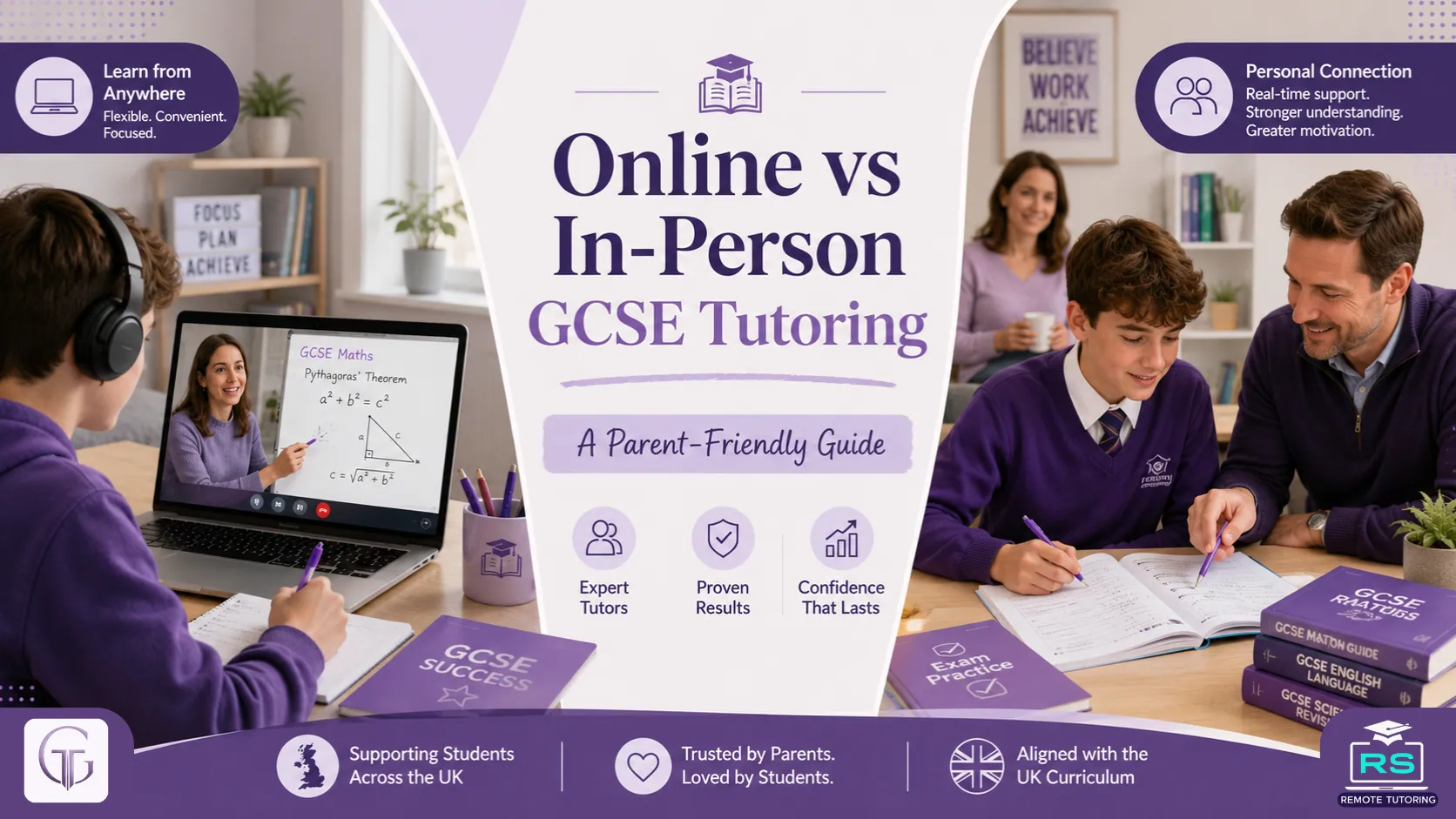
Choosing the right type of GCSE tutoring isn’t as simple as deciding whether your child prefers a screen or a classroom, it’s about finding the approach that fits them best. As a parent, you’re juggling school schedules, extracurricular activities and, often, a teenager who might be anxious about exams. I’ve spent years writing about GCSE preparation and study skills, and I’ve seen families thrive with both online and face‑to‑face tuition. In this guide I’ll walk you through the differences between online and in‑person GCSE tutoring, share insights from research and my own experience, and help you decide which option is right for your child.
What do “online” and “in‑person” GCSE tutoring mean?
Online GCSE tutoring uses digital tools, video calls, shared whiteboards, interactive quizzes and cloud‑based documents to connect students with tutors from wherever they happen to be. Sessions typically take place via platforms such as Zoom, Teams or bespoke tutoring software. Learners can attend from home, school or even while travelling. These platforms make it possible to share worked examples, annotate documents and record lessons for later review.
In‑person GCSE tutoring involves meeting the tutor in a physical space, either at the student’s home, the tutor’s home, a tuition centre or a neutral location such as a library. Face‑to‑face lessons are the traditional model: tutor and student sit side by side, work through questions together on paper, and build rapport through direct interaction.
Both formats can be delivered one‑to‑one or in small groups, and both can cover the full range of GCSE subjects: Maths, English, Sciences, Humanities and languages. The core difference is where and how the learning takes place.
Quick comparison: online vs in‑person GCSE tutoring
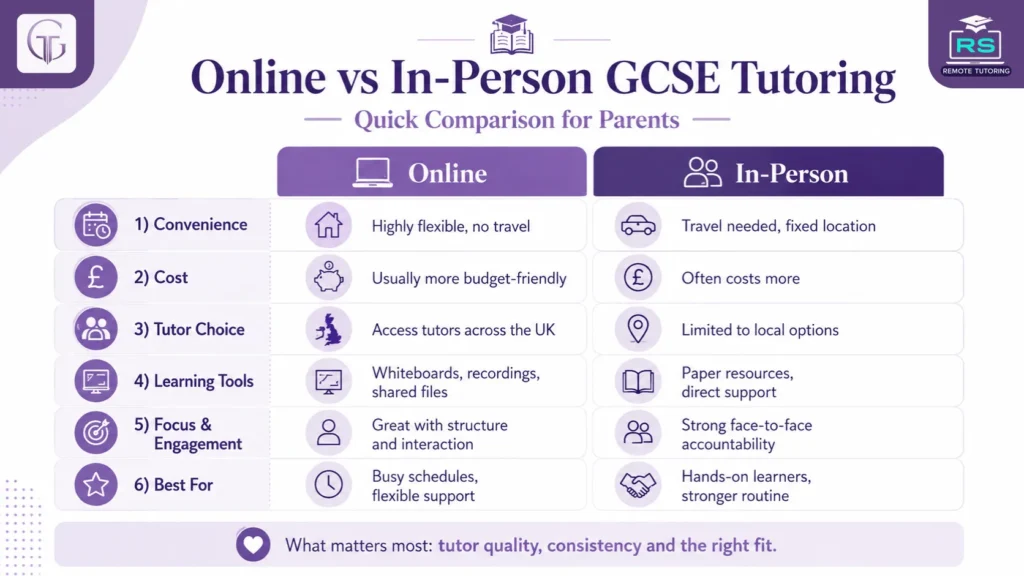
| Factor | Online GCSE tutoring | In‑person GCSE tutoring | Parent tip |
|---|---|---|---|
| Convenience | Highly flexible; sessions can be scheduled around school, clubs and family commitments; saves travel time. | Less flexible; requires travelling or hosting; cancellations due to weather or transport can occur. | Consider your weekly routine, online sessions are easier to slot in if evenings are hectic. |
| Cost | Usually 10–30% cheaper because tutors don’t charge for travel or venue costs. | Often more expensive due to travel time and overheads. | Check whether travel expenses are included, online may free up budget for more frequent lessons. |
| Tutor availability | Wider pool of tutors across the UK; easier to find subject and exam‑board specialists. | Limited to local tutors; harder to find niche expertise in smaller towns. | If you need a tutor for an uncommon GCSE option (e.g., Triple Science or Literature texts), online widens your options. |
| Learning tools | Interactive whiteboards, screen sharing, recorded sessions and digital notes support varied learning styles. | Physical whiteboards, paper resources and hands‑on demonstrations. | Ask tutors which tools they use, online lessons should still feel interactive, and in‑person tutors can use digital resources. |
| Engagement & feedback | Relies on video and audio; can be equally engaging when tutors use interactive tools; attendance can be an issue if students don’t log in. | Face‑to‑face contact allows tutors to read non‑verbal cues and provide immediate feedback. | For students who easily get distracted, in‑person sessions or monitored online sessions can help. |
| Suitability for different learners | Ideal for self‑motivated students, those with busy schedules or families who live far from tutors; supportive for anxious learners who feel safer at home. | Better for kinesthetic learners who need hands‑on activities or students who struggle to focus online; creates a routine and accountability. | Observe how your child learns, do they engage better with digital tools or with someone beside them? |
| Safety and safeguarding | Requires secure platforms and DBS‑checked tutors; sessions are recorded for transparency; parents can monitor from nearby. | Requires ensuring tutors are DBS‑checked and sessions take place in safe, comfortable environments. | Always ask about safeguarding policies and whether session recordings or notes are provided. |
Jump to Section
Does online GCSE tutoring actually work?
The short answer is yes, when it’s done properly. Recent research from the Johns Hopkins University’s Center for Research and Reform in Education found that live, virtual tutoring delivered with the same safeguards and structure as in‑person programs can be nearly as effective as traditional face‑to‑face tutoring. The researchers emphasised that virtual tutors can be anywhere, expanding the talent pool and lowering costs. Crucially, the study noted that it’s the quality and consistency of the tutoring, not the format, that drives results.
As a GCSE writer and tutor, I’ve seen this play out in practice. Students who attend online sessions regularly, complete assignments and have a good rapport with their tutor make excellent progress, sometimes surpassing peers in face‑to‑face classes. The key is to treat online sessions as seriously as in‑person lessons: have a quiet workspace, use a laptop rather than a phone, and commit to turning up on time. When online lessons include interactive whiteboards, shared files and the ability to replay recordings, they often provide more opportunities for review than traditional sessions.
What makes in‑person GCSE tutoring effective?
Face‑to‑face tutoring offers benefits that online sessions sometimes can’t match. Direct interaction helps tutors read body language and adapt explanations in real time. It also helps anxious or kinesthetic learners feel more secure: physically working through problems on paper or using manipulatives can aid understanding. A dedicated tutoring environment away from household distractions creates routine and discipline. Immediate feedback, a tutor leaning over your child’s work and pointing out a mistake can reinforce concepts quickly.
From experience, I’ve noticed that some Year 10 students, especially those with attention difficulties or younger siblings at home, focus much better when they’re in the same room as a tutor. In‑person sessions also encourage accountability: it’s harder to cancel when the tutor is on your doorstep.
When online GCSE tutoring works best
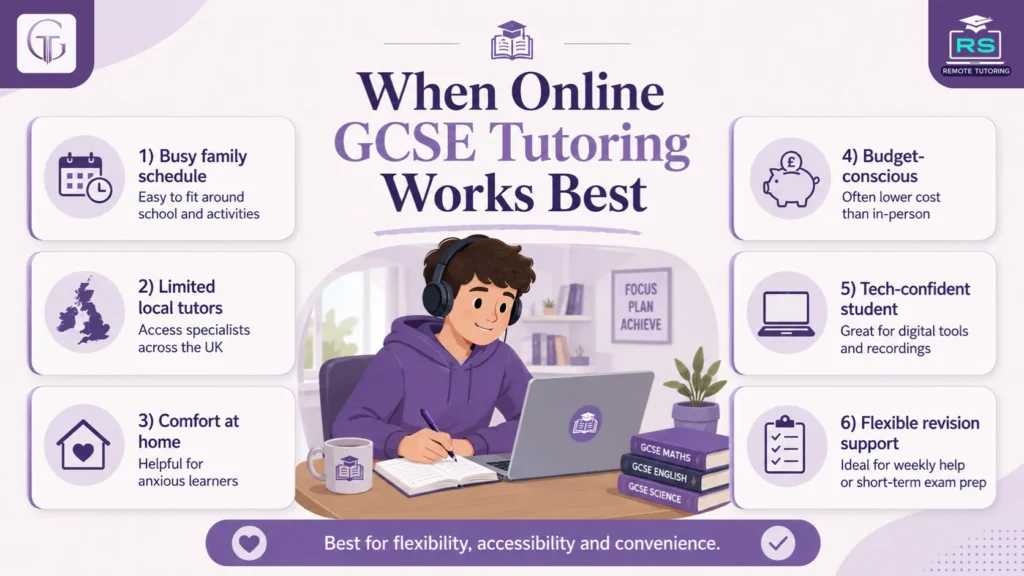
GCSE Online tutoring isn’t a “second‑best” option, it simply suits certain students and families better. Consider online lessons if:
- You need flexibility. Sessions can be booked around football practice, dance lessons or weekend activities. With the ability to schedule early mornings or late evenings, there’s less chance of missing lessons.
- You live in a rural area or abroad. Online tuition removes geographic barriers and gives you access to the UK’s top GCSE tutors, including specialists in AQA, Edexcel, OCR and WJEC subjects.
- Your child is comfortable with technology. Students who enjoy using tablets, digital pens and interactive tools often thrive online. The ability to record sessions and review them before exams is a powerful advantage.
- Your budget is limited. As research and industry comparisons show, online tutoring usually costs 10–30% less than in‑person sessions and saves travel time.
- Your child feels anxious in unfamiliar settings. Many students find the comfort of their own home reduces stress and makes them more willing to participate.
I still remember working with a Year 11 student who was shy in the classroom but came alive during online sessions. With the camera slightly off and the digital whiteboard at their fingertips, they felt confident enough to try challenging algebra problems and ask questions they might have withheld in person.
When in‑person GCSE tutoring may be better
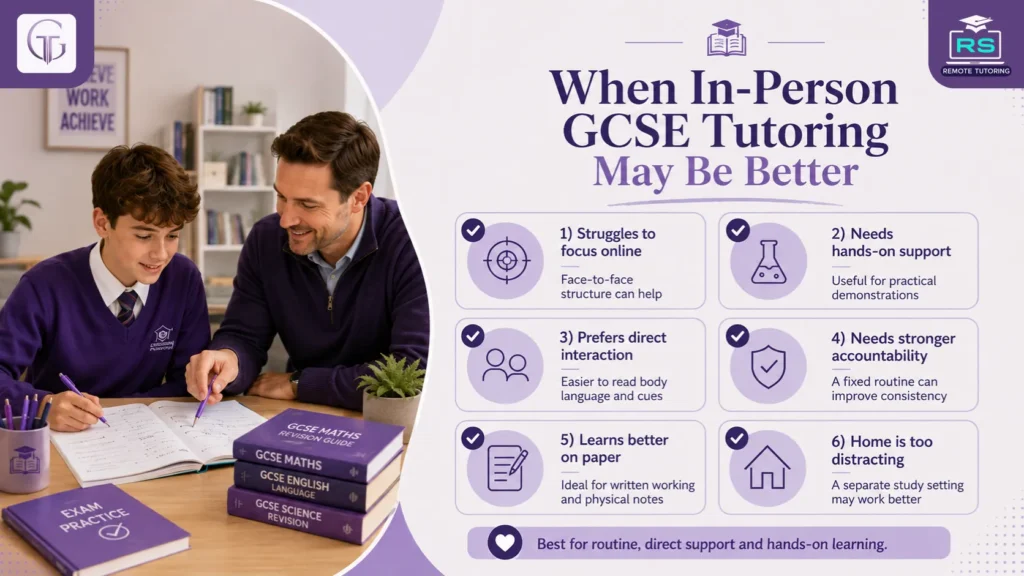
For some learners, an online environment simply isn’t enough. Choose face‑to‑face sessions if:
- Your child struggles to focus online. Kinesthetic learners or students with attention difficulties benefit from the structure and physical presence of a tutor.
- They need hands‑on support. Subjects like science experiments or geometry constructions can sometimes be demonstrated more effectively in person, where tutors can use models or manipulatives.
- They lack self‑discipline. In‑person lessons create routine and accountability; there’s a set time to prepare, travel and sit down to work.
- Social connection is important. Building rapport through eye contact and body language can motivate some students in ways that online sessions can’t.
- Your home environment isn’t suitable. If your house is noisy or lacks a quiet study space, meeting at a tuition centre or library may be more productive.
One thing that becomes clear quite quickly is that in‑person tutoring isn’t automatically “better” – it’s “better” for specific students. In my years writing about tutoring, I’ve seen siblings choose different formats: one thrived with the flexibility of online history lessons; the other needed a weekly in‑person maths session to stay on track.
Subject‑by‑subject comparison
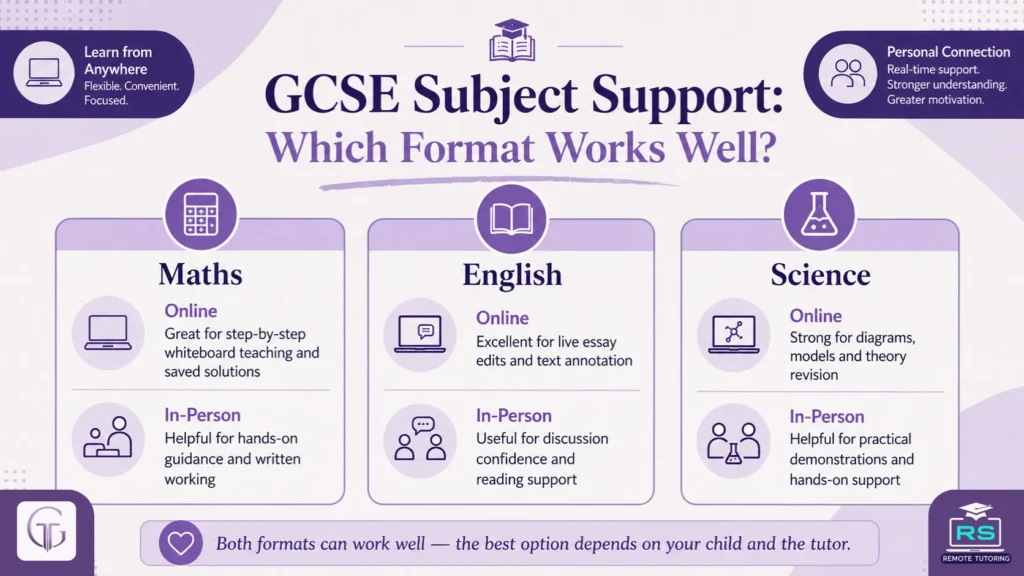
Maths
For GCSE Maths, online tutoring can be incredibly effective. Digital whiteboards allow tutors to walk through solutions step by step, and students can save screenshots for revision. Recorded sessions mean your child can revisit tricky topics like trigonometry or simultaneous equations. However, if your child benefits from writing problems out by hand with immediate physical guidance, an in‑person session might feel more natural.
English (Language and Literature)
English tutoring depends on discussion and writing practice. Online platforms excel at collaborative document editing, tutors can highlight text, annotate essays and write model paragraphs in real time. Essay planning templates and past paper questions can be shared instantly. In‑person sessions might suit students who struggle to type or who need more support with reading aloud and building confidence in public speaking.
Science (Combined and Triple)
For GCSE Science, diagrams, animations and online simulations make complex concepts accessible. Many science tutors use virtual labs or interactive models to illustrate biology processes or physics principles. But practical work, such as practising GCSE Required Practical skills is harder to replicate online. If your child needs guidance with hands‑on experiments, occasional in‑person sessions could bridge that gap.
Which option helps more with study skills and revision planning?
Study skills, planning revision, managing time, creating flashcards, practising past papers – can be taught effectively in both formats. Online tutors often share digital revision planners and use apps to set homework reminders. In‑person tutors can physically demonstrate how to organise notes, use highlighters and create mind maps. The best option depends on your child’s learning style and the structure offered by the tutor.
Which option helps more with exam technique?
Exam technique, reading questions carefully, planning answers, checking work and managing time is crucial for GCSE success. In my experience, it’s the quality of the tutor that matters most. Both online and in‑person tutors can set timed questions, walk through mark schemes and practise past papers. Online lessons have the advantage of recording timed practice; in‑person sessions sometimes better mimic the pressure of a real exam environment. I often recommend combining both approaches: online lessons for content and follow‑up, and occasional in‑person mock exams to build stamina.
Which option is better for confidence and motivation?
Confidence grows when students feel supported and see their progress. An empathetic, patient tutor can build a student’s belief in themselves regardless of format. Some students feel safer speaking up online; others need the human warmth of an in‑person mentor. From experience, what makes the biggest difference is regular praise, constructive feedback and a tutor who celebrates small wins.
Cost, travel and flexibility compared
Money matters when you’re budgeting for months of GCSE tuition. Online tutoring typically costs less than in‑person because there are no travel or venue expenses. Tutors can schedule back‑to‑back sessions without commuting, so they often charge lower hourly rates. Parents also save on petrol, parking and lost work time. In‑person tutoring, however, may justify higher costs if your child truly needs physical support or lacks a safe home study space.
Flexibility is another key consideration. Online tutoring slots can be booked early in the morning or late at night and are easier to reschedule. In‑person sessions require more coordination and can be disrupted by traffic or bad weather.
Safety and safeguarding considerations for parents
Safety should be paramount, whichever format you choose. Ensure the tutor has an up‑to‑date DBS check and references. For online tutors, use secure platforms that provide waiting rooms and the ability to record sessions. Ask how your child’s data is protected and who can access recordings. For in‑person tutoring, meet the tutor in a public place or at home with another adult present initially. Clear communication, progress reports and open feedback loops are non‑negotiable.
What matters more than format?
The latest evidence shows that the quality and consistency of tutoring have a greater impact on GCSE results than the delivery method. A highly trained, empathetic tutor who understands exam board specifications, tailors lessons to the student’s needs and builds confidence will yield better results, whether online or in person. Likewise, commitment from the student, parental support and a structured revision plan are essential.
Common mistakes parents make when choosing GCSE tutoring
Having written about GCSE education for years, I’ve noticed a few recurring pitfalls:
- Choosing on price alone. Bargain‑rate tutoring can be tempting, but if the tutor lacks exam‑board expertise, poor feedback or inconsistent scheduling, your child may not benefit.
- Ignoring your child’s preferences. Some teenagers simply won’t engage online; others find it awkward to invite a tutor into their home. Discuss options with them – their buy‑in is essential.
- Not checking qualifications. Ensure the tutor is experienced with the correct GCSE subjects and exam boards. A science tutor who has only taught AQA may not be familiar with Edexcel mark schemes.
- Overloading the schedule. Weekly tutoring is effective; daily sessions can be overwhelming, especially alongside school and clubs. Balance is critical for motivation.
- Skipping trial lessons. A trial session lets you gauge rapport and teaching style. Most tutors offer a discounted or free introductory lesson – use it.
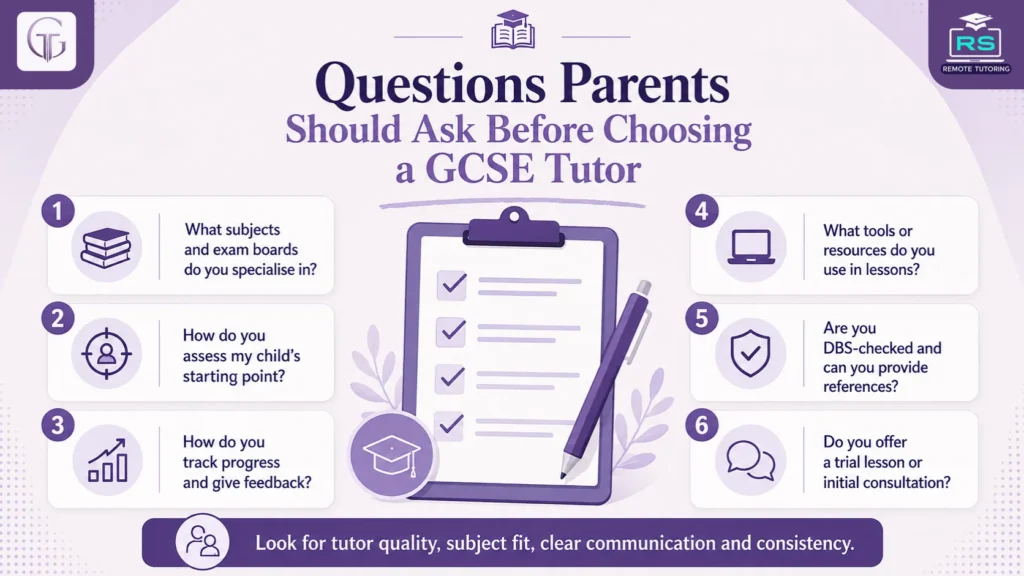
Questions to ask before choosing a GCSE tutor
| Question | Why it matters | Good sign to look for |
|---|---|---|
| What GCSE subjects and exam boards do you specialise in? | Ensures alignment with your child’s syllabus. | Tutor can explain differences between AQA, Edexcel, OCR, WJEC and provide resources. |
| How do you assess a student’s needs at the start? | Shows whether lessons are personalised or generic. | Tutor describes a diagnostic test or initial assessment. |
| How do you track progress and communicate with parents? | Transparency builds trust and allows you to see improvements. | Tutor sends regular reports, uses lesson notes and sets targets. |
| What technology or materials do you use? | For online tutoring, interactive tools are essential; for in‑person, varied resources keep lessons engaging. | Tutor mentions whiteboards, shared documents, past papers and homework feedback. |
| Are you DBS‑checked and can you provide references? | Safeguarding and professionalism. | Tutor produces current certification and is happy to share testimonials. |
How to tell if tutoring is working
Monitoring progress is vital. Here are signs your child’s tutoring is paying off:
| Sign | What it means | What parents should do next |
|---|---|---|
| Improved classroom performance. | Homework and class tests show higher scores; teachers note better understanding. | Keep supporting regular sessions and celebrate progress. |
| Increased confidence. | Your child asks more questions, attempts harder problems and stops avoiding challenging tasks. | Encourage them to share their successes and reflect on what’s working. |
| Better study habits. | They create revision plans, manage time effectively and stay organised. | Reinforce these habits at home with a study timetable and quiet space. |
| Positive feedback from the tutor. | Tutor reports strong engagement and completion of assignments. | Discuss next steps – perhaps introduce past paper practice or reduce frequency if independence increases. |
| Steady progress on mock exams. | Mock grades move closer to target grades; silly mistakes decrease. | Continue targeted tutoring and focus on exam technique closer to the exam. |
So, which works better for GCSE students?
There isn’t a one‑size‑fits‑all answer. Online GCSE tutoring offers flexibility, wider tutor choice, lower costs and powerful digital tools. In‑person tutoring provides tangible support, stronger non‑verbal communication and a structured environment. The most effective option depends on your child’s learning style, subject needs, schedule and personality. Many families now adopt a hybrid approach – using online sessions for weekly support and periodic in‑person lessons for subjects or topics that benefit from face‑to‑face attention.
From experience, the biggest determinant of success isn’t the platform – it’s the partnership between tutor, student and family. When that partnership is built on clear goals, consistent practice and open communication, your child can flourish in either format.
When an online GCSE tutor can help
If your family’s schedule is packed or you live in an area with limited tutor choice, structured one‑to‑one online GCSE tutoring can give your child the support they need without adding travel stress. Look for a tutor who is experienced in your child’s subjects, uses interactive tools and provides regular feedback. Sometimes, a few online lessons can boost confidence enough that your child no longer needs weekly support – a win‑win for everyone.
FAQs
Is online GCSE tutoring as effective as in‑person tutoring?
Research suggests that high‑quality virtual tutoring can be nearly as effective as traditional face‑to‑face tutoring when delivered with proper safeguards and structure. The key factors are tutor expertise, consistent attendance and interactive learning tools. Many students appreciate the flexibility and recorded sessions that online tutoring offers.
Is online tutoring better than face‑to‑face tutoring for GCSE students?
Neither format is inherently better for all students. Online tutoring is often more flexible and cost‑effective, while face‑to‑face sessions provide direct interaction and a structured environment. Parents should consider their child’s learning style, the subject, the quality of the tutor and their schedule.
What are the disadvantages of online GCSE tutoring?
Online tutoring relies on a stable internet connection and requires students to be self‑disciplined. Some learners may feel less engaged on screen or struggle with screen fatigue. Attendance can also be harder to enforce, and tutors may miss non‑verbal cues that indicate confusion.
What are the disadvantages of in‑person GCSE tutoring?
Face‑to‑face tutoring is often more expensive and less flexible. You need to coordinate travel, which can lead to missed sessions due to traffic or bad weather. Tutor choice is limited to your local area, which may restrict subject specialism. For some students, the pressure of meeting a tutor in person can be intimidating.
Is online GCSE Maths tutoring effective?
Yes. Digital whiteboards and screen sharing allow tutors to demonstrate solutions clearly and provide immediate feedback. Students can save annotated notes and replay recorded sessions, which aids revision. However, students who need hands‑on guidance or struggle to focus online may benefit from periodic in‑person lessons.
Is online GCSE English tutoring effective?
Online English tutoring can be highly effective. Tutors and students can collaborate on essays, annotate texts and share resources in real time. Shared documents make it easy to provide detailed feedback. For students who prefer to discuss and brainstorm in person, occasional face‑to‑face meetings may enhance confidence.
Is online GCSE Science tutoring effective?
Online Science tutoring is effective for theory and problem‑solving. Interactive simulations and diagrams help explain complex concepts. However, practical experiments are better demonstrated in person. Students preparing for required practical assessments may benefit from a blended approach.
Which is cheaper, online or in‑person GCSE tutoring?
Online tutoring is generally less expensive because there are no travel or venue costs. In‑person tutoring often charges a premium for travel time and overheads. Always ask about pricing structures and any additional fees.
How do I know if my child will focus during online tutoring?
Trial lessons can help you gauge engagement. A good online tutor will use interactive tools, set clear goals and maintain communication. Ensure your child has a quiet workspace and remind them that online sessions require the same focus as in‑person lessons. If they struggle after a few weeks, consider switching to face‑to‑face or hybrid sessions.
What should parents look for in a GCSE tutor?
Check the tutor’s qualifications, exam‑board experience, DBS status and communication style. Ask how they assess students, track progress and involve parents. Look for a tutor who is patient, adaptable and uses a variety of teaching methods. A short introductory session can help you judge compatibility.
Is one‑to‑one GCSE tutoring better than group tutoring?
One‑to‑one tutoring offers personalised attention, allowing the tutor to focus on specific gaps and exam techniques. Group tutoring can be effective for revision classes or general support, but it may not address individual weaknesses. If your child needs tailored help, one‑to‑one sessions, online or in person are usually more effective.
Can online GCSE tutoring improve grades?
High‑quality online tutoring often leads to improved grades when students attend regularly, complete homework and engage with feedback. Studies show that consistent virtual tutoring can produce substantial progress, approaching the effectiveness of in‑person models. However, there are no guarantees, effort and quality of instruction are key.
How many GCSE tutoring sessions does a student need?
There’s no universal number. Some students benefit from weekly sessions throughout Year 10 and 11; others need a short, intensive block before mock exams. Discuss your child’s goals, current attainment and exam schedule with the tutor to agree a plan. Regular check‑ins will help you decide whether to continue, reduce or increase sessions.
Should my child start GCSE tutoring in Year 10 or Year 11?
Starting in Year 10 allows time to build strong foundations, identify weak areas and develop good study habits. Year 11 tutoring often focuses on consolidation, exam technique and closing any remaining gaps. If your child is struggling or aiming for high grades, earlier is better. Even a few months of structured support can make a significant difference.
Final thoughts
If your child needs GCSE Maths, English or Science support but local tutor availability is limited, structured one‑to‑one online tutoring can provide consistent help without adding travel stress. On the other hand, if your child thrives on direct human interaction or needs hands‑on support, face‑to‑face lessons may be the right choice. Whichever format you choose, prioritise tutor quality, a regular schedule and open communication to give your child the best chance of success.

Leave a Comment
Share your question or feedback below. Your comment will appear after approval.
1 Comment